
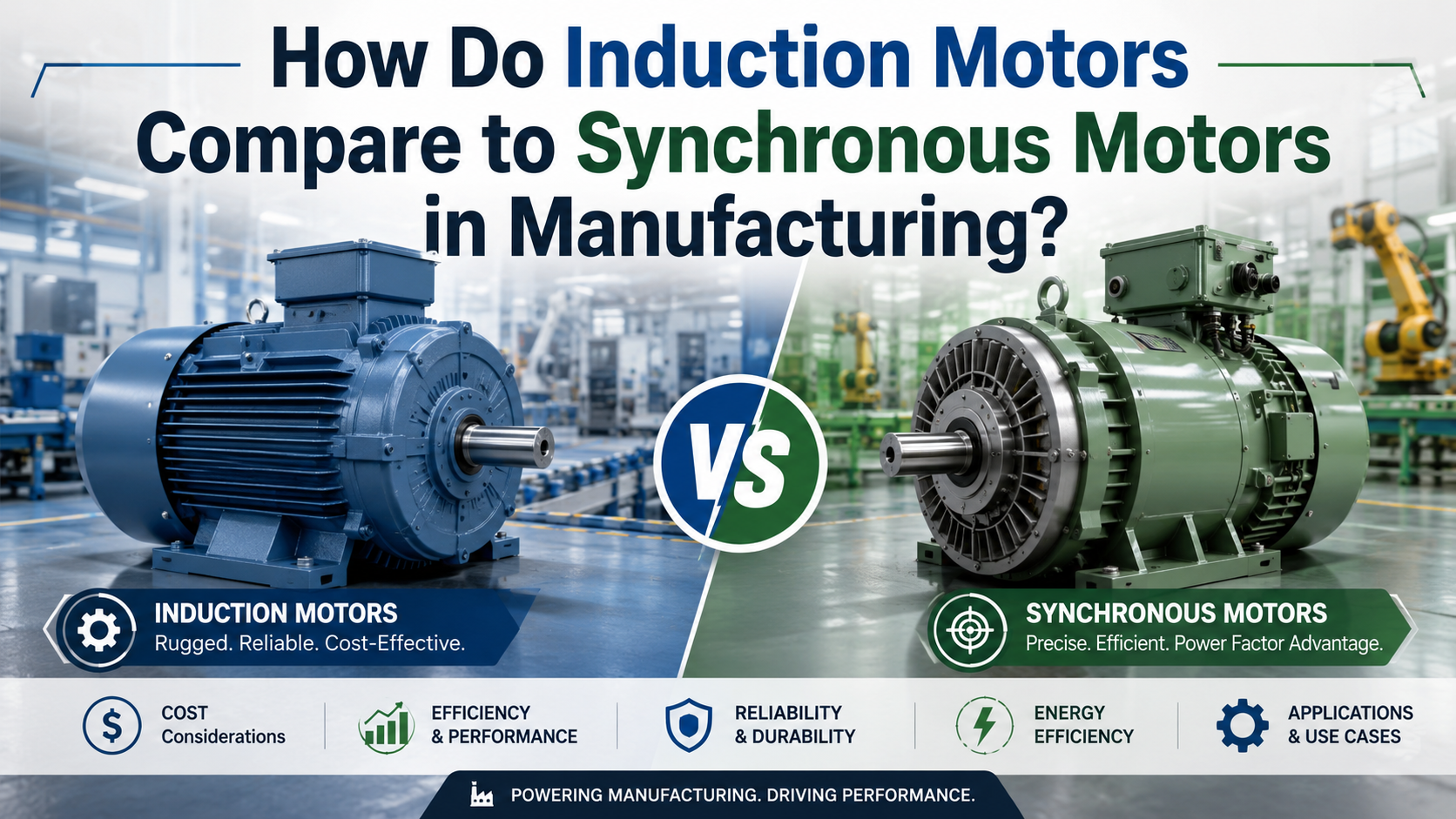
An induction motor is generally the best choice for most manufacturing equipment because it is rugged, inexpensive, easy to maintain, and performs well across a wide range of industrial applications.
A synchronous motor offers higher efficiency, constant speed, and better power factor, making it ideal for precision manufacturing, high-power continuous-duty equipment, and energy-efficient production lines.
For most factories:
Choose an induction motor for pumps, fans, conveyors, mixers, and compressors.
Choose a synchronous motor for CNC machines, paper mills, precision processing, high-power compressors, and applications requiring constant speed.
Source: U.S. Department of Energy (DOE), Improving Motor and Drive System Performance, 2014; International Electrotechnical Commission (IEC 60034 Series); IEEE Industry Applications Society.
What Is an Induction Motor?
An induction motor is an AC electric motor whose rotor receives power through electromagnetic induction rather than direct electrical connections.
The stator creates a rotating magnetic field. This magnetic field induces current inside the rotor bars, producing torque.
Because the rotor always rotates slightly slower than the rotating magnetic field, induction motors operate with slip, typically between 1% and 5% at rated load.
Typical characteristics include:
- Simple construction
- No permanent magnets
- No brushes
- Low maintenance
- Excellent durability
- Suitable for variable loads
According to the U.S. Department of Energy, electric motor systems account for approximately 70% of industrial electricity consumption, making motor selection one of the largest opportunities for energy savings.
Source: U.S. Department of Energy, Improving Motor and Drive System Performance, 2014.
What Is a Synchronous Motor?
A synchronous motor rotates at exactly the same speed as the rotating magnetic field generated by the stator.
Unlike induction motors, synchronous motors experience zero slip during steady-state operation.
Rotor excitation may come from:
- Permanent magnets (PMSM)
- DC excitation winding
- Brushless excitation systems
Because the rotor remains synchronized with the stator field, synchronous motors deliver:
- Constant speed
- High efficiency
- Excellent power factor
- Superior positioning accuracy
These characteristics make them common in precision manufacturing and large industrial processes.
Source: IEEE Industry Applications Society; IEC 60034 Standards.
How Do Induction Motors and Synchronous Motors Work?
Induction Motor Operating Principle
Step 1
Three-phase AC power energizes the stator.
Step 2
The stator creates a rotating magnetic field.
Step 3
Rotor conductors experience electromagnetic induction.
Step 4
Induced current produces rotor torque.
Step 5
Rotor speed stabilizes slightly below synchronous speed.
Synchronous Motor Operating Principle
Step 1
Three-phase AC energizes the stator.
Step 2
Rotor magnetic field is created by permanent magnets or DC excitation.
Step 3
Rotor locks onto the rotating magnetic field.
Step 4
Rotor rotates at synchronous speed with zero slip.
Induction Motor vs Synchronous Motor
| Feature | Induction Motor | Synchronous Motor |
| Operating Principle | Electromagnetic induction | Rotor synchronizes with stator field |
| Slip | 1–5% | 0% |
| Speed Stability | Slightly changes with load | Constant |
| Starting | Self-starting | Often requires starting method |
| Efficiency | 88–96% | 92–98% |
| Power Factor | Lagging | Can operate near unity |
| Initial Cost | Lower | Higher |
| Maintenance | Very low | Moderate |
| Speed Control | Excellent with VFD | Excellent with servo/VFD |
| Precision | Moderate | Very high |
| Typical Power Range | Fractional HP to several MW | Several kW to multi-MW |
Which Motor Is More Efficient?
Efficiency directly affects operating costs throughout a motor’s lifetime.
Typical efficiencies:
Induction motors
IE3: 89–94%
IE4: 91–96%
Synchronous motors
PMSM: 93–98%
Large synchronous motors: up to 98%
Because manufacturing equipment often operates 24 hours per day, even a 2% efficiency improvement can significantly reduce annual electricity consumption.
According to the International Energy Agency (IEA), improving motor efficiency remains one of the most cost-effective industrial energy-saving measures.
Source: International Energy Agency, Energy Efficiency Report, latest industrial motor guidance.
Speed Control Comparison
Induction Motor
Without a Variable Frequency Drive (VFD):
Speed varies slightly with load
Slip increases under heavier loads
With a VFD:
- Excellent variable-speed performance
- Widely used in automated production
Synchronous Motor
- Constant speed regardless of load
- Excellent for precision motion
- High positioning accuracy
- Often paired with servo control systems
For robotics and CNC manufacturing, synchronous motors generally provide superior motion accuracy.
Torque Characteristics
Induction motors typically provide:
- High starting torque (depending on rotor design)
- Smooth acceleration
- Good overload capability
Synchronous motors provide:
- Constant torque
- Excellent low-speed control
- Stable torque under varying loads
- Better dynamic response
For heavy conveyor startup, induction motors are often sufficient.
For precision indexing or robotic positioning, synchronous motors usually outperform induction motors.
Maintenance Comparison
Induction Motor
Routine maintenance includes:
- Bearing lubrication
- Cooling fan inspection
- Vibration monitoring
- Insulation testing
No brushes or rotor electrical connections simplify maintenance.
Synchronous Motor
Additional maintenance may include:
- Excitation system inspection
- Permanent magnet temperature monitoring
- Rotor synchronization checks
- Encoder calibration (where applicable)
Permanent magnet synchronous motors generally require less maintenance than wound-field synchronous motors.
Manufacturing Applications
Best Applications for Induction Motors
An induction motor is commonly used in:
- Conveyor systems
- Pumps
- Fans
- Air compressors
- Mixers
- Packaging machinery
- HVAC equipment
- Industrial blowers
These applications benefit from reliability and lower initial cost.
Best Applications for Synchronous Motors
Synchronous motors are preferred for:
- CNC machine tools
- Robotics
- Semiconductor manufacturing
- Printing equipment
- Textile machinery
- High-speed production lines
- Paper mills
- Precision positioning systems
These applications require accurate speed control and high efficiency.
Cost Comparison
Purchase price is only one part of motor ownership.
Engineers should evaluate:
- Initial equipment cost
- Installation
- Energy consumption
- Downtime
- Maintenance
- Expected service life
Although synchronous motors cost more initially, energy savings may offset the investment during long-term continuous operation.
The U.S. DOE notes that energy costs often represent over 95% of a motor’s total lifecycle cost, while the purchase price accounts for only a small percentage.
Source: U.S. Department of Energy, Motor Challenge Program, 2014.
Common Engineering Mistakes
Choosing Only by Purchase Price
Lower initial cost may result in higher lifetime operating expenses.
Always evaluate lifecycle cost.
Ignoring Load Profile
Constant-load applications may benefit more from synchronous motors.
Variable-load equipment often performs well with induction motors and VFDs.
Oversizing the Motor
Oversized motors operate below optimal efficiency.
Correct motor sizing improves:
- Efficiency
- Power factor
- Equipment lifespan
Ignoring Environmental Conditions
Dust, humidity, vibration, and ambient temperature influence motor selection.
Manufacturing environments may require IP55, IP65, or higher protection ratings.
Troubleshooting Guide
| Problem | Possible Cause | Recommended Solution |
| Motor overheats | Overload, poor ventilation, voltage imbalance | Check load, clean cooling paths, verify supply voltage |
| Low efficiency | Incorrect motor sizing | Match motor rating to application |
| Excessive vibration | Bearing wear, shaft misalignment | Inspect bearings and alignment |
| Speed fluctuation | Supply frequency variation or drive issue | Inspect VFD settings and electrical supply |
| High energy consumption | Aging motor or low efficiency class | Upgrade to IE4 induction motor or high-efficiency synchronous motor |
| Poor power factor | Large inductive loads | Consider synchronous motor or power factor correction |
How to Select the Right Motor for Manufacturing?
Follow these engineering steps:
Step 1
Determine load type:
- Constant torque
- Variable torque
- Cyclic load
Step 2
Calculate required:
- Rated torque
- Starting torque
- Peak torque
Step 3
Identify operating conditions:
- Ambient temperature
- Duty cycle
- Installation altitude
- Protection level
Step 4
Evaluate energy efficiency requirements.
Step 5
Determine required speed accuracy.
Step 6
Calculate lifecycle operating cost instead of focusing solely on purchase price.
Why Choose UNITED MOTION INC.?
At UNITED MOTION INC., we provide reliable motion solutions for industrial automation and manufacturing.
Our product portfolio includes:
- Induction motors
- BLDC motors
- Servo motors
- Gear motors
- Motor drivers and controllers
Our engineering team supports OEMs and equipment manufacturers with:
- Custom motor selection
- Performance optimization
- Motion control integration
- Technical application support
- Global manufacturing capabilities
Whether you’re designing new production equipment or upgrading an existing manufacturing line, selecting the right motor technology can significantly improve efficiency, reliability, and long-term operating costs.
Frequently Asked Questions
Is an induction motor better than a synchronous motor?
Neither is universally better. An induction motor is ideal for general industrial applications because of its low cost, reliability, and simple maintenance. Synchronous motors excel where constant speed, high efficiency, and precise control are essential.
Why are induction motors more common in manufacturing?
Induction motors are self-starting, rugged, economical, and suitable for a wide range of industrial equipment. Their simplicity and proven reliability make them the standard choice for many manufacturing systems.
Are synchronous motors more energy efficient?
Yes. Many permanent magnet synchronous motors achieve efficiencies above 95%, especially under constant-load conditions.
Can induction motors use variable frequency drives?
Yes. Modern induction motors are commonly paired with VFDs for efficient variable-speed operation, improved process control, and energy savings.
Which motor lasts longer?
Both motor types can exceed 20 years of service when correctly sized, installed, and maintained. Service life depends more on operating conditions, maintenance practices, and load management than on motor type alone.