
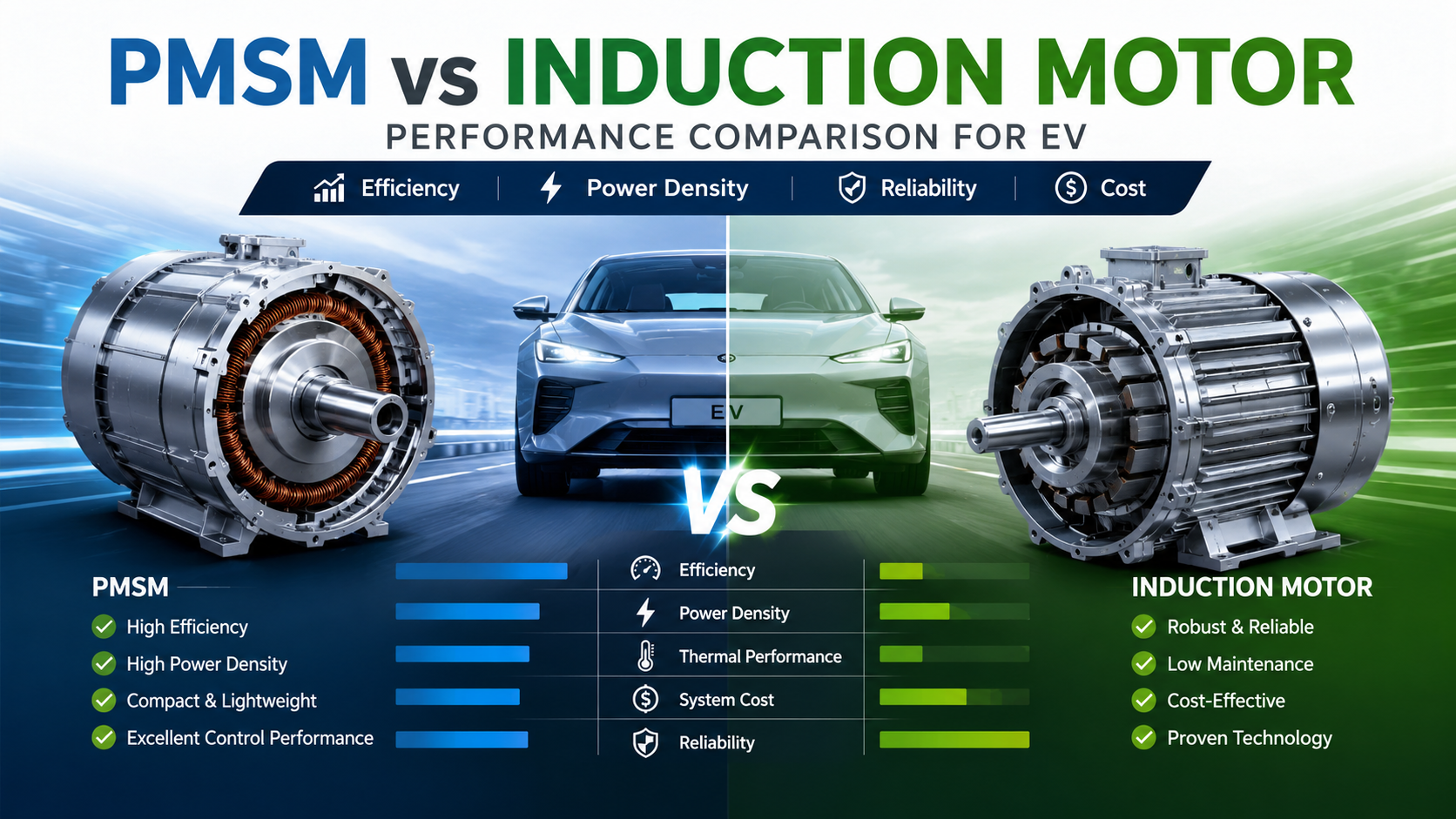
For most modern electric vehicles (EVs), a PMSM motor (Permanent Magnet Synchronous Motor) delivers higher efficiency, greater torque density, and longer driving range than an induction motor, especially during city driving and partial-load operation.
However, an induction motor offers advantages in cost, high-speed durability, rare-earth independence, and overload capability, making it attractive for certain commercial vehicles and performance applications.
The best choice depends on vehicle type, performance targets, manufacturing cost, and supply-chain considerations.
What Is a PMSM Motor?
A PMSM motor uses permanent magnets embedded or mounted on the rotor.
Instead of generating rotor magnetic fields electrically, high-strength permanent magnets provide constant magnetic flux.
The stator creates a rotating magnetic field synchronized with the rotor.
Common magnet materials include:
- NdFeB (Neodymium Iron Boron)
- SmCo (Samarium Cobalt)
Typical EV specifications:
- Voltage: 200–800 V
- Peak efficiency: 95–98%
- Speed: 12,000–22,000 rpm
- Continuous power: 50–300 kW
Because no rotor current is required, rotor copper losses are eliminated.
What Is an Induction Motor?
An induction motor does not use permanent magnets.
Instead, rotor currents are induced by the rotating magnetic field produced by the stator.
The rotor must rotate slightly slower than the stator magnetic field (called slip) to generate torque.
Typical EV specifications:
- Voltage: 200–800 V
- Peak efficiency: 90–95%
- Speed: up to 20,000 rpm
- Continuous power: 50–350 kW
Because rotor current produces heat, induction motors experience higher rotor losses than PMSM motors.
PMSM Motor vs Induction Motor: Working Principle
PMSM Motor
Operation steps:
Battery supplies DC power.
Inverter converts DC into three-phase AC.
Stator generates rotating magnetic field.
Permanent magnets lock onto the rotating field.
Rotor rotates synchronously with no slip.
Advantages include:
- High efficiency
- High torque density
- Precise speed control
Induction Motor
Operation steps:
Inverter supplies three-phase AC.
Rotating magnetic field cuts rotor conductors.
Induced current flows inside rotor.
Rotor magnetic field interacts with stator.
Rotor follows stator field with slip.
Advantages include:
- Rugged construction
- Magnet-free design
- Strong overload capability
Efficiency Comparison
Efficiency directly affects vehicle range.
A few percentage points of efficiency can translate into several kilometers of additional driving distance.
PMSM Motor
Typical efficiency:
Peak: 95–98%
Partial load: 92–97%
Rotor losses are minimal because permanent magnets produce the magnetic field.
This makes PMSM motors especially efficient during:
- Urban driving
- Stop-and-go traffic
- Low-speed operation
Induction Motor
Typical efficiency:
Peak: 90–95%
Partial load: 85–92%
Rotor copper losses increase under heavy loads.
Efficiency drops more noticeably during partial-load operation.
Engineering Insight
Battery-powered vehicles spend much of their operating time at partial load, where PMSM motors maintain a clear efficiency advantage.
Torque and Power Density
Torque density determines motor size and vehicle packaging.
PMSM Motor
Characteristics:
- Higher torque per kilogram
- Higher continuous torque
- Smaller motor dimensions
- Better packaging flexibility
Typical torque density:
4–7 Nm/kg
Induction Motor
Characteristics:
- Larger frame
- Lower torque de
nsity
More copper and steel required
Typical torque density:
2.5–5 Nm/kg
Higher torque density allows EV manufacturers to reduce motor weight while maintaining vehicle performance.
Thermal Performance
Thermal management greatly influences motor reliability.
PMSM Motor
Advantages:
- Lower rotor temperature
- Lower copper loss
- Reduced cooling demand
Potential concern:
Permanent magnets may begin losing magnetic strength if rotor temperatures exceed approximately 150–180°C, depending on magnet grade.
Induction Motor
Advantages:
- No permanent magnets
- Excellent thermal robustness
- Better tolerance to overload
Challenges:
Rotor heating is significantly higher because induced current continuously flows inside rotor bars.
Proper cooling is essential.
High-Speed Performance
High-speed operation is increasingly important in modern EV drivetrains.
PMSM Motor
Requires field weakening above base speed.
Efficiency gradually decreases during high-speed operation.
Advanced vector control improves performance.
Induction Motor
Naturally performs well at high speed.
Can sustain higher rotational speeds without magnet limitations.
Often preferred for:
- Sports vehicles
- Heavy-duty acceleration
- High-speed highway driving
Cost Comparison
Motor cost depends on materials and manufacturing.
PMSM Motor
Major cost contributors:
- Rare-earth magnets
- Precision rotor assembly
- Magnet supply chain
Prices fluctuate with rare-earth material availability.
Induction Motor
Lower material cost because it uses:
- Aluminum rotor
- Copper windings
- Electrical steel
No dependence on permanent magnets.
This improves supply-chain stability.
Control Complexity
Modern EVs use advanced field-oriented control (FOC).
PMSM Motor
Requires:
- Rotor position estimation
- Encoder or sensorless control
- Magnet flux estimation
Produces:
- Excellent torque accuracy
- Fast dynamic response
Induction Motor
Requires:
- Slip estimation
- Rotor flux calculation
- Adaptive control algorithms
Control algorithms are generally more computationally intensive.
Reliability and Maintenance
Both motor types eliminate brushes and commutators.
Common maintenance items include:
- Bearings
- Cooling systems
- Power electronics
Insulation condition
Neither motor requires routine rotor maintenance.
With proper thermal management, service life commonly exceeds:
20,000–30,000 operating hours.
Which EV Applications Prefer PMSM Motors?
PMSM motors are commonly selected for:
- Passenger EVs
- Premium electric SUVs
- Electric crossovers
- Autonomous vehicles
- Electric motorcycles
Reasons include:
- Higher efficiency
- Compact size
- Longer battery range
- Lower energy consumption
Which Applications Prefer Induction Motors?
Induction motors remain attractive for:
- Commercial trucks
- Heavy-duty vehicles
- Performance EVs
- Industrial electric transport
- Cost-sensitive platforms
Reasons include:
- Lower manufacturing cost
- Excellent overload capability
- Magnet-free construction
- High-speed durability
Common Engineering Mistakes
Assuming peak efficiency equals real-world efficiency
EVs spend most operating time under partial load.
Always evaluate drive cycles instead of peak efficiency alone.
Ignoring cooling requirements
Motor performance depends heavily on cooling system design.
Rotor temperature directly affects efficiency and lifetime.
Selecting motors only by peak power
Continuous torque often matters more for climbing, towing, and sustained acceleration.
Overlooking rare-earth supply risks
PMSM motors rely on permanent magnets whose availability and cost can fluctuate.
Supply-chain resilience should be considered during product planning.
Troubleshooting Guide
| Problem | Possible Cause | Recommended Solution |
| Reduced driving range | Low motor efficiency | Optimize inverter control and verify operating efficiency map |
| Motor overheating | Inadequate cooling or overload | Improve liquid cooling and monitor temperature sensors |
| Low starting torque | Incorrect motor sizing | Increase continuous torque rating or revise gear ratio |
| High inverter current | Poor control parameter tuning | Recalibrate field-oriented control parameters |
| Excessive vibration | Rotor imbalance or bearing wear | Perform dynamic balancing and inspect bearings |
| Reduced PMSM performance | Magnet overheating | Improve thermal design and use higher-temperature magnet grades |
| Efficiency loss in induction motor | Excessive rotor slip | Optimize vector control and minimize unnecessary overload |
Frequently Asked Questions
Is a PMSM motor more efficient than an induction motor?
Yes. A PMSM motor generally achieves 95–98% peak efficiency, while an induction motor typically reaches 90–95%, with the largest advantage occurring during partial-load operation.
Why do many modern EVs use PMSM motors?
Because they offer:
Higher efficiency
Greater torque density
Better battery utilization
Longer driving range
Compact packaging
Why are induction motors still used in EVs?
Induction motors avoid rare-earth magnets, tolerate overload well, and often cost less to manufacture, making them suitable for specific performance and commercial applications.
Which motor lasts longer?
Both technologies can achieve service lives exceeding 20,000 operating hours when designed with proper cooling, insulation, and bearing systems. Reliability depends more on thermal management and operating conditions than on motor type alone.
Which motor is better for commercial electric vehicles?
The answer depends on application requirements. Heavy-duty vehicles that prioritize durability and cost may benefit from induction motors, while vehicles emphasizing efficiency and driving range often favor PMSM motors.
Related blog: Why PMSM Motor is Used in Electric Vehicles ?