
Quick Answer
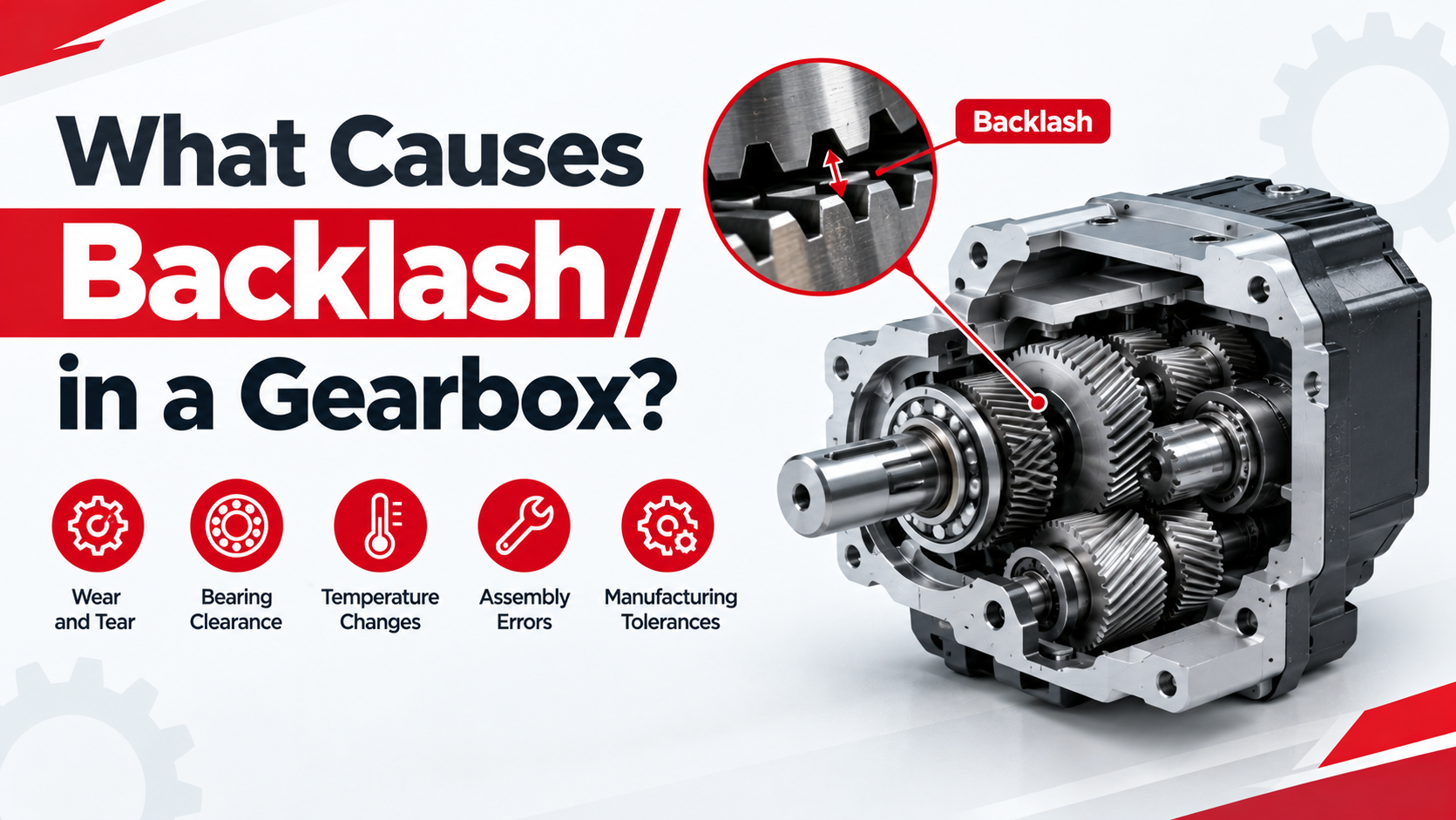
Gearbox backlash is the clearance between mating gear teeth that allows a small amount of output movement when the driving direction reverses. It is a normal characteristic of most gear transmissions, but excessive backlash can develop because of gear tooth wear, manufacturing tolerances, incorrect assembly, bearing clearance, shaft misalignment, thermal expansion, or inadequate lubrication.
In industrial motor applications, excessive backlash can cause positioning errors, impact noise, vibration, inconsistent motion, and reduced control accuracy. The appropriate solution depends on the root cause: worn gears may require replacement, misalignment may require assembly correction, and precision applications may benefit from a low-backlash gearbox design.
Engineering takeaway: backlash should be measured and evaluated against the gearbox manufacturer’s specification and the application’s positioning, torque, speed, and service-life requirements rather than eliminated indiscriminately.
What Is Gearbox Backlash?
Gearbox backlash is the amount of free movement between mating gear teeth when the input shaft changes direction before the output shaft begins to respond fully.
For example, when a motor reverses direction, the driving gear must cross the clearance between the previously loaded tooth flanks and the opposite tooth flanks before transmitting torque in the new direction.
Backlash is commonly specified as angular movement at the gearbox output shaft, measured in degrees or arcminutes, or as linear clearance at the gear mesh, measured in millimeters.
The measurement method matters because output angular backlash and tooth-to-tooth clearance are not interchangeable without considering the gear geometry and transmission ratio.
Some backlash is necessary in conventional gear systems to accommodate manufacturing variations, lubrication requirements, and dimensional changes caused by temperature. An excessively tight mesh can increase friction, generate heat, and cause premature failure.
What Causes Backlash in a Gearbox?
Gear Tooth Wear
Gear tooth wear is one of the most common causes of increasing backlash during service.
Repeated contact between gear teeth gradually changes their working profiles, particularly when the gearbox experiences high loads, frequent reversals, contamination, or inadequate lubrication.
Typical warning signs include increasing free movement, clicking during direction changes, vibration, and visible wear patterns on the tooth flanks.
Engineering solution: inspect the tooth surfaces for wear, pitting, scoring, or deformation, and replace damaged gears when measurements exceed the manufacturer’s acceptance limits. Simply adjusting the gear mesh will not restore the original tooth geometry.
Manufacturing Tolerances
Gearbox backlash is affected by tooth thickness, pitch accuracy, tooth profile, runout, and the center distance between mating gears.
Even when individual gears meet their dimensional specifications, the combined tolerances of the assembled gear pair can produce a different backlash value from the nominal design.
This is why gear quality alone does not fully determine the backlash of a completed gearbox.
Engineering solution: specify the required output backlash for the assembled gearbox, establish an appropriate inspection method, and verify performance under the manufacturer’s defined measurement conditions.
Incorrect Assembly or Shaft Misalignment
Incorrect assembly can change the relative position of gears, shafts, and bearings, resulting in uneven tooth contact or excessive clearance.
Misalignment may also concentrate the load on one side of a tooth, increasing local stress and accelerating wear.
Potential causes include incorrect bearing seating, improper housing alignment, damaged locating surfaces, and mounting distortion.
Engineering solution: inspect shaft alignment, bearing seating, housing dimensions, and gear contact patterns before adjusting the gear mesh. Correct the underlying assembly problem rather than compensating for it with an arbitrary clearance adjustment.
Bearing Clearance and Shaft Deflection
Bearings support the shafts that maintain the relative positions of mating gears. Excessive bearing clearance, worn bearings, or shaft deflection under load can change the effective gear mesh and increase output movement.
This problem may be more noticeable when the gearbox operates under changing torque, because the shafts and gear supports can shift as the load direction changes.
Engineering solution: check bearing condition, shaft runout, radial movement, axial movement, and support stiffness. If the gearbox exhibits substantially different backlash under different loads, investigate shaft and bearing movement rather than assuming that the gear teeth alone are responsible.
Technical reference: NASA Goddard Space Flight Center, “GSFC_8929_TN14675-1,” 2015, which discusses radial deflection and thermal compatibility in a precision planetary gearbox design.
Thermal Expansion
Gear teeth, shafts, bearings, and gearbox housings expand or contract as temperature changes. Because these components may use different materials and experience different temperature distributions, the effective gear clearance can change during operation.
For example, a steel gear installed in an aluminum housing may experience a different change in operating clearance from a gear and housing made from materials with more closely matched thermal expansion characteristics.
Engineering solution: evaluate backlash across the intended operating temperature range, especially for high-speed, high-duty-cycle, or precision applications. The design must retain sufficient clearance at the most restrictive operating condition while maintaining acceptable motion accuracy.
Inadequate Lubrication and Contamination
Incorrect lubricant selection, insufficient lubricant, degraded lubricant, or particulate contamination can accelerate tooth surface damage and bearing wear.
Although lubrication problems do not necessarily create excessive backlash immediately, the resulting wear can increase clearance over time and shorten gearbox service life.
Engineering solution: use the lubricant type and maintenance interval specified by the gearbox manufacturer, inspect for contamination or leakage, and investigate unusual noise or temperature increases before further damage occurs.
Comparison: Normal vs. Excessive Gearbox Backlash
| Parameter | Normal Backlash | Excessive Backlash |
| Direction reversal | Small, expected delay | Noticeable lost motion |
| Positioning accuracy | Within application requirements | May exceed positioning error limits |
| Operating noise | Usually consistent | May include clicking or impact noise |
| Tooth condition | Acceptable contact pattern | May show wear or damage |
| Motion control | Predictable response | Reversal errors or oscillation may occur |
| Maintenance | Routine monitoring | Inspection and corrective action required |
Important: acceptable backlash depends on gearbox type, size, transmission ratio, operating temperature, load, and measurement method. There is no single backlash limit suitable for every gearbox.
How to Diagnose Gearbox Backlash Step by Step?
Step 1: Confirm the Symptom
Determine whether the problem is excessive free movement, delayed reversal, unusual noise, vibration, or positioning error. These symptoms can overlap with encoder error, coupling looseness, shaft deflection, and control-system problems.
Step 2: Measure Output Backlash
Secure the gearbox according to the manufacturer’s test procedure, prevent unintended movement, and apply a small, controlled reversing torque to the input or output as specified by the test method. Measure the resulting output movement using an appropriate dial indicator, encoder, or angular measurement instrument.
Record the test setup, applied torque, temperature, and measurement location so that results can be compared consistently.
Step 3: Inspect Mechanical Components
Check gear teeth, bearings, shafts, couplings, mounting surfaces, and housing alignment. Look for visible wear, loose fasteners, abnormal contact patterns, or changes in shaft position.
Step 4: Compare Results with Specifications
Compare the measured value with the gearbox manufacturer’s specified backlash range under equivalent test conditions. Do not compare measurements taken at different shafts or under different loads without accounting for the test configuration.
Step 5: Correct the Root Cause
Replace worn components, correct assembly or alignment issues, restore the specified lubrication, or select a gearbox designed for lower backlash if the existing design cannot meet the application requirements.
Gearbox Backlash Troubleshooting Table
| Symptom | Possible Cause | Recommended Action |
| Excessive free movement | Gear wear or excessive tooth clearance | Measure backlash and inspect tooth profiles |
| Clicking during reversal | Clearance impact or loose components | Inspect gears, couplings, and fasteners |
| Positioning errors | Backlash, encoder issues, or control error | Measure mechanical lost motion and verify feedback |
| Increasing noise | Wear, lubrication problems, or misalignment | Inspect lubricant, tooth contact, and shaft alignment |
| Backlash changes with load | Shaft deflection or bearing clearance | Check bearings and structural stiffness |
| Performance changes with temperature | Thermal expansion or lubricant changes | Test across the operating temperature range |
| Early gearbox failure | Incorrect loading, contamination, or poor assembly | Review the operating conditions and failure evidence |
How to Reduce Gearbox Backlash?
The most effective method depends on the application and the source of the problem.
- Choose precision gearing: tighter manufacturing control can reduce the variation in tooth geometry and assembled backlash.
- Consider a low-backlash gearbox: precision planetary and other specialized gearbox designs may suit applications requiring repeatable positioning.
- Maintain correct alignment: accurate shaft positioning and proper bearing installation help maintain the intended gear mesh.
- Use suitable lubrication: correct lubricant selection and maintenance reduce wear and support long-term performance.
- Validate thermal behavior: verify that operating temperatures do not cause unacceptable clearance changes.
- Match the gearbox to the load: excessive torque, frequent reversals, shock loading, or unsuitable duty cycles can accelerate wear and degrade motion performance.
Why Backlash Matters in Motor and Motion Control Systems?
In an integrated motor and gearbox assembly, output accuracy depends on more than the motor’s electrical performance. Gearbox backlash, shaft stiffness, bearing clearance, coupling behavior, and feedback sensor location all influence how accurately motor rotation translates into useful output movement.
For applications such as robotics, automated machinery, medical equipment, stairlift systems, and industrial actuators, engineers should evaluate the complete drive system under realistic load and reversal conditions.
UNITED MOTION INC. supports OEM motor applications with motor and motion-control options that can be selected around application-specific speed, torque, mechanical integration, and feedback requirements. When choosing a motor with a gearbox, confirm the required output backlash, rated and peak torque, transmission ratio, operating speed, duty cycle, and expected service life with the supplier.
Engineering takeaway: selecting a gearbox based only on its reduction ratio or rated torque is insufficient when positioning accuracy and repeatability are critical.
FAQ
1. What is the main cause of gearbox backlash?
Gearbox backlash is primarily the clearance between mating gear teeth. Excessive backlash may result from gear wear, manufacturing tolerances, incorrect assembly, bearing clearance, shaft deflection, or thermal effects.
2. Is gearbox backlash always a problem?
No. Some backlash is necessary in conventional gear meshes to accommodate manufacturing variation, lubrication, and dimensional changes. It becomes a problem when it exceeds the gearbox specification or the application’s accuracy requirements.
3. Can gearbox backlash be adjusted?
Some gearboxes provide adjustment mechanisms, but many do not. Adjustment should follow the manufacturer’s procedure because reducing clearance excessively can cause binding, heat generation, and premature wear.
4. How is gearbox backlash measured?
It is commonly measured as output angular movement while the input or output load is reversed under a defined test procedure. The applied torque, shaft location, temperature, and test setup should be documented.
5. Which gearbox is best for low-backlash applications?
The best choice depends on the required torque, speed, positioning accuracy, stiffness, duty cycle, operating environment, and budget. Precision planetary and specialized low-backlash gearboxes are possible options, but the supplier’s specified backlash and test conditions should always be verified.
6. Does a higher gear ratio reduce backlash?
Not necessarily. The relationship between input-side and output-side backlash depends on the gearbox architecture, gear stages, and measurement location. A higher reduction ratio alone does not guarantee lower output backlash.