
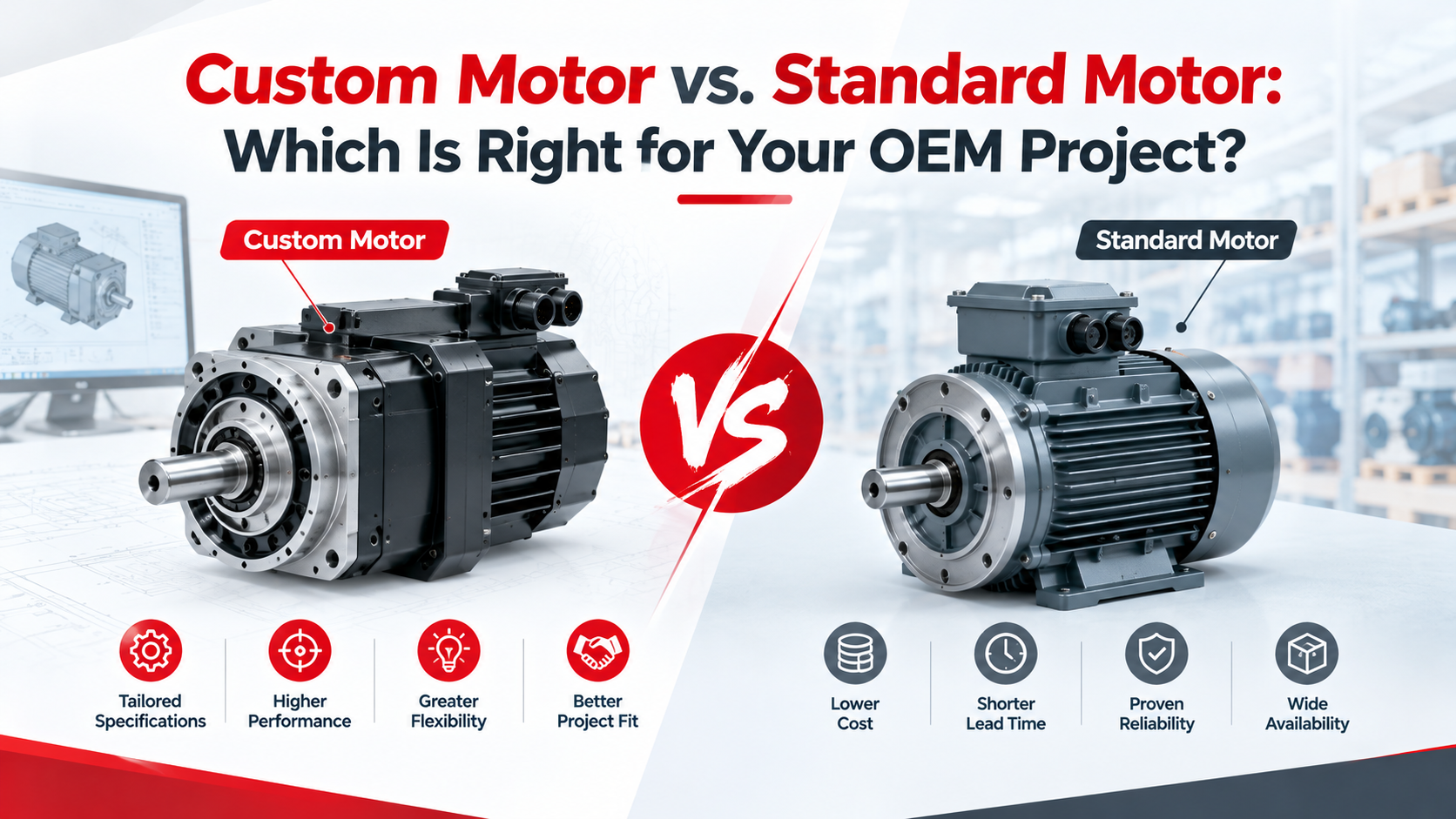
Quick Answer
Choosing between a custom motor and a standard motor depends on your application’s performance requirements, installation constraints, production volume, development timeline, and total cost of ownership. A standard motor is usually the better choice when its existing specifications meet your requirements, while a custom motor is more suitable when your equipment requires specific torque, speed, dimensions, control interfaces, or mechanical integration that standard products cannot provide.
For OEM manufacturers, the decision should not be based on the initial motor price alone. Electrical compatibility, thermal performance, mounting dimensions, gearbox requirements, feedback devices, production consistency, and long-term serviceability must also be considered.
UNITED MOTION INC. provides BLDC motors, servo motors, gear motors, and customized motor solutions for industrial OEM applications, helping customers evaluate motor configurations according to their equipment requirements.
What Is the Difference Between a Custom Motor and a Standard Motor?
Standard Motor
A standard motor is an existing product manufactured according to an established design, with predefined electrical specifications, mechanical dimensions, and performance characteristics. It is generally available in established configurations, making it suitable for projects that can accommodate existing motor specifications.
Typical selection parameters include rated voltage, rated speed, continuous torque, peak torque, shaft dimensions, mounting flange, and protection requirements.
Standard motors are commonly used in industrial equipment, pumps, fans, conveyors, appliances, and automation systems where the required operating conditions fall within the motor’s published performance range.
Custom Motor
A custom motor is configured or developed to meet application-specific electrical, mechanical, or control requirements. Depending on the project, customization may involve winding design, motor dimensions, shaft configuration, mounting structure, feedback devices, gearbox integration, or driver compatibility.
For example, an OEM developing a compact robotic actuator may require a particular motor diameter, output speed, encoder interface, and gearbox arrangement that cannot be achieved with an off-the-shelf motor without significant system modifications.
Engineering principle: Customization is most valuable when it resolves a measurable application constraint rather than adding unnecessary complexity.
Custom Motor vs. Standard Motor: Key Differences
| Selection Factor | Standard Motor | Custom Motor |
| Initial development cost | Generally lower | Generally higher |
| Availability | Existing configurations may be readily available | Depends on design and production readiness |
| Engineering lead time | Usually shorter | May require design and validation |
| Dimensions | Predetermined | Can be adapted to the application |
| Voltage and speed | Selected from available specifications | Can be configured around project requirements |
| Torque performance | Limited to available models and operating conditions | Can be optimized for the target load |
| Encoder integration | Depends on available options | Can be included in the design |
| Gearbox integration | Depends on compatible models | Can be designed around system requirements |
| Production volume | Suitable for low or high volumes, subject to availability | Economics depend on tooling, design, and volume |
| Long-term optimization | Limited by the existing design | Greater opportunity for application-specific improvements |
These are general selection guidelines rather than universal rules. Some standard motors offer extensive configuration options, while certain custom designs may be relatively straightforward when based on an existing motor platform.
When Should OEMs Choose a Standard Motor?
A standard motor is often the most practical solution when the application can accommodate an established motor configuration without compromising performance or reliability.
Consider a standard motor when:
- The required voltage, speed, and torque match an available model.
- The existing shaft and mounting dimensions fit the equipment.
- The motor operates within its rated thermal and mechanical limits.
- Available Hall sensors, encoders, or drivers meet the control requirements.
- The project needs a short development cycle.
- Initial engineering investment must be minimized.
For example, an equipment manufacturer developing a compact pump may be able to use an existing BLDC motor if its flow requirements, operating speed, available installation space, and control interface are compatible with the selected model.
Before making a decision, engineers should confirm the motor’s continuous-duty capability, startup behavior, ambient-temperature limits, and performance under the actual load rather than relying exclusively on its rated power.
When Is a Custom Motor the Better Choice?
A custom motor becomes more attractive when existing products cannot satisfy important application requirements without expensive mechanical modifications or performance compromises.
Common reasons for customization include:
1. Limited installation space
A compact device may require a specific motor diameter, length, shaft extension, or mounting flange to fit within its housing.
2. Specialized torque and speed requirements
Some applications require high starting torque, low-speed stability, frequent acceleration, or a particular continuous-to-peak torque profile.
3. Integrated feedback and control
Robotics, automated machinery, and positioning systems may require an encoder, Hall sensors, a compatible motor driver, or a particular control interface.
4. Gearbox integration
When the equipment requires low output speed and high torque, the motor and gearbox may need to be selected together to satisfy output-load requirements, packaging constraints, and allowable backlash.
5. Environmental and mechanical requirements
Applications exposed to vibration, moisture, temperature variation, or limited cooling may need a motor configuration specifically evaluated for those conditions.
UNITED MOTION INC. supports application-oriented BLDC motor customization, including motor dimensions, winding design, voltage, speed, shaft configuration, mounting flange, encoder integration, gearbox integration, and driver integration.
How to Compare Total Cost of Ownership?
The lowest purchase price does not necessarily produce the lowest overall project cost.
OEM engineers should evaluate the following cost categories:
| Cost Factor | What to Evaluate |
| Motor purchase price | Unit cost at the expected order quantity |
| Engineering cost | Design work, integration, and validation |
| Mechanical adaptation | Brackets, couplings, housing changes, and machining |
| Control integration | Driver compatibility, feedback, and wiring |
| Energy consumption | Efficiency under the actual operating load |
| Reliability | Expected service life and maintenance requirements |
| Supply continuity | Production capacity and long-term availability |
| Assembly cost | Installation time and component count |
A standard motor may have a lower unit price but require a custom bracket, additional coupling, or external control components. A custom motor may require more development investment but reduce integration work or improve performance when produced at sufficient volume.
The correct comparison should therefore use the complete system cost over the expected product lifecycle, with realistic assumptions about production volume, maintenance, and energy consumption.
Step-by-Step Guide to Selecting the Right Motor
Step 1: Define the Load Profile
Document continuous torque, peak torque, operating speed, acceleration, duty cycle, and startup conditions. Distinguish short-duration peak requirements from continuous operating requirements.
Step 2: Confirm Electrical Compatibility
Specify supply voltage, current limits, controller type, feedback requirements, and maximum operating speed. For BLDC motors, verify compatibility between the motor’s electrical characteristics and the selected driver.
Step 3: Check Mechanical Integration
Confirm motor diameter, overall length, shaft dimensions, mounting pattern, cable exit, cooling conditions, and gearbox requirements.
Step 4: Evaluate Standard Products First
Compare available motor specifications against the actual application requirements. If an existing model satisfies the critical performance and integration requirements, a standard motor may be the most economical option.
Step 5: Identify Unresolved Constraints
If the standard motor requires excessive mechanical modification, cannot provide the necessary operating performance, or lacks compatible feedback or control options, request a custom configuration.
Step 6: Validate the Prototype
Before production release, evaluate torque-speed performance, current, temperature rise, noise, vibration, control response, and endurance under representative operating conditions.
Common Motor Selection Problems and Solutions
| Problem | Possible Cause | Recommended Action |
| Motor overheats | Insufficient continuous torque capability or inadequate cooling | Review load profile, current, and thermal conditions |
| Starting torque is insufficient | Motor characteristics do not match startup load | Evaluate peak torque and startup requirements |
| Motor does not fit the housing | Incorrect dimensions or mounting interface | Confirm mechanical drawings or consider customization |
| Speed control is unstable | Driver and motor are incompatible or control parameters are incorrect | Verify electrical compatibility and control settings |
| Output torque is insufficient | Incorrect motor selection or transmission ratio | Reassess motor sizing and gearbox configuration |
| Excessive integration cost | Too many adapters or separate components | Evaluate an integrated motor and gearbox solution |
| Production delays occur | Unclear specifications or insufficient supply planning | Confirm requirements, validation milestones, and production capacity |
How UNITED MOTION INC. Supports OEM Motor Projects?
UNITED MOTION INC. provides motor and motion control solutions for OEMs across industrial automation, robotics, mobility, medical equipment, pumps, and other engineered applications.
Available motor technologies include BLDC, servo, and gear motor solutions, with customization options depending on the selected platform and project requirements.
For example, the company’s published 28 mm BLDC motor series includes 24 V models with nominal speeds of 4,000–10,000 rpm and nominal torque ratings of 14.5–51 mNm across the listed configurations. Its published 110 mm BLDC series includes 48 V models rated at 1,100–1,413 W, with nominal speeds of 3,000 rpm and nominal torque ratings of 3.5–4.5 Nm.
These figures illustrate the range of available configurations, not guaranteed performance for every application. Engineers should consult the relevant model specifications and confirm the operating conditions before final selection.
For OEM projects requiring a different combination of dimensions, torque, speed, encoder feedback, gearbox, or driver integration, UNITED MOTION INC. can review the application requirements and assess suitable customization options.
FAQ
Is a custom motor better than a standard motor?
Not necessarily. A standard motor is often preferable when its specifications meet the application’s requirements because it can reduce development work and simplify procurement. A custom motor is more appropriate when specific performance or integration constraints cannot be adequately addressed by standard products.
Are custom motors more expensive?
Custom motors may involve additional engineering, prototyping, tooling, and validation costs. However, total project cost also depends on production volume, integration complexity, assembly requirements, and operating efficiency.
What information should OEMs provide when requesting a custom motor?
Provide the application, supply voltage, continuous and peak torque, operating speed, duty cycle, installation dimensions, environmental conditions, control requirements, expected annual quantity, and any gearbox or encoder requirements.
Can a standard BLDC motor be customized?
Depending on the motor platform, customization may include winding parameters, shaft design, mounting flange, feedback devices, gearbox integration, and driver integration. The available options should be confirmed for the specific model.
When should OEMs begin custom motor development?
Begin technical discussions during the early mechanical and electrical design stages, when motor dimensions, mounting interfaces, load requirements, and control architecture can still be adjusted without major redesign costs.