
Quick Answer
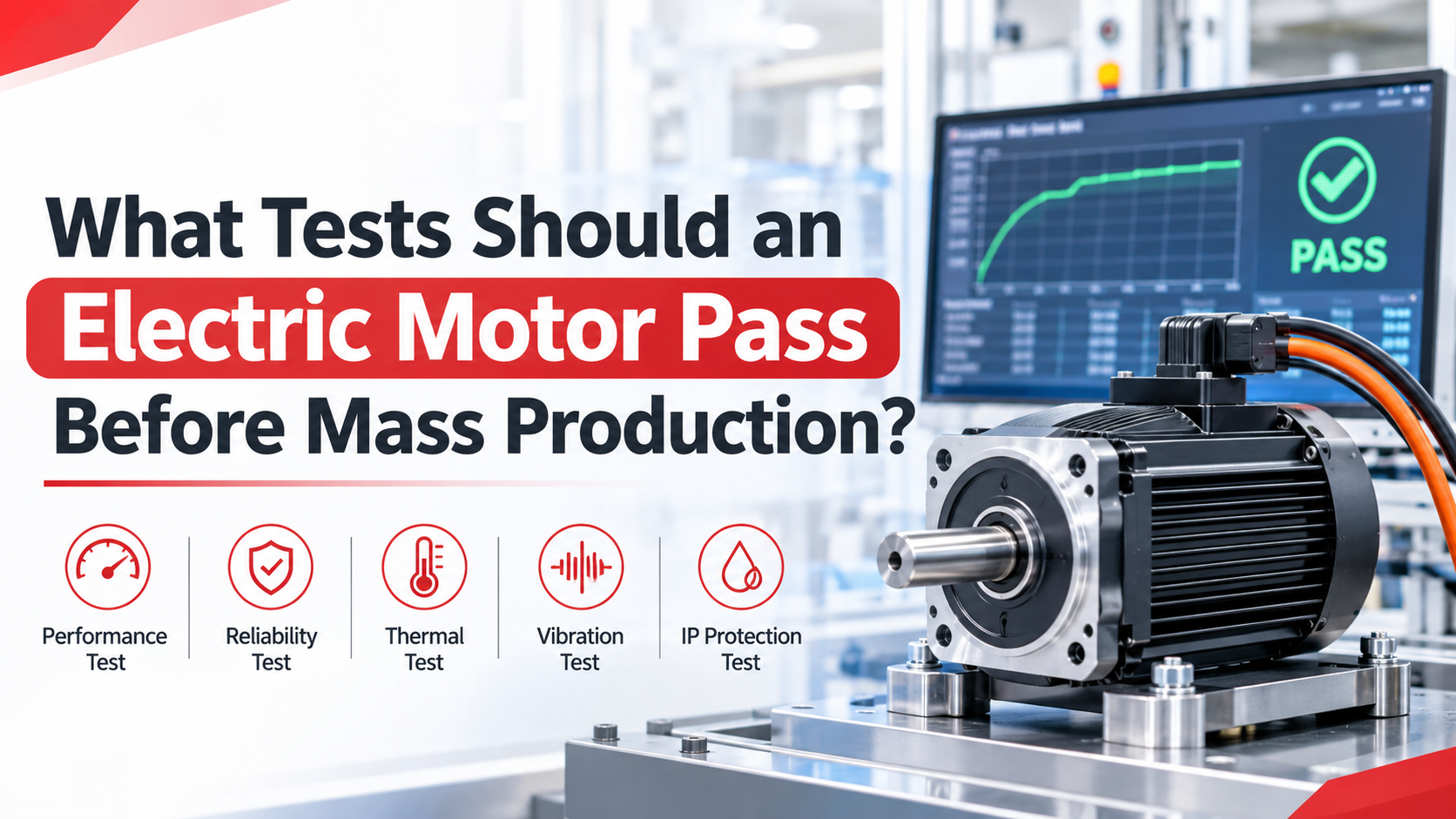
Before entering mass production, an electric motor should pass a series of electrical, mechanical, thermal, performance, and reliability tests to verify that it meets its design specifications and can operate consistently under actual application conditions.
The essential tests include winding resistance testing, insulation resistance testing, dielectric withstand testing, no-load testing, load testing, temperature rise testing, vibration testing, noise testing, efficiency testing, and endurance testing.
For OEM motor manufacturers, passing individual tests is not enough. The complete motor assembly must also demonstrate consistent performance across multiple prototype units, with controlled manufacturing tolerances, reliable component assembly, and repeatable quality inspection procedures.
At UNITED MOTION INC., motor validation should be considered an essential step before mass production, helping ensure that every customized motor configuration meets the electrical, mechanical, and operational requirements of its intended application.
Why Is Electric Motor Testing Important Before Mass Production?
An electric motor may perform well during initial development but still encounter problems after continuous operation, under different loads, or during large-scale manufacturing.
For example, a motor may achieve its rated speed during no-load testing but experience excessive temperature rise under continuous load. Similarly, a prototype may operate quietly while production units develop vibration due to rotor imbalance, bearing variation, or assembly inconsistencies.
Pre-production testing helps identify these problems before they affect product quality, delivery schedules, and customer applications.
The main objectives are to:
- Verify electrical and mechanical specifications
- Confirm rated torque, speed, voltage, and current
- Evaluate thermal performance under operating loads
- Identify abnormal vibration and acoustic noise
- Verify insulation and electrical safety
- Assess durability under repeated operating conditions
- Establish consistent manufacturing quality standards
Essential Electrical Tests
Electrical testing verifies whether the motor’s winding system, insulation, and electrical characteristics meet the design requirements.
Winding Resistance Test
Winding resistance testing measures the resistance of each motor phase to identify winding inconsistencies, poor connections, or manufacturing defects.
For three-phase motors, engineers should compare the resistance values of all three phases under consistent measurement conditions.
- Significant differences may indicate:
- Incorrect winding connections
- Uneven conductor distribution
- Poor soldering or terminal connections
- Winding manufacturing defects
For BLDC and PMSM motors, balanced phase resistance is particularly important because phase imbalance can contribute to uneven current distribution and additional heating.
Insulation Resistance Test
This test evaluates the electrical insulation between motor windings and the motor housing or other grounded components.
Insufficient insulation resistance may indicate moisture contamination, damaged insulation, manufacturing defects, or improper assembly.
The acceptance criteria should be established according to motor voltage, insulation system, operating environment, and applicable electrical safety requirements.
Dielectric Withstand Test
Also known as a hipot test, this test applies a specified test voltage between electrically isolated components to verify that the insulation system can withstand the required electrical stress without breakdown.
It is especially important for motors used in industrial equipment, medical devices, automation systems, and other applications where electrical safety is critical.
Motor Performance Tests
Electrical safety alone cannot confirm whether a motor can deliver the required output. Performance testing evaluates the motor under actual operating conditions.
No-Load Test
The no-load test evaluates motor operation without an external mechanical load.
Engineers typically measure:
- No-load speed (RPM)
- No-load current (A)
- Operating voltage (V)
- Abnormal vibration
- Unusual mechanical noise
For BLDC motors, unusually high no-load current may indicate excessive friction, incorrect commutation, winding problems, or improper bearing assembly.
Load Test
Load testing verifies whether the motor can deliver its specified torque and speed under actual mechanical resistance.
Important parameters include rated torque, output speed, input current, output power, and operating temperature.
For example, a BLDC motor designed for 24 V operation should be evaluated at its specified voltage and intended load conditions rather than relying exclusively on no-load speed measurements.
Efficiency Test
Efficiency testing compares the motor’s electrical input power with its mechanical output power.
Engineers should evaluate efficiency at multiple operating points because a motor’s efficiency can vary significantly with speed and load.
For OEM applications, the most important consideration is whether the motor maintains acceptable efficiency throughout its expected operating range, rather than achieving a high efficiency value at only one operating point.
Thermal and Mechanical Reliability Tests
Temperature Rise Test
Temperature rise testing determines how much the motor temperature increases during operation under specified load and environmental conditions.
This test helps identify overheating caused by:
- Excessive winding current
- Inadequate cooling
- High mechanical friction
- Incorrect motor sizing
- Poor electromagnetic design
The motor should be evaluated under representative continuous operating conditions until thermal stabilization or the defined test endpoint is reached.
Vibration Test
Vibration testing identifies mechanical imbalance, bearing defects, rotor eccentricity, misalignment, and assembly problems.
For high-speed BLDC motors and precision servo motors, excessive vibration can affect bearing life, operating stability, and the performance of connected equipment.
Noise Test
Acoustic testing measures motor noise during operation at specified speeds and loads.
Noise can originate from electromagnetic forces, bearing friction, rotor imbalance, mechanical resonance, or cooling structures.
For medical equipment, rehabilitation beds, household appliances, and precision automation systems, acoustic performance can be an important OEM acceptance criterion.
Endurance Test
Endurance testing evaluates whether the motor can maintain stable performance during extended operation or repeated operating cycles.
Depending on the application, testing may include continuous running, repeated starting and stopping, load cycling, and thermal cycling.
Comparison of Essential Pre-Production Motor Tests
| Test Category | Main Parameters | Primary Purpose |
|---|---|---|
| Winding resistance | Phase resistance (Ω) | Verify winding consistency |
| Insulation resistance | Insulation resistance (MΩ) | Check insulation condition |
| Dielectric withstand | Test voltage and leakage current | Verify electrical insulation strength |
| No-load test | RPM, current, voltage | Check basic motor operation |
| Load test | Torque, RPM, current | Verify output performance |
| Efficiency test | Input and output power | Evaluate energy performance |
| Temperature rise | Winding and housing temperature | Prevent overheating |
| Vibration test | Vibration velocity or acceleration | Identify mechanical defects |
| Noise test | Sound pressure level (dB) | Verify acoustic performance |
| Endurance test | Operating hours and performance changes | Evaluate long-term reliability |
The exact test requirements and acceptance limits should be determined by motor type, rated voltage, power, application, customer specifications, and applicable safety standards.
Common Motor Testing Problems and Troubleshooting
| Test Result | Possible Cause | Recommended Action |
|---|---|---|
| High no-load current | Bearing friction or winding issues | Inspect bearings and winding |
| Uneven phase resistance | Winding or connection defects | Check phase connections |
| Low insulation resistance | Moisture or damaged insulation | Inspect and dry the winding |
| Excessive temperature rise | Overload or insufficient cooling | Review load and thermal design |
| High vibration | Rotor imbalance or misalignment | Check rotor balance and assembly |
| Excessive noise | Bearing defects or electromagnetic vibration | Inspect mechanical and magnetic components |
| Insufficient output torque | Incorrect winding or magnetic design | Recheck electromagnetic parameters |
| Unstable speed | Driver configuration or feedback issues | Verify controller and encoder signals |
A failed test should trigger root-cause analysis rather than simply repeating the test until the motor passes. Corrective actions should be documented and verified through subsequent testing.
How to Establish a Reliable Pre-Production Testing Process?
A structured validation process helps prevent quality problems from reaching mass production.
Step 1: Confirm design specifications.
Establish rated voltage, power, speed, torque, duty cycle, mounting dimensions, and environmental requirements.
Step 2: Complete prototype testing.
Evaluate electrical characteristics, motor performance, temperature rise, vibration, and acoustic behavior.
Step 3: Conduct application-based testing.
Install the motor in representative equipment to verify starting performance, operating stability, load capacity, and compatibility with the motor driver.
Step 4: Validate manufacturing consistency.
Test multiple production-intent samples to identify variations in winding, assembly, mechanical dimensions, and electrical performance.
Step 5: Establish production quality standards.
Define inspection procedures, acceptance limits, test records, and traceability requirements before releasing the motor for mass production.
Why Choose UNITED MOTION INC. for Custom Motor Solutions?
UNITED MOTION INC. is the U.S. subsidiary of Greensky Power Company, a professional motor and driver manufacturer with more than 15 years of industry experience.
We provide motor solutions for global OEM customers, covering BLDC motors, servo motors, gear motors, and customized drive systems.
Our BLDC motor product range covers approximately 28–110 mm frame sizes, with customization options including gearboxes, encoders, and integrated drivers.
For OEM projects, selecting a motor manufacturer with engineering support and structured product validation is important for ensuring that the final motor meets the application’s electrical, mechanical, and operational requirements.
From prototype development to production preparation, UNITED MOTION INC. supports customized motor solutions for industrial automation, robotics, medical equipment, lawn equipment, and other motion control applications.
Contact our team to discuss your motor specifications and OEM project requirements.
FAQ
1. What tests are required before an electric motor enters mass production?
Essential tests include winding resistance, insulation resistance, dielectric withstand, no-load performance, load performance, temperature rise, vibration, noise, efficiency, and endurance testing. Additional tests depend on the motor design and application.
2. Why is a load test important for electric motors?
A load test verifies whether the motor can deliver its specified torque and speed under actual mechanical resistance while maintaining acceptable current, temperature, and operating stability.
3. How long should an electric motor undergo endurance testing?
There is no universal testing duration. The required duration depends on the application, duty cycle, expected service life, customer requirements, and product validation plan.
4. Is no-load testing sufficient before mass production?
No. No-load testing verifies basic operating characteristics but cannot establish rated torque capability, thermal stability, efficiency under load, or long-term reliability.
5. What causes an electric motor to fail pre-production testing?
Common causes include winding defects, insufficient insulation, excessive current, overheating, rotor imbalance, bearing problems, electromagnetic noise, and incorrect motor-controller configuration.
6. Should every motor undergo the same tests?
No. Different motor types and applications require different validation procedures. A BLDC motor, PMSM, servo motor, and induction motor may have different electrical, mechanical, control, and safety requirements.