
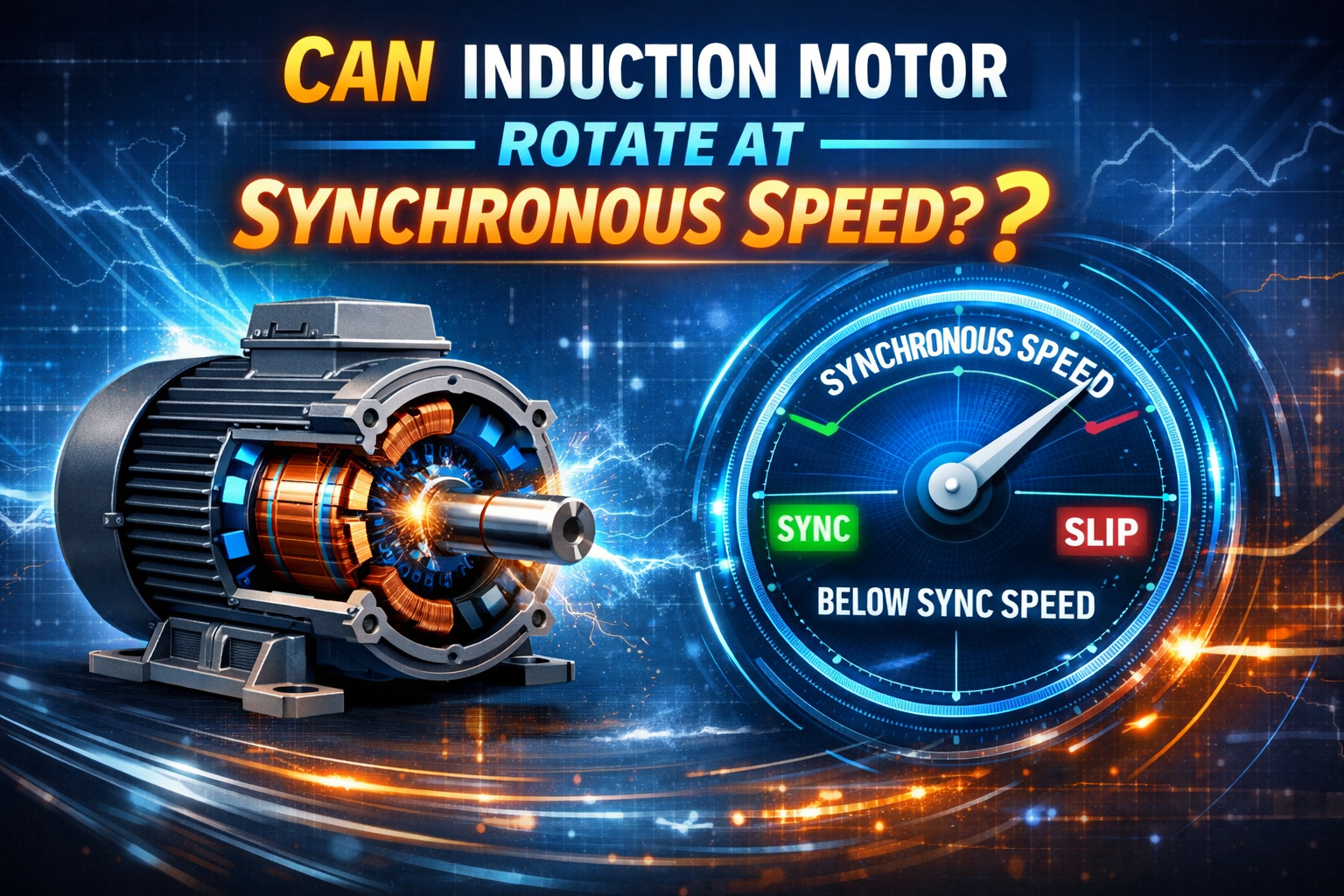
Can Induction Motor Rotate at Synchronous Speed?
In many industrial projects, buyers, engineers, and procurement teams ask a simple but critical question: can an induction motor rotate at synchronous speed? This question often comes up when selecting motors for pumps, conveyors, compressors, and automated equipment. It reflects a real concern about efficiency, torque stability, energy cost, and long-term reliability. The short answer is no, a standard induction motor cannot reach synchronous speed under load. However, the real value lies in understanding why this is the case and what it means for motor selection, system design, and purchasing decisions. This article explains the topic in a practical, buyer-focused way. It connects theory with real industrial use, avoids unnecessary complexity, and helps you make better decisions when choosing electric motors for demanding applications.
Understanding Synchronous Speed in Simple Terms
Synchronous speed is the theoretical speed at which the magnetic field inside the stator rotates. It is not chosen randomly. It depends only on the supply frequency and the number of stator poles. In simple language, when you supply power to the motor, the stator creates a rotating magnetic field, and this field moves at a fixed speed.
For example, with a 50 Hz power supply and a 4-pole motor, the synchronous speed is 1500 rpm. With a 60 Hz supply, the same motor has a synchronous speed of 1800 rpm. Buyers often see these numbers on motor nameplates and assume the motor will run at exactly that speed in real operation. This is where confusion starts. In reality, the rotor of an induction motor always runs slightly slower than the rotating magnetic field. This speed difference is not a defect. It is a fundamental operating condition that allows torque to exist.
Why Induction Motors Need Slip to Work?
The key concept behind induction motors is slip. Slip is the difference between synchronous speed and actual rotor speed. Without slip, there is no induced current in the rotor, and without rotor current, there is no torque.
Think of it like this: the stator magnetic field must “cut” through the rotor conductors to induce current. If the rotor were spinning at the same speed as the magnetic field, there would be no relative motion, no induced current, and no torque. The motor would simply coast. This is why an induction motor can approach synchronous speed but never truly reach it under normal operating conditions. Even at no load, there is still a small slip to overcome losses such as friction, windage, and core losses.
What Happens at No-load Conditions?
A common question from buyers is whether an induction motor can reach synchronous speed when there is no load. In practice, even under no-load conditions, the rotor speed remains slightly below synchronous speed. The slip becomes very small, often less than 1%, but it never becomes zero. This behavior ensures the motor can instantly respond to load changes. If the motor were truly synchronous, it would lose torque the moment any load was applied. The small slip acts as a reserve, allowing the motor to generate torque smoothly and reliably. From a purchasing point of view, this means nameplate speeds like 1450 rpm or 1750 rpm are not mistakes. They reflect realistic operating speeds that align with stable torque production.
Comparing Induction Motors and Synchronous Motors
Understanding the difference between induction motors and synchronous motors helps buyers choose the right solution. A synchronous motor does rotate at synchronous speed. It achieves this by using a rotor with permanent magnets or DC excitation, which locks into the stator magnetic field.
Induction motors, on the other hand, rely on induced rotor current. This makes them simpler, more rugged, and often more cost-effective. For many industrial users, the small speed difference is not only acceptable but desirable because it provides inherent load adaptability.
Synchronous motors are often used where precise speed control or high efficiency at constant speed is critical. Induction motors dominate applications where reliability, low maintenance, and flexible load handling matter most.
Induction Motor vs PMSM vs Synchronous Motor
| Feature | Induction Motor | PMSM (Permanent Magnet Synchronous Motor) | Synchronous Motor |
|---|---|---|---|
| Operating Speed | Always below synchronous speed | Exactly synchronous speed | Exactly synchronous speed |
| Slip | Required for torque production | No slip | No slip |
| Speed Accuracy | Moderate | Very high | Very high |
| Efficiency | Good | Excellent | High |
| Starting Method | Direct-on-line or VFD | Requires drive | Requires excitation or drive |
| Control Complexity | Low | Medium to high | High |
| Maintenance | Low | Very low | Medium |
| Initial Cost | Low | Higher | Higher |
| Typical Applications | Pumps, fans, conveyors | Robotics, EVs, precision systems | Compressors, power factor correction |
Practical Implications for Industrial Buyers
For buyers sourcing motors for real-world applications, understanding slip helps avoid mismatched expectations. If your application requires exact speed matching, such as certain positioning systems or specialized process lines, an induction motor alone may not be ideal without a variable frequency drive (VFD). However, for pumps, fans, compressors, mixers, and conveyors, induction motors remain the most widely used option. Their slight speed variation under load actually protects mechanical components and reduces stress on the system.
Torque-speed Curve and Why it Matters
One of the most important tools for understanding induction motor behavior is the torque-speed curve. This curve shows how torque changes as speed increases from standstill to near synchronous speed. At standstill, the motor produces starting torque. As speed increases, torque rises to a maximum known as breakdown torque, then gradually decreases as the rotor approaches synchronous speed. At synchronous speed, torque drops to zero. This curve explains why induction motors cannot operate at synchronous speed under load. Torque simply does not exist at that point. For buyers, this means you should always consider rated speed and rated torque together, not just frequency and poles.
Role of Variable Frequency Drives (VFDs)
Modern systems often use VFDs to control motor speed. Some buyers assume that using a VFD allows an induction motor to run at synchronous speed. In reality, the VFD changes the synchronous speed itself by adjusting frequency. Even with a VFD, the rotor still runs slightly below the synchronous speed corresponding to the applied frequency. Slip still exists. What changes is that the entire speed range becomes adjustable, giving better control, energy savings, and soft starting. This is why induction motors paired with VFDs are so popular in energy-efficient systems. They offer flexibility without sacrificing the inherent robustness of the motor design.
Efficiency Considerations and Energy Use
Another buyer concern is efficiency. Some believe that because induction motors do not reach synchronous speed, they are inefficient. This is a misunderstanding. High-quality induction motors can reach very high efficiency levels, especially when properly sized. Efficiency losses come from electrical resistance, magnetic losses, and mechanical friction, not from slip alone. In fact, slip-related losses are relatively small in well-designed motors operating near rated load. Choosing a motor that is too large or too small often has a bigger impact on efficiency than the difference between synchronous and rated speed.
Common Application Examples
In pump systems, slight speed reduction under load helps manage pressure fluctuations. In conveyors, slip allows the motor to absorb sudden load changes without stalling. In fans and blowers, induction motors naturally match airflow demand with load torque. These real-world benefits explain why induction motors remain the backbone of industrial motion systems. Buyers who focus only on theoretical speed often miss these practical advantages.
Misconceptions Buyers often Have
One common misconception is that a motor running below synchronous speed is underperforming. In truth, it is operating exactly as designed. Another misconception is that slip means poor quality. Slip is not a quality issue; it is a functional requirement. Buyers sometimes request motors “that run at exactly 1500 rpm.” What they usually need is consistent output speed under load. This can be achieved with proper motor selection, gear ratios, or control systems, not by eliminating slip. Clear communication between suppliers and buyers is critical to avoid costly redesigns or performance complaints.
How to Select the Right Induction Motor?
When selecting an induction motor, focus on rated speed, torque requirements, duty cycle, efficiency class, and environmental conditions. Ask suppliers for performance curves and application guidance rather than relying only on catalog data. Working with experienced manufacturers like United Motion Inc. helps ensure that motor characteristics match real operating conditions. This reduces downtime, energy waste, and long-term maintenance costs.
Future Trends and Evolving Solutions
As energy regulations tighten and automation increases, induction motors continue to evolve. Improved materials, better cooling designs, and advanced control systems are pushing efficiency higher while maintaining reliability. Hybrid solutions combining induction motors with intelligent drives are becoming standard in many industries. These systems preserve the benefits of slip while delivering precise speed control when needed.
References
IEEE Electric Machinery Fundamentals
NEMA Motor Standards and Application Guides
Industrial Motor Control Handbook
Energy Efficiency in Electric Motors – Technical Review