
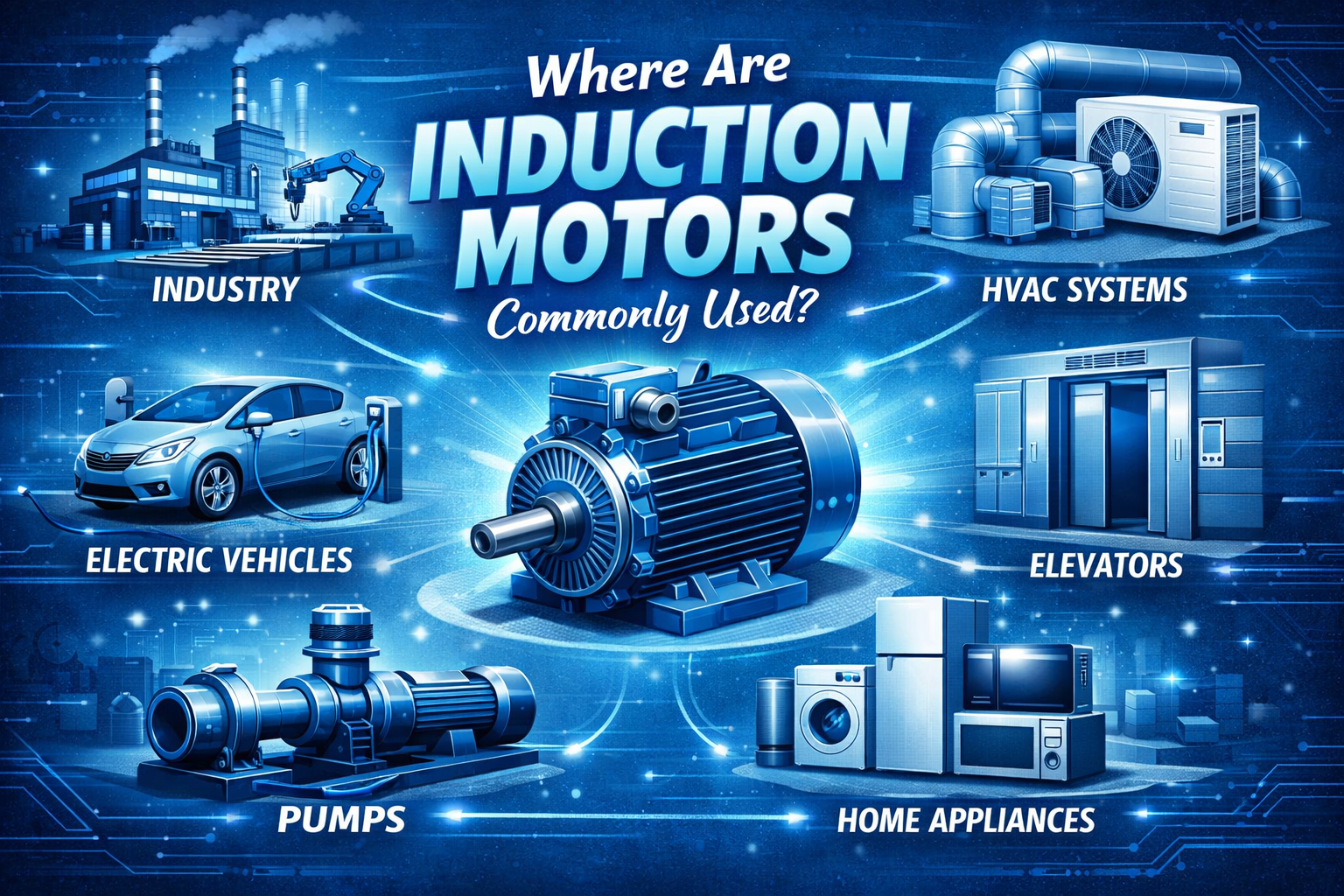
Where Are Induction Motors Commonly Used?
Induction motors are one of the most widely used electric motors in the world, and for good reason. They are reliable, cost-effective, easy to maintain, and suitable for a wide range of industrial and commercial applications. From factories and warehouses to farms, buildings, and infrastructure systems, induction motors quietly power the modern world.
For buyers, engineers, and procurement teams, the real question is not what an induction motor is, but where it makes the most sense to use one. Choosing the right motor type directly affects energy efficiency, system reliability, operating cost, and long-term maintenance. This article explains where induction motors are commonly used, why they are chosen in those scenarios, and how companies like United Motion Inc. support customers with application-focused motor solutions.
Understanding Induction Motors Before Choosing Applications
An induction motor, also known as an asynchronous motor, works by inducing current in the rotor through electromagnetic fields generated by the stator. Unlike synchronous motors, the rotor does not rotate at exactly the same speed as the magnetic field. This simple operating principle removes the need for brushes or external excitation, which is one reason induction motors are so robust and widely accepted.
From a buyer’s perspective, induction motors solve several common pain points:
- They require minimal maintenance compared to brushed or DC motors
- They are available in standardized sizes and power ratings
- They perform well in harsh or dusty environments
- They offer long service life with predictable performance
Because of these strengths, induction motors are often selected as the “default” solution when reliability and cost control matter more than ultra-precise speed or position control.
Industrial Manufacturing and Production Lines
One of the most common places induction motors are used is in industrial manufacturing. Production lines depend on motors that can operate continuously, handle variable loads, and tolerate tough operating conditions such as heat, vibration, and dust.
Induction motors are widely used in:
- Conveyor systems
- Assembly lines
- Packaging machines
- Material handling equipment
In these applications, speed stability and durability are more important than fine motion control. Induction motors paired with variable frequency drives (VFDs) allow manufacturers to adjust speed while still keeping costs manageable. This combination has become standard in factories aiming to improve energy efficiency without switching to more complex motor technologies.
Pumps and Fluid Handling Systems
Pumps represent one of the largest segments of induction motor usage worldwide. Water supply systems, wastewater treatment plants, chemical processing facilities, and oil & gas operations all rely heavily on pumps driven by induction motors.
The reasons are practical:
- Pumps typically run at constant or slowly varying speeds
- Torque requirements are predictable
- Continuous operation is common
Induction motors handle these conditions very well. Their efficiency improves at steady operating points, and their rugged design allows them to run for years with minimal downtime. In water and wastewater facilities, induction motors are often chosen because maintenance teams can service them easily, even in remote locations.
Fans, Blowers, and HVAC Systems
Heating, ventilation, and air conditioning systems depend heavily on induction motors. Fans and blowers used in commercial buildings, factories, tunnels, and data centers typically run for long hours, making reliability and energy efficiency key concerns.
Induction motors are commonly used in:
- Air handling units (AHUs)
- Cooling tower fans
- Exhaust and ventilation systems
- Industrial blowers
For building operators, induction motors provide a balance between upfront cost and long-term operating expense. When combined with energy-efficient motor designs and modern drives, they help meet increasingly strict energy regulations without complex system redesigns.
Compressors and Refrigeration Equipment
Compressors used in refrigeration, air conditioning, and industrial gas systems are another major application area. These systems often require motors that can handle high starting torque and frequent start-stop cycles.
Induction motors are preferred because:
- They tolerate mechanical stress well
- Spare parts and replacements are widely available
- Their performance is well understood across industries
From cold storage warehouses to food processing plants, induction motors help maintain stable temperatures and reliable operation.
Mining, Cement, and Heavy Industries
Heavy industries place extreme demands on electric motors. Dust, vibration, heavy loads, and continuous operation are common challenges. Induction motors are widely used in mining, cement, steel, and paper industries because they are mechanically strong and electrically simple.
Typical applications include:
- Crushers and grinders
- Kilns and rotary equipment
- Heavy conveyors
- Mixers and mills
In these environments, buyers often prioritize proven designs over cutting-edge technology. Induction motors meet this need by offering predictable performance and long operational life.
Agricultural Equipment and Irrigation
Agriculture relies heavily on electric motors, especially for irrigation systems, grain handling, and feed processing. Induction motors are commonly used on farms because they can operate in outdoor and semi-controlled environments.
Applications include:
- Irrigation pumps
- Grain elevators
- Feed mixers
- Ventilation systems for livestock buildings
For farmers and agricultural equipment manufacturers, induction motors offer affordability and ease of replacement, which is critical during peak seasons when downtime can be costly.
Transportation and Infrastructure
Induction motors also play an important role in transportation and public infrastructure. While modern electric vehicles often use permanent magnet motors, induction motors are still widely used in rail systems, escalators, elevators, and automated transit solutions.
Their advantages in infrastructure projects include:
- Long service intervals
- Stable performance under continuous use
- Compatibility with standardized control systems
Elevators and escalators in commercial buildings often rely on induction motors due to their reliability and ability to handle frequent daily operation.
Commercial and Consumer Applications
Beyond heavy industry, induction motors are found in many commercial and consumer products. Washing machines, dryers, commercial kitchen equipment, and vending machines often use small induction motors.
Manufacturers choose induction motors because:
- They reduce product cost
- They are easy to certify and standardize
- They perform consistently across different regions
Even as newer motor technologies emerge, induction motors remain a practical choice for many everyday applications.
Why Buyers Still Choose Induction Motors?
From a procurement and engineering perspective, induction motors solve several recurring challenges:
Cost control: Competitive pricing across global markets
Supply stability: Widely available from multiple manufacturers
Serviceability: Easy to repair or replace
Proven performance: Decades of field data
These factors explain why induction motors continue to dominate many sectors, even as BLDC and PMSM motors gain popularity in precision-driven applications.
How United Motion Inc. Supports Induction Motor Applications?
As an experienced motor manufacturer, United Motion Inc. understands that buyers do not just need motors—they need solutions that match real operating conditions. Our team works closely with OEMs, system integrators, and industrial buyers to select induction motors based on load profiles, duty cycles, environment, and efficiency targets. By focusing on application-driven design and consistent quality control, United Motion Inc. helps customers reduce total cost of ownership while ensuring long-term reliability across industrial, commercial, and infrastructure projects.
References
International Electrotechnical Commission (IEC) – Electric Motor Standards
IEEE Industry Applications Society – Motor Application Guides
U.S. Department of Energy – Electric Motor Systems Efficiency
Industrial Energy Efficiency Handbook