
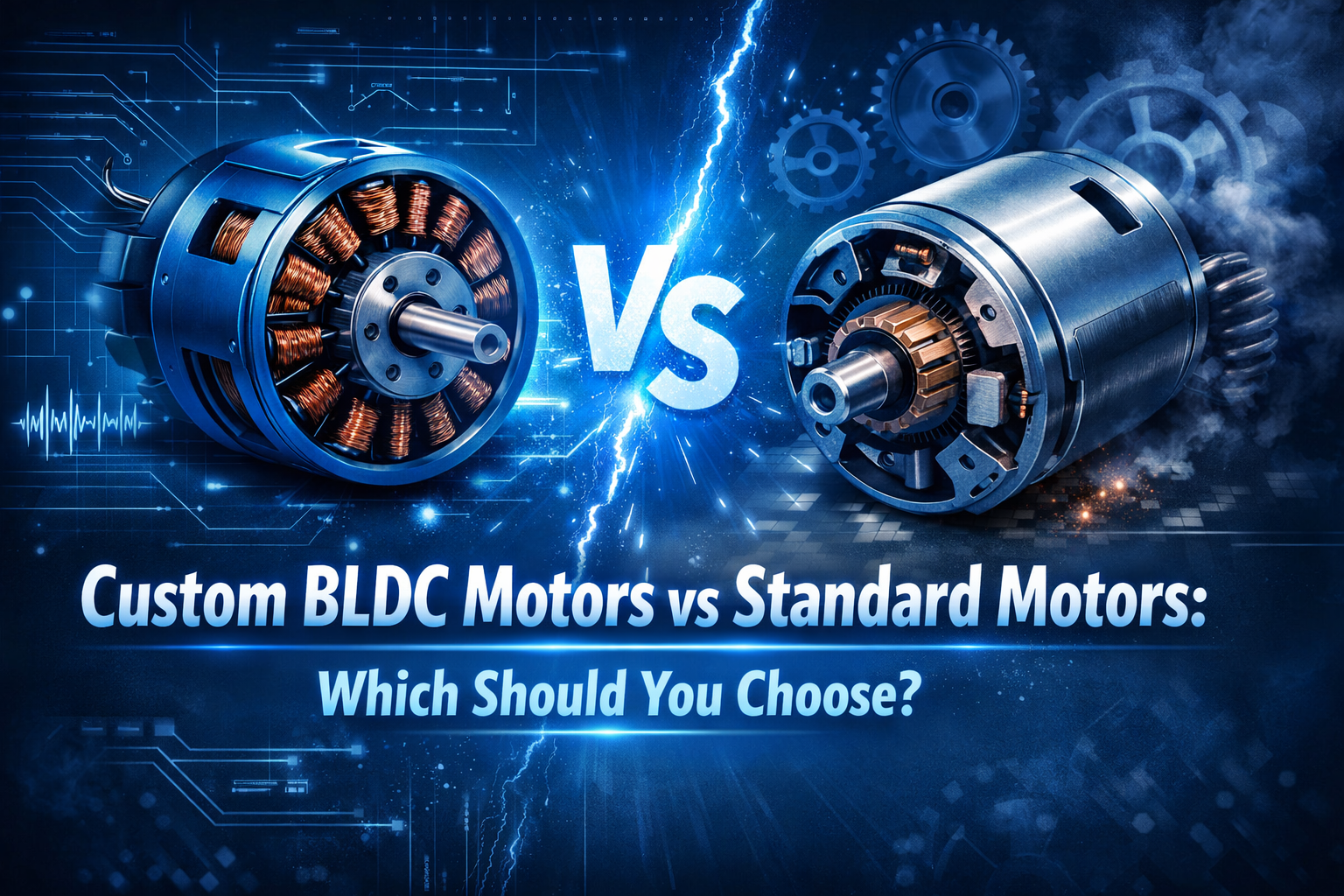
Custom BLDC Motors vs Standard Motors: Which Should You Choose?
In today’s competitive industrial and commercial landscape, electric motors are no longer simple components hidden inside machines. They directly affect product performance, energy efficiency, reliability, noise level, and even brand reputation. Among all motor types, brushless DC motors, commonly known as BLDC motors, have become a preferred choice for manufacturers across automation, medical devices, robotics, electric vehicles, HVAC systems, and consumer electronics. As buyers research BLDC motors, one critical question appears again and again: should you choose a custom BLDC motor or a standard off-the-shelf motor?
This question is not just technical. It involves cost control, development speed, supply chain stability, long-term scalability, and product differentiation. At United Motion Inc., we work closely with OEMs, engineers, and procurement teams who face this decision every day. This article is written based on real industry pain points and buyer search behavior, aiming to provide clear, practical guidance without unnecessary jargon.
Understanding BLDC Motors in Simple Terms
A BLDC motor is an electric motor that uses electronic commutation instead of mechanical brushes. This design reduces friction, minimizes maintenance, improves efficiency, and enables precise speed and torque control. Because of these advantages, BLDC motors are widely used in applications that demand reliability, long service life, and consistent performance.
From a buyer’s perspective, BLDC motors offer strong value in energy savings, compact size, and integration flexibility. However, not all BLDC motors are created equal. The market generally divides them into two categories: standard BLDC motors and custom BLDC motors. Understanding how these options differ is essential before making a purchasing decision.
What Is a Standard BLDC Motor?
A standard BLDC motor is a mass-produced motor designed to meet common application needs. These motors are usually available in fixed frame sizes, standard voltage ranges, predefined torque and speed curves, and limited configuration options. Manufacturers design them to serve a wide range of industries, which helps keep unit costs low and delivery times short.
Standard BLDC motors are often listed in catalogs with clear specifications, drawings, and certifications. Buyers can quickly compare models and place orders without extensive engineering discussions. For applications with well-defined requirements and no special constraints, standard motors can be an efficient and economical choice.
What Is a Custom BLDC Motor?
A custom BLDC motor is designed or modified specifically to match the exact needs of a customer’s application. This may involve changes to mechanical dimensions, winding design, magnet material, shaft length, mounting interface, insulation class, encoder type, or integrated driver electronics. In some cases, the motor is fully co-developed from scratch based on unique performance targets.
Custom BLDC motors are commonly used when standard products cannot meet space limitations, torque density requirements, environmental conditions, or control system compatibility. While custom solutions require more upfront engineering effort, they often deliver better overall system performance and long-term cost benefits.
Key Differences Between Custom and Standard BLDC Motors
Performance Matching
One of the biggest differences lies in how closely the motor matches the application requirements. Standard BLDC motors are designed to cover average use cases. This means buyers may end up oversizing or underutilizing the motor to compensate for mismatched torque or speed ranges. Over time, this can lead to energy waste, excess heat, or reduced lifespan.
Custom BLDC motors, on the other hand, are engineered to operate precisely within the required load profile. This improves efficiency, reduces thermal stress, and enhances reliability. For applications with continuous duty cycles or variable loads, this precise matching can make a significant difference.
Mechanical Integration
Mechanical fit is a common pain point for equipment designers. Standard motors come with fixed housings, shafts, and mounting patterns. If these do not align with the existing mechanical design, engineers may need to redesign brackets, couplings, or enclosures, which increases development time and cost.
Custom BLDC motors can be designed to fit seamlessly into the existing structure. Adjustments to shaft geometry, flange dimensions, and mounting holes reduce the need for additional components. This not only simplifies assembly but also improves system stability and reduces vibration.
Electrical and Control Compatibility
Standard BLDC motors typically support common voltage levels and basic control methods. However, modern applications often require specific communication protocols, feedback devices, or integrated drivers. Adding external components to achieve this can increase system complexity and wiring errors.
With a custom BLDC motor, electrical parameters and control features can be optimized from the start. This includes selecting the right winding configuration, integrating encoders or Hall sensors, and matching the motor to the intended drive or controller. The result is a cleaner, more reliable system architecture.
Cost Considerations
At first glance, standard BLDC motors appear more affordable due to their lower unit price. For low-volume or short-term projects, this cost advantage is often real. However, buyers should consider the total cost of ownership rather than just the purchase price.
Custom BLDC motors may have higher upfront costs related to design, tooling, and validation. Yet they often reduce costs elsewhere, such as energy consumption, maintenance, assembly labor, and system redesign. Over the product lifecycle, these savings can outweigh the initial investment.
Industry Pain Points That Drive the Need for Custom BLDC Motors
Space Constraints
Many modern devices are becoming smaller while demanding higher performance. Standard motors may simply not fit within the available space. Designers are then forced to compromise or redesign the entire system.
Custom BLDC motors allow for compact, high-torque designs tailored to tight spaces. By optimizing magnetic circuits and winding layouts, manufacturers like United Motion Inc. help customers achieve higher power density without increasing motor size.
Noise and Vibration Control
Noise is a critical concern in medical devices, office automation, and consumer products. Standard motors may meet basic specifications but still produce unacceptable acoustic levels in sensitive environments.
Custom BLDC motors can be optimized for smoother operation through improved rotor balance, customized commutation strategies, and precise mechanical tolerances. This results in quieter and more comfortable end-user experiences.
Harsh Operating Conditions
Applications in industrial automation, outdoor equipment, or transportation often expose motors to dust, moisture, temperature extremes, and chemical agents. Standard motors may not provide adequate protection or durability.
Custom BLDC motors can be designed with special coatings, sealing methods, and insulation systems to handle these conditions. This improves reliability and reduces the risk of unexpected failures.
Buyer Search Behavior and Decision Factors
When buyers search for BLDC motors online, they are often looking for solutions rather than components. Keywords such as “custom BLDC motor manufacturer,” “BLDC motor for automation,” “high efficiency brushless motor,” and “OEM BLDC motor supplier” reflect this intent.
Decision-makers want clear answers to practical questions: Will this motor fit my design? Can it meet my performance targets? Is the supplier reliable? Can the motor be customized if needed? Addressing these concerns openly builds trust and positions the supplier as a long-term partner.
When Standard BLDC Motors Make Sense?
Standard BLDC motors are well suited for applications with stable, predictable requirements. If the design has enough flexibility to accommodate standard dimensions and performance ranges, off-the-shelf motors can reduce time to market.
They are also a good option for prototyping, testing, or short production runs. In these cases, the speed and availability of standard products outweigh the benefits of customization.
When Custom BLDC Motors Are the Better Choice?
Custom BLDC motors are ideal for products that aim to stand out in performance, efficiency, or reliability. They are especially valuable in high-volume production, where small efficiency gains translate into significant cost savings over time.
They also make sense when intellectual property protection is important. A custom motor design can be harder for competitors to replicate, giving your product a competitive edge.
The Role of United Motion Inc. in Custom BLDC Motor Development
At United Motion Inc., we specialize in both standard and custom BLDC motor solutions. Our engineering team works closely with customers to understand application requirements, operating conditions, and long-term goals. This collaborative approach ensures that the motor design supports the entire system, not just isolated specifications.
From concept and simulation to prototyping and mass production, we provide end-to-end support. Our experience across multiple industries allows us to anticipate challenges and deliver reliable, scalable solutions.
Future Trends in BLDC Motor Customization
As industries continue to adopt automation and electrification, the demand for tailored motor solutions will grow. Digital design tools, advanced materials, and smarter control algorithms are making customization more accessible and cost-effective.
In the future, we expect to see greater integration of motors, drives, and sensors into compact, intelligent modules. Custom BLDC motors will play a key role in enabling these innovations.
References
1. IEC 60034 Standards for Rotating Electrical Machines
2. IEEE Industry Applications Society Publications on Motor Design
3. U.S. Department of Energy – Electric Motor Systems Efficiency Guide
4. Engineering texts on Brushless DC Motor Design and Control