
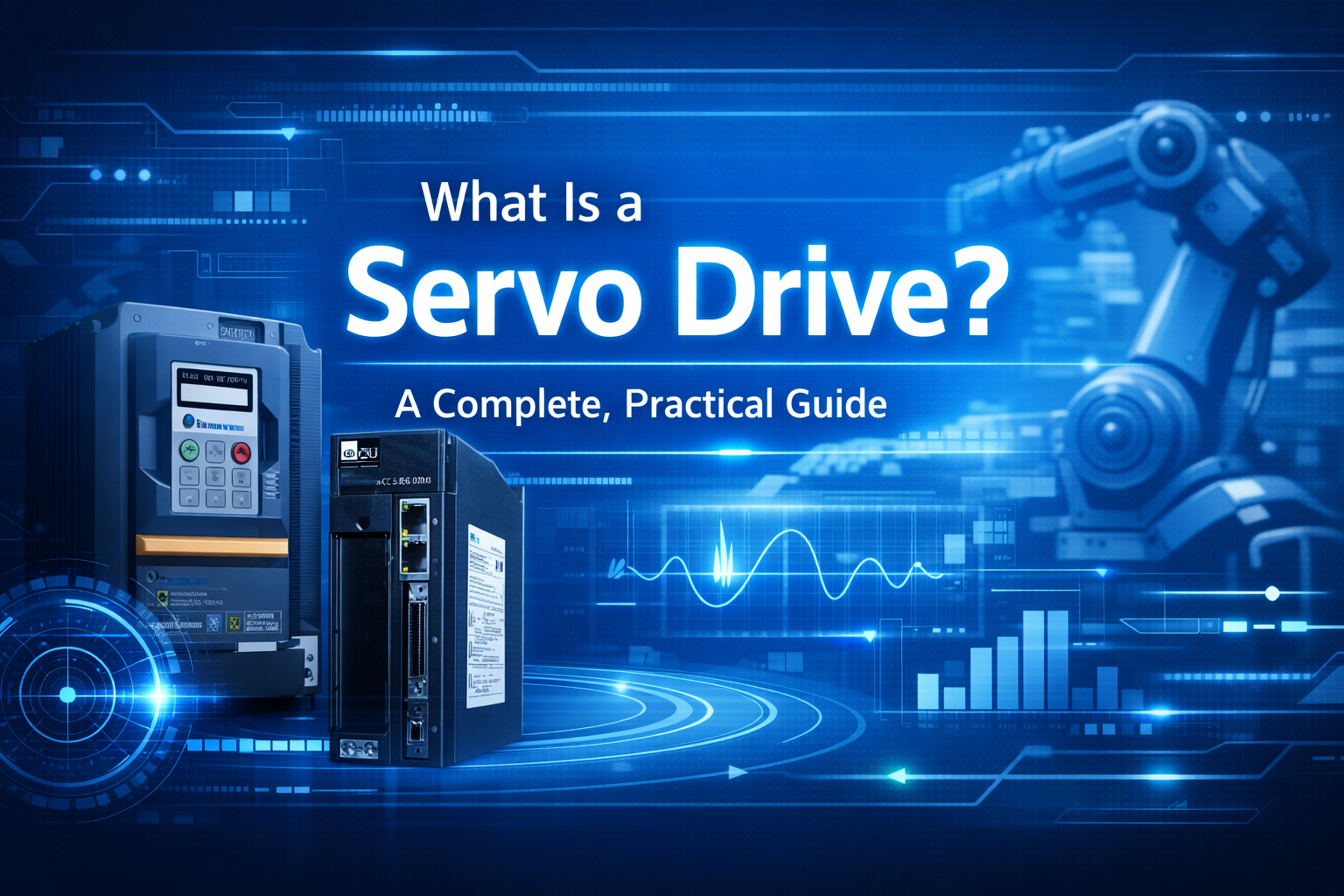
What Is a Servo Drive? A Complete, Practical Guide
In today’s automated world, precision is no longer a luxury—it is a requirement. From CNC machines and industrial robots to packaging lines and electric vehicle manufacturing, motion must be accurate, repeatable, and reliable. At the center of this precision sits a critical but often misunderstood component: the servo drive. If you have ever searched for terms like servo drive, servo motor driver, AC servo drive, or industrial servo drive, you are not alone. Buyers, engineers, and system integrators across industries are actively looking for clear, practical answers—not theory-heavy explanations. This guide is written to meet that need. This article is based on real industry pain points, buyer questions, and practical application experience. It explains what a servo drive is, how it works, why it matters, and how to choose the right one—without unnecessary complexity.
Understanding the Basics: What Is a Servo Drive?
A servo drive, also known as a servo motor drive or servo amplifier, is an electronic device that controls the movement of a servo motor. Its main role is to receive command signals from a controller and precisely regulate motor speed, position, and torque based on real-time feedback. Unlike basic motor drivers, a servo drive does not simply turn a motor on or off. It constantly monitors feedback from the motor—usually through an encoder or resolver—and makes rapid adjustments to ensure the motor follows the commanded motion exactly. This closed-loop control is what gives servo systems their unmatched precision. In practical terms, a servo drive acts as the “brain” of a servo system. While the servo motor provides mechanical motion, the drive determines how that motion happens—how fast, how smoothly, and how accurately. Without a servo drive, even the most advanced servo motor cannot perform to its full capability.
Why Servo Drives Are Essential in Modern Automation?
Modern industrial environments demand more than just movement. They require repeatability, efficiency, safety, and energy optimization. Servo drives are designed to meet all these demands simultaneously. One of the key reasons servo drives are so widely used is their ability to deliver precise motion control under changing load conditions. In real production lines, loads are rarely constant. Materials vary, speeds change, and operating conditions shift throughout the day. A servo drive automatically compensates for these variations, ensuring stable performance. Another important advantage is dynamic response. Servo drives can accelerate, decelerate, and reverse direction extremely quickly without losing accuracy. This makes them ideal for high-speed automation systems where cycle time directly affects productivity and profitability. From a business perspective, servo drives also help reduce long-term costs. Their high efficiency minimizes energy waste, while their precise control reduces mechanical stress, extending the life of motors, gearboxes, and connected equipment.
Key Components Inside a Servo Drive
Although servo drives are compact, they contain several critical internal components that work together to deliver precise control. At the core is the power stage, which converts incoming AC or DC power into controlled voltage and current for the motor. This stage uses advanced semiconductor devices such as IGBTs or MOSFETs to handle fast switching and high power efficiency. The control processor is another vital component. It runs motion control algorithms that calculate how much current, voltage, and speed the motor needs at any given moment. These calculations happen thousands of times per second, allowing the servo system to respond instantly to changes. Feedback processing is equally important. Servo drives receive position and speed data from encoders or resolvers mounted on the motor shaft. This feedback allows the drive to compare actual motor behavior with commanded motion and correct any deviation immediately. Modern servo drives from manufacturers like United Motion Inc. also include communication interfaces, safety circuits, and diagnostic functions, making them easy to integrate into complex automation systems.
How a Servo Drive Works: A Step-by-Step Explanation?
To fully understand the value of a servo drive, it helps to look at how it operates during real motion. First, a motion controller or PLC sends a command signal to the servo drive. This command may specify a target position, speed, or torque. The signal can be transmitted through pulse signals, analog signals, or digital fieldbus protocols such as EtherCAT or CANopen. Next, the servo drive interprets this command and compares it with feedback from the motor encoder. If the motor is not moving as required, the drive calculates the necessary correction. The drive then adjusts the output current and voltage supplied to the motor. This adjustment happens continuously in a closed-loop system, allowing for extremely fine control even at very low speeds or high loads. Finally, the drive monitors system performance and provides diagnostic data, alarms, or fault signals if operating conditions fall outside safe limits. This intelligent feedback loop is what makes servo drives so reliable in demanding industrial environments.
Servo Drive vs VFD: Understanding the Difference
A common question among buyers is the difference between a servo drive and a variable frequency drive (VFD). While both control motors, their purposes and capabilities are very different. A VFD is primarily designed to control the speed of AC induction motors. It works well for applications like pumps, fans, and conveyors where speed control is needed but precision is not critical. Servo drives, on the other hand, are built for high-precision motion control. They offer closed-loop feedback, high dynamic response, and accurate positioning—capabilities that VFDs cannot match. In short, if your application requires exact positioning, rapid acceleration, or synchronized multi-axis motion, a servo drive is the correct choice. This distinction is crucial for buyers searching for the right motor control solution.
Types of Servo Drives Used in Industry
Servo drives come in several types, each designed for specific applications and system requirements.
AC servo drives are the most common in industrial automation. They are compatible with AC servo motors and offer high power density, excellent efficiency, and broad voltage ranges.
DC servo drives are typically used in legacy systems or specialized applications. While less common today, they are still found in certain industrial machines.
Digital servo drives use advanced digital signal processing to deliver precise control and flexible tuning. These drives are preferred in modern smart factories and Industry 4.0 environments. Some servo drives are designed for single-axis control, while others support multi-axis synchronization, making them ideal for complex motion systems such as robotics and packaging machinery.
Common Applications of Servo Drives
Servo drives are used across a wide range of industries due to their flexibility and performance advantages.
In CNC machining, servo drives control spindle motors and axis movements with extreme accuracy, ensuring consistent part quality.
In robotics, servo drives enable smooth, coordinated motion across multiple joints, allowing robots to perform complex tasks with high repeatability.
In packaging and labeling systems, servo drives ensure precise timing and positioning, even at high production speeds.
Servo drives are also widely used in semiconductor manufacturing, medical equipment, printing machines, and electric vehicle production lines. Their ability to deliver consistent performance makes them indispensable in modern manufacturing.
Key Benefits of Using Servo Drives
One of the biggest advantages of servo drives is precision. They allow machines to achieve exact positions and speeds, which directly improves product quality.
Another major benefit is efficiency. Servo drives deliver power only when needed, reducing energy consumption compared to traditional motor control methods.
Servo drives also offer flexibility. Through software configuration, a single drive can support multiple control modes, making it adaptable to changing production requirements.
From a maintenance perspective, servo drives provide advanced diagnostics that help identify issues early, reducing downtime and repair costs.
Important Specifications to Consider When Choosing a Servo Drive
Selecting the right servo drive requires careful evaluation of several technical parameters.
Power rating is a fundamental consideration. The drive must match the motor’s voltage and current requirements.
Control mode compatibility is also important. Many applications require position, speed, and torque control within a single system.
Communication capability plays a critical role in modern automation. Servo drives that support industrial protocols such as EtherCAT or Modbus integrate more easily with PLCs and motion controllers.
Environmental factors such as temperature, vibration, and enclosure rating should also be considered to ensure reliable operation in industrial conditions.
Integration Challenges and How to Overcome Them
Despite their advantages, servo drives can present integration challenges if not properly selected or configured.
One common issue is improper tuning, which can lead to vibration or instability. Modern servo drives address this with auto-tuning functions that simplify setup.
Another challenge is system compatibility. Ensuring that the servo drive, motor, and controller work seamlessly together is essential. Choosing a reliable servo drive manufacturer like United Motion Inc. helps minimize these risks.
Training and documentation also play a key role. Well-documented servo drives reduce learning curves and speed up deployment.
Why Choose United Motion Inc. for Servo Drive Solutions?
At United Motion Inc., we focus on delivering servo drive solutions that balance performance, reliability, and cost efficiency. Our servo drives are designed to meet the demands of modern industrial automation, offering advanced control algorithms, flexible communication options, and robust safety features. We understand that buyers are not just purchasing hardware—they are investing in long-term system performance. That is why our solutions are backed by technical expertise and practical application support.
References
International Electrotechnical Commission (IEC) – Motion Control Standards
IEEE Industrial Electronics Society – Servo Control Systems
Bosch Rexroth Motion Control Technical Guides
Siemens Automation Industry Documentation
Rockwell Automation – Servo Drive Application Notes
Frequently Asked Questions About Servo Drives
What does a servo drive do in an automation system?
In an automation system, a servo drive acts as the control center for motor motion. It converts control commands into accurate electrical signals that drive the motor while monitoring feedback to ensure the motor follows the required motion path. This makes servo drives essential for applications that demand accuracy, fast response, and repeatability.
What is the difference between a servo drive and a VFD?
The main difference lies in precision and control capability. A servo drive provides closed-loop control with real-time feedback, enabling precise positioning, rapid acceleration, and exact speed control. A VFD, by contrast, mainly adjusts motor speed and is commonly used in applications such as pumps and fans where precise positioning is not required.
What are servo drives commonly used for?
Servo drives are widely used in CNC machines, industrial robots, packaging and labeling equipment, printing machines, semiconductor manufacturing systems, medical devices, and electric vehicle production lines. Any application that requires accurate motion control and high dynamic performance typically relies on servo drives.
How do I choose the right servo drive for my application?
Choosing the right servo drive depends on several factors, including motor power rating, required control modes (position, speed, or torque), feedback type, communication protocol, and environmental conditions. It is also important to ensure compatibility with your controller and automation system. Working with an experienced supplier like United Motion Inc. can simplify the selection process.
Are servo drives difficult to install and tune?
Modern servo drives are designed to be user-friendly. Many models include auto-tuning functions, clear parameter settings, and diagnostic tools that simplify installation and commissioning. Proper setup ensures smooth motion, reduces vibration, and improves overall system performance.
Can servo drives improve energy efficiency?
Yes. Servo drives supply only the amount of power required for each motion task, which reduces energy waste. Their precise control also minimizes mechanical stress, leading to longer equipment life and lower maintenance costs over time.
Why choose servo drives from United Motion Inc.?
United Motion Inc. provides reliable, high-performance servo drives designed for modern industrial automation. Our solutions offer precise control, flexible communication options, and strong system compatibility, backed by practical application support to help customers achieve stable and efficient motion control.