
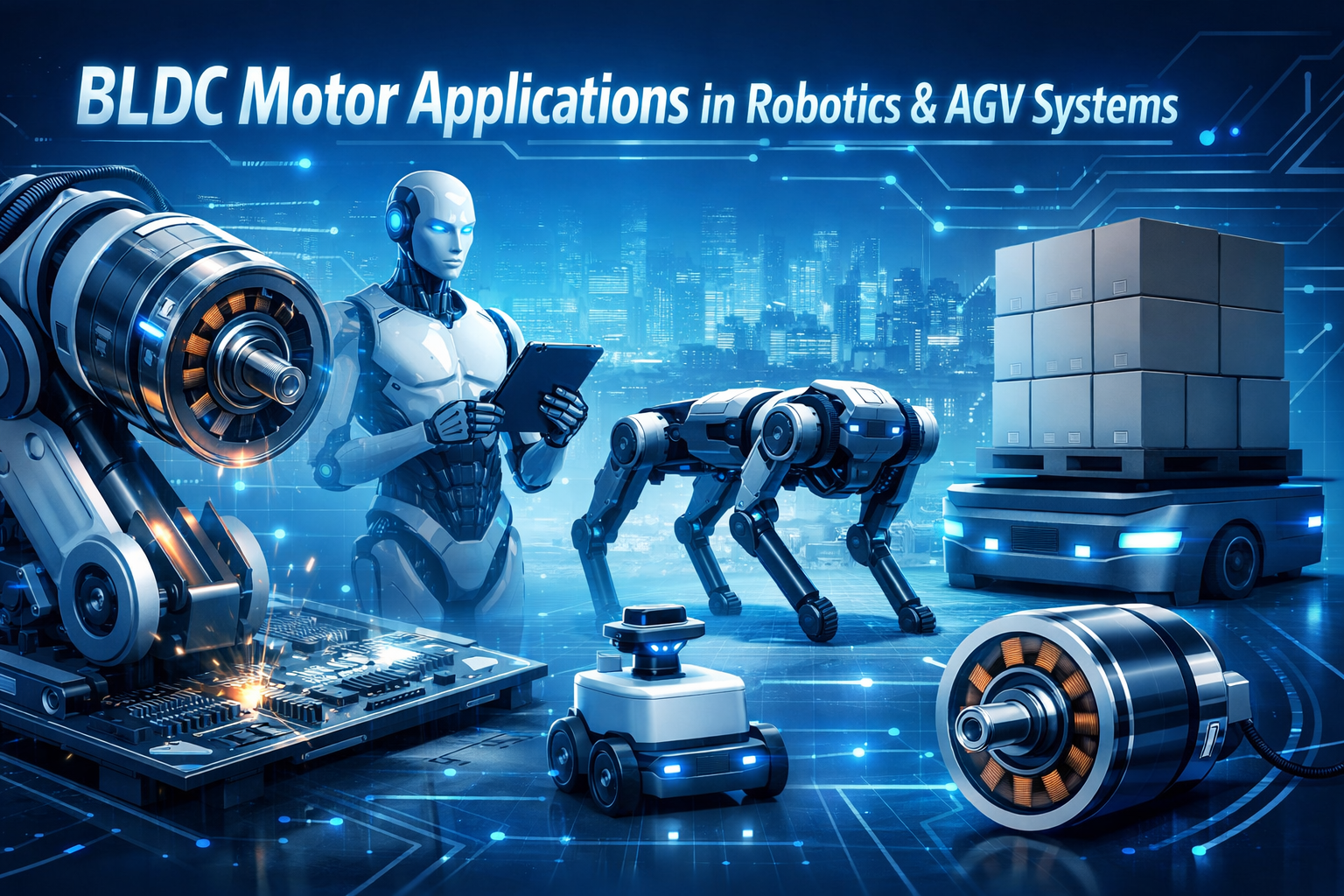
BLDC Motor Applications in Robotics and AGV Systems
In today’s fast-moving automation landscape, robotics and Automaed Guided Vehicle (AGV) systems are no longer experimental technologies. They are core production tools in factories, warehouses, hospitals, and logistics hubs. As these systems become more intelligent, compact, and energy-efficient, the choice of motor technology has a direct impact on performance, reliability, and lifetime cost. Among all available motor types, the Brushless DC motor, commonly known as the BLDC motor, has emerged as one of the most practical and widely adopted solutions.
Unlike brushed motors, BLDC motors eliminate mechanical commutation, reducing wear and maintenance while delivering higher efficiency and precise control. For robotics and AGV designers, this directly addresses some of the most common industry pain points: frequent downtime, poor motion accuracy, limited battery life, and high operating costs.
Understanding BLDC Motors in Simple Terms
A BLDC motor is an electric motor that uses electronic commutation instead of mechanical brushes. The rotor typically contains permanent magnets, while the stator uses windings controlled by an electronic drive. Sensors or sensorless algorithms detect rotor position and switch current accordingly. This structure allows the motor to operate smoothly, efficiently, and with minimal mechanical wear.
From a system perspective, the most important benefits are consistent torque output, high speed capability, and precise control. BLDC motors respond well to advanced control algorithms, making them ideal for robotics and AGV applications that require smooth acceleration, accurate positioning, and dynamic speed changes. Compared with traditional brushed DC motors, BLDC motors offer longer service life, reduced noise, and improved energy efficiency. For automation buyers, the value lies not just in motor performance but in total cost of ownership. Lower maintenance, higher uptime, and better energy use directly translate into lower operational costs. This is one reason BLDC motor demand continues to grow across industrial automation sectors.
Why Robotics and AGVs Demand Advanced Motor Technology?
Robotic systems and AGVs operate in environments where precision and reliability are non-negotiable. Industrial robots must repeat movements thousands of times per day with minimal deviation. AGVs must transport loads safely while navigating dynamic environments, often running continuously across multiple shifts.
Traditional motor technologies struggle to meet these demands consistently. Brushed motors suffer from brush wear, arcing, and inconsistent performance over time. Induction motors, while robust, are often larger and less efficient at lower speeds, making them less suitable for compact or battery-powered systems. BLDC motors address these challenges directly. Their electronic commutation enables accurate torque control and smooth low-speed operation. High efficiency extends battery life in mobile systems. Compact designs allow integration into tight mechanical spaces. For robotics and AGVs, these advantages are not optional features; they are baseline requirements.
Core Advantages of BLDC Motors for Robotics Applications
One of the most important advantages of BLDC motors in robotics is precision. Robots rely on exact motion control to perform tasks such as assembly, welding, pick-and-place operations, and inspection. BLDC motors support closed-loop control with encoders or resolvers, enabling precise positioning and repeatability.
Another critical advantage is dynamic response. Robots frequently change speed and direction. BLDC motors handle rapid acceleration and deceleration without significant torque ripple, improving motion smoothness and reducing mechanical stress on gearboxes and structures.
Thermal performance is also a key factor. BLDC motors generate less heat compared to brushed motors at similar power levels. This improves reliability and allows continuous operation without overheating. In multi-axis robotic systems, reduced heat simplifies system cooling and enclosure design.
From a maintenance standpoint, the absence of brushes eliminates a common failure point. For robotic cells operating around the clock, reduced maintenance translates into higher uptime and predictable service schedules.
BLDC Motors in Industrial Robotics: Key Use Cases
Industrial robotics covers a wide range of applications, each with unique motion requirements. BLDC motors are used across articulated robots, SCARA robots, delta robots, and collaborative robots.
In articulated robots, BLDC motors provide high torque density and precise control for joint movement. Their ability to maintain torque at low speeds supports smooth, controlled motion during assembly or welding tasks. Combined with harmonic or planetary gearboxes, BLDC motors deliver both strength and accuracy.
SCARA and delta robots, often used in high-speed pick-and-place operations, benefit from the high speed and low inertia of BLDC motors. Fast acceleration improves cycle times, while precise control ensures accurate positioning even at high throughput.
Collaborative robots, designed to work alongside humans, rely on smooth, predictable motion and advanced safety features. BLDC motors integrate well with torque sensing and control algorithms that enable safe interaction. Their quiet operation also improves the working environment.
AGV Systems: Why BLDC Motors Are the Preferred Choice
AGVs place different demands on motor systems compared to stationary robots. Mobility, efficiency, and reliability are the top priorities. BLDC motors meet these requirements better than most alternatives.
Battery life is a critical concern in AGV systems. BLDC motors operate with high efficiency across a wide speed range, reducing energy consumption. This allows AGVs to run longer between charges or use smaller battery packs, lowering system weight and cost.
Torque control is equally important. AGVs must start smoothly, stop accurately, and handle varying loads without jerking or slipping. BLDC motors deliver consistent torque and smooth low-speed performance, improving navigation accuracy and load stability.
Noise reduction is another advantage. In warehouses, hospitals, and clean environments, quiet operation is often required. BLDC motors produce less noise and vibration, contributing to a safer and more comfortable workspace.
BLDC Motors in AGV Drive and Steering Systems
Within AGV platforms, BLDC motors are commonly used in both drive and steering subsystems. Drive motors provide propulsion, while steering motors control wheel orientation or differential drive behavior.
For drive systems, BLDC motors offer high torque at low speeds, ideal for starting heavy loads. Their electronic control allows precise speed regulation, enabling smooth acceleration and deceleration. This reduces mechanical wear and improves load safety.
In steering systems, accuracy is essential. BLDC motors paired with encoders provide precise angular control, allowing AGVs to navigate tight spaces and follow complex paths. The fast response of BLDC motors improves system agility, especially in dynamic environments where routes may change frequently.
Integration with Drives and Control Systems
A BLDC motor does not operate alone. Its performance depends heavily on the drive and control system. Modern BLDC drives use advanced algorithms such as field-oriented control to optimize torque, efficiency, and dynamic response.
For robotics and AGVs, integration flexibility is a major buying consideration. BLDC motor systems must support common industrial communication protocols, including EtherCAT, CANopen, and Modbus. This ensures seamless integration with PLCs, robot controllers, and fleet management systems.
At United Motion Inc., we focus on offering BLDC motor solutions that integrate smoothly with modern automation architectures. This includes support for feedback devices, flexible voltage ranges, and configurable control modes to meet diverse application needs.
Reliability and Lifecycle Considerations
Reliability is a primary concern for automation buyers. Downtime directly impacts productivity and profitability. BLDC motors offer inherent reliability advantages due to their brushless design.
However, long-term reliability also depends on proper selection and system design. Factors such as load profiles, duty cycles, ambient temperature, and cooling must be considered. Oversizing or undersizing motors can both lead to performance issues and premature failure.
In robotics and AGVs, continuous operation is common. Selecting BLDC motors with appropriate thermal margins and robust bearings is essential. Proper motor-drive matching further improves system stability and lifespan.
Cost Considerations and ROI
BLDC motors typically have a higher upfront cost than brushed motors. However, focusing only on purchase price can be misleading. For robotics and AGV systems, total cost of ownership is a more meaningful metric.
Lower maintenance requirements reduce service costs. Higher efficiency lowers energy consumption. Longer service life delays replacement expenses. When these factors are considered together, BLDC motors often deliver a strong return on investment.
For automation projects with long operating hours and high reliability requirements, the economic case for BLDC motors becomes even stronger. This is why many system integrators and OEMs now consider BLDC motors a standard choice rather than a premium option.
Emerging Trends in BLDC Motor Applications
As robotics and AGV technologies evolve, BLDC motors continue to adapt. One notable trend is the integration of smart sensors and embedded intelligence. Motors increasingly provide diagnostic data, enabling predictive maintenance and condition monitoring.
Another trend is higher power density. Advances in magnetic materials and winding techniques allow smaller motors to deliver higher torque. This supports more compact robot designs and lighter AGV platforms.
Energy efficiency standards and sustainability goals are also driving innovation. BLDC motors align well with these trends due to their high efficiency and compatibility with regenerative braking systems.
Selection Guidelines for Buyers and Engineers
When selecting a BLDC motor for robotics or AGV applications, buyers should evaluate several key factors. These include torque and speed requirements, voltage levels, feedback options, and environmental conditions. It is also important to consider future scalability. Automation systems often evolve, and selecting motors with sufficient performance margins can support upgrades without major redesigns. Working with experienced suppliers simplifies this process. A partner who understands both motor technology and application requirements can help avoid common pitfalls and ensure a successful implementation.
References
1. IEEE Industry Applications Society – Electric Motor Efficiency and Control
2. International Federation of Robotics – World Robotics Reports
3. Motion Control Industry Association – Motor Selection Guidelines
4. Industrial Automation Magazine – Trends in AGV Drive Systems
5. Technical papers on BLDC motor control and applications from leading automation journals