
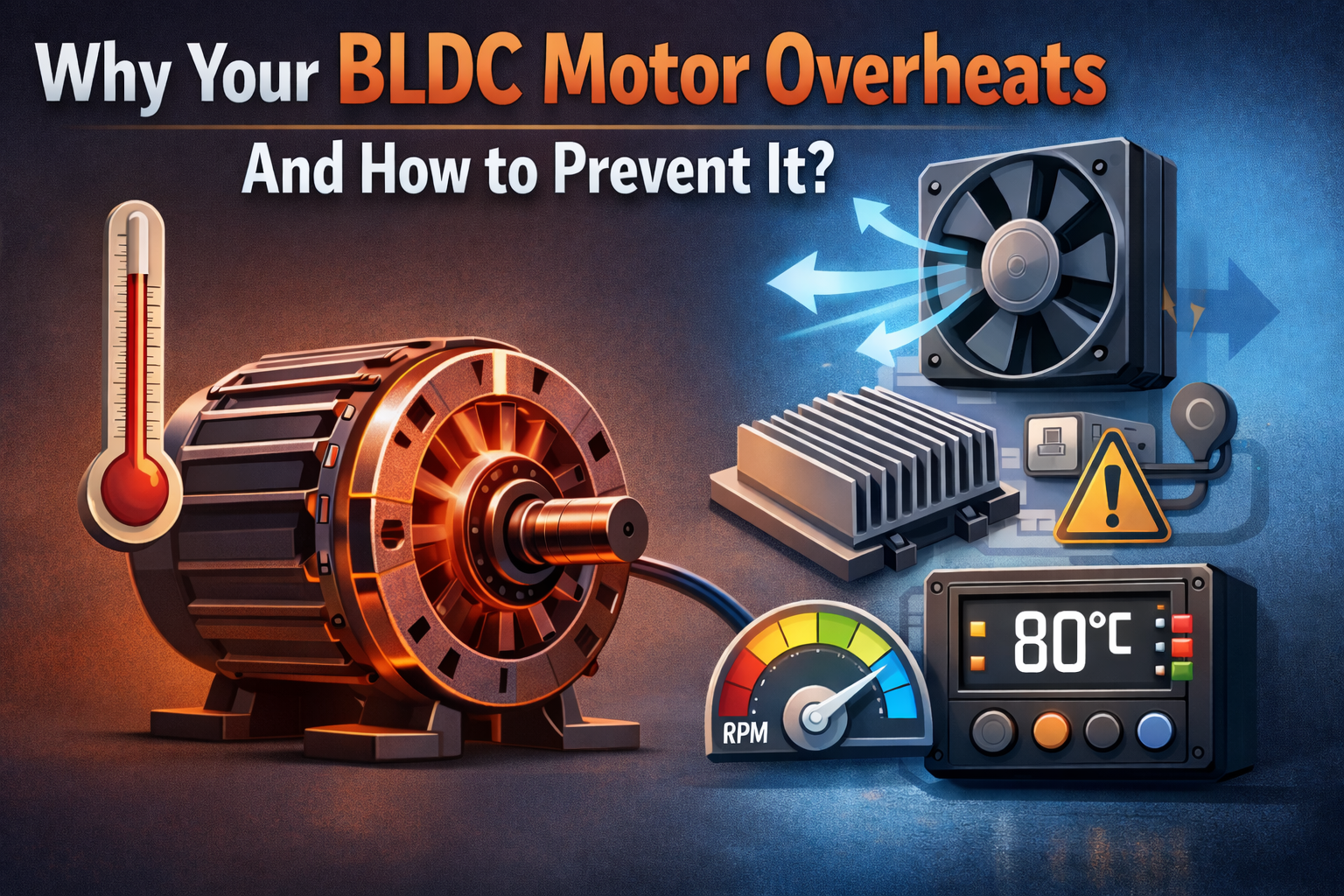
Why Your BLDC Motor Overheats And How to Prevent It?
Brushless DC motors, often called BLDC motors, have become a core component in modern equipment. From electric vehicles and medical devices to industrial automation and HVAC systems, they are valued for high efficiency, compact size, and long service life. Yet despite these advantages, overheating remains one of the most common and costly problems users face. For many buyers, overheating is confusing and frustrating because BLDC motors are often marketed as “low heat” or “high efficiency” solutions. When excessive heat appears, it raises concerns about reliability, safety, and long-term performance.
This article answers those questions in a practical, buyer-focused way. We will explore the real causes of BLDC motor overheating, how those causes appear in real applications, and what proven strategies can prevent heat-related failures.
What Overheating Really Means in a BLDC Motor?
Overheating in a BLDC motor does not simply mean that the housing feels warm to the touch. All electric motors generate heat during normal operation, and a certain temperature rise is expected. The real problem begins when internal temperatures exceed the design limits of critical components such as windings, magnets, bearings, or electronic controllers. When this happens repeatedly or for long periods, the motor’s lifespan is sharply reduced.
Inside a BLDC motor, heat mainly builds up in the stator windings due to electrical losses, and in the rotor due to magnetic and mechanical losses. If heat cannot escape fast enough, temperature rises until insulation degrades, magnets lose strength, or bearings break down. In many cases, the motor still runs, but performance slowly declines. Torque drops, efficiency falls, noise increases, and sudden failure becomes more likely.
From an industry perspective, overheating is not just a technical issue but also a business risk. Unexpected downtime, warranty claims, and safety concerns can quickly outweigh the initial cost savings of choosing a smaller or cheaper motor. That is why understanding overheating is essential not only for engineers, but also for buyers who care about total cost of ownership.
The Most Common Causes of BLDC Motor Overheating
Although overheating may seem complex, most cases can be traced back to a few core causes. These causes often interact with each other, which makes diagnosis harder. Below are the most common reasons BLDC motors overheat in real-world applications.
Incorrect Motor Sizing
One of the leading causes of BLDC motor overheating is improper sizing. Many buyers focus on rated power or rated torque without fully considering real operating conditions. If a motor is consistently required to operate near or beyond its rated torque, current increases, and electrical losses rise rapidly. This extra loss turns directly into heat.
In practical terms, undersized motors are often chosen to reduce cost, save space, or meet aggressive efficiency targets. However, when a motor is pushed too hard, it runs hot even if it technically meets the datasheet specifications. Continuous overload is especially dangerous because it may not trigger immediate failure, but it silently damages insulation and magnets over time.
Correct motor sizing means evaluating not only nominal load, but also peak load, duty cycle, ambient temperature, and safety margin. At United Motion Inc., we often recommend selecting a BLDC motor that operates at 60 to 80 percent of its maximum capability under normal conditions. This approach significantly reduces overheating risk while improving reliability.
Excessive Current and Poor Control Settings
BLDC motors rely on electronic controllers to manage current, speed, and torque. If controller parameters are poorly configured, the motor may draw more current than necessary. High current directly translates into higher copper losses in the windings, which is one of the primary heat sources in a BLDC motor.
Common control-related issues include incorrect current limits, aggressive acceleration profiles, and poorly tuned PID parameters. For example, rapid starts and stops may look efficient on paper, but they can cause repeated current spikes that generate excessive heat. Over time, this thermal stress reduces motor life.
Another overlooked factor is mismatch between the motor and the controller. Not all BLDC controllers are equally suited for every motor. Differences in switching frequency, commutation method, and feedback type can significantly affect thermal behavior. Ensuring compatibility between motor and controller is a simple but powerful way to reduce overheating.
Inadequate Cooling and Ventilation
Even a perfectly sized and controlled BLDC motor can overheat if heat cannot escape. Cooling is often underestimated, especially in compact or enclosed systems. Unlike traditional AC motors, many BLDC motors rely on natural convection or conduction rather than active cooling fans.
When a motor is installed in a sealed enclosure, near other heat sources, or in a high ambient temperature environment, its ability to dissipate heat is reduced. Over time, internal temperatures climb higher than expected, even at moderate loads. This situation is common in applications such as medical devices, battery-powered equipment, and compact automation systems.
Effective cooling does not always require complex solutions. Simple design changes such as improving airflow paths, using thermally conductive mounting surfaces, or adding external heat sinks can make a significant difference. The key is to treat thermal management as part of the system design, not an afterthought.
Poor Power Supply Quality
Power quality plays a surprisingly important role in BLDC motor temperature. Voltage fluctuations, electrical noise, and unstable DC supply can cause uneven current distribution in the windings. This leads to localized heating, which is harder to detect but just as damaging as uniform overheating.
In battery-powered systems, declining battery voltage can force the controller to draw higher current to maintain torque. In industrial systems, poorly regulated power supplies may introduce harmonics that increase losses. Over time, these effects add up and raise the average operating temperature of the motor.
Ensuring a stable, well-regulated power supply is a basic but often overlooked step in preventing overheating. This is especially important in precision applications where thermal stability directly affects performance.
Mechanical Load Issues and Misalignment
Mechanical problems are another frequent cause of BLDC motor overheating. Excessive friction, misalignment, or unexpected load variations force the motor to work harder than intended. This increased effort shows up as higher current and higher temperature.
For example, tight bearings, poor lubrication, or misaligned couplings can significantly increase mechanical losses. In conveyor systems or gear-driven applications, improper gear ratios can cause the motor to operate far from its optimal efficiency point. All of these factors increase heat generation without delivering useful output.
Regular mechanical inspection and proper system integration are essential. Many overheating issues blamed on the motor itself are actually caused by external mechanical problems.
How Overheating Impacts Motor Performance and Lifespan?
Understanding the consequences of overheating helps explain why prevention is so important. Heat affects almost every part of a BLDC motor, often in ways that are not immediately visible.
The first component to suffer is usually the winding insulation. As temperature rises, insulation materials age faster, becoming brittle and losing dielectric strength. This increases the risk of short circuits and sudden failure. Even a small increase in operating temperature can dramatically shorten insulation life.
Permanent magnets are another vulnerable component. Excessive heat can cause partial demagnetization, which reduces torque and efficiency. Once magnets are damaged, performance loss is often permanent. Bearings also suffer under high temperatures, as lubricants break down and wear accelerates.
From a system perspective, overheating reduces efficiency, increases noise, and compromises reliability. In regulated industries, such as medical or transportation, this can lead to compliance issues and safety risks. For buyers, these risks translate into higher maintenance costs and unexpected downtime.
Practical Ways to Prevent BLDC Motor Overheating
Preventing overheating is not about a single solution, but about a balanced approach that combines correct selection, proper control, and smart system design.
Choose the Right Motor from the Start
Motor selection is the foundation of thermal performance. Buyers should look beyond basic power ratings and consider torque-speed curves, efficiency maps, and thermal limits. Selecting a motor with sufficient thermal margin ensures stable operation even under demanding conditions.
At United Motion Inc., we support customers with application-specific motor selection, taking into account real load profiles and environmental conditions. This approach reduces trial-and-error and prevents costly redesigns later.
Optimize Controller Settings
Careful tuning of controller parameters can significantly reduce heat generation. Setting appropriate current limits, smoothing acceleration profiles, and using advanced control algorithms all help keep temperatures under control. In many cases, a small reduction in peak performance yields a large improvement in thermal stability.
Improve Heat Dissipation
Thermal design should be integrated into the overall system layout. Using metal mounting surfaces, thermal interface materials, or external heat sinks can improve conduction. Where possible, ensuring adequate airflow around the motor helps remove heat more effectively.
In harsh or high-temperature environments, additional cooling methods such as forced air or liquid cooling may be justified. The key is to match the cooling strategy to the application’s real needs.
Monitor Temperature and Operating Conditions
Modern BLDC systems often include temperature sensors or thermal protection features. Using these features allows early detection of abnormal conditions. Continuous monitoring not only prevents damage, but also provides valuable data for optimizing system performance.
Maintain Mechanical Components
Regular maintenance of bearings, couplings, and load mechanisms reduces unnecessary mechanical losses. Smooth mechanical operation directly lowers electrical demand and heat generation.
Extra Insights for Buyers and Engineers
One important insight is that overheating is rarely caused by a single mistake. It is usually the result of small mismatches adding up over time. Slight undersizing combined with limited cooling and aggressive control settings can quietly push a motor beyond its comfort zone.
Another key point is that higher efficiency does not automatically mean lower temperature. A highly efficient BLDC motor can still overheat if it is used incorrectly. Efficiency ratings are measured under specific conditions that may not match real applications.
Finally, working with an experienced motor supplier can make a significant difference. At United Motion Inc., we see motor selection and thermal management as a partnership. By understanding the application early, we help customers avoid overheating issues before they appear.
References
IEC 60034-1: Rotating Electrical Machines – Rating and Performance
IEEE Industry Applications Society: Motor Thermal Management Guidelines
Electric Motor Handbook, H. Wayne Beaty
NEMA MG 1 Motors and Generators Standard
Manufacturer application notes on BLDC motor thermal design
Related blog: Common failure cases of BLDC motors in automation equipment — what have you seen?