
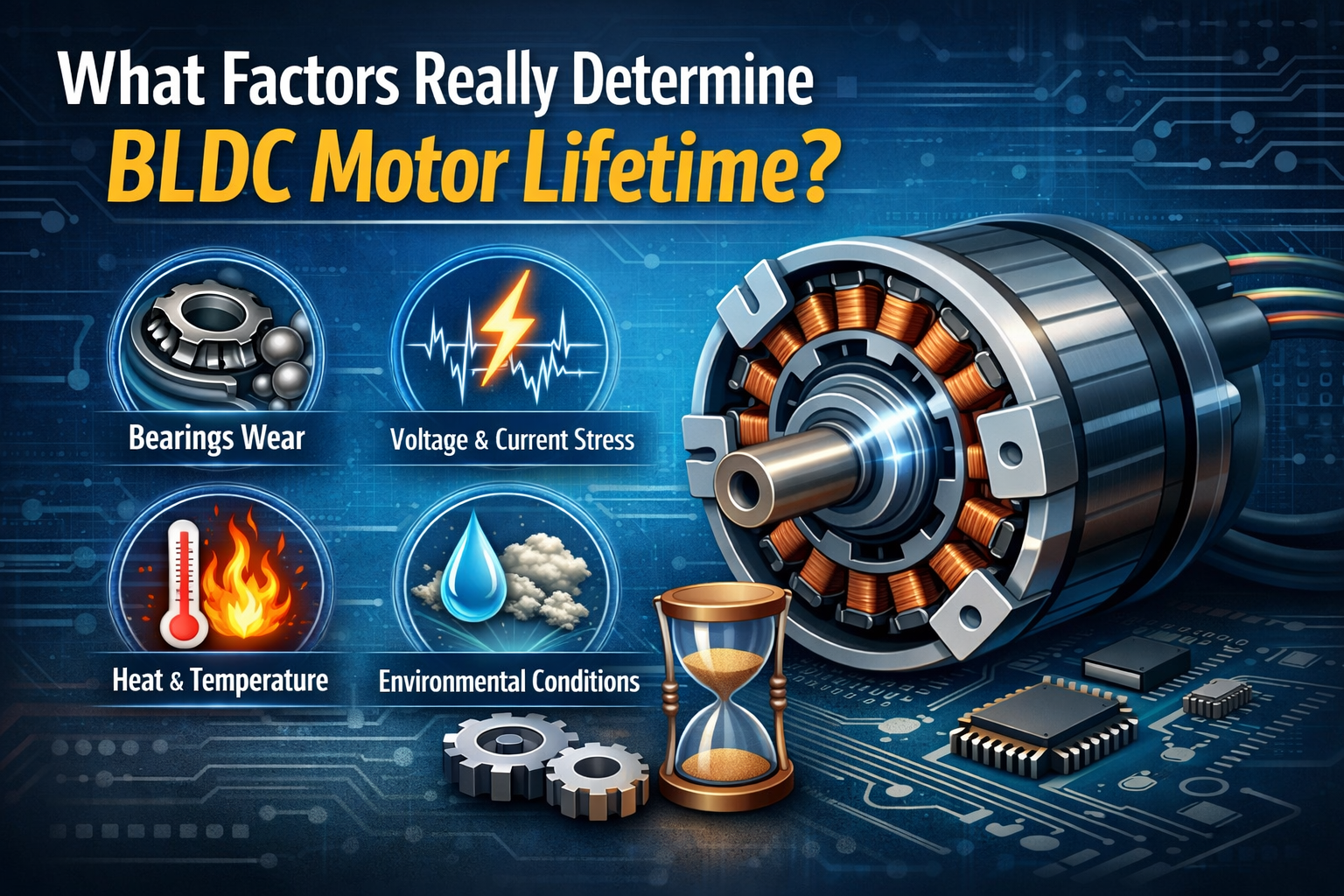
What Factors Really Determine BLDC Motor Lifetime?
In industrial automation, robotics, medical devices, electric vehicles, and smart equipment, the brushless DC motor is often described as “maintenance-free” and “long-lasting.” But in real-world applications, many engineers and buyers quietly ask the same question: Why do some BLDC motors last 10 years while others fail within two?
The truth is simple. BLDC motor lifetime is not defined by theory. It is determined by design choices, operating conditions, component quality, and application matching. If you want reliable performance and long service life, you need to understand what truly affects durability. In this guide, we will break down the real factors that determine BLDC motor lifespan, explain common failure modes, and share practical insights to help buyers make smarter decisions.
Understanding BLDC Motor Lifetime: What Does “Long Life” Really Mean?
When manufacturers say a BLDC motor has a “20,000-hour life,” what does that actually mean? In most cases, this number refers to the bearing life under rated conditions. It does not mean every component will last that long in every environment.
A BLDC motor consists of several critical systems: bearings, stator windings, rotor magnets, electronic controller, insulation materials, and housing. Each component has its own stress limits. The motor’s true lifetime is determined by the weakest link in that chain.
This is why two motors with similar torque ratings can have completely different service lives. Lifetime is not just about power output. It is about thermal balance, mechanical integrity, electrical stability, and environmental protection.
For buyers searching terms like “how long does a BLDC motor last,” “BLDC motor reliability,” or “BLDC motor durability factors,” the key answer is this: lifespan depends more on application matching than on nameplate specifications.
1. Bearing Quality: The Most Common Failure Point
In most BLDC motors, bearings are the first components to fail. Even though brushless motors eliminate carbon brush wear, they still rely on mechanical bearings to support the rotor.
Bearing life depends on several variables: load, speed, lubrication quality, alignment accuracy, and temperature. If the motor operates at high radial loads or experiences vibration from poor mounting, bearing wear accelerates quickly.
Lower-cost motors often use standard-grade bearings with limited grease life. In contrast, premium motors may use high-quality sealed bearings with optimized preload and better lubrication systems. The difference can mean thousands of additional operating hours.
Overheating is another silent bearing killer. Every 10°C increase above rated temperature can significantly reduce grease life. Many premature failures traced back to “motor problems” are actually bearing lubrication breakdown.
At United Motion Inc., we carefully select bearing grades based on real application conditions, not just theoretical speed ratings. For long-life BLDC motor design, bearing quality is not an area to compromise.
2. Thermal Management: Heat Is the Silent Enemy
Heat is the single biggest factor that determines BLDC motor lifetime. Even though brushless motors are more efficient than brushed DC motors, they still generate heat from copper losses, iron losses, and switching losses.
If internal temperature rises beyond insulation class limits, winding insulation begins to degrade. Over time, this leads to short circuits or phase imbalance. Many buyers focus only on torque and speed, but ignore thermal design. The real question should be: can the motor continuously dissipate heat under load?
Poor airflow, enclosed spaces, high ambient temperature, or oversized current draw can push a motor beyond its thermal comfort zone. Once insulation breakdown starts, failure becomes inevitable.
Effective thermal management includes:
- Proper winding design with adequate copper fill
- High-quality insulation materials (Class B, F, or H)
- Efficient housing heat dissipation
- Controlled current settings
- Smart motor controller programming
In applications like electric vehicles or robotics, where motors operate continuously, thermal balance defines long-term reliability.
If you search “BLDC motor overheating causes” or “how to extend BLDC motor life,” you will find that temperature control appears in every expert recommendation.
3. Operating Load and Duty Cycle
A BLDC motor may be rated for a specific torque and speed, but real-world operation often differs from catalog values.
Continuous load near maximum torque reduces lifetime. Repeated start-stop cycles also introduce mechanical stress. High acceleration demands increase current spikes, which create extra heat and stress electronic components. Duty cycle matters. A motor running at 70% load continuously may last longer than one frequently switching between 10% and 100% load. Improper motor sizing is a common industry problem. Buyers sometimes select smaller motors to reduce cost, assuming brushless technology can handle overload. While BLDC motors are robust, consistent overload shortens insulation life and stresses magnets.
Correct motor selection should consider:
- Continuous torque vs. peak torque
- Duty cycle percentage
- Acceleration requirements
- Ambient temperature
- Safety margin
4. Motor Controller Quality and Programming
A BLDC motor cannot operate without an electronic controller. The quality of the motor driver plays a direct role in lifespan. Poor commutation control can create current ripple, vibration, and excess heating. Incorrect PWM frequency may increase switching losses. Unstable voltage input can stress internal components. Many early failures are not caused by the motor itself, but by mismatched controllers.
Advanced controllers offer:
- Soft start features
- Current limiting
- Thermal protection
- Voltage stabilization
- Closed-loop speed control
If you search for “BLDC motor failure reasons” in forums, you will notice many cases linked to improper controller configuration.
A high-quality motor paired with a poorly programmed driver will never reach its designed lifetime.
5. Environmental Conditions: Dust, Moisture, and Vibration
BLDC motor lifetime depends heavily on operating environment. Dust can penetrate bearings and reduce lubrication life. Moisture can cause corrosion in windings and electronic boards. High humidity may lead to insulation degradation. In industrial environments such as agriculture equipment or outdoor robotics, protection level matters. Motors with proper IP ratings (such as IP54, IP65, or higher) perform better in harsh conditions. Vibration from surrounding machinery can also shorten bearing life and loosen mechanical connections.
When selecting a long-life BLDC motor for harsh environments, consider:
- Sealing structure
- Corrosion-resistant coatings
- Reinforced shaft design
- Shock resistance
- Protective housing
Ignoring environmental factors is one of the most common buyer mistakes.
6. Magnet Quality and Demagnetization Risk
Permanent magnets are critical in BLDC motors. High-quality neodymium magnets provide strong magnetic fields, improving efficiency and torque density. However, excessive heat or electrical overload can cause partial demagnetization. Once magnet strength decreases, motor efficiency drops and heat increases further. This creates a damaging cycle. High-grade magnets with proper temperature ratings reduce this risk. Although magnet degradation is less common than bearing failure, it becomes critical in high-temperature applications such as EV traction systems or industrial automation.
7. Manufacturing Precision and Design Integrity
Not all BLDC motors are built with the same manufacturing standards. Rotor balancing accuracy affects vibration. Winding precision influences heat distribution. Air gap uniformity impacts efficiency and noise levels. Even small design flaws can accumulate stress over time. This is why selecting a reputable manufacturer matters. Long motor lifetime begins with quality control, material selection, and engineering validation.
At United Motion Inc., we emphasize production consistency, dynamic balancing, and reliability testing to ensure extended service life.
8. Voltage Stability and Power Supply Quality
Unstable power supply is another hidden factor. Voltage spikes can damage electronic components. Undervoltage can increase current draw, raising temperature. Industrial environments often experience electrical noise. Without proper filtering or protection circuits, long-term reliability decreases. Using stable power systems and surge protection can significantly extend BLDC motor durability.
9. Maintenance and Monitoring
Although BLDC motors are often described as “maintenance-free,” preventive inspection improves lifespan.
Periodic checks may include:
- Monitoring temperature trends
- Listening for abnormal noise
- Checking vibration levels
- Inspecting connectors
Condition monitoring systems can detect early signs of bearing wear or electrical imbalance.
Predictive maintenance strategies are becoming standard in smart factories. Data-driven monitoring prevents unexpected downtime.
10. Real-World Case Insight
In one automation project, two identical BLDC motors were installed in similar conveyor systems. One lasted over eight years. The other failed in less than three. The difference was not brand or torque rating. It was environment and controller configuration. The failed motor operated in a poorly ventilated enclosure and experienced frequent overload spikes. This example highlights a key lesson: motor lifetime is system-dependent.
How to Maximize BLDC Motor Lifetime?
If you want to extend BLDC motor service life, follow these principles:
- Choose proper motor size with safety margin
- Ensure efficient heat dissipation
- Use high-quality bearings
- Pair with compatible motor controller
- Protect against dust and moisture
- Monitor temperature and vibration
- Avoid continuous overload
Long-term reliability is not accidental. It is engineered.
Why Buyers Choose United Motion Inc.?
At United Motion Inc., we understand that industrial buyers do not just purchase motors. They invest in reliability, reduced downtime, and long-term stability.
Our BLDC motor solutions are designed with:
- Precision-balanced rotors
- High-grade neodymium magnets
- Optimized thermal design
- Industrial-grade bearings
- Strict quality testing
We work closely with OEM customers to match motor parameters with real operating conditions. That alignment directly impacts lifetime and ROI.
When buyers search for “reliable BLDC motor supplier,” “long life brushless DC motor manufacturer,” or “industrial BLDC motor solutions,” they are not only looking for specifications. They are looking for trust.
Final Thoughts
BLDC motor lifetime is determined by many interacting factors. There is no single number that guarantees durability. Heat control, bearing quality, controller programming, environment, and correct sizing all play critical roles. Understanding these variables helps buyers avoid costly downtime and premature failure. A well-designed BLDC motor system can deliver years of stable operation. A poorly matched one may struggle early. The difference lies in engineering decisions. If your project demands reliability, efficiency, and long service life, choosing the right motor partner makes all the difference.
References
IEEE Industry Applications Society – Motor Reliability Studies
NEMA Standards Publication MG 1 – Motors and Generators
SKF Bearing Life Calculation Guidelines
IEC 60034 Rotating Electrical Machines Standards
Research on Thermal Aging of Motor Insulation Systems
Related blog: How Do BLDC Motors Perform in High-humidity or Dusty Environments?