
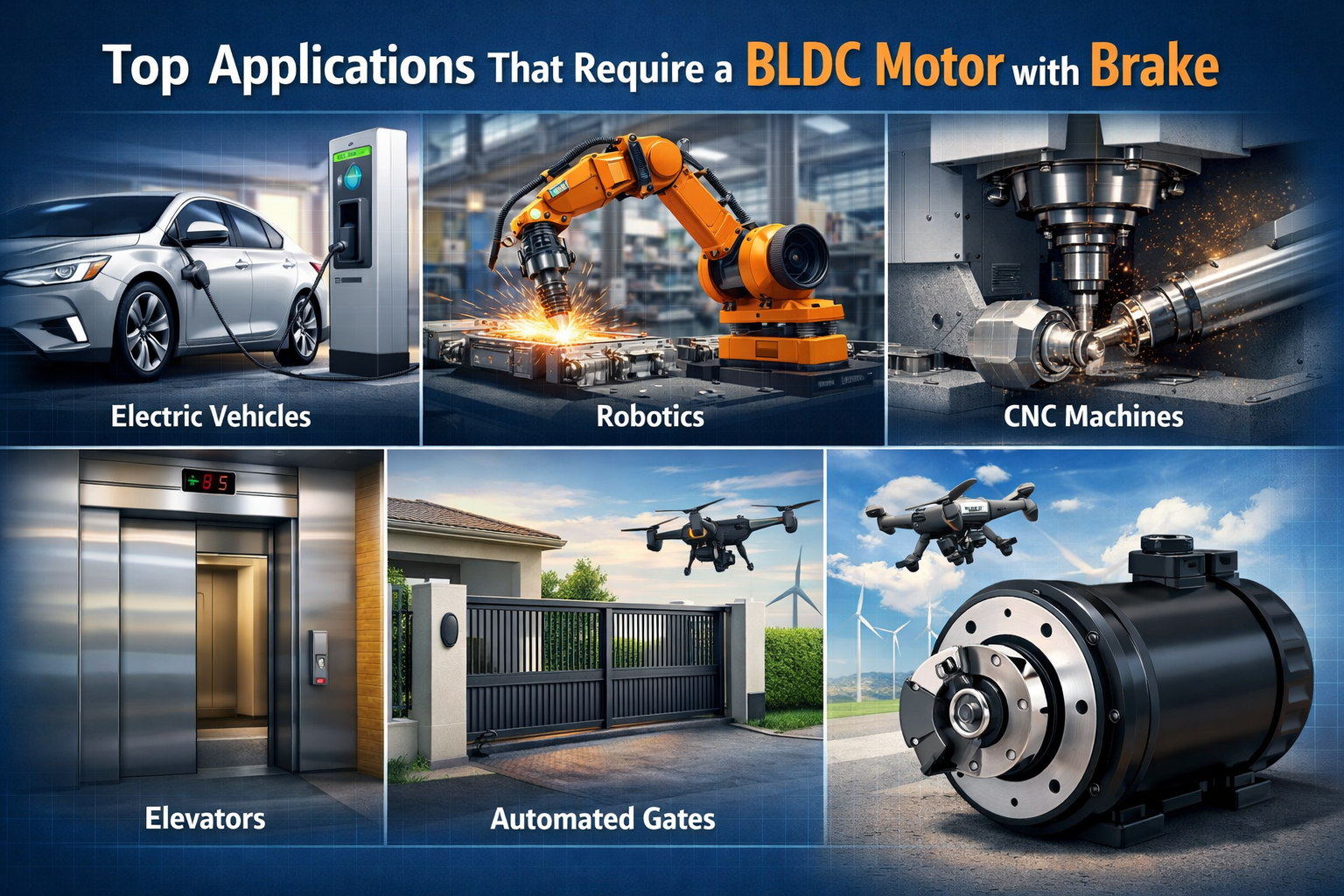
Top Applications That Require a BLDC Motor with Brake
In today’s automation-driven world, motion control is not just about speed and torque. It is about precision, safety, and control after power is cut off. This is why the BLDC motor with brake has become a preferred solution in many industries. Buyers searching for “bldc motor with brake,” “brushless dc motor with holding brake,” or “electric motor with brake for automation” are usually facing one common problem: how to stop and hold a load securely without sacrificing efficiency. This guide explains the top applications that require a BLDC motor with brake, the real-world pain points behind these needs, and how to choose the right configuration for long-term reliability.
What Is a BLDC Motor with Brake?
A BLDC motor with brake combines a brushless DC motor and an electromagnetic brake system in one compact structure. The motor delivers high efficiency, low noise, and long service life. The brake provides holding torque when power is removed. In most designs, the brake is spring-applied and electrically released. When power is on, the brake disengages. When power is cut, the brake engages automatically and locks the shaft.
This feature solves one of the biggest problems in motion control: uncontrolled movement after shutdown. In vertical or load-bearing systems, gravity does not wait for the controller to react. Without a holding brake, a system can drift, drop, or shift position. This creates safety risks, product damage, and costly downtime.
Why Industries Are Moving Toward BLDC Motors with Brake?
Traditional brushed motors wear out faster due to brush friction. AC motors may require more complex control systems. A brushless DC motor with brake offers a balanced solution: high efficiency, compact size, precise speed control, and integrated safety.
From an operational standpoint, companies want:
- Stable holding torque
- Energy-efficient performance
- Low maintenance
- Compact motor + brake integration
- Easy installation in tight spaces
When buyers search for “24V BLDC motor with brake” or “high torque brushless motor with brake,” they usually need a solution for vertical motion, positioning systems, or safety-critical applications. The brake is not optional. It is a requirement.
Top Applications That Require a BLDC Motor with Brake
Now let’s explore where these motors are truly essential and why the brake function makes the difference.
1. Industrial Automation Equipment
Industrial automation is one of the largest markets for BLDC motors with brake. In conveyor systems, pick-and-place machines, packaging lines, and indexing tables, precise positioning is critical. If the motor stops unexpectedly, the load must stay in place.
In vertical conveyor lifts or palletizers, gravity creates constant downward force. A brushless DC motor alone cannot guarantee holding torque once power is removed. The integrated brake prevents back-driving and load drop. This protects both operators and products.
In automated assembly lines, even a few millimeters of drift can cause misalignment. A holding brake ensures repeatable accuracy during emergency stops or power interruptions. Many manufacturers now consider “motor with brake” a standard specification in automation design, not an upgrade option.
2. Robotics and Collaborative Robots (Cobots)
Modern robots require smooth motion and instant stopping capability. In robotic arms, especially multi-axis systems, certain joints carry heavy loads in vertical directions. When power shuts down, those joints must hold position safely.
Companies such as ABB Robotics and KUKA integrate brake systems in robot joints to prevent unexpected arm movement. Without a brake, gravity can cause joint collapse, damaging tools or harming nearby operators.
In collaborative robots, safety standards are even stricter. If a cobot loses power, the brake locks the axis immediately. This reduces risk during human-machine interaction. Buyers searching for “robot joint bldc motor with brake” often need compact, lightweight motors that combine torque density and secure holding capability.
3. Medical Equipment
Medical devices demand silent operation, precision, and fail-safe performance. Applications such as patient lifts, surgical tables, infusion systems, and imaging equipment rely on controlled vertical movement.
For example, in hospital bed lifting systems, the motor must raise and lower patients smoothly. If power fails, the system must hold its position to avoid sudden drops. The brake provides this security.
Manufacturers such as GE HealthCare integrate motion systems that include braking mechanisms to meet strict safety standards. In medical design, safety redundancy is critical. A brushless motor with brake ensures that patient positioning remains stable during emergencies.
Low noise is also important. BLDC motors operate quietly compared to brushed alternatives, which makes them suitable for clinical environments.
4. Electric Wheelchairs and Mobility Devices
Mobility devices require high torque at low speeds and reliable holding on slopes. Electric wheelchairs must stop and remain stationary even on inclined surfaces.
A standard motor without brake may allow slight rolling if the gearbox experiences backlash. An electromagnetic brake locks the shaft and prevents movement when the joystick is released or power is cut.
Manufacturers in this field often search for “24V brushless motor with brake for wheelchair” or “high torque BLDC motor for mobility device.” The brake ensures user safety and compliance with mobility standards. It also improves user confidence when navigating ramps or uneven ground.
5. Automated Guided Vehicles (AGVs) and AMRs
In warehouses and smart factories, AGVs and autonomous mobile robots move goods across large areas. While regenerative braking handles motion deceleration, a mechanical holding brake is still necessary when the vehicle is parked or powered down.
Companies like Amazon Robotics operate large fleets of robotic systems where motion control reliability is essential. A BLDC motor with brake ensures stable stopping during charging cycles, emergency stops, or maintenance shutdowns.
If the system loses power while carrying cargo, the brake prevents unintended rolling. This is especially important in sloped loading zones.
6. Elevation Systems and Linear Actuators
Any vertical lifting system requires a brake. This includes small platform lifts, stage equipment, height-adjustable desks, and industrial linear actuators.
Without a brake, back-driving can occur due to gravity or load imbalance. The brake acts as a mechanical lock that engages automatically during power loss.
For example, in stage lighting rigs, precise positioning must be maintained during performance. Unexpected drop is unacceptable. Many designers now specify “brushless DC motor with holding brake for lift system” to ensure stability.
7. CNC Machines and Precision Equipment
CNC axes sometimes use servo systems with integrated brakes, especially on vertical Z-axes. When the machine powers down, the spindle head must not drift downward.
Manufacturers such as DMG MORI implement braking systems to maintain axis stability. Even small position changes can damage workpieces or tooling.
In precision machining, accuracy and repeatability define product quality. A BLDC motor with brake reduces mechanical shift during idle states.
8. Electric Doors and Access Control Systems
Automatic doors in commercial buildings, elevators, and security gates must hold position securely when closed or open. Wind load, vibration, or mechanical stress can cause drift if no brake is present.
In security environments, a locked door must remain locked even during power failure. A spring-applied brake ensures that the motor shaft cannot rotate freely.
When searching for “electric door motor with brake,” buyers often prioritize compact size, quiet operation, and reliable locking torque.
9. Agricultural and Outdoor Equipment
Modern agricultural systems use electric actuators for positioning, steering, and lifting. These systems operate in rough environments where reliability is critical.
Companies like John Deere integrate electric motion systems into advanced equipment. A motor with brake prevents load shift when machinery is powered down on uneven terrain.
Dust, vibration, and temperature variation demand robust motor and brake design. A sealed BLDC motor with brake provides better durability in outdoor conditions.
Why a Brake Matters: Real Buyer Pain Points?
Understanding the technical function is not enough. Buyers care about outcomes. Here are common pain points:
1. Load Dropping After Power Failure
Unexpected shutdowns happen. Without a brake, vertical loads can fall.
2. Position Drift
Even small shaft movement can damage high-precision systems.
3. Safety Compliance
Many industries require fail-safe holding mechanisms.
4. Reduced Maintenance
Integrated brake systems reduce external locking mechanisms.
5. Compact Design Needs
Space is limited. Combined motor + brake solutions simplify assembly.
At United Motion Inc., we often consult clients who initially chose a standard BLDC motor but later faced safety or positioning problems. Upgrading to a BLDC motor with brake solved these issues.
Key Technical Considerations When Choosing a BLDC Motor with Brake
Selecting the correct motor involves more than voltage and torque.
Holding Torque Rating
The brake holding torque must exceed maximum load torque with safety margin.
Voltage Compatibility
Common options include 12V, 24V, 48V systems.
Brake Type
Spring-applied, power-off brakes are most common for safety.
Environmental Protection
Check IP rating for dust and moisture resistance.
Thermal Management
Continuous operation requires proper heat dissipation.
Control System Integration
Ensure driver compatibility and proper brake release timing.
Emerging Trends in BLDC Motor with Brake Applications
As Industry 4.0 expands, smart systems demand intelligent motion control. Integration of encoders, smart drivers, and IoT monitoring allows predictive maintenance and real-time diagnostics.
Electric mobility and robotics markets continue to grow. The demand for compact, high torque density brushless motors with integrated braking systems is rising each year.
Energy efficiency regulations also push industries toward brushless solutions instead of brushed motors. Lower power consumption reduces operational costs and carbon footprint.
Why Work with United Motion Inc.?
At United Motion Inc., we combine engineering expertise with global manufacturing capability. We design and supply customized BLDC motor with brake solutions for automation, medical, robotics, and mobility industries.
Our team supports clients with:
- Custom voltage and torque design
- Integrated planetary gear options
- Encoder integration
- Thermal optimization
- Long-life brake systems
We understand that buyers search for reliable, energy-efficient, and safety-focused motor solutions. Our goal is to provide systems that meet both performance and compliance standards.
References
ABB Robotics – Industrial robot safety standards
KUKA – Robotic joint braking systems
GE HealthCare – Medical equipment motion control
Amazon Robotics – Autonomous warehouse systems
DMG MORI – CNC vertical axis brake systems
John Deere – Electric agricultural machinery
Related blog: What Motor Do Electric Lawn Mowers Use?