
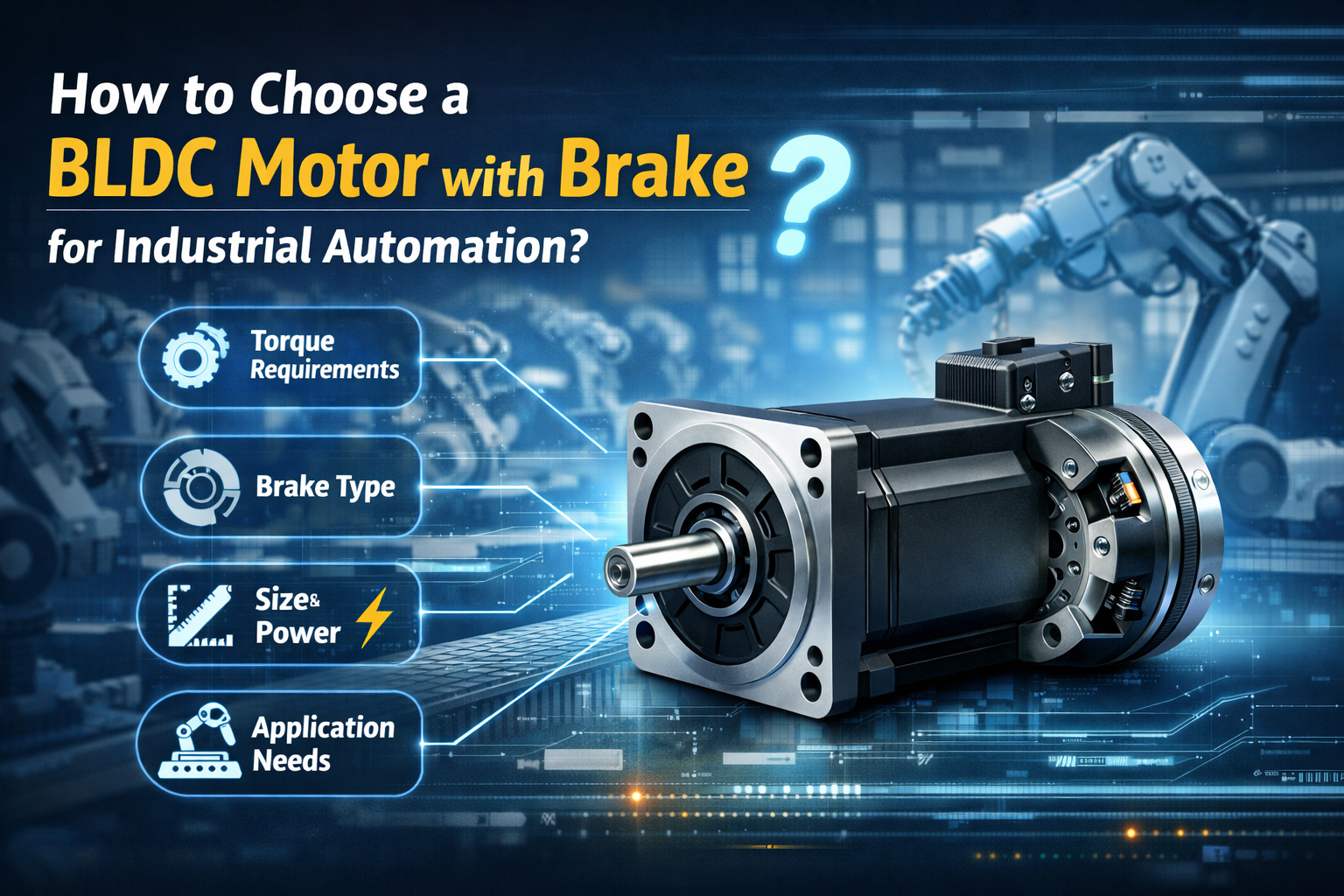
How to Choose a BLDC Motor with Brake for Industrial Automation?
Industrial automation systems demand motion control solutions that are precise, reliable, and energy efficient. One component that plays a critical role in many automation machines is the BLDC motor with brake. From robotics and packaging systems to medical equipment and CNC machines, these motors help control movement while ensuring safety and positioning accuracy.
Selecting the right brushless DC motor with brake can be challenging. Engineers often struggle with choosing the correct torque rating, brake type, voltage requirements, and integration compatibility. A wrong choice may lead to unstable positioning, overheating, or premature equipment failure.
This guide explains how to choose the right BLDC motor with brake for industrial automation, what specifications matter most, and how manufacturers design these motors to meet modern automation demands.
Understanding BLDC Motors with Brake
A BLDC motor with brake combines a brushless DC motor with an integrated braking system. The motor provides efficient and precise rotation, while the brake holds the shaft in position when power is removed.
Unlike brushed motors, BLDC motors use electronic commutation instead of mechanical brushes. This design reduces wear, improves efficiency, and increases motor lifespan.
The braking mechanism is usually an electromagnetic brake, which activates when power is cut off. This allows machines to stop immediately and hold position safely. In industrial environments where precision and safety are essential, this feature becomes extremely important.
Common applications include:
• robotic arms
• automated conveyor systems
• CNC machine tools
• packaging equipment
• medical automation devices
In these applications, the motor must not only drive motion but also stop and hold loads securely.
Why Industrial Automation Systems Need Motor Brakes?
Many automation systems operate vertically or carry heavy loads. Without a brake, gravity or external forces may cause the mechanism to move unexpectedly when the motor stops.
This creates several risks:
Load dropping
In lifting equipment or robotic axes, a lack of braking force may allow the load to fall.
Position drift
Precision machinery such as pick-and-place robots requires exact positioning. Even a small movement can affect product quality.
Safety hazards
Unexpected movement may damage machines or injure operators.
Adding a braking system for electric motors solves these issues. The brake locks the shaft when the system loses power, ensuring the equipment stays in a safe state.
For automation designers, integrating a brushless DC motor with brake simplifies system architecture because the braking solution is already built into the motor.
Key Advantages of BLDC Motors with Brake
Modern industrial machines increasingly adopt BLDC motors with integrated brakes because they offer several advantages over traditional motor systems.
High Efficiency
BLDC motors operate with high electrical efficiency because they eliminate brush friction. This reduces energy consumption and heat generation, making them ideal for continuous industrial operation.
Longer Service Life
Brush wear is one of the main causes of motor failure. Because BLDC motors use electronic commutation, they experience much less mechanical wear. This results in longer operational life and lower maintenance costs.
Precise Motion Control
When paired with controllers or servo drives, BLDC motors provide accurate speed and torque control. The integrated brake adds an extra layer of precision by holding the shaft firmly in position.
Compact Design
Many BLDC motor manufacturers integrate the brake within the motor housing. This reduces installation space and simplifies machine design.
Types of Brakes Used in BLDC Motors
Not all braking systems are the same. Understanding the different brake types helps engineers choose the most suitable solution.
Electromagnetic Spring Brake
This is the most common brake type used in industrial automation motors.
It works through a spring-loaded mechanism that automatically engages when power is removed. When voltage is applied, the electromagnetic field releases the brake and allows the motor to rotate.
Advantages include:
• automatic fail-safe braking
• fast response time
• simple control integration
Because of its reliability, this brake type is widely used in robotics and automated equipment.
Permanent Magnet Brake
Permanent magnet brakes use magnetic attraction instead of springs. These brakes provide smooth holding force and require minimal electrical power.
They are typically used in precision equipment where noise and vibration must be minimized.
Dynamic Braking
Dynamic braking is an electronic method where the motor driver converts kinetic energy into electrical energy. Although it slows the motor quickly, it usually cannot hold a load at rest. Therefore it is often combined with mechanical brakes.
Key Specifications to Consider When Choosing a BLDC Motor with Brake
Selecting the correct motor requires analyzing several performance parameters.
Many automation failures occur because engineers underestimate these requirements.
Torque Requirements
Torque determines how much rotational force the motor can produce. If the torque is insufficient, the system may stall or fail to move the load.
Engineers should calculate:
• load weight
• acceleration requirements
• friction losses
• gearbox ratio
Industrial automation equipment often requires high torque BLDC motors when heavy loads or rapid acceleration are involved.
Safety factors are usually applied to ensure stable operation.
Brake Holding Torque
Brake torque must be strong enough to hold the load when the motor stops.
For example, vertical lifting equipment requires a brake that can support the entire load weight without slipping.
Typically, the brake torque should exceed the motor rated torque to guarantee safe holding performance.
Voltage and Power Requirements
BLDC motors are available in several voltage ranges:
• 12V / 24V systems for compact equipment
• 48V motors for automation machinery
• higher voltage motors for heavy industrial machines
Choosing the correct voltage ensures compatibility with the motor driver and power supply.
Motor Speed
Speed requirements depend on the application.
For example:
• conveyors require moderate speeds with continuous operation
• robotic joints require variable speeds with precise positioning
• medical automation equipment requires smooth and quiet operation
Motor speed is usually controlled through an electronic controller.
Motor Size and Frame
Industrial automation equipment often has limited installation space. Choosing the correct motor frame size ensures the motor fits within the mechanical structure.
Common BLDC motor sizes include:
• 36mm motors
• 42mm motors
• 52mm motors
Larger motors generally provide higher torque.
Environmental Considerations
Industrial environments can be harsh. Motors must withstand conditions such as dust, vibration, and temperature variations.
Important environmental factors include:
Temperature
High temperatures reduce motor efficiency and may shorten component life.
Ingress Protection
Motors used in dusty or humid environments should have adequate IP protection ratings.
Vibration Resistance
Automation equipment may experience continuous vibration. The motor and brake assembly must maintain structural integrity.
Integration with Automation Systems
Modern industrial machines rely on multiple control systems working together.
A BLDC motor with brake must integrate smoothly with controllers, sensors, and communication systems.
Important compatibility factors include:
• motor drivers and controllers
• encoder feedback systems
• programmable logic controllers (PLCs)
Many advanced motors include built-in Hall sensors or encoders to improve control accuracy.
Common Applications of BLDC Motors with Brake
BLDC motors with brakes are used in many industrial sectors.
Robotics
Robotic arms must stop precisely and hold their position while performing tasks such as welding, assembly, or packaging. A brake ensures the robot maintains its position even during power loss.
Automated Guided Vehicles (AGVs)
AGVs transport materials within factories and warehouses. A motor brake helps stop the vehicle safely and prevents unintended movement when parked.
CNC Machines
In CNC equipment, motors control axes that require accurate positioning. A brake helps maintain axis stability during tool changes or emergency stops.
Medical Automation Equipment
Medical devices such as surgical robots and diagnostic machines require smooth and safe motion control. BLDC motors provide low noise and precise movement.
Common Mistakes When Selecting a BLDC Motor with Brake
Many companies encounter problems because they overlook key design factors.
Common mistakes include:
Undersized torque selection
Choosing a motor based only on average load rather than peak load may cause performance issues.
Ignoring brake torque requirements
The brake must hold the load safely in all conditions.
Poor thermal design
Motors operating continuously must dissipate heat effectively.
Lack of system compatibility
Controllers, drivers, and feedback sensors must match the motor specifications.
Future Trends in BLDC Motor Technology
Industrial automation continues to evolve rapidly. As factories adopt smarter systems and robotics, the demand for advanced motors continues to grow.
Future brushless DC motor technology is expected to include:
• integrated smart controllers
• IoT monitoring capability
• improved efficiency designs
• compact high-torque motors
Manufacturers are also developing motors that combine gearboxes, brakes, and drivers in a single integrated unit, making installation easier for automation engineers.
Choosing the Right BLDC Motor Manufacturer
Working with an experienced BLDC motor manufacturer is just as important as choosing the right motor specifications.
Reliable manufacturers provide:
• engineering support
• customization options
• stable product quality
• long-term supply capability
For automation companies, partnering with the right supplier helps reduce development time and ensures system reliability.
Why United Motion Inc. Is a Trusted BLDC Motor Manufacturer?
At United Motion Inc., we specialize in designing and manufacturing high-performance BLDC motors with integrated braking systems for industrial automation.
Our solutions support applications such as robotics, packaging equipment, automated machinery, and smart manufacturing systems.
Key advantages include:
• high efficiency brushless motor design
• reliable electromagnetic braking systems
• customizable motor sizes and torque levels
• strict quality control standards
Our engineering team works closely with customers to provide optimized motor solutions tailored to specific automation requirements.
References
Boldea, I., & Nasar, S. A. – Electric Drives
Krishnan, R. – Permanent Magnet Synchronous and Brushless DC Motor Drives
Texas Instruments – Brushless DC Motor Control Fundamentals
IEEE Industry Applications Society – Motor Drive Systems Research
ABB Motion Control – Industrial Motor Technologies
Siemens Automation – Electric Drive Engineering Guide