
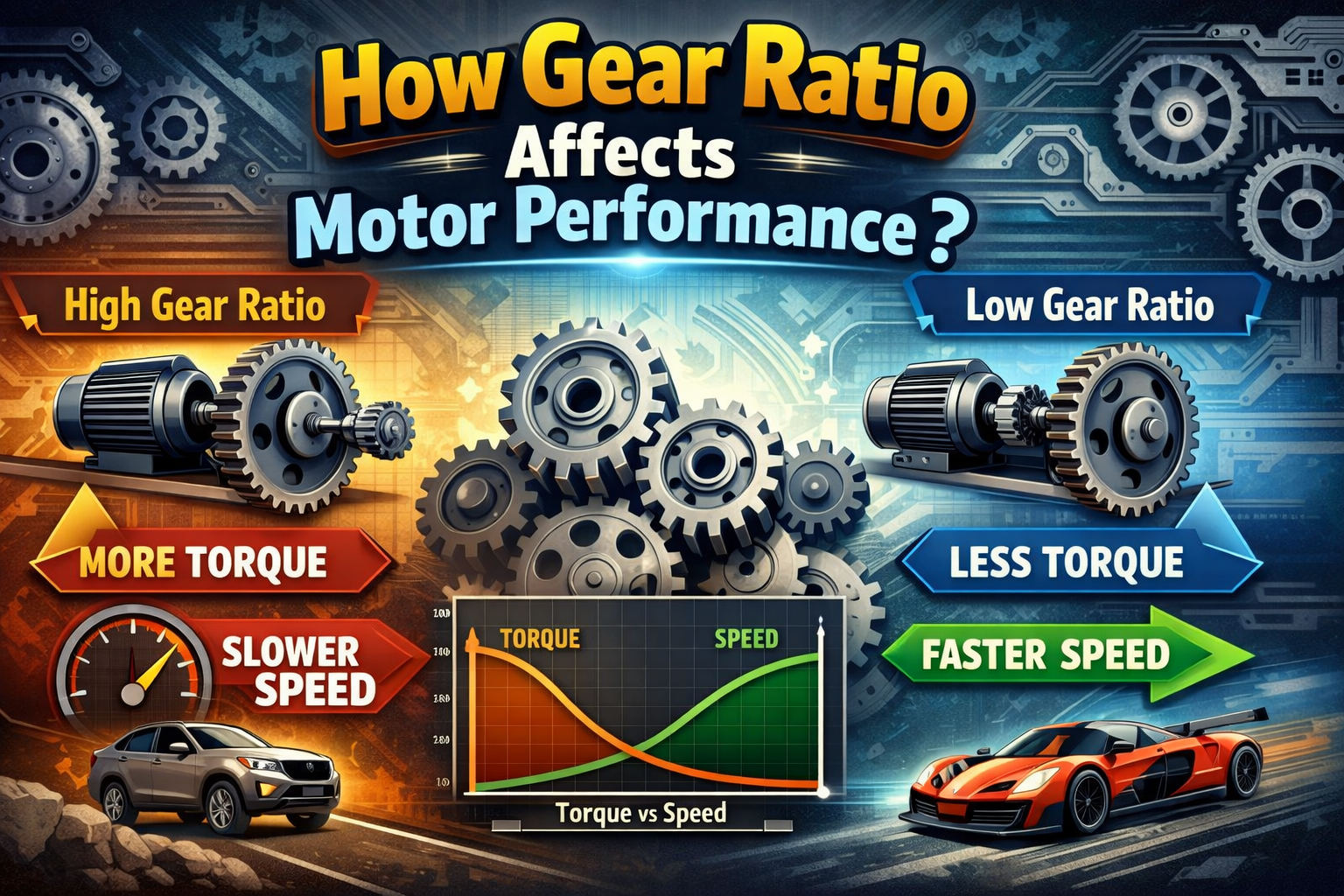
How Gear Ratio Affects Motor Performance?
Gear ratio is one of the most important factors in motor performance, yet many buyers overlook its real impact during selection. Whether you are designing automation equipment, robotics, or electric vehicles, understanding how gear ratio affects speed, torque, efficiency, and lifespan can help you avoid costly mistakes and improve system performance. In this guide, we will break down how gear ratios work, why they matter, and how to choose the right configuration for your application.
What Is Gear Ratio in a Motor System?
Gear ratio refers to the relationship between the number of teeth on two meshing gears. It determines how the motor’s output speed and torque are modified before reaching the load. In simple terms, a gear ratio tells you how many times the motor shaft must rotate to produce one rotation of the output shaft. For example, a 10:1 gear ratio means the motor rotates ten times while the output shaft rotates once. This concept is essential in applications that require precise motion control, such as robotic arms, conveyor systems, and medical equipment. A properly selected gear ratio allows engineers to match motor performance to real-world load requirements without oversizing the motor.
Why Gear Ratio Matters in Motor Performance?
Gear ratio directly affects four critical aspects of motor behavior: torque, speed, efficiency, and load handling. Ignoring these relationships can lead to poor performance, overheating, or premature failure. For industrial buyers, this means higher maintenance costs and lower system reliability. For engineers, it often results in redesign cycles and project delays. Understanding gear ratio is not just a theoretical concept—it is a practical tool for improving performance while reducing cost.
How Gear Ratio Affects Torque?
One of the most important effects of gear ratio is torque multiplication. When you increase the gear ratio, you increase the output torque. For example, if a motor produces 1 Nm of torque and is paired with a 20:1 gear reducer, the output torque becomes approximately 20 Nm (ignoring efficiency losses). This makes gear motors ideal for heavy-load applications like lifting systems, automated guided vehicles (AGVs), and industrial machinery.
However, higher torque comes at a cost. Increasing gear ratio also increases mechanical stress on the gearbox components. If not properly designed, this can reduce the lifespan of the gear system.
This is why many engineers prefer working with experienced suppliers like United Motion Inc., who optimize both motor and gearbox integration to ensure long-term durability.
How Gear Ratio Affects Speed?
Gear ratio and speed have an inverse relationship. As gear ratio increases, output speed decreases. For instance, if a motor runs at 3000 RPM and is connected to a 10:1 gearbox, the output speed will be reduced to 300 RPM. This is particularly useful in applications where precision and control are more important than speed. Examples include CNC machines, robotic joints, and medical devices. However, selecting too high of a gear ratio can make the system unnecessarily slow, reducing productivity. This is a common mistake in industrial design, especially when torque requirements are overestimated.
The Balance Between Torque and Speed
One of the biggest challenges in motor selection is finding the right balance between torque and speed. Gear ratio acts as the bridge between these two parameters. A low gear ratio provides higher speed but lower torque, making it suitable for fans, pumps, and lightweight conveyors. A high gear ratio provides high torque but lower speed, which is better for lifting, positioning, and heavy-duty automation. The key is to match the gear ratio to the actual load requirements rather than relying on assumptions. This requires accurate calculations and a deep understanding of application conditions.
Impact on Motor Efficiency
Gear ratio also affects system efficiency. Every gear stage introduces friction and energy loss, typically ranging from 5% to 15% per stage depending on the gearbox design.
Higher gear ratios often require multiple gear stages, which can reduce overall efficiency. This leads to increased energy consumption and heat generation.
For industries focused on energy efficiency, such as electric vehicles or renewable energy systems, optimizing gear ratio is critical.
Modern solutions like planetary gear motors offer higher efficiency compared to traditional spur gear systems, making them a preferred choice in high-performance applications.
How Gear Ratio Affects Motor Lifespan?
An incorrect gear ratio can significantly reduce motor lifespan. If the ratio is too low, the motor may operate under excessive load, leading to overheating and premature wear.
On the other hand, an excessively high gear ratio can introduce unnecessary mechanical stress on the gearbox, causing gear wear and failure over time.
Proper gear ratio selection ensures that both the motor and gearbox operate within their optimal performance range, reducing maintenance and extending service life.
This is especially important in industries where downtime is costly, such as manufacturing and logistics.
Common Mistakes Buyers Make When Choosing Gear Ratios
Many buyers focus only on torque requirements without considering other factors. This often leads to oversized gear ratios, reduced efficiency, and higher costs.
Another common mistake is ignoring duty cycle and load variations. Real-world applications rarely operate under constant conditions, so the gear ratio must accommodate dynamic loads.
Some buyers also overlook the importance of gearbox quality. Even with the correct gear ratio, a poorly designed gearbox can lead to noise, vibration, and early failure.
Working with a reliable gear motor manufacturer helps avoid these issues by providing application-specific recommendations.
How to Select the Right Gear Ratio?
Choosing the correct gear ratio requires a systematic approach. First, determine the required output torque and speed based on your application.
Next, calculate the ideal gear ratio by dividing motor speed by desired output speed. Then, verify that the selected ratio provides sufficient torque while maintaining efficiency.
It is also important to consider environmental factors such as temperature, humidity, and operating conditions.
In many cases, consulting with an experienced supplier like United Motion Inc. can simplify the process and ensure optimal results.
Gear Ratio in Different Applications
Gear ratio requirements vary significantly across industries. In robotics, precise positioning requires moderate gear ratios with high accuracy. In conveyor systems, lower ratios are preferred for continuous operation.
In electric vehicles, gear ratio plays a critical role in acceleration and energy efficiency. A well-designed ratio can improve both performance and battery life.
In medical devices, quiet operation and precision are key, making planetary gear systems with optimized ratios the preferred choice.
Planetary Gear Motors vs Spur Gear Motors
Planetary gear motors are widely used due to their compact design and high efficiency. They distribute load across multiple gears, resulting in higher torque capacity and longer lifespan.
Spur gear motors, while simpler and more cost-effective, may not offer the same level of performance and durability in demanding applications.
Choosing between these options depends on application requirements, budget, and performance expectations.
Advanced Considerations for Engineers
For advanced applications, factors such as backlash, noise, and thermal performance must also be considered. Gear ratio influences all these parameters.
Lower backlash is essential for precision systems, while noise reduction is critical in medical and consumer applications.
Thermal management becomes important in high-load conditions, where inefficient gear ratios can lead to excessive heat buildup.
Future Trends in Gear Motor Technology
As industries move toward automation and electrification, the demand for optimized gear ratios continues to grow. Smart motor systems with integrated controllers are becoming more common, allowing dynamic adjustment of performance parameters.
Lightweight materials and advanced manufacturing techniques are also improving gearbox efficiency and durability.
Companies like United Motion Inc. are at the forefront of these innovations, providing high-performance solutions for modern industrial applications.
Conclusion
Gear ratio is more than just a number—it is a critical factor that defines motor performance. From torque and speed to efficiency and lifespan, every aspect of a motor system is influenced by gear ratio.
By understanding these relationships and avoiding common mistakes, buyers and engineers can make better decisions and achieve optimal performance.
Choosing the right gear motor solution is not just about specifications; it is about matching the system to real-world needs.
References
1. IEEE Industry Applications Society – Electric Motor Performance Standards
2. Machinery’s Handbook – Gear Design and Applications
3. U.S. Department of Energy – Motor Systems Efficiency Guide
4. AGMA (American Gear Manufacturers Association) – Gear Classification and Design Manual
5. ISO 6336 – Calculation of Load Capacity of Spur and Helical Gears
Related blog: Top Mistakes to Avoid When Selecting a BLDC Motor