
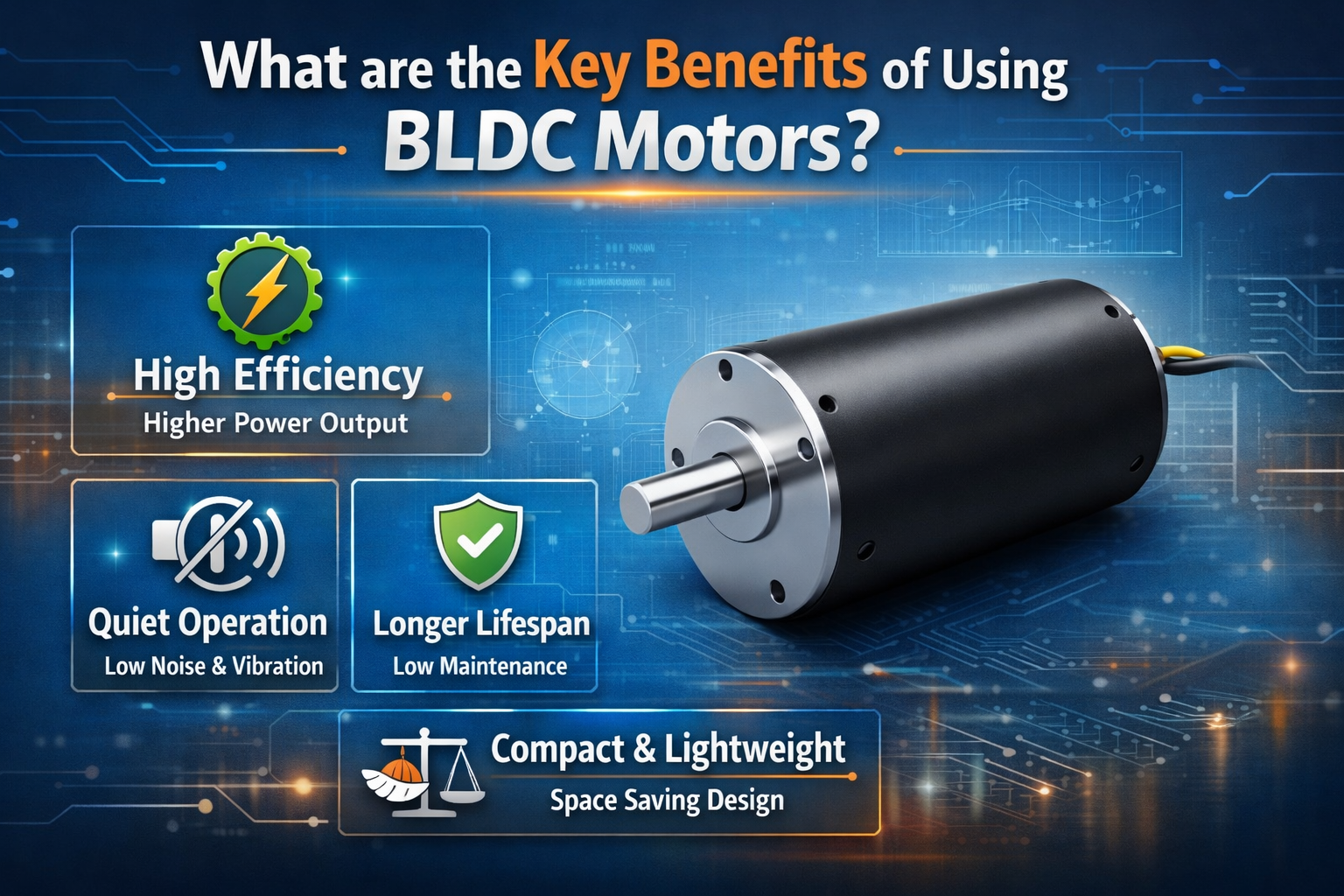
What Are the Key Benefits of Using BLDC Motors?
Brushless DC motors, commonly known as BLDC motors, are quickly becoming the preferred choice across industries that demand efficiency, durability, and precise control. From industrial automation to robotics and electric vehicles, their adoption is not just a trend—it is a shift driven by real operational advantages.
If you are a buyer, engineer, or product developer, understanding the true benefits of BLDC motors can directly impact your product performance, maintenance cost, and long-term ROI.
Understanding BLDC Motors: A Practical Overview
A BLDC motor is an electric motor that operates without brushes, using electronic commutation instead of mechanical contact. This design eliminates friction-related losses and significantly improves performance consistency.
Unlike traditional brushed motors, BLDC motors rely on controllers to manage current flow, allowing better speed control, torque stability, and energy efficiency. This makes them especially suitable for applications where precision and reliability are critical.
For buyers, this translates into fewer breakdowns, longer service life, and reduced maintenance intervention—three major factors when evaluating motor solutions at scale.
Key Benefits of Using BLDC Motors
1. High Efficiency and Energy Savings
One of the most important benefits of BLDC motors is their superior efficiency. Because there are no brushes creating friction, less energy is lost as heat. This allows BLDC motors to achieve efficiency levels of 85% to 95%, significantly higher than traditional brushed motors.
For industrial buyers, energy efficiency is not just a technical metric—it directly impacts operational costs. In high-duty applications such as conveyor systems, HVAC units, or robotic systems, even a small increase in efficiency can result in substantial long-term savings.
This is why keywords like high efficiency electric motor and energy-saving motor solution are increasingly relevant in procurement searches.
2. Longer Lifespan and Reliability
BLDC motors are designed for durability. Since there are no brushes to wear out, the motor experiences less mechanical degradation over time.
In industries where downtime is expensive—such as manufacturing, logistics, or medical equipment—this reliability becomes a major selling point. Buyers are no longer just purchasing motors; they are investing in system uptime.
From a sourcing perspective, this aligns with search intent around long life motor and low maintenance motor solution.
3. Low Maintenance Requirements
Traditional brushed motors require periodic maintenance due to brush wear and sparking issues. BLDC motors eliminate this problem entirely.
This results in:
- Reduced maintenance costs
- Fewer service interruptions
- Lower total cost of ownership (TCO)
For procurement teams, especially in OEM manufacturing, this is a critical factor. Lower maintenance means fewer warranty claims and better product reputation in the market.
4. High Power Density
BLDC motors offer a higher power-to-size ratio compared to conventional motors. This means you can achieve more output power in a smaller and lighter design.
This benefit is particularly valuable in applications such as:
- Robotics
- Drones
- Electric vehicles
- Medical devices
For product designers, this allows more compact designs without sacrificing performance. It also aligns with buyer searches like compact high torque motor and high power density motor.
5. Precise Speed and Torque Control
BLDC motors provide excellent controllability thanks to electronic commutation. When paired with advanced controllers, they enable precise speed regulation and torque management.
This is essential in applications such as:
- CNC machines
- Automated production lines
- Smart home devices
- AGV (Automated Guided Vehicles)
From a buyer’s perspective, precision translates into better product quality and improved process consistency.
6. Low Noise and Smooth Operation
Noise reduction is becoming increasingly important, especially in consumer-facing and indoor applications. BLDC motors operate quietly due to the absence of brush friction and reduced vibration.
This makes them ideal for:
- Home appliances
- Medical equipment
- Office automation systems
In fact, many buyers actively search for low noise electric motor solutions when designing modern products.
7. Better Thermal Performance
BLDC motors dissipate heat more effectively because the windings are located on the stator rather than the rotor. This allows better heat management and reduces the risk of overheating.
For industrial applications, this means:
- Stable performance under continuous load
- Lower risk of failure
- Improved safety
Thermal efficiency is often an overlooked factor, but it plays a major role in long-term reliability.
8. Wide Speed Range
BLDC motors can operate efficiently across a wide speed range. Whether the application requires low-speed torque or high-speed rotation, BLDC motors can adapt easily.
This flexibility reduces the need for multiple motor types in different applications, simplifying procurement and inventory management.
9. Environmentally Friendly
Energy efficiency and reduced maintenance also contribute to environmental sustainability. BLDC motors consume less power and generate less waste over their lifecycle.
For companies focusing on ESG goals or green manufacturing, this is an important advantage. It also aligns with increasing search trends like eco-friendly motor solutions.
Common Industry Pain Points Solved by BLDC Motors
High Maintenance Costs
Many industries still rely on brushed motors that require frequent servicing. BLDC motors eliminate this issue, offering a more cost-effective solution over time.
Energy Consumption Concerns
With rising energy costs, companies are actively seeking energy-efficient motor solutions. BLDC motors provide a direct answer to this challenge.
Product Reliability Issues
Frequent motor failures can damage brand reputation. BLDC motors offer consistent performance and longer lifespan, reducing product failure rates.
Noise and Heat Problems
Traditional motors often generate excessive noise and heat. BLDC motors solve both issues, making them suitable for modern applications.
Applications of BLDC Motors Across Industries
BLDC motors are widely used in:
- Industrial automation systems
- Electric vehicles (EVs)
- HVAC systems
- Robotics and AI-driven equipment
- Medical devices
- Consumer electronics
Their versatility is one of the main reasons they are becoming the standard choice for modern engineering solutions.
Why Buyers Are Switching to BLDC Motors?
From a buyer’s perspective, the shift toward BLDC motors is driven by a combination of performance, cost savings, and long-term reliability.
Key decision factors include:
- Lower total cost of ownership
- Improved product performance
- Reduced warranty and service costs
- Compliance with energy efficiency standards
This is why search queries such as BLDC motor manufacturer, custom BLDC motor supplier, and high efficiency motor solution are growing rapidly.
How United Motion Inc. Supports Your BLDC Motor Needs?
At United Motion Inc., we understand the real challenges faced by OEM buyers and engineers. Our BLDC motor solutions are designed to deliver:
- High efficiency and durability
- Customization for specific applications
- Stable supply chain support
- Competitive pricing for bulk orders
Whether you are developing a new product or upgrading an existing system, our team can help you find the right BLDC motor solution tailored to your needs.
Future Trends in BLDC Motor Technology
The future of BLDC motors is closely tied to advancements in:
- Smart motor controllers
- IoT integration
- AI-driven predictive maintenance
- Energy optimization technologies
As industries move toward automation and electrification, BLDC motors will continue to play a central role.
Conclusion
BLDC motors offer a powerful combination of efficiency, reliability, and performance that addresses many of the common challenges faced by modern industries. From reducing energy costs to improving product lifespan, their benefits are both practical and measurable.
For buyers and engineers, choosing BLDC motors is not just a technical upgrade—it is a strategic decision that impacts long-term success.
References
IEC Standards on Electric Motor Efficiency
U.S. Department of Energy – Motor Systems Efficiency Guide
IEEE Papers on Brushless DC Motor Performance
Industry Reports on Electric Motor Market Trends (2024–2025)
Engineering Handbook: Electric Motor Design and Applications
Related blog: How to Reduce Noise and Vibration in BLDC Motors?