
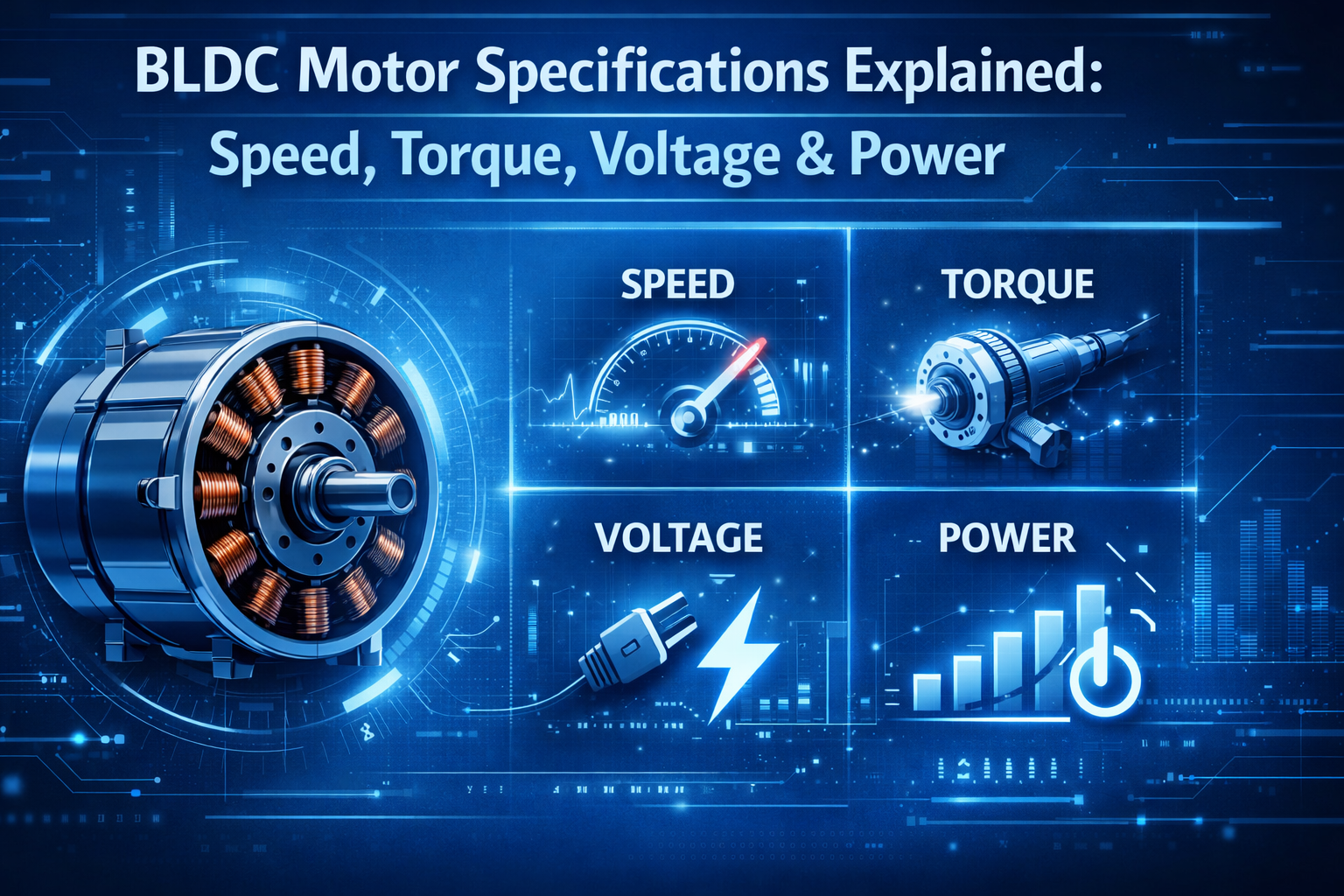
BLDC Motor Specifications Explained: Speed, Torque, Voltage & Power
Brushless DC (BLDC) motors are now at the center of modern motion systems. They are used in factory automation, robotics, medical equipment, electric vehicles, HVAC systems, and many other applications where efficiency, control, and reliability matter. Yet for many buyers and engineers, BLDC motor specifications still feel confusing. Speed, torque, voltage, and power often look simple on a datasheet, but choosing the wrong combination can lead to overheating, noise, short lifespan, or system failure.
This guide from United Motion Inc. explains BLDC motor specifications in clear, practical terms. Instead of focusing only on theory, we connect each parameter to real-world applications and buying decisions. By the end, you will understand how to read BLDC motor specs correctly, how they interact with each other, and how to select the right motor for your project with confidence.
What Is a BLDC Motor and Why Specifications Matter?
A BLDC motor is an electric motor that uses electronic commutation instead of mechanical brushes. This design reduces friction, improves efficiency, and extends service life. Unlike brushed motors, BLDC motors rely on a controller or driver to manage current switching based on rotor position feedback from Hall sensors or encoders.
Specifications are critical because a BLDC motor never works alone. It operates as part of a system that includes a power supply, driver, load, gearbox, and control logic. When one parameter is misunderstood or ignored, the entire system performance can suffer. This is why experienced motor manufacturers focus not just on raw numbers, but on how specifications behave under real operating conditions.
Understanding BLDC Motor Speed (RPM)
Speed is one of the first parameters buyers look at, usually expressed in revolutions per minute (RPM). It defines how fast the motor shaft rotates under a given condition. However, rated speed on a datasheet is often misunderstood.
In BLDC motors, speed is closely tied to voltage. At no load, the motor will spin close to its maximum rated speed. As load increases, speed drops. This is normal behavior and should be expected in system design. Many buyers make the mistake of selecting a motor based only on maximum speed, without considering how speed changes under load.
For applications like fans, pumps, and centrifugal systems, speed is the dominant factor because torque demand increases with speed. For robotics, conveyors, and medical devices, speed must be stable and controllable across a wide operating range. This is why BLDC motors paired with proper drivers offer better speed regulation than simple DC motors.
Rated Speed vs No-Load Speed
A key distinction in BLDC motor specifications is the difference between no-load speed and rated speed. No-load speed is measured when the motor runs without any mechanical load. Rated speed, on the other hand, is the speed at which the motor can operate continuously while delivering rated torque without overheating.
Buyers who design systems around no-load speed often face performance issues. In real applications, motors almost always operate under load. For example, an automated linear actuator may require consistent speed while pushing a load. In such cases, rated speed is the value that truly matters.
Speed Control and Feedback Systems
BLDC motors are valued for their precise speed control. This is achieved through feedback devices such as Hall sensors or encoders. Hall sensors provide basic rotor position information, suitable for many industrial and consumer applications. Encoders offer higher resolution and are used when accurate speed and position control is required.
From a system perspective, speed control is not just about the motor. The driver, control algorithm, and power supply all influence speed stability. This is why reputable manufacturers like United Motion Inc. often recommend complete motor-driver solutions rather than standalone motors.
BLDC Motor Torque Explained
Torque defines how much rotational force a motor can produce. It is usually expressed in newton-meters (Nm) or ounce-inches (oz-in). In practical terms, torque determines whether a motor can start a load, accelerate it, and maintain motion without stalling.
BLDC motors typically provide higher torque density compared to brushed motors. This means more torque in a smaller size. However, torque values on datasheets must be interpreted carefully. Peak torque and continuous torque are not the same, and confusing them can lead to system failure.
Continuous Torque vs Peak Torque
Continuous torque is the amount of torque a motor can deliver continuously without exceeding its thermal limits. Peak torque is the maximum torque the motor can deliver for a short period, usually during startup or acceleration. Many applications require high peak torque but relatively low continuous torque. For example, an automated door system needs high torque to start moving but much less torque once in motion. In contrast, a conveyor system may require steady continuous torque for long periods. Choosing a motor based only on peak torque is risky. Long-term reliability depends on staying within continuous torque limits. This is a common pain point for buyers who experience premature motor overheating.
Torque-Speed Relationship in BLDC Motors
Torque and speed are inversely related. As speed increases, available torque decreases. This relationship is defined by the motor’s torque-speed curve. Understanding this curve is essential for correct motor selection.
For high-speed applications, torque demand must be carefully evaluated. Gearboxes are often used to trade speed for torque, allowing a smaller motor to handle heavier loads. United Motion Inc. frequently customizes BLDC motors with gearboxes to match application-specific torque requirements.
Voltage Rating and Its Real Impact
Voltage is one of the most misunderstood BLDC motor specifications. Common voltage ratings include 12V, 24V, 36V, and 48V. Voltage affects speed, torque, efficiency, and current draw. A higher voltage motor generally operates at lower current for the same power output. This reduces heat generation and improves efficiency. This is why many industrial systems prefer 24V or 48V BLDC motors over 12V designs. However, voltage selection must match the available power supply and driver. Using the wrong voltage can damage the motor or reduce performance.
Nominal Voltage vs Operating Voltage Range
Nominal voltage is the standard voltage at which the motor is designed to operate. Operating voltage range defines how much variation the motor can tolerate. Real-world power supplies are rarely perfect, and voltage fluctuations are common. Designers should always consider voltage tolerance, especially in battery-powered systems like electric vehicles or portable medical devices. A motor that performs well at nominal voltage may behave very differently at low battery levels.
Power Rating: What It Really Means
Power is typically expressed in watts (W) or kilowatts (kW). It represents the mechanical output power of the motor, calculated as torque multiplied by speed. While power is a useful overall indicator, it should never be the only selection criterion. Two motors with the same power rating can behave very differently. One may deliver high torque at low speed, while the other delivers low torque at high speed. Understanding how power relates to your application is essential.
Input Power vs Output Power
BLDC motor datasheets often list output power, not input power. Input power includes electrical losses, while output power reflects usable mechanical energy. Efficiency bridges the gap between the two. High-efficiency BLDC motors convert more electrical energy into mechanical motion, reducing heat and energy costs. This is especially important in continuous-duty industrial applications.
Efficiency and Thermal Considerations
Efficiency is a major reason why BLDC motors are replacing traditional motors. Higher efficiency means less wasted energy and lower operating temperatures. However, efficiency is not constant across all operating points. Motors are most efficient near their rated load. Operating far below or above this point reduces efficiency and increases heat. Thermal management, including proper ventilation and heat sinking, is critical for long motor life.
Current, Power, and Heat Generation
Current draw is directly linked to torque. Higher torque requires higher current, which increases heat. This is why torque overloads are a common cause of motor failure. Understanding current limits helps buyers select the right driver and power supply. Undersized drivers can lead to unstable operation, while oversized drivers increase system cost unnecessarily.
Matching BLDC Motor Specifications to Applications
Every application has unique requirements. Robotics demand precise control and high peak torque. Medical devices prioritize low noise and reliability. Automation systems require long service life and stable performance. The key is to start with the load requirements, then work backward to motor specifications. United Motion Inc. often assists customers with application analysis to ensure proper motor selection.
Common Buyer Mistakes When Reading BLDC Motor Specs
Many buyers focus on one parameter and ignore the rest. Others rely solely on catalog values without considering real-world conditions. Another common mistake is ignoring environmental factors such as temperature, humidity, and duty cycle. Avoiding these mistakes requires a system-level approach. Motors, drivers, and mechanical components must be evaluated together.
Custom BLDC Motors vs Standard Models
Standard BLDC motors work well for many applications, but custom solutions often provide better performance and cost efficiency in high-volume or specialized projects. Customization may include winding changes, shaft modifications, integrated drivers, encoders, or gearboxes. United Motion Inc. specializes in both standard and custom BLDC motor solutions to meet diverse industry needs.
Why Datasheets Alone Are Not Enough?
Datasheets provide essential information, but they cannot capture every operating condition. Real-world testing and manufacturer support are critical, especially for high-risk applications. Working with an experienced motor manufacturer reduces risk and shortens development cycles.
Future Trends in BLDC Motor Technology
BLDC motors continue to evolve. Higher power density, improved materials, and smarter drivers are shaping the future. Integration with IoT and predictive maintenance systems is becoming more common. As energy efficiency regulations tighten, BLDC motors will play an even larger role across industries.
References
IEEE Standards Association – Electric Motor Efficiency and Performance
NEMA Motor Standards and Definitions
Texas Instruments – BLDC Motor Control Fundamentals
MIT OpenCourseWare – Electric Machinery and Drives
IEC 60034 – Rotating Electrical Machines