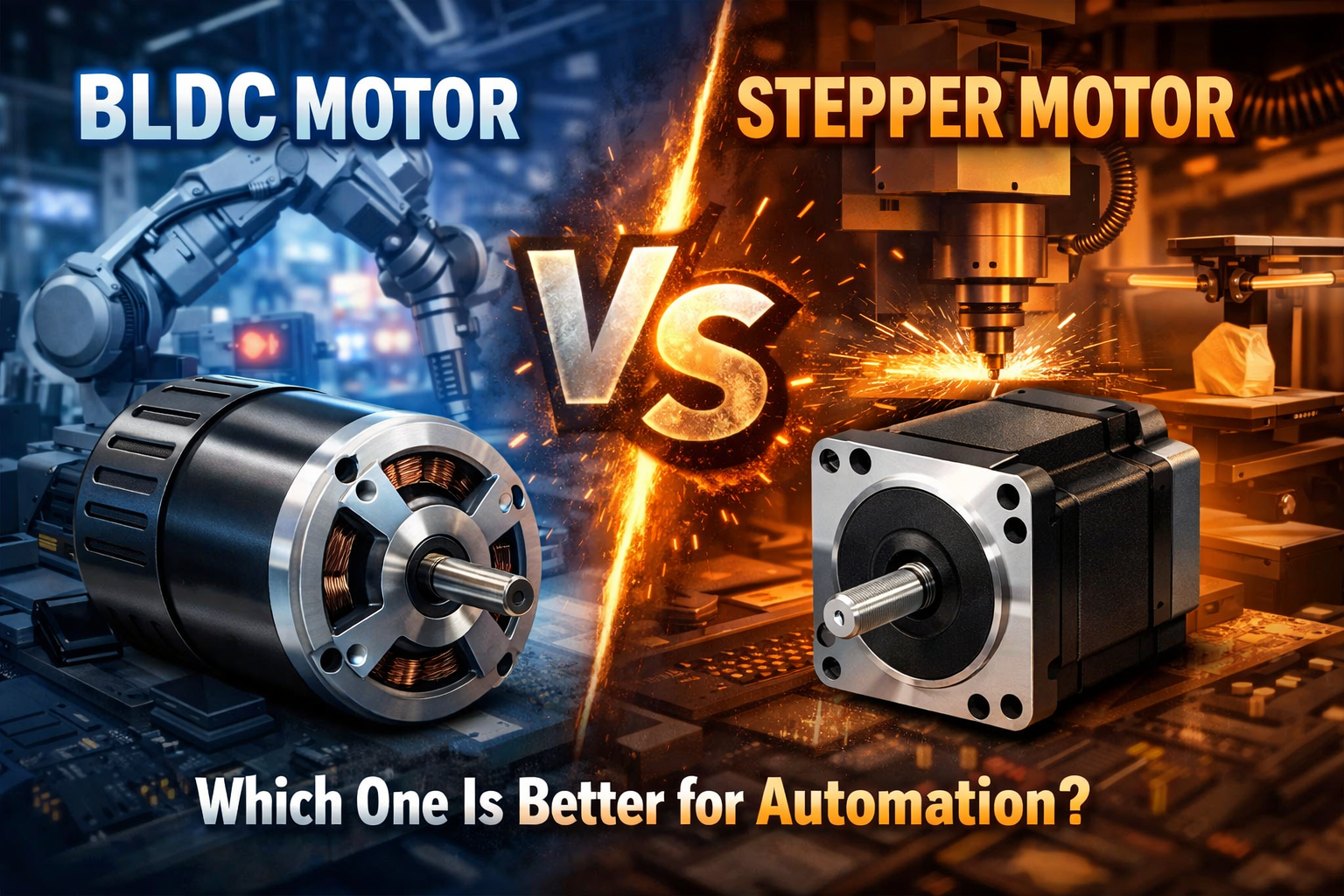
BLDC Motor vs Stepper Motor: Which One Is Better for Automation?
Choosing the right motor is one of the most critical decisions in automation design. Many engineers and buyers often face the same question: BLDC motor vs stepper motor—which one is better?
The answer is not simple, because each motor type solves different problems. Selecting the wrong one can lead to poor performance, higher costs, and system failure. In this guide, we will break down the real differences, practical use cases, and decision factors to help you choose the best motor for your automation system.
Understanding the Basics of BLDC Motors and Stepper Motors
Before comparing performance, it is important to understand how these motors work in real applications.
What Is a BLDC Motor?
A BLDC motor is an electronically controlled motor that replaces mechanical brushes with a controller. It uses sensors or sensorless algorithms to control rotation.
BLDC motors are widely used in:
- Industrial automation systems
- Robotic platforms
- Electric vehicles
- HVAC systems
- High-speed machinery
The key advantage of BLDC motors is efficiency. Because there is no physical contact inside, wear is minimal, and performance remains stable over time.
What Is a Stepper Motor?
A stepper motor moves in fixed steps instead of continuous rotation. Each electrical pulse results in a precise movement.
Stepper motors are commonly used in:
- CNC machines
- 3D printers
- Medical devices
- Positioning systems
Their biggest advantage is precise positioning without needing feedback systems in many cases.
BLDC Motor vs Stepper Motor: Core Differences
When comparing these motors, buyers usually care about performance, cost, control complexity, and reliability.
1. Motion Control and Precision
Stepper motors are known for precise positioning. Each step is predictable, which makes them ideal for applications where position matters more than speed.
However, BLDC motors offer smoother motion. With the help of encoders, they can achieve even higher precision than stepper motors, especially in dynamic systems.
Key insight:
Stepper motor = simple precision
BLDC motor = high-performance precision
2. Speed and Torque Performance
BLDC motors perform better at high speeds. They maintain torque even as speed increases, which makes them suitable for demanding automation systems.
Stepper motors lose torque at higher speeds. This limitation often becomes a bottleneck in advanced applications.
Typical scenario:
If your system needs continuous high-speed operation, a BLDC motor is the better choice.
3. Efficiency and Heat Generation
Efficiency is one of the biggest pain points in industrial systems.
BLDC motors are highly efficient because they only consume power when needed. They also generate less heat.
Stepper motors, on the other hand, draw current continuously—even when holding position. This leads to:
- Higher energy consumption
- Increased heat
- Reduced system lifespan
4. Control Complexity
Stepper motors are easy to control. They do not require complex feedback systems in many applications.
BLDC motors require:
- Motor drivers
- Controllers
- Feedback systems (optional but recommended)
This increases system complexity but also unlocks higher performance.
5. Noise and Vibration
Stepper motors tend to produce vibration and noise, especially at certain speeds.
BLDC motors run smoothly and quietly, which makes them ideal for:
- Medical devices
- Consumer electronics
- Indoor robotics
6. Cost Consideration
Cost is always a deciding factor.
Stepper motors usually have:
- Lower upfront cost
- Simpler control systems
BLDC motors have:
- Higher initial cost
- Lower long-term operational cost
Important insight:
Many buyers focus only on purchase price, but total cost of ownership is often lower with BLDC motors.
Application-Based Comparison
Instead of asking “which motor is better,” a better question is: which motor is better for your application?
When to Choose a Stepper Motor
Stepper motors are ideal when:
- Precise positioning is required
- Speed is not critical
- Budget is limited
- System complexity needs to be low
Typical use cases:
- 3D printers
- CNC positioning systems
- Labeling machines
When to Choose a BLDC Motor
BLDC motors are better when:
- High efficiency is required
- Continuous operation is needed
- Noise must be minimized
- Long lifespan is important
Typical use cases:
- Robotic lawn mowers
- Industrial automation systems
- Conveyor systems
- AGV robots
Real Industry Pain Points and Solutions
Pain Point 1: Motor Overheating
Many systems using stepper motors face overheating issues during continuous operation.
Solution:
Switching to BLDC motors can significantly reduce heat generation and improve reliability.
Pain Point 2: Limited Speed Performance
Stepper motors often fail to deliver stable performance at high speeds.
Solution:
BLDC motors provide consistent torque across a wide speed range.
Pain Point 3: High Energy Consumption
Energy costs are rising, and inefficient systems increase operational expenses.
Solution:
BLDC motors offer better energy efficiency, reducing long-term costs.
Pain Point 4: Maintenance and Downtime
Frequent maintenance interrupts production.
Solution:
BLDC motors have longer lifespans due to reduced mechanical wear.
BLDC vs Stepper in Automation Trends
Modern automation is evolving quickly. The demand for smarter, more efficient systems is increasing.
Key trends include:
- Smart factories
- Robotics integration
- Energy-efficient systems
- AI-driven automation
BLDC motors align better with these trends because they support:
- Advanced control algorithms
- IoT integration
- High efficiency
Stepper motors still play a role, especially in cost-sensitive and low-speed applications.
How to Choose the Right Motor for Your Project?
When selecting a motor, consider these factors:
1. Load Requirements
Understand torque and load conditions.
2. Speed Range
Determine whether your system requires high-speed operation.
3. Precision Needs
Decide if open-loop precision is enough or if closed-loop control is required.
4. Budget vs Lifetime Cost
Look beyond initial cost.
5. Environment
Consider temperature, noise, and operating conditions.
Why Many Buyers Are Switching to BLDC Motors?
In recent years, more companies are moving toward BLDC motors.
Reasons include:
- Energy efficiency regulations
- Demand for longer product lifespan
- Need for smarter automation systems
This shift is especially visible in:
- Robotics
- Smart home devices
- Electric mobility
How United Motion Inc. Supports Your Motor Selection?
At United Motion Inc., we understand that choosing the right motor is not just about specifications—it is about solving real business problems.
We provide:
- Customized BLDC motor solutions
- Application-based engineering support
- High-performance motor design
- Reliable supply for industrial needs
Whether you are developing robotic systems or upgrading automation equipment, our team helps you find the right balance between performance, cost, and reliability.
Final Verdict: BLDC Motor vs Stepper Motor
- Choose a stepper motor for simplicity and low-cost positioning
- Choose a BLDC motor for performance, efficiency, and long-term value
For modern automation systems, BLDC motors are often the better investment, especially when scalability and efficiency matter.
References
Texas Instruments – Brushless DC Motor Fundamentals
STMicroelectronics – Stepper Motor Control Guide
IEEE Papers on Motor Efficiency in Industrial Automation
Maxon Motor Technical Documentation
Industry reports on energy-efficient motor systems