
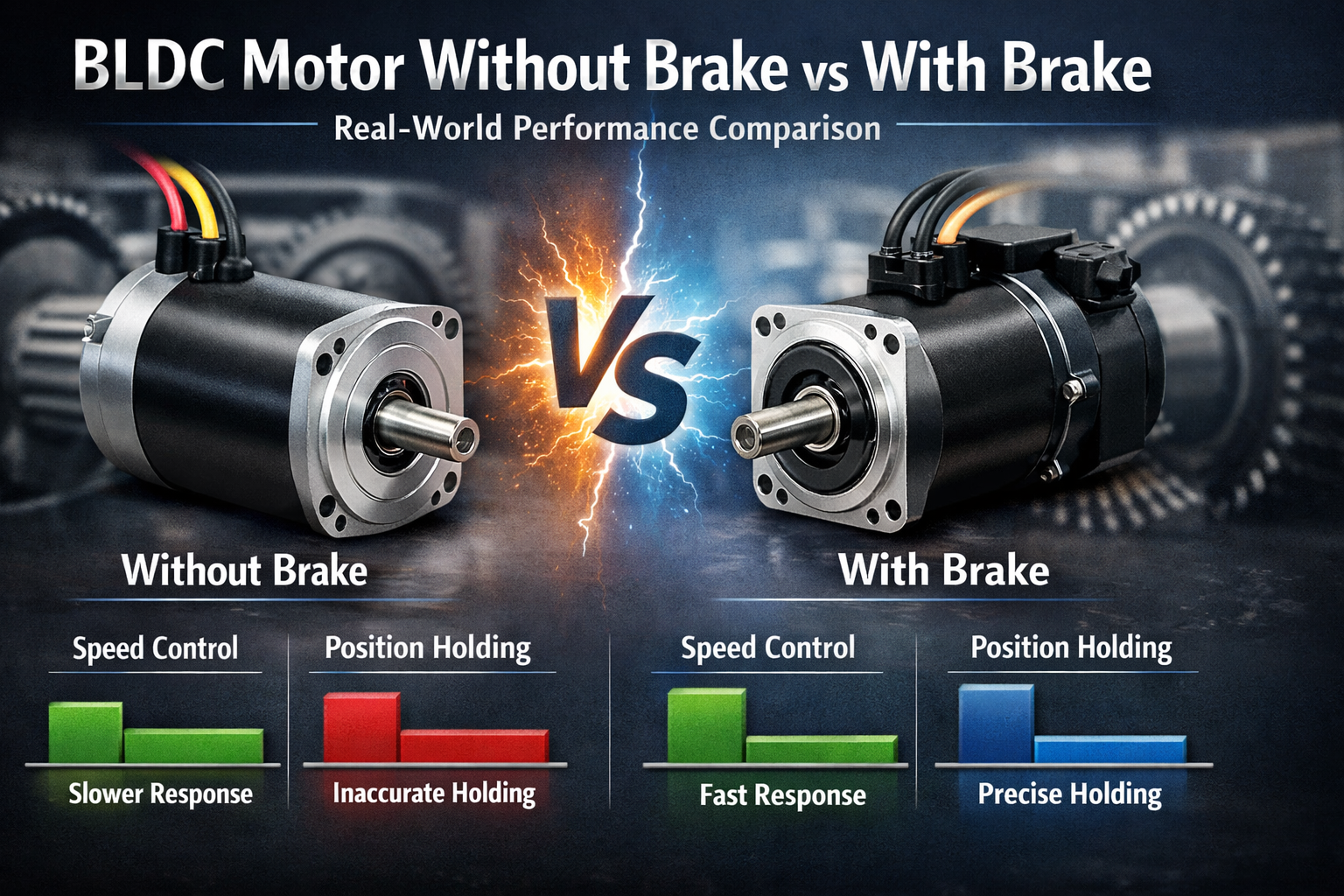
BLDC Motor Without Brake vs With Brake: Real-World Performance Comparison
In modern motion control systems, choosing the right motor configuration is not just about torque or speed anymore. One of the most overlooked—but critical—decisions is whether to use a BLDC motor with brake or without brake. This choice directly impacts system safety, precision, cost, and long-term reliability. Many engineers and buyers struggle with this decision because datasheets rarely show real-world differences.
This article breaks down the real performance differences, practical use cases, and selection strategies based on real engineering scenarios. If you are sourcing or designing a system, this guide will help you avoid costly mistakes and make a more confident decision.
What Is a BLDC Motor Without Brake?
A brushless DC motor without brake is the standard configuration used in most applications. It operates based on electronic commutation and provides smooth, efficient motion without any mechanical stopping mechanism built into the motor.
In simple terms, when power is cut off, the motor will coast to a stop instead of stopping immediately. This behavior is acceptable—and even preferred—in many applications where gradual deceleration is not a problem.
These motors are widely used because they are:
• Structurally simple
• Cost-effective
• Energy-efficient
• Low maintenance
However, the lack of braking capability introduces limitations in applications that require instant stopping or position holding.
What Is a BLDC Motor With Brake?
A BLDC motor with brake integrates an electromagnetic braking system, typically mounted at the rear of the motor. This brake is usually spring-applied and electrically released, meaning:
• When power is ON → brake releases → motor rotates
• When power is OFF → brake engages → motor stops immediately
This mechanism ensures instant stopping and position holding, even under load.
Compared to standard motors, brake-equipped BLDC motors are designed for:
• Safety-critical systems
• Vertical motion control
• Precision positioning
• Load-holding applications
Although they increase system complexity and cost, they provide a level of control that cannot be achieved through software alone.
Core Difference: Coast vs Instant Stop
The most fundamental difference between these two motor types lies in how they behave when power is removed.
A BLDC motor without brake will:
• Continue spinning due to inertia
• Gradually slow down depending on load and friction
• Require external control (like regenerative braking) for faster stops
A BLDC motor with brake will:
• Stop almost immediately
• Hold its position firmly
• Prevent unwanted movement due to gravity or external forces
This difference becomes critical in applications like elevators, robotic arms, and medical devices, where uncontrolled motion is not acceptable.
Real-World Performance Comparison
1. Stopping Accuracy
In real industrial environments, stopping accuracy is rarely perfect due to inertia, load variation, and environmental factors.
A motor without brake often shows:
• Overshoot after stop command
• Position drift over time
• Dependency on control algorithms
A motor with brake delivers:
• Near-zero overshoot
• Immediate locking of position
• Reliable repeatability
For example, in automated assembly lines, even a small positioning error can lead to defects. This is where brake motors show clear advantages.
2. Safety Performance
Safety is one of the biggest reasons engineers choose brake motors.
Without a brake:
• Loads can fall in vertical systems
• Machines may continue moving after power loss
• Emergency stops rely only on electronic control
With a brake:
• Loads are held securely
• Motion stops instantly during power failure
• Systems meet higher safety standards
In applications like lifting platforms or hospital beds, using a motor without brake can create serious risks.
3. Energy Consumption
At first glance, motors without brakes appear more energy-efficient. However, real-world scenarios tell a more nuanced story.
A motor without brake may:
• Consume more energy to maintain position using torque
• Require continuous power in holding applications
A motor with brake:
• Consumes energy only during motion
• Uses mechanical locking to hold position
In systems where the motor spends a lot of time holding position rather than moving, brake motors can actually be more energy-efficient overall.
4. System Complexity
BLDC motors without brakes are easier to integrate:
• Fewer components
• Simpler wiring
• Lower failure points
BLDC motors with brakes require:
• Additional wiring for brake control
• Power supply considerations
• More complex control logic
However, this added complexity often replaces the need for external braking systems, which can simplify the overall system design.
5. Cost Consideration
Cost is always a key factor in purchasing decisions.
Motors without brakes:
• Lower initial cost
• Lower maintenance cost
• Suitable for cost-sensitive projects
Motors with brakes:
• Higher upfront cost
• Slightly higher maintenance
• Lower risk of system failure
From a long-term perspective, brake motors can reduce costs related to:
• Product damage
• Safety incidents
• System redesign
Application-Based Comparison
When to Use BLDC Motor Without Brake
This type is ideal for:
• Cooling fans
• Pumps
• Conveyor belts
• Household appliances
• Applications with low safety risk
In these scenarios, gradual stopping is acceptable, and cost efficiency is more important than precision stopping.
When to Use BLDC Motor With Brake?
This configuration is essential for:
• Elevators and lifts
• Robotic arms
• CNC machines
• Medical equipment
• Automated guided vehicles (AGVs)
In these cases, position holding and safety are critical, making brake motors the preferred choice.
Hidden Pain Points Buyers Often Ignore
Many buyers focus only on specifications like voltage, torque, and RPM. However, ignoring braking requirements can lead to serious issues later.
Common problems include:
• Unexpected load movement after shutdown
• Difficulty in achieving precise positioning
• Increased wear due to frequent electronic braking
• Safety compliance failures
These issues often result in redesign costs that far exceed the initial savings from choosing a non-brake motor.
Industry Trend: Why Brake Motors Are Becoming Standard
With the rise of automation and smart manufacturing, the demand for high-precision and safety-compliant systems is growing rapidly.
Trends driving brake motor adoption include:
• Increased use of collaborative robots
• Stricter safety regulations
• Demand for energy-efficient systems
• Growth of vertical motion applications
As a result, more OEMs are integrating brake motors as a default configuration, especially in high-end equipment.
Engineering Tip: Brake vs Electronic Braking
Some engineers try to replace mechanical brakes with electronic braking methods such as:
• Regenerative braking
• Dynamic braking
While these methods help slow down the motor, they cannot:
• Hold position when power is off
• Prevent movement under external forces
Mechanical brakes provide physical locking, which is something electronic methods cannot fully replicate.
How to Choose the Right Option?
When selecting between BLDC motor with or without brake, consider these factors:
1. Is position holding required?
If yes, choose a brake motor.
2. Is the system vertical or load-bearing?
Brake motor is strongly recommended.
3. What are the safety requirements?
Higher safety = brake motor.
4. Is cost the main concern?
Non-brake motor may be sufficient.
5. How often does the motor stop?
Frequent stops favor brake motors.
Making the right decision requires balancing performance, safety, and cost.
Why Choose United Motion Inc.?
At United Motion Inc., we understand that motor selection is not just about specifications—it’s about real-world performance.
We offer:
• High-efficiency BLDC motors
• Integrated brake motor solutions
• Custom design support
• Reliable supply for OEM projects
Our engineering team works closely with clients to ensure that each motor solution fits the exact application requirements, helping reduce risk and improve system performance.
Final Thoughts
The choice between a BLDC motor with brake vs without brake is more than a technical detail—it is a strategic decision that affects the entire system.
Motors without brakes offer simplicity and cost advantages, making them suitable for general-purpose applications. On the other hand, motors with brakes provide unmatched safety, precision, and reliability in demanding environments.
If your application involves load holding, vertical motion, or safety-critical operations, investing in a brake motor is not just a better option—it is often a necessary one.
References
1. IEC Standards for Electrical Machines – Safety and braking systems
2. IEEE Industry Applications Society – Motor control and braking methods
3. Bosch Rexroth Application Notes – Electromechanical braking systems
4. Schneider Electric White Papers – Motor protection and safety design
5. Industry case studies from automation and robotics sectors
Related blog: How to Choose a BLDC Motor with Brake for Industrial Automation?