
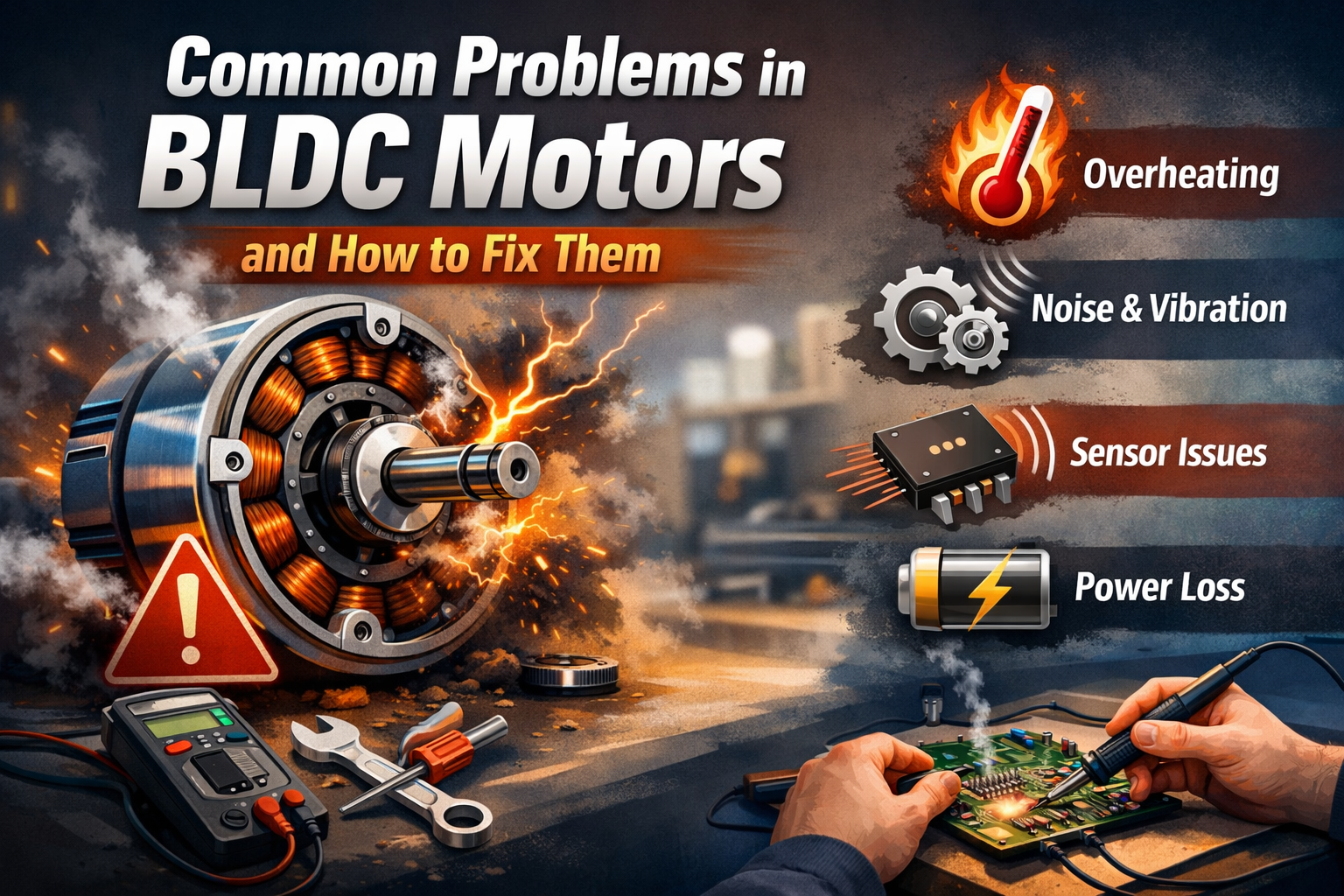
Common Problems in BLDC Motors and How to Fix Them
Brushless DC motors (BLDC motors) are widely used in modern industries because of their high efficiency, low maintenance, and long lifespan. However, even the most reliable systems can face issues over time. Understanding these common problems and knowing how to fix them is essential for engineers, buyers, and maintenance teams who rely on consistent motor performance in applications like robotics, electric vehicles, and industrial automation.
This guide explores real-world BLDC motor issues, their root causes, and practical solutions, helping you reduce downtime, improve performance, and make better purchasing decisions.
Why BLDC Motors Fail: A Practical Overview
BLDC motors are often marketed as maintenance-free, but that does not mean they are problem-free. In reality, failures usually come from system-level issues rather than the motor itself. Factors like poor controller design, incorrect load matching, overheating, and installation errors often lead to performance problems.
From a buyer’s perspective, one of the biggest challenges is identifying whether the issue lies in the motor, the driver, or the application setup. Many procurement teams search for terms like “BLDC motor not working properly” or “brushless motor troubleshooting guide” because they face unclear failures that are hard to diagnose quickly.
Understanding these challenges helps reduce unnecessary replacements and ensures better long-term ROI when sourcing from a reliable BLDC motor manufacturer like United Motion Inc.
Problem 1: BLDC Motor Not Starting
One of the most common issues users face is a BLDC motor that simply does not start. This problem can be frustrating because there are multiple possible causes, and the motor may appear completely unresponsive.
In most cases, the issue is related to the motor controller rather than the motor itself. BLDC motors rely on electronic commutation, meaning they need a properly functioning driver to energize the coils in the correct sequence. If the controller is not providing the correct signals, the motor will not rotate.
Another common cause is incorrect wiring, especially with Hall sensors. If the sensor signals are mismatched, the controller cannot determine rotor position, preventing startup. Power supply issues, such as insufficient voltage or current, can also stop the motor from starting.
To fix this problem, start by checking the controller configuration and ensuring it matches the motor specifications. Verify wiring connections carefully, especially Hall sensor alignment. Use a stable power source with adequate current capacity. In many cases, replacing a low-quality driver with a more reliable solution can immediately resolve startup issues.
Problem 2: Overheating in BLDC Motors
Overheating is one of the most serious problems in BLDC motors because it directly affects lifespan, efficiency, and safety. Many users search for “BLDC motor overheating causes” when they notice performance drops or unexpected shutdowns.
The root cause of overheating is usually excessive current draw. This can happen when the motor is overloaded, improperly sized for the application, or running at inefficient operating points. Poor ventilation and high ambient temperatures can also contribute to heat buildup.
Another overlooked factor is improper PWM (pulse-width modulation) settings in the controller. Incorrect switching frequencies can increase losses in the motor windings and cause unnecessary heat generation.
To fix overheating, first ensure the motor is correctly sized for the load. Avoid running the motor continuously at maximum capacity. Improve cooling through better airflow or heat sinks. Adjust controller parameters such as current limits and switching frequency to optimize efficiency.
Working with an experienced brushless DC motor supplier like United Motion Inc. can help you select the right motor for your thermal requirements, reducing the risk of overheating from the start.
Problem 3: Noise and Vibration Issues
Noise and vibration are common complaints, especially in precision applications like medical devices, robotics, and smart home systems. Many buyers search for “quiet BLDC motor solutions”when dealing with this issue.
Vibration is often caused by mechanical imbalance, misalignment, or poor mounting. However, electrical factors such as improper commutation timing and phase imbalance can also contribute to noise.
In sensorless BLDC systems, inaccurate rotor position estimation can lead to unstable operation, causing noticeable vibration. Low-quality controllers may also generate uneven current waveforms, increasing noise levels.
To fix noise and vibration issues, ensure proper mechanical alignment and secure mounting. Use high-quality controllers with advanced commutation algorithms. If precision is critical, consider switching to a Hall-sensor or encoder-based system for more accurate control.
Choosing a high-quality BLDC motor manufacturer ensures tighter tolerances and better balance, which significantly reduces noise from the beginning.
Problem 4: Speed Fluctuation and Instability
Speed instability is another frequent issue that affects applications requiring consistent performance, such as conveyors, fans, and automated systems. Users often search for “BLDC motor speed control problems” when facing this challenge.
The main cause of speed fluctuation is poor feedback control. In closed-loop systems, incorrect PID tuning can lead to oscillations or slow response times. In open-loop systems, load variations can directly affect speed because there is no feedback to compensate.
Voltage fluctuations in the power supply can also cause speed instability. Additionally, incorrect parameter settings in the motor driver may result in inconsistent performance.
To fix speed issues, implement a closed-loop control system with proper feedback using Hall sensors or encoders. Fine-tune the PID parameters to achieve stable operation. Ensure a stable power supply and use a high-quality motor driver with precise control capabilities.
Problem 5: Reduced Efficiency
Efficiency is one of the main reasons industries choose BLDC motors, but poor system design can significantly reduce their performance. Many buyers search for “high efficiency BLDC motor solutions” when trying to optimize energy consumption.
Efficiency losses can come from several sources, including poor motor selection, incorrect operating conditions, and inefficient controllers. Running a motor outside its optimal speed-torque range can lead to higher losses.
Another factor is electrical losses caused by low-quality components or improper wiring. Resistance in cables and connectors can reduce overall system efficiency.
To improve efficiency, select a motor that matches your application requirements. Operate it within its optimal performance range. Use high-quality drivers and minimize electrical losses by ensuring proper wiring and connections.
Problem 6: Controller Failure
The controller is the brain of a BLDC motor system, and its failure can bring the entire system to a halt. Many issues attributed to motors are actually caused by faulty controllers.
Controller failures can result from overheating, voltage spikes, or poor design. In industrial environments, electrical noise and unstable power supplies can damage sensitive electronics.
To fix controller issues, use drivers with built-in protection features such as overcurrent, overvoltage, and thermal protection. Ensure proper grounding and shielding to reduce electrical noise. Regularly inspect and maintain the system to prevent unexpected failures.
Problem 7: Hall Sensor Malfunction
Hall sensors play a critical role in many BLDC motor systems by providing rotor position feedback. When these sensors fail, the motor may run erratically or stop completely.
Common causes of Hall sensor failure include wiring issues, overheating, and physical damage. In some cases, electromagnetic interference can disrupt sensor signals.
To fix this issue, check sensor wiring and connections carefully. Replace damaged sensors if necessary. For applications where reliability is critical, consider using sensorless systems with advanced control algorithms or adding redundancy in feedback systems.
Problem 8: Bearing Wear and Mechanical Failure
Although BLDC motors have fewer wear components than brushed motors, bearings are still subject to wear over time. Bearing failure can lead to noise, vibration, and eventually motor breakdown.
Causes of bearing wear include poor lubrication, contamination, and excessive loads. High temperatures can also accelerate wear.
To fix this issue, use high-quality bearings and ensure proper lubrication. Avoid overloading the motor and operate it within recommended limits. Regular maintenance and inspection can help detect early signs of wear.
How to Prevent BLDC Motor Problems?
Prevention is always better than repair. The best way to avoid common BLDC motor problems is through proper system design, correct motor selection, and regular maintenance.
Start by clearly defining your application requirements, including torque, speed, and environmental conditions. Choose a motor and controller that match these needs. Work with a reliable BLDC motor manufacturer like United Motion Inc. to ensure quality and performance.
Implement proper installation practices, including correct wiring and alignment. Use high-quality components and ensure adequate cooling. Regularly monitor system performance and address issues early before they escalate.
References
1. Texas Instruments – “Sensorless BLDC Motor Control Basics”
2. STMicroelectronics – “BLDC Motor Control Design Guide”
3. IEEE Papers on Electric Motor Efficiency and Fault Diagnosis
4. Bosch Engineering – “Electric Drive Systems Overview”
5. Nidec Motor Corporation – “Brushless Motor Maintenance Guide”
Related blog: What Factors Really Determine BLDC Motor Lifetime?