
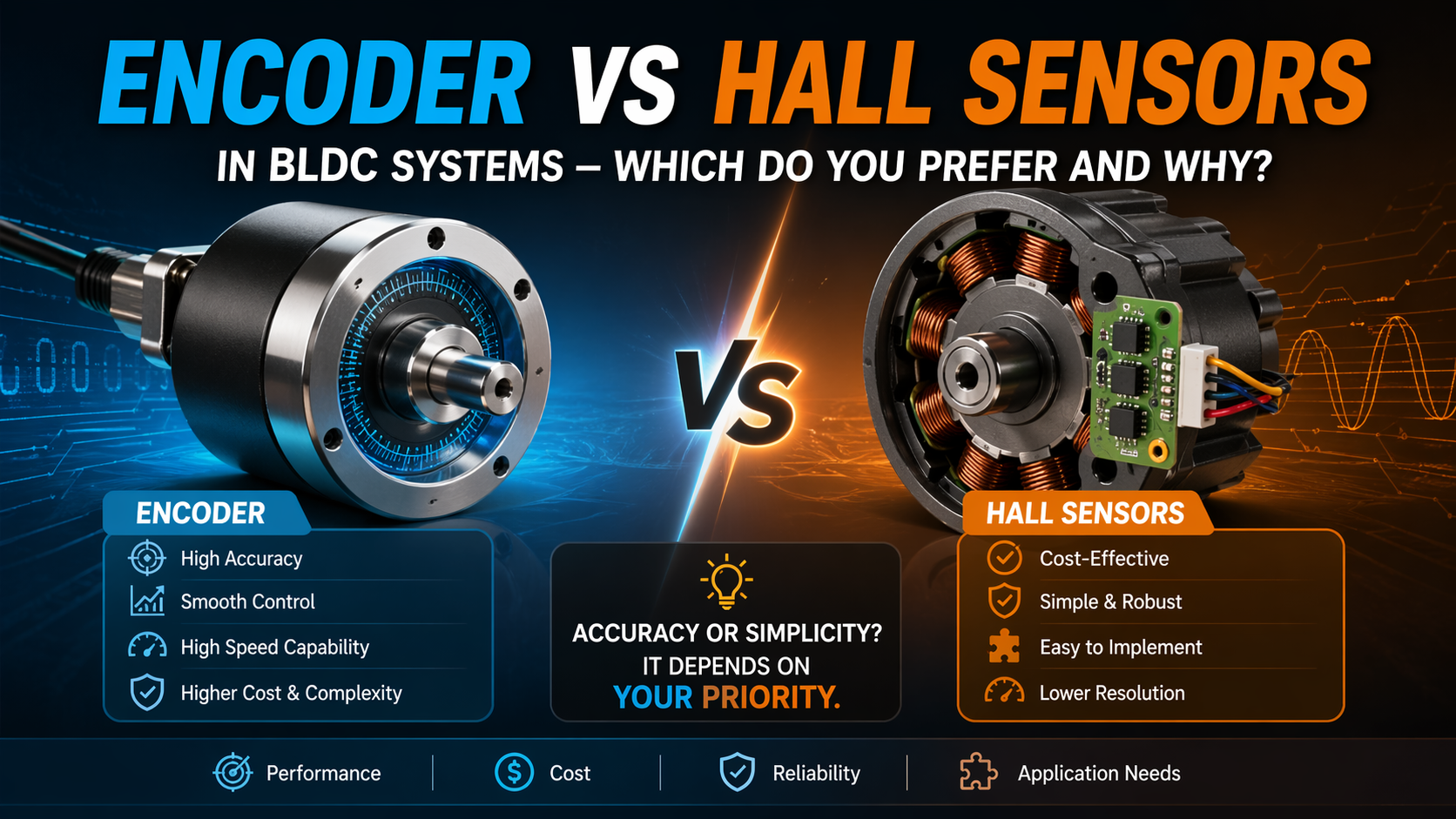
Encoder vs Hall Sensors in BLDC Systems — Which Do You Prefer and Why?
In brushless DC motor (BLDC motor) systems, position feedback is everything. It defines how smoothly the motor runs, how efficiently it performs, and how accurately it responds to control inputs. When engineers or procurement teams compare encoder vs Hall sensors, they are not just choosing components — they are deciding the performance ceiling of the entire system.
This article breaks down the real differences, trade-offs, and application-driven decisions between these two feedback methods. It also highlights practical insights that buyers often miss when selecting a BLDC motor with encoder or a BLDC motor with Hall sensors.
Understanding the Basics of BLDC Motor Feedback
A BLDC motor does not rely on brushes to control commutation. Instead, it needs an external method to determine rotor position so the controller can energize the correct windings at the right time. This is where position sensors come into play.
The two most widely used solutions are:
• Hall effect sensors
• Encoders
Both serve the same purpose but differ greatly in precision, cost, complexity, and application suitability.
What Are Hall Sensors in BLDC Motors?
Hall sensors are simple magnetic sensors embedded inside the motor. They detect changes in the magnetic field as the rotor spins and provide discrete signals to the controller.
Typically, a BLDC motor uses three Hall sensors spaced 120 degrees apart. These sensors output digital signals (high or low), which the controller uses to determine rotor position.
Key Characteristics of Hall Sensors
Hall sensors are widely used because they are simple, cost-effective, and reliable in many environments. They are especially common in:
• Electric scooters and e-bikes
• Cooling fans
• Pumps and blowers
• Basic automation systems
However, Hall sensors only provide coarse position information. They divide the rotation into six steps per electrical cycle, which limits control precision.
What Is an Encoder in a BLDC Motor?
An encoder is a more advanced feedback device that provides high-resolution position information. Unlike Hall sensors, encoders can measure:
• Exact angular position
• Speed
• Direction
Encoders can be optical, magnetic, or capacitive, and they output either digital pulses or absolute position data.
Types of Encoders Used in BLDC Motors
There are two main types:
Incremental encoders
These provide pulses as the motor rotates. The controller counts pulses to determine position and speed.
Absolute encoders
These provide a unique position value for each shaft angle, even after power loss.
Encoder vs Hall Sensors: Core Differences
When comparing encoder vs Hall sensors in BLDC motor systems, the decision comes down to precision vs simplicity.
1. Position Accuracy
Encoders provide high-resolution feedback, often thousands of pulses per revolution. This allows precise speed and position control.
Hall sensors provide only six-step commutation, which is sufficient for basic motion but not for fine control.
Conclusion: Encoders win in accuracy.
2. Cost Consideration
Hall sensors are significantly cheaper and are often built into the motor by default.
Encoders add extra cost due to hardware, wiring, and integration.
Conclusion: Hall sensors are more budget-friendly.
3. Control Performance
With encoders, you can implement advanced control methods such as:
• Field-oriented control (FOC)
• Servo-level positioning
• Closed-loop speed regulation
Hall sensors support simpler trapezoidal control.
Conclusion: Encoders enable high-performance control.
4. Reliability and Durability
Hall sensors are robust and perform well in harsh environments like dust, vibration, and temperature changes.
Encoders, especially optical ones, can be sensitive to contamination and mechanical misalignment.
Conclusion: Hall sensors are more rugged.
5. Installation and Integration
Hall sensors are usually integrated inside the motor and require minimal setup.
Encoders require mounting, alignment, and calibration, which increases system complexity.
Conclusion: Hall sensors are easier to implement.
Real-World Application Comparison
Understanding real applications helps clarify the decision.
When Hall Sensors Are Preferred
Hall sensors are ideal for:
• Cost-sensitive products
• Applications with moderate precision requirements
• High-volume consumer devices
Examples include:
• Electric fans
• Water pumps
• E-bikes
• Basic conveyor systems
In these cases, the simplicity and low cost outweigh the need for precision.
When Encoders Are Preferred
Encoders are essential when precision and control matter.
Typical applications include:
• Robotics
• CNC machines
• Medical devices
• Industrial automation
• AGV and AMR systems
In these scenarios, accurate feedback directly impacts product quality and system performance.
Performance Impact on BLDC Motor Systems
Choosing between encoder and Hall sensors does not just affect feedback — it affects the entire system behavior.
Smoothness and Noise
Motors with encoders run smoother and quieter because the controller can make continuous adjustments.
Hall sensor-based motors often produce torque ripple and noise due to step commutation.
Efficiency and Energy Consumption
Encoders enable optimized current control, improving efficiency and reducing heat.
Hall sensor systems are less efficient under variable loads.
Low-Speed Performance
Hall sensors struggle at very low speeds because of limited resolution.
Encoders provide stable control even at near-zero speeds.
Buyer Pain Points and How to Solve Them
From a buyer’s perspective, selecting between encoder and Hall sensors often involves confusion around performance vs cost.
Pain Point 1: Overpaying for Unnecessary Precision
Many buyers choose encoders when Hall sensors are sufficient. This increases cost without adding real value.
Solution: Match sensor type to application requirements.
Pain Point 2: Underestimating Control Needs
Some buyers choose Hall sensors for cost savings but later face issues with precision and smoothness.
Solution: Consider future performance requirements, not just current needs.
Pain Point 3: Integration Complexity
Encoders can complicate system design and increase development time.
Solution: Work with experienced BLDC motor manufacturers who provide integrated solutions.
Hybrid Solutions: Can You Use Both?
In some advanced systems, both Hall sensors and encoders are used together.
• Hall sensors assist with startup and commutation
• Encoders provide high-resolution feedback for control
This hybrid approach balances cost and performance but is more complex.
Industry Trends in BLDC Feedback Systems
The industry is moving toward higher efficiency and smarter control.
Sensorless Control
Some modern systems eliminate sensors entirely and use back-EMF detection. However, this method has limitations at low speed.
Magnetic Encoders
Magnetic encoders are becoming popular because they offer:
• Good accuracy
• Better durability than optical encoders
• Lower cost
Integrated Smart Motors
Manufacturers are increasingly offering integrated BLDC motors with built-in controllers and feedback systems, simplifying system design.
Which Do We Prefer and Why?
From a practical engineering and business perspective, the choice depends on application goals.
If the goal is cost efficiency and simplicity, Hall sensors are the better option.
If the goal is precision, performance, and control, encoders are the clear winner.
At United Motion Inc., we typically recommend:
• Hall sensor BLDC motors for consumer and cost-driven applications
• Encoder BLDC motors for industrial, medical, and automation systems
The key is not which is “better,” but which is more suitable.
Final Thoughts
The debate between encoder vs Hall sensors in BLDC systems is not about superiority — it is about alignment with application needs.
Hall sensors offer simplicity, durability, and affordability. Encoders provide precision, control, and performance.
For buyers and engineers, the best approach is to evaluate:
• Required precision
• Budget constraints
• Operating environment
• Control complexity
Choosing the right feedback system will directly impact product performance, reliability, and long-term cost.
References
1. Krishnan, R. Permanent Magnet Synchronous and Brushless DC Motor Drives
2. Texas Instruments – BLDC Motor Control Application Notes
3. STMicroelectronics – Motor Control SDK Documentation
4. Microchip Technology – Sensorless and Sensored BLDC Motor Control Guides
5. IEEE Papers on BLDC Motor Position Sensing Techniques
Related blog: BLDC Motor Without Brake vs With Brake: Real-World Performance Comparison