
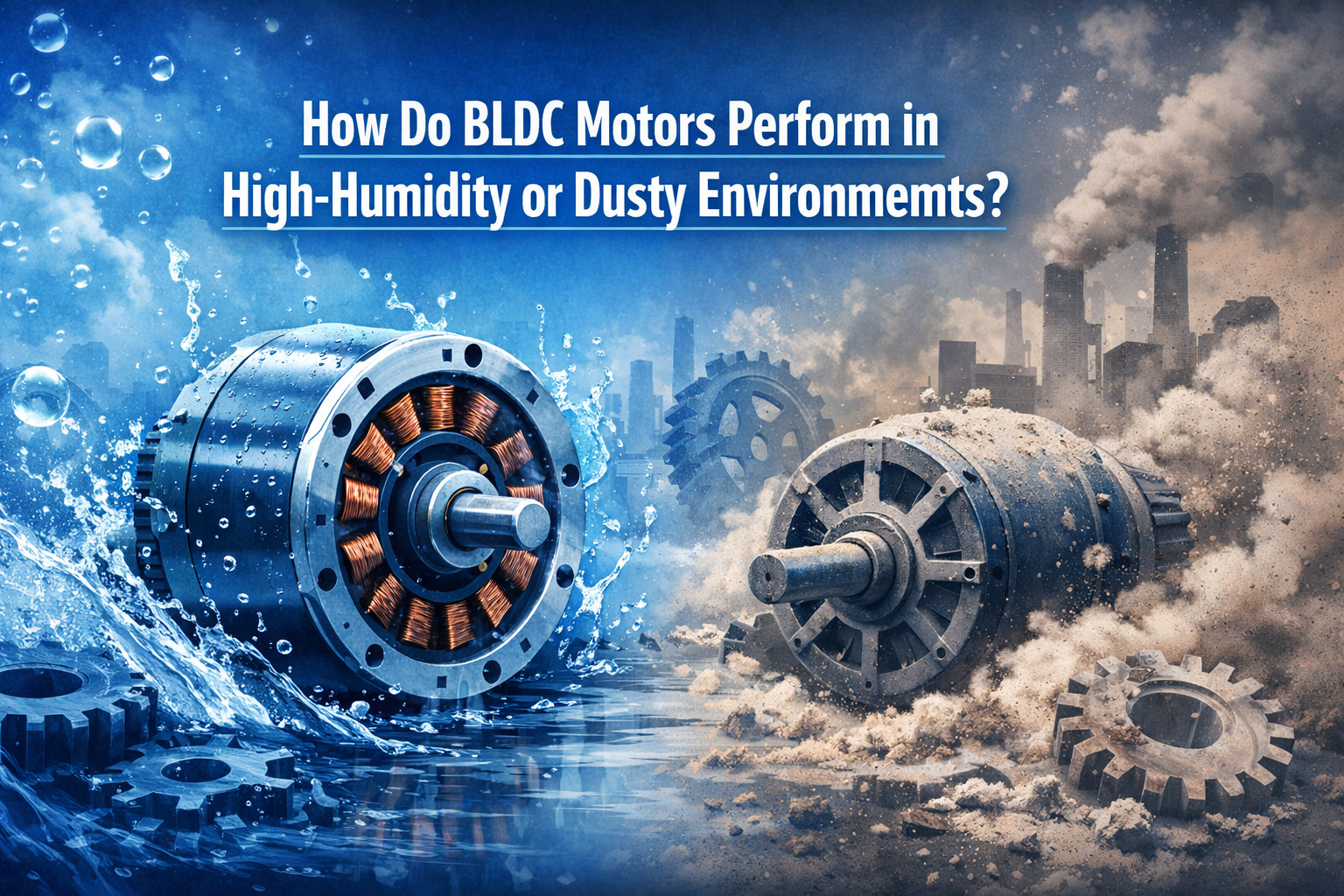
How Do BLDC Motors Perform in High-Humidity or Dusty Environments?
When engineers or purchasing managers select a motor, performance data on paper often looks impressive. High efficiency, long lifespan, and low maintenance are attractive on any datasheet. But in real industrial environments, motors rarely operate under ideal lab conditions. High humidity, airborne dust, oil mist, and temperature swings are common challenges across industries such as automation, food processing, agriculture, logistics, and renewable energy.
This is where many traditional motor solutions fall short. Brush wear, corrosion, insulation breakdown, and bearing failure often appear much earlier than expected. As a result, more system designers are asking a critical question: How do BLDC motors perform in high-humidity or dusty environments, and are they truly reliable in the long run?
Understanding BLDC Motors Beyond the Basic
A Brushless DC motor, commonly known as a BLDC motor, is fundamentally different from a brushed DC motor in both structure and operation. Instead of using mechanical brushes and a commutator, BLDC motors rely on electronic commutation controlled by a drive or controller. This design eliminates one of the most failure-prone components in conventional motors.
Because there is no physical contact between brushes and the rotor, BLDC motors generate less friction, less heat, and far fewer particles during operation. This core structural advantage plays a major role in how BLDC motors behave in environments where moisture and dust are constant threats. From a buyer’s perspective, BLDC motors are often chosen not only for efficiency, but also for reliability, cleanliness, and long service life, especially in demanding applications.
Why High Humidity Is a Serious Threat to Electric Motors?
Humidity is more than just moisture in the air. In industrial environments, high humidity can lead to condensation inside motor housings, especially during temperature changes between day and night or during intermittent operation. This moisture can attack motors in several ways.
First, moisture can degrade insulation materials over time, leading to reduced dielectric strength and eventual electrical failure. Second, corrosion can develop on metal components such as shafts, laminations, and connectors. Third, humidity can contaminate lubricants inside bearings, increasing friction and accelerating wear.
Traditional brushed motors are particularly vulnerable because moisture can directly affect the brush-commutator interface. Oxidation, arcing instability, and increased electrical noise are common symptoms in humid environments.
How BLDC Motors Handle High-Humidity Conditions?
BLDC motors perform significantly better in high-humidity environments compared to brushed motors, primarily due to their contact-free commutation system. Since there are no brushes or exposed commutators, one of the most sensitive areas is completely removed from the design.
In well-designed BLDC motors, stator windings are often treated with insulation varnish or epoxy coatings that provide an additional moisture barrier. When combined with sealed housings and proper ingress protection ratings, BLDC motors can operate reliably even in consistently humid conditions.
Another advantage is thermal efficiency. BLDC motors generate less heat during operation, which reduces temperature differentials that cause condensation. Less internal condensation means lower risk of corrosion and insulation damage over time. For applications such as coastal equipment, greenhouse automation, beverage processing lines, and outdoor energy systems, this moisture resistance becomes a decisive factor.
Dust: The Silent Motor Killer in Industrial Applications
Dust may seem harmless, but in industrial settings, it is one of the most common causes of premature motor failure. Dust particles can be conductive, abrasive, or hygroscopic, meaning they attract moisture. When dust enters a motor, it can interfere with airflow, clog cooling paths, and settle on electronic components.
In brushed motors, dust accumulation often mixes with carbon debris from brush wear, forming conductive paths that increase the risk of short circuits and unstable performance. Over time, this leads to efficiency loss, overheating, and unpredictable downtime. Dust-heavy environments are common in industries such as woodworking, cement production, grain handling, mining, and packaging operations.
BLDC Motors in Dusty Environments: Structural Advantages
BLDC motors offer clear benefits in dusty environments due to their sealed construction and reduced internal debris generation. Because there are no brushes, BLDC motors do not produce carbon dust internally, which dramatically reduces contamination risk.
Many industrial BLDC motors are designed with enclosed housings and can be specified with higher IP ratings such as IP54, IP65, or even IP67 depending on the application. These protection levels limit dust ingress and protect sensitive internal components.
Additionally, BLDC motors often rely on external or integrated electronic drives that can be mounted separately in protected control cabinets. This separation allows designers to shield electronics from dust while maintaining efficient motor operation.
The Role of IP Ratings in Harsh Environments
Ingress Protection (IP) ratings are a critical specification when evaluating BLDC motors for humid or dusty environments. The first digit indicates protection against solid particles, while the second digit relates to moisture resistance.
For dusty environments, an IP5X or IP6X rating ensures that dust will not enter the motor in quantities that affect performance. For high-humidity or washdown conditions, IP65 or higher ratings provide protection against water jets and splashing.
At United Motion Inc., customers often underestimate the importance of selecting the correct IP rating. Choosing a motor with insufficient protection may reduce initial cost but leads to higher maintenance and replacement expenses over time.
Materials and Coatings That Improve Environmental Resistance
Material selection plays a significant role in how BLDC motors perform in challenging environments. Stainless steel shafts, corrosion-resistant fasteners, and treated laminations all contribute to long-term reliability.
Advanced coating technologies, such as conformal coating on PCBs and epoxy encapsulation of windings, further protect against moisture and dust infiltration. These coatings act as physical barriers, preventing contaminants from reaching sensitive electrical areas. For buyers, asking about internal coatings and material treatments is just as important as reviewing torque or speed specifications.
Bearings: A Hidden Weak Point in Harsh Conditions
Even the best motor design can fail prematurely if bearing protection is overlooked. In humid or dusty environments, bearings are often the first mechanical component to degrade. BLDC motors designed for harsh environments typically use sealed or shielded bearings with specialized lubricants that resist moisture washout and particle contamination. In some applications, stainless steel or ceramic bearings may be used to further improve corrosion resistance. Proper bearing selection directly impacts motor lifespan, noise levels, and maintenance intervals, making it a critical consideration for industrial buyers.
Electronics and Controllers in Humid or Dusty Areas
While the motor itself may be well protected, the electronic controller is equally important. BLDC controllers exposed to humidity or dust without proper enclosure can suffer from corrosion, short circuits, or sensor errors. Many system designers choose to install controllers in sealed control cabinets with climate control or use drives rated for industrial environments. Communication protocols such as CANopen, EtherCAT, or Modbus allow controllers to be placed remotely without performance loss.
Thermal Management Under Harsh Conditions
Effective cooling is essential for any motor, but dust can restrict airflow and humidity can affect heat dissipation. BLDC motors are generally more efficient than brushed motors, producing less waste heat for the same output power. Lower operating temperatures reduce thermal stress on insulation and electronics, extending service life. In sealed designs, heat is often dissipated through the motor housing, making proper mounting and thermal paths critical. In high-humidity or dusty environments, a thermally optimized BLDC motor can outperform a higher-power brushed motor simply because it stays cooler and more stable.
Real-World Applications Where BLDC Motors Excel
BLDC motors are widely used in applications where humidity and dust are unavoidable. In food and beverage processing, they handle frequent washdowns and moist air. In agricultural machinery, they operate amid dust, dirt, and temperature extremes. In logistics and warehousing, they power AGVs and conveyors exposed to fine particulate matter.
Outdoor renewable energy systems, such as solar tracking mechanisms and small wind systems, also rely on BLDC motors for their resistance to environmental stress and low maintenance requirements. These real-world examples demonstrate that BLDC motors are not just theoretically suitable for harsh environments but proven in practice.
Maintenance Benefits in Challenging Environments
One of the strongest arguments for BLDC motors in humid or dusty environments is reduced maintenance. With no brushes to replace and fewer wear components, service intervals are longer and more predictable. This is especially valuable in applications where equipment is difficult to access or downtime is costly. Over time, the lower total cost of ownership often outweighs the higher initial investment of a BLDC motor system. From a procurement perspective, this reliability translates into fewer emergency replacements, less spare inventory, and improved operational planning.
Common Buyer Mistakes When Selecting Motors for Harsh Environments
Despite the advantages of BLDC motors, buyers sometimes make costly mistakes by focusing only on power or price. Ignoring environmental factors, IP ratings, or material quality can lead to premature failure.
Another common mistake is selecting a high-performance motor without considering the controller’s environmental rating. A system is only as strong as its weakest component.
Working with experienced suppliers like United Motion Inc. helps avoid these pitfalls by aligning motor selection with real operating conditions.
Future Trends: Smarter and More Resilient BLDC Motors
As industries move toward automation and electrification, BLDC motors are evolving with smarter sensors, better sealing technologies, and improved materials. Predictive maintenance features and real-time condition monitoring are becoming more common, allowing operators to detect issues before failure occurs. These innovations further strengthen the position of BLDC motors as the preferred choice for harsh and variable environments.
References
IEC 60529 – Degrees of Protection Provided by Enclosures (IP Code)
IEEE Industry Applications Magazine – Motor Reliability in Harsh Environments
NEMA Standards Publication MG-1 – Motors and Generators
Schneider Electric White Paper – Environmental Factors Affecting Motor Performance
ABB Technical Guide – Electric Motors in Dusty and Humid Conditions
Related blog: BLDC Motor Specifications Explained: Speed, Torque, Voltage & Power