
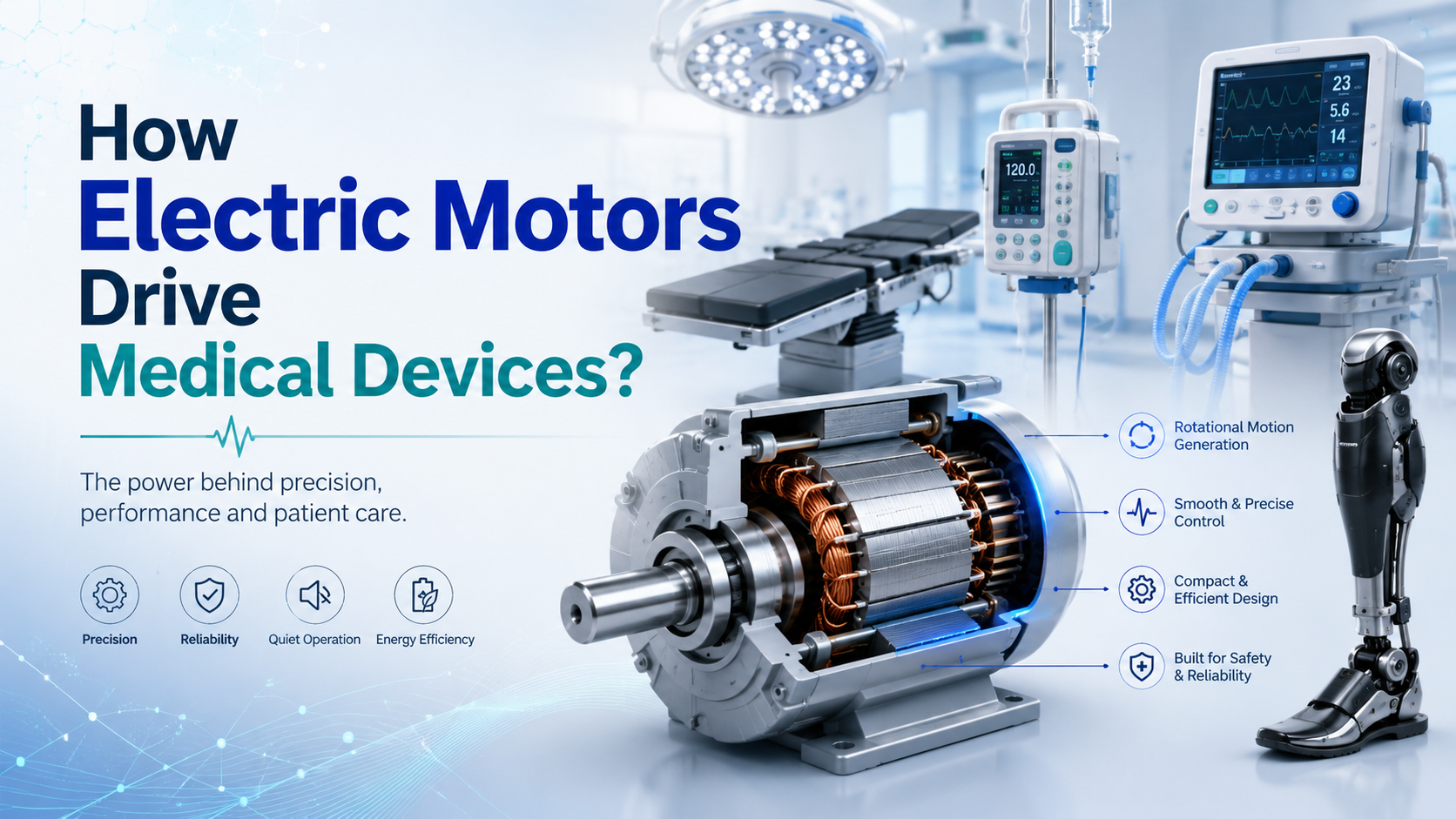
Electric motors are the core motion-generating components in modern medical devices. They convert electrical energy into precise mechanical movement to power ventilators, infusion pumps, surgical robots, diagnostic imaging systems, laboratory analyzers, rehabilitation equipment, and portable medical devices.
Medical device motors must deliver:
- High precision motion control
- Low noise and vibration
- High reliability
- Long operating life
- Compact size
- Energy efficiency
- Compliance with medical safety standards
Common motor technologies used in medical devices include Brushless DC motors, servo motors, stepper motors, and precision gear motors.
According to the U.S. Food and Drug Administration (FDA), reliability and safety are critical design requirements for medical equipment because equipment failure can directly impact patient care and treatment outcomes.
Source: U.S. Food and Drug Administration (FDA), Medical Device Safety Overview, U.S. Department of Health and Human Services, updated 2024.
Why Electric Motors Are Essential in Medical Devices?
Healthcare equipment increasingly relies on automated motion systems.
Whether delivering medication, controlling airflow, positioning patients, or assisting surgery, electric motors provide the mechanical movement required for device functionality.
Without electric motors, modern healthcare technologies such as robotic surgery systems, infusion pumps, MRI patient tables, and respiratory support equipment would not be possible.
Medical equipment manufacturers prioritize motors that provide:
- Repeatable positioning accuracy
- Stable torque output
- Smooth speed control
- Minimal maintenance
- High efficiency
- Quiet operation
Research published by the National Institutes of Health (NIH) indicates that precision motion control directly affects the performance and reliability of many medical devices, particularly those used for diagnosis and treatment.
Source: National Institutes of Health (NIH), Biomedical Engineering and Medical Device Systems Research, 2023.
Types of Electric Motors Used in Medical Devices
Brushless DC (BLDC) Motors
BLDC motors have become the preferred solution for many medical applications.
They use electronic commutation instead of mechanical brushes, eliminating brush wear and reducing maintenance requirements.
Advantages
- High efficiency (85–95%)
- Long service life
- Low electromagnetic interference
- Quiet operation
- Compact design
- High power density
Typical Applications
- Ventilators
- Surgical tools
- Infusion pumps
- Portable diagnostic equipment
- Medical imaging systems
Typical Specifications
| Parameter | Typical Range |
| Voltage | 12V–48V DC |
| Speed | 1,000–20,000 RPM |
| Efficiency | 85–95% |
| Lifetime | 20,000–50,000+ hours |
| Noise Level | <40 dB in many applications |
Servo Motors
Servo motors provide closed-loop motion control.
An encoder continuously monitors motor position, speed, and torque, allowing highly accurate movement.
Advantages
• Precise positioning
• Dynamic response
• High repeatability
• Excellent speed regulation
Applications
• Surgical robots
• Laboratory automation
• Diagnostic analyzers
• Medical imaging positioning systems
Position Accuracy
Modern medical servo systems can achieve positioning accuracy better than ±0.01 mm depending on system design.
Stepper Motors
Stepper motors move in discrete angular increments.
They are commonly used where precise positioning is required without complex feedback systems.
Advantages
• Simple control
• Accurate positioning
• High holding torque
• Cost-effective
Applications
• Syringe pumps
• Infusion systems
• Sample handling equipment
• Automated laboratory instruments
Precision Gear Motors
Many medical devices require high torque at low speeds.
Gear motors combine electric motors with gearboxes to achieve desired speed reduction and torque multiplication.
Applications
• Patient lifts
• Hospital beds
• Rehabilitation equipment
• Positioning systems
Major Medical Devices Powered by Electric Motors
Ventilators
Ventilators assist or replace patient breathing.
Electric motors control airflow generation and pressure regulation.
BLDC motors are commonly selected because they provide:
• Smooth speed control
• High reliability
• Low acoustic noise
• Long operating life
During the COVID-19 pandemic, motor reliability became a critical design consideration due to continuous operation requirements.
Key Requirements
| Requirement | Typical Value |
| Noise Level | <40 dB |
| Speed Stability | ±1% |
| Service Life | >20,000 hours |
Infusion Pumps
Infusion pumps deliver precise medication dosages.
Stepper motors or servo motors move the pumping mechanism with extremely high accuracy.
Even small speed deviations may affect dosage accuracy.
Critical Requirements
- Precise flow control
- Low power consumption
- Compact size
- Reliable operation
According to FDA guidance, infusion pump failures can result in under-delivery or over-delivery of medication.
Source: FDA Infusion Pump Improvement Initiative, U.S. Food and Drug Administration, updated 2024.
Surgical Robots
Robot-assisted surgery systems depend heavily on precision motors.
Each robotic axis requires coordinated motion control to translate surgeon commands into highly accurate movement.
Motor Requirements
- High torque density
- Low backlash
- Fast response
- Encoder feedback
- Smooth motion profiles
Servo motors are typically the preferred solution.
Medical Imaging Equipment
Medical imaging systems such as CT scanners, MRI systems, and X-ray equipment use electric motors for:
- Patient table positioning
- Gantry movement
- Cooling systems
- Internal mechanisms
High precision positioning improves image quality and diagnostic accuracy.
Laboratory Automation Equipment
Automated laboratory systems use motors for:
- Sample transport
- Pipetting
- Test tube handling
- Reagent dispensing
Precision motion minimizes testing errors and increases throughput.
Rehabilitation and Mobility Equipment
Electric motors assist patients with mobility and rehabilitation.
Examples include:
- Electric wheelchairs
- Exoskeleton systems
- Rehabilitation robots
- Powered hospital beds
These systems require high torque and smooth controllability.
Key Engineering Requirements for Medical Device Motors
1. Reliability
Medical equipment often operates continuously.
Motor failures can disrupt treatment or diagnosis.
Engineers typically target:
- MTBF greater than 30,000 hours
- Long bearing life
- Stable thermal performance
According to reliability engineering studies published by IEEE, component reliability directly affects overall medical device availability.
Source: IEEE Reliability Society Publications, 2023.
2. Low Noise Operation
Patient comfort is important.
Noise generated by motors may affect:
- Sleep quality
- Patient stress levels
- Clinical environments
Medical motors commonly operate below:
30–45 dB
This is comparable to a quiet library environment.
3. Precision Motion Control
Many healthcare devices require precise positioning.
Examples include:
- Drug delivery
- Surgical robotics
- Diagnostic instruments
Typical requirements include:
- Speed accuracy ±1%
- Position repeatability ±0.01 mm
- Torque ripple minimization
4. Compact Design
Portable and wearable medical devices continue to grow rapidly.
Motor engineers must maximize:
- Torque density
- Power density
- Efficiency
while minimizing overall size and weight.
5. Energy Efficiency
Battery-powered equipment requires efficient motors.
Examples include:
- Portable ventilators
- Wearable devices
- Mobile diagnostic systems
The U.S. Department of Energy identifies electric motor efficiency as a major factor affecting overall system energy consumption.
Source: U.S. Department of Energy (DOE), Motor Systems Energy Efficiency Program, 2024.
Why BLDC Motors Are Becoming the Preferred Choice?
BLDC technology continues to gain market share in medical equipment.
Comparison of Motor Technologies
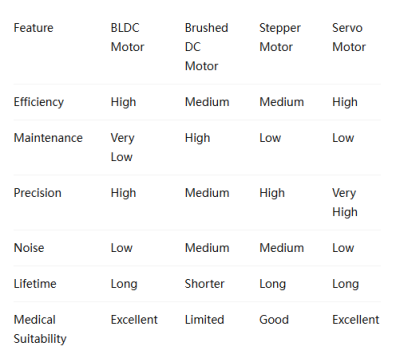
BLDC motors eliminate brush wear, which is especially important in healthcare environments where maintenance access may be limited.
Research published by the International Journal of Engineering Research indicates that BLDC motors typically achieve significantly higher efficiency and service life than brushed motor alternatives.
Source: International Journal of Engineering Research and Applications (IJERA), Brushless DC Motor Performance Analysis, 2022.
Common Engineering Challenges and Solutions
Challenge 1: Excessive Motor Heating
Causes
• Overloading
• Poor ventilation
• High duty cycles
• Improper motor sizing
Solutions
• Select higher-efficiency motors
• Improve cooling paths
• Reduce load conditions
• Optimize controller settings
Challenge 2: Positioning Errors
Causes
• Encoder inaccuracies
• Mechanical backlash
• Poor calibration
Solutions
• Use higher-resolution encoders
• Implement closed-loop control
• Reduce gearbox backlash
Challenge 3: Noise and Vibration
Causes
• Bearing wear
• Torque ripple
• Imbalanced rotors
Solutions
• Dynamic balancing
• Precision bearings
• Sinusoidal motor control algorithms
Challenge 4: Short Service Life
Causes
• Excessive heat
• Bearing contamination
• Frequent overloads
Solutions
• Improve sealing
• Select medical-grade bearings
• Follow proper duty cycle ratings
Troubleshooting Guide for Medical Device Motors
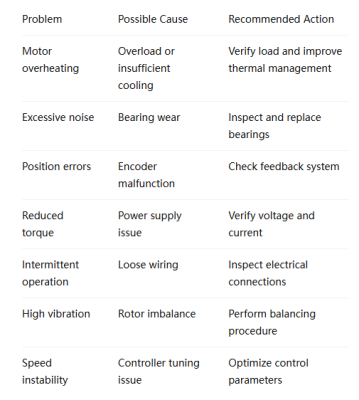
How to Select the Right Electric Motor for a Medical Device?
Step 1: Define Motion Requirements
Determine:
- Speed
- Torque
- Position accuracy
- Duty cycle
Step 2: Evaluate Environmental Conditions
Consider:
- Operating temperature
- Humidity
- Sterilization requirements
- Electromagnetic compatibility
Step 3: Choose Appropriate Motor Technology
Match application requirements with:
- BLDC motors
- Servo motors
- Stepper motors
- Gear motors
Step 4: Analyze Reliability Requirements
Evaluate:
- Expected service life
- MTBF targets
- Maintenance intervals
Step 5: Validate Through Testing
Perform:
- Thermal testing
- Vibration testing
- EMC testing
- Life-cycle testing
How UNITED MOTION INC. Supports Medical Device Manufacturers?
At UNITED MOTION INC., we provide customized motion solutions for precision medical equipment applications.
Our engineering capabilities include:
- Brushless DC motors
- Servo motors
- Planetary gear motors
- Integrated motor-driver solutions
- Custom motor design services
- Motion control optimization
For medical device manufacturers, selecting the right motor is not simply about torque and speed. It requires balancing precision, reliability, noise performance, efficiency, and long-term durability.
By leveraging advanced BLDC and servo motor technologies, medical equipment designers can improve device performance, enhance patient safety, and reduce maintenance costs.
Conclusion
Electric motors are the foundation of modern medical devices.
From ventilators and infusion pumps to surgical robots and diagnostic equipment, they provide the precise motion required for life-saving healthcare applications.
BLDC motors, servo motors, stepper motors, and precision gear motors each serve important roles depending on the application requirements.
As healthcare equipment becomes more intelligent, portable, and automated, demand for high-efficiency, high-reliability electric motors will continue to grow. Manufacturers that select properly engineered motion solutions can achieve better device performance, longer service life, and improved patient outcomes.
FAQ
What type of electric motor is commonly used in medical devices?
Brushless DC (BLDC) motors are among the most commonly used motors in medical devices because they offer high efficiency, low noise, long service life, and precise speed control.
Why are BLDC motors preferred for ventilators?
BLDC motors provide smooth airflow control, low acoustic noise, high reliability, and long operating life, making them ideal for continuous-duty ventilator applications.
Are servo motors used in surgical robots?
Yes. Servo motors are widely used in surgical robotics because they provide highly accurate position, speed, and torque control through closed-loop feedback systems.
What factors should engineers consider when selecting a medical device motor?
Engineers should evaluate torque, speed, precision, duty cycle, reliability, noise level, efficiency, environmental conditions, and regulatory requirements.
How long do medical-grade electric motors last?
Depending on design and operating conditions, medical-grade BLDC motors often achieve service lives exceeding 20,000 to 50,000 operating hours.