
Quick Answer
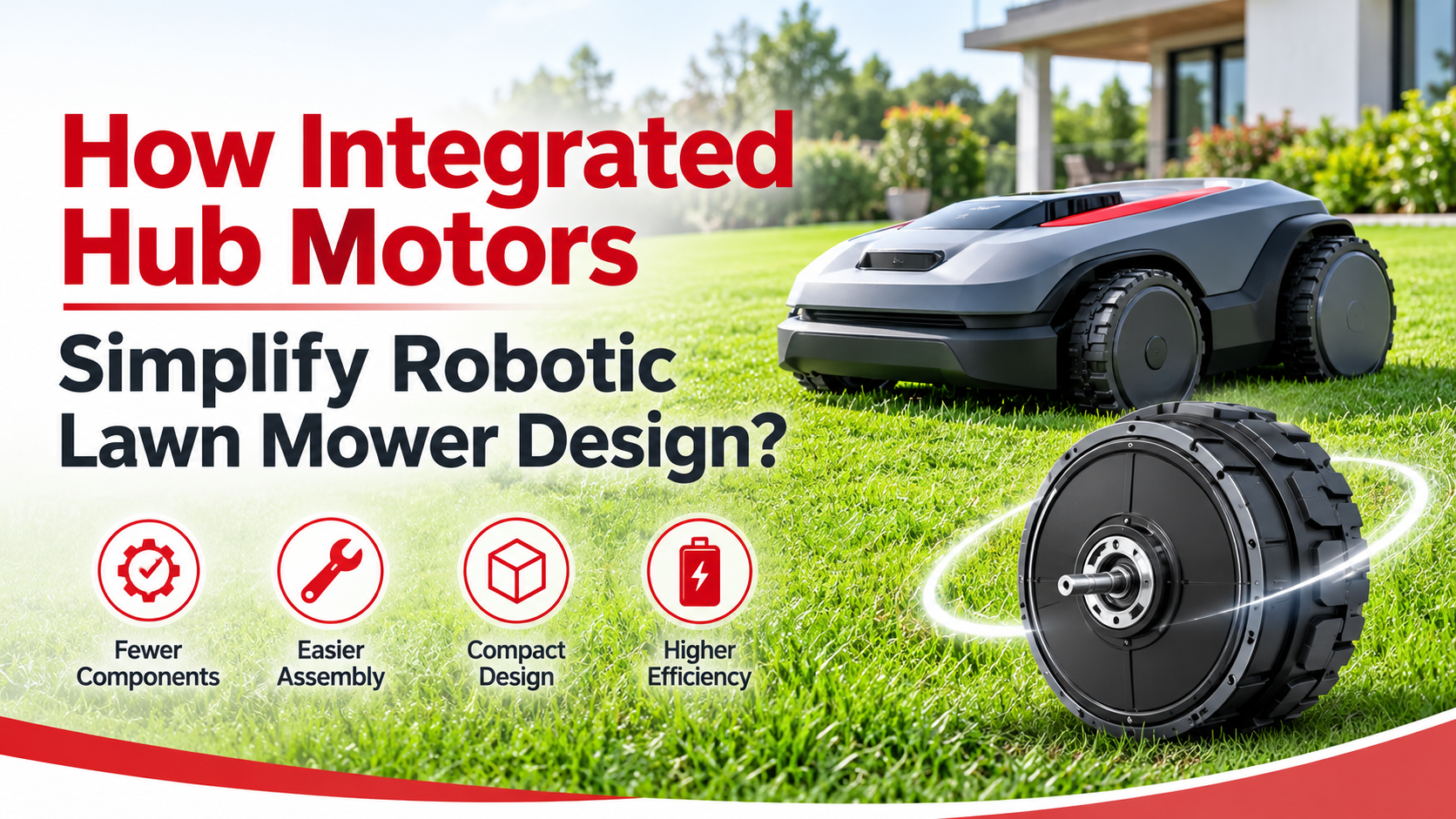
Integrated hub motors simplify robotic lawn mower design by combining the motor and wheel into a compact drive unit, reducing the need for traditional transmission components such as external gearboxes, drive shafts, belts, and chains. This integrated structure helps OEM manufacturers reduce mechanical complexity, optimize chassis space, simplify assembly, and improve overall drive-system integration.
For robotic lawn mower applications, hub motors also provide direct wheel drive, independent left-right speed control, and flexible integration with electronic controllers, making them suitable for autonomous navigation, differential steering, slope climbing, and operation across different lawn conditions.
However, selecting the right integrated hub motor requires more than matching rated power. Engineers must evaluate wheel diameter, continuous and peak torque, operating speed, vehicle weight, traction requirements, waterproofing, thermal performance, and control compatibility.
For manufacturers developing next-generation robotic lawn mowers, an appropriately designed integrated hub motor can simplify the entire drive architecture while providing greater flexibility for customized robotic platforms.
What Is an Integrated Hub Motor?
An integrated hub motor is a compact electric drive system in which the motor is installed directly inside or incorporated into the wheel assembly, allowing the wheel to receive driving torque without requiring a conventional external transmission arrangement.
Unlike traditional drive systems, where the motor transfers power through multiple mechanical components, a hub motor places the driving unit closer to the actual load.
A typical robotic lawn mower hub motor assembly may include:
– Permanent magnet motor
– Rotor and stator assembly
– Wheel housing
– Bearing system
– Output shaft or mounting structure
– Electrical connections
– Optional Hall sensors or encoder feedback
Depending on the design, the motor can also incorporate a reduction mechanism to provide the required wheel torque and operating speed.
For robotic lawn mower manufacturers, this arrangement offers an opportunity to simplify mechanical integration while reducing the number of separate components required in the drive system.
How Integrated Hub Motors Simplify Robotic Lawn Mower Design?
Fewer Mechanical Components
Traditional robotic lawn mower drive systems may require separate motors, gearboxes, transmission shafts, belts, and wheel connections.
Each additional mechanical component introduces potential challenges, including installation complexity, alignment requirements, transmission losses, maintenance needs, and possible mechanical failure points.
An integrated hub motor combines the driving function with the wheel assembly, reducing the need for several external transmission components.
Key engineering advantages include:
– Simplified mechanical architecture
– Fewer external transmission connections
– Reduced assembly procedures
– More flexible chassis design
– Easier drive-system integration
For OEM manufacturers producing multiple robotic mower models, reducing mechanical complexity can also simplify product development and production-line assembly.
More Efficient Use of Chassis Space
Space is a major design constraint in robotic lawn mowers because the chassis must accommodate the battery, cutting motor, electronic controller, sensors, navigation system, and charging components.
Traditional transmission arrangements can occupy valuable internal space, limiting the flexibility of the overall product layout.
By integrating the drive motor into the wheel assembly, engineers can reduce the space required for external transmission components and allocate more room to other functional modules.
This is particularly useful for compact autonomous lawn mowers that require a smaller chassis without sacrificing drive capability.
Independent Wheel Control
Many robotic lawn mowers use a dual-wheel drive configuration, with independent motors controlling the left and right driving wheels.
Integrated hub motors make this architecture easier to implement because each wheel can have its own dedicated drive unit.
Through independent motor speed and direction control, the mower can perform:
– Forward and reverse movement
– Differential steering
– Turning in confined spaces
– Speed adjustment during navigation
– Controlled movement on uneven terrain
When combined with suitable motor drivers and feedback systems, this configuration supports more precise vehicle movement and flexible autonomous navigation.
Integrated Hub Motor vs. Traditional Drive System
| Design Factor | Integrated Hub Motor | Traditional Drive System |
|---|---|---|
| Mechanical structure | Compact integrated design | Multiple separate components |
| Transmission | Direct wheel integration | External transmission often required |
| Installation | Simplified assembly | More alignment procedures |
| Chassis space | More flexible | Additional transmission space |
| Wheel control | Independent control possible | Depends on drive configuration |
| Maintenance | Fewer external drive components | More mechanical components |
| Customization | Wheel-level integration | More separate components to configure |
| System integration | Compact drive architecture | More mechanical interfaces |
Important: Integrated hub motors do not automatically eliminate every gearbox or transmission component. Some hub motor designs incorporate internal reduction mechanisms, depending on the required torque, speed, and wheel configuration.
Key Motor Parameters for Robotic Lawn Mowers
Although integrated hub motors simplify mechanical design, incorrect motor selection can still result in insufficient traction, excessive current consumption, overheating, or poor performance on slopes.
Engineers should evaluate the following parameters before finalizing a motor specification.
| Parameter | Engineering Consideration |
| Rated voltage | Must match the battery and driver |
| Rated power | Must support continuous operating requirements |
| Peak torque | Determines short-term acceleration and climbing capability |
| Continuous torque | Determines sustained driving capability |
| Wheel diameter | Influences vehicle speed and ground clearance |
| Motor speed | Must match the required wheel operating speed |
| Gear ratio | Determines the balance between output speed and torque |
| IP protection | Must suit wet grass, dust, and outdoor conditions |
| Thermal performance | Must support continuous operation |
| Feedback | Hall sensors or encoders can support motor control |
Why Torque Matters More Than Rated Power Alone?
A robotic lawn mower must overcome several types of resistance during operation, including rolling resistance, grass-related resistance, terrain variation, and slope-related load.
A motor with sufficient rated power may still perform poorly if its available wheel torque is insufficient during starting, turning, or climbing.
Therefore, engineers should evaluate continuous torque and peak torque alongside rated power, particularly when designing robotic lawn mowers for uneven gardens or sloped terrain.
How Hub Motors Improve Robotic Lawn Mower Performance?
Better Traction and Climbing Capability
Robotic lawn mowers frequently operate on wet grass, uneven ground, and inclined surfaces, where wheel traction and available driving torque directly affect mobility.
A properly selected hub motor can deliver the required wheel torque while allowing engineers to configure motor speed and reduction according to the mower’s weight, wheel diameter, and terrain requirements.
However, climbing performance depends on more than motor torque. Tire material, tread pattern, wheel loading, vehicle center of gravity, and ground conditions must also be considered.
Simplified Electrical and Mechanical Integration
An integrated hub motor can reduce external wiring and mechanical interfaces, particularly when the drive architecture uses independent left and right motors.
When paired with compatible motor drivers and feedback devices, the system can support coordinated wheel-speed control and more flexible motion-control strategies.
Greater OEM Design Flexibility
Different robotic lawn mower models may require different wheel diameters, output torque, operating speeds, mounting dimensions, and electrical configurations.
A customized hub motor allows manufacturers to optimize the drive unit according to the actual application rather than adapting the entire chassis around a standard motor.
Common Hub Motor Problems and Troubleshooting
| Problem | Possible Cause | Recommended Engineering Check |
|---|---|---|
| Insufficient climbing ability | Low wheel torque | Check peak torque and gear ratio |
| Wheel slipping | Insufficient traction | Check tire material and wheel loading |
| Excessive motor temperature | Overloading or poor heat dissipation | Check continuous current and thermal conditions |
| High battery consumption | Incorrect motor sizing | Evaluate efficiency across operating loads |
| Uneven turning | Different left/right wheel speeds | Check motor synchronization and control settings |
| Water ingress | Inadequate sealing | Verify IP protection and cable sealing |
| Excessive vibration | Wheel imbalance or bearing issues | Inspect wheel concentricity and bearings |
| Poor low-speed control | Incorrect feedback or driver configuration | Check Hall signals, encoder feedback, and control parameters |
Common Engineering Mistakes When Selecting Hub Motors
Mistake 1: Selecting a motor based only on rated power
Rated power does not fully describe starting performance, climbing capability, or peak load capacity. Engineers should evaluate the complete torque-speed curve.
Mistake 2: Ignoring wheel diameter
A larger wheel changes the relationship between motor output torque and ground traction, meaning that motor specifications must be matched to the actual wheel configuration.
Mistake 3: Overlooking outdoor operating conditions
Robotic lawn mowers encounter moisture, grass clippings, dust, temperature changes, and vibration. Housing protection, bearing selection, sealing, and cable connections are therefore essential design considerations.
Mistake 4: Ignoring controller compatibility
The motor, battery, and driver must work as a coordinated system, with appropriate voltage, current limits, speed feedback, and protection functions.
UNITED MOTION INC. Integrated Hub Motor Solutions for Robotic Lawn Mowers
For robotic lawn mower manufacturers, developing an effective drive system requires balancing mechanical integration, torque output, operating speed, environmental protection, and production requirements.
UNITED MOTION INC. provides customized motor solutions for robotic lawn mower applications, including integrated wheel hub motor configurations designed around specific OEM requirements.
Our engineering considerations include:
– Customized motor dimensions and mounting structures
– Voltage and power configuration
– Output torque and operating speed
– Wheel integration
– Gear reduction options
– Motor driver compatibility
– Hall sensor and encoder configurations
– Application-specific mechanical design
By integrating the motor directly into the wheel assembly, OEM manufacturers can reduce external transmission complexity and develop more compact robotic lawn mower platforms.
For projects requiring customized wheel drive systems, selecting the appropriate motor architecture early in the product development process can help reduce mechanical redesign and improve overall system integration.
Step-by-Step Guide to Selecting a Hub Motor for Robotic Lawn Mowers
1. Define the mower specifications: Confirm vehicle weight, wheel diameter, target speed, operating time, and maximum slope.
2. Calculate the required wheel torque: Consider rolling resistance, slope resistance, acceleration, and expected operating conditions.
3. Select motor voltage and power: Match the motor to the battery voltage, controller capacity, and continuous operating requirements.
4. Evaluate mechanical integration: Confirm mounting dimensions, wheel structure, bearing arrangement, and available chassis space.
5. Check environmental protection: Evaluate sealing, moisture resistance, dust protection, and thermal performance.
6. Validate the complete drive system: Test climbing capability, turning performance, current consumption, temperature rise, noise, and durability under representative lawn conditions.
Following this process helps OEM manufacturers avoid common motor-selection problems and develop a more reliable robotic lawn mower drive system.
FAQ
1. What is an integrated hub motor in a robotic lawn mower?
An integrated hub motor is a compact drive unit incorporated into the wheel assembly, allowing the motor to drive the wheel directly without requiring a conventional external transmission arrangement.
2. Why are hub motors suitable for robotic lawn mowers?
Hub motors provide compact wheel-drive integration, independent wheel control, reduced external mechanical components, and flexible installation, making them suitable for autonomous lawn mower platforms.
3. Do robotic lawn mower hub motors need gearboxes?
Not necessarily. Some hub motors use direct-drive configurations, while others incorporate internal gear reduction to provide the required wheel torque and operating speed.
4. How many hub motors does a robotic lawn mower need?
Many differential-drive robotic lawn mowers use two independent drive motors, one for each driving wheel. The actual configuration depends on vehicle architecture and steering requirements.
5. What should engineers consider when selecting a robotic lawn mower hub motor?
Important factors include rated voltage, continuous torque, peak torque, motor speed, wheel diameter, gear ratio, IP protection, thermal performance, and controller compatibility.
6. Can hub motors be customized for OEM robotic lawn mower projects?
Yes. Motor dimensions, voltage, torque, speed, mounting structures, wheel configurations, feedback devices, and driver compatibility can be evaluated according to specific OEM application requirements.