
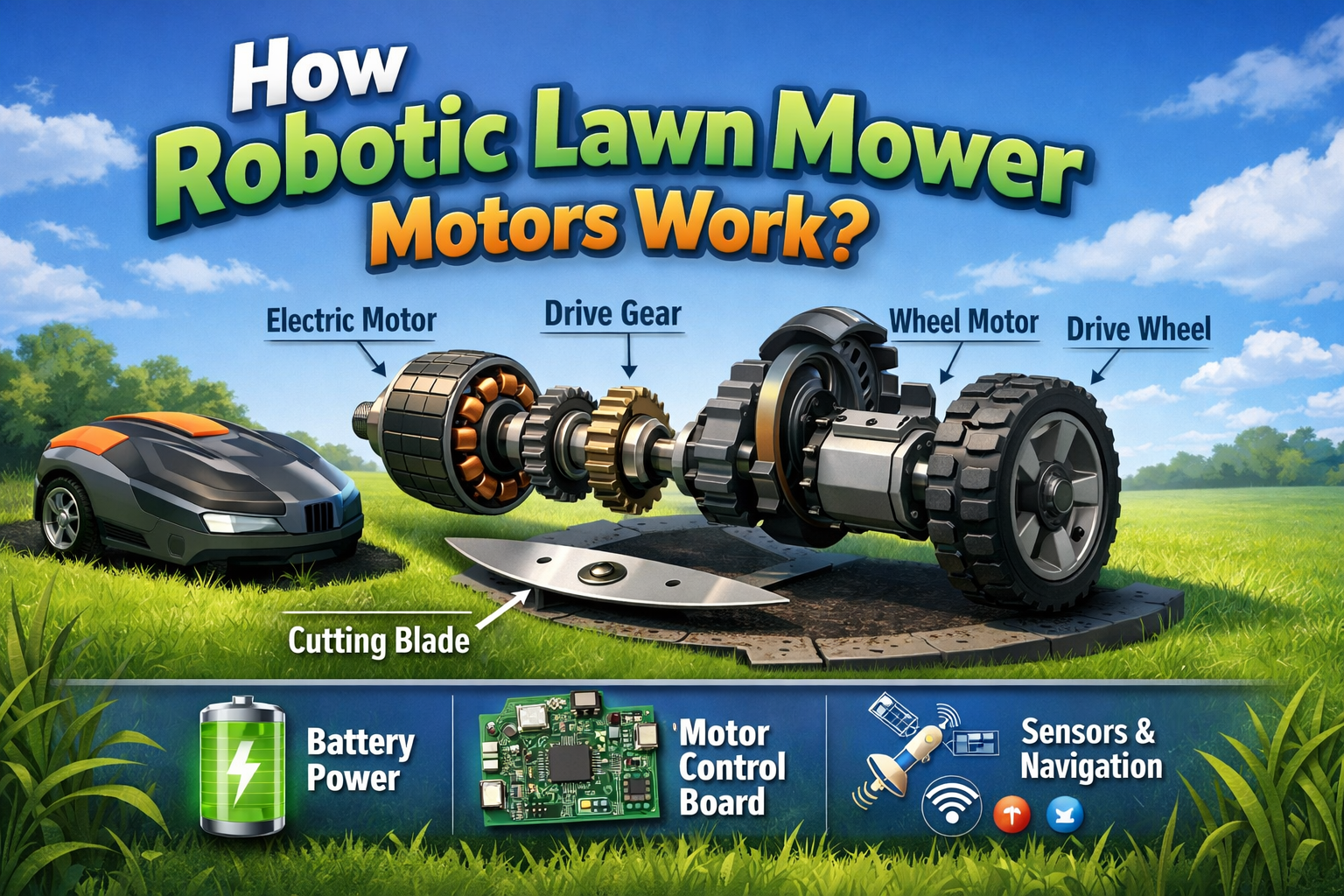
How Robotic Lawn Mower Motors Work?
Robotic lawn mowers have quickly become one of the most important innovations in modern landscaping technology. From residential smart gardens to large commercial lawns, these machines are transforming how grass is maintained. At the center of every robotic mower is a sophisticated motor system that drives movement, powers the cutting blades, and enables intelligent control. Understanding how robotic lawn mower motors work helps engineers choose the right components and helps buyers identify reliable solutions for long-term performance.
This guide explains the working principles of robotic lawn mower motors, the types of motors used, the key design challenges, and how manufacturers optimize performance for efficiency, durability, and precision. For buyers searching for a robotic lawn mower motor manufacturer or evaluating BLDC motors for lawn mowers, this article also highlights what to look for when selecting the right motor solution.
The Rapid Growth of Robotic Lawn Mowers
Over the past decade, robotic lawn mowers have shifted from niche consumer gadgets to mainstream landscaping tools. Advances in batteries, sensors, and motor technology have made them more reliable, quieter, and energy efficient than traditional gas-powered equipment.
Modern robotic lawn mowers rely on multiple electric motors working together to perform three core functions:
- Driving the wheels
- Rotating the cutting blades
- Adjusting movement and navigation
Unlike traditional lawn mowers that depend on a single combustion engine, robotic mowers use distributed electric motor systems. This allows precise control, improved efficiency, and better integration with sensors and software.
Because of these requirements, manufacturers increasingly adopt brushless DC motors (BLDC motors) for robotic lawn mower designs.
Why Motors Are the Core of Robotic Lawn Mowers?
The motor system is the heart of a robotic lawn mower. Without efficient motors, the machine cannot move smoothly, cut evenly, or operate for long periods on battery power.
A typical robotic mower uses several motors simultaneously:
- Drive Motors – Move the mower across the lawn
- Blade Motor – Rotates the cutting disc
- Adjustment Motors – Control height or steering mechanisms
Each motor must deliver a careful balance of torque, efficiency, durability, and noise reduction. These factors directly affect user experience and overall product reliability.
For manufacturers developing smart landscaping equipment, choosing the right lawn mower motor solution is critical.
Main Types of Motors Used in Robotic Lawn Mowers
Brushless DC Motors (BLDC)
Most modern robotic lawn mowers rely on BLDC motors. These motors use electronic controllers instead of brushes to control rotor movement.
The benefits include:
- Higher energy efficiency
- Longer lifespan
- Lower maintenance
- Quieter operation
- Better torque control
Because robotic mowers run continuously for hours, efficiency is extremely important. BLDC motors help extend battery life while maintaining strong cutting performance.
This is why many manufacturers partner with a specialized BLDC motor manufacturer to develop customized drive and blade motors.
Brushed DC Motors
Some entry-level robotic mowers still use brushed DC motors because they are inexpensive and simple to control.
However, brushed motors have limitations:
- Brushes wear out over time
- Lower efficiency
- Higher heat generation
- More maintenance requirements
For high-end robotic lawn mower systems, brushed motors are gradually being replaced by BLDC motors.
Planetary Gear Motors
Many robotic mowers use planetary gear motors for wheel drive systems. These motors combine a DC or BLDC motor with a planetary gearbox.
The gearbox provides several advantages:
- Higher torque output
- Compact size
- Improved power transmission
- Smooth operation under load
A planetary gear motor for robotic lawn mowers allows the machine to climb slopes, move across uneven terrain, and maintain stable speed.
The Motor Architecture Inside a Robotic Lawn Mower
A robotic lawn mower usually contains three core motor subsystems.
Drive Wheel Motors
Drive motors control the movement of the mower. Each wheel may have its own motor, enabling differential steering.
By adjusting the speed of each wheel independently, the mower can:
- Turn left or right
- Navigate obstacles
- Follow programmed mowing paths
This system is similar to the drive systems used in mobile robots and automated guided vehicles.
Most robotic mowers use high torque BLDC gear motors with planetary reducers for wheel drive.
Cutting Blade Motor
The blade motor spins a cutting disc equipped with small razor blades. Unlike traditional mowers that use large steel blades, robotic mowers rely on lightweight rotating discs.
The blade motor must deliver:
- High rotational speed
- Stable torque
- Low vibration
Typical blade motor speeds range from 2000 to 4000 RPM.
Because cutting grass requires consistent performance, manufacturers often use high efficiency brushless motors to power the blade system.
Auxiliary Motors
Some advanced robotic mowers include additional motors for functions such as:
- Cutting height adjustment
- Automatic charging port alignment
- Sensor positioning
Although smaller, these motors still require precise control and high reliability.
How Robotic Lawn Mower Motors Work?
The operation of robotic lawn mower motors involves a combination of electrical control, mechanical transmission, and sensor feedback.
The process generally works as follows.
First, the onboard battery supplies DC power to the motor controller. The controller converts this power into controlled electrical signals.
Next, the motor controller sends timed electrical pulses to the stator coils of the BLDC motor. These pulses generate a rotating magnetic field.
This magnetic field interacts with the permanent magnets in the rotor. The interaction produces rotational force, which spins the motor shaft.
Once the shaft rotates, the motion is transferred to either:
- The drive wheels
- The cutting blade disc
- A gearbox
Sensors constantly monitor motor speed, temperature, and load. The control system adjusts motor performance in real time to maintain efficient operation.
This closed-loop control system allows robotic lawn mowers to adapt to changing terrain and grass conditions.
The Role of Motor Controllers
Motor controllers are essential components in robotic lawn mower systems.
A motor controller performs several functions:
- Regulating motor speed
- Controlling torque output
- Protecting against overheating
- Improving energy efficiency
For BLDC motors, the controller replaces the mechanical commutation used in brushed motors.
Advanced robotic mowers often use field-oriented control (FOC) algorithms. These algorithms improve torque smoothness and reduce noise.
This level of control is especially important when navigating complex lawns with obstacles.
Battery and Motor Efficiency
Robotic lawn mowers operate on rechargeable lithium batteries. Because battery capacity is limited, motor efficiency directly affects operating time.
High-efficiency motors provide several advantages:
- Longer mowing cycles
- Reduced heat generation
- Lower power consumption
A well-designed robotic lawn mower motor system can extend runtime by more than 30 percent compared to less efficient designs.
This is one reason why manufacturers prioritize energy-efficient BLDC motors.
Key Design Challenges for Lawn Mower Motors
Motor systems used in robotic lawn mowers must overcome several engineering challenges.
Operating in Outdoor Environments
Robotic mowers operate outdoors under challenging conditions, including:
- Dust
- Moisture
- Temperature changes
- Grass debris
Motors must be sealed and protected to ensure reliable operation.
Handling Impact and Vibration
While moving across lawns, robotic mowers encounter uneven ground and obstacles.
Drive motors must tolerate:
- Mechanical shock
- Continuous vibration
- Sudden load changes
High-quality bearings and gear systems are essential for durability.
Noise Reduction
Homeowners prefer quiet lawn equipment. Motor noise is therefore a major design concern.
BLDC motors are popular because they produce:
- Less electrical noise
- Smoother rotation
- Reduced mechanical friction
Key Performance Factors When Choosing a Robotic Lawn Mower Motor
When selecting a motor for robotic lawn mowers, manufacturers usually evaluate several important parameters.
Torque
Drive motors must produce enough torque to climb slopes and move through thick grass.
Efficiency
High efficiency reduces battery consumption and improves operating time.
Size and Weight
Compact motors allow designers to build lightweight robotic mowers.
Durability
Outdoor equipment requires motors that can operate for thousands of hours without failure.
The Role of Gearboxes in Robotic Mower Motors
Gearboxes are commonly used to improve torque output.
Planetary gearboxes are particularly popular because they offer:
- High torque density
- Compact structure
- Smooth power transmission
A planetary gear motor for robotic lawn mowers allows the mower to move slowly with strong pulling force.
This is essential for navigating slopes and rough terrain.
Why Manufacturers Prefer BLDC Motors?
The shift toward brushless motors in robotic lawn mowers is driven by several advantages.
First, BLDC motors offer longer service life because there are no brushes to wear out.
Second, they provide higher efficiency, which helps extend battery runtime.
Third, BLDC motors support precise electronic control, allowing the mower to adjust speed based on terrain and grass density.
Because of these advantages, many equipment brands partner with a specialized BLDC motor manufacturer to develop custom motor solutions.
Future Trends in Robotic Lawn Mower Motors
The robotic lawn mower industry continues to evolve rapidly. Several trends are shaping the future of motor technology.
Smart Motor Control
Advanced algorithms are improving motor efficiency and motion precision.
Integrated Motor Modules
Manufacturers are integrating motors, gearboxes, and controllers into compact modules.
Higher Efficiency Designs
Improved magnetic materials and winding techniques are increasing motor performance.
AI-Based Motion Control
Artificial intelligence systems may soon optimize motor performance automatically based on lawn conditions.
Robotic Lawn Mower Motor Solutions from United Motion Inc.
As robotic lawn mowers become more popular worldwide, equipment manufacturers need reliable motor partners.
United Motion Inc. specializes in designing and manufacturing high-performance motors for automation equipment and robotic systems.
Our motor solutions for robotic lawn mowers include:
- 36mm BLDC drive motors for compact robotic mowers
- 42mm planetary gear motors for high torque wheel drive
- 57mm brushless motors for cutting blade systems
These motors are designed for:
- High efficiency
- Low noise operation
- Long service life
- Stable torque output
By combining advanced motor design with precision manufacturing, United Motion Inc. helps robotic mower manufacturers build more reliable and efficient products.
Conclusion
Robotic lawn mowers rely on sophisticated motor systems to deliver reliable and efficient lawn maintenance. From drive wheel motors to high-speed blade motors, every component plays a critical role in overall performance.
Brushless DC motors have become the preferred solution for robotic lawn mowers because they provide higher efficiency, longer lifespan, and better control compared to traditional motor technologies.
For equipment manufacturers developing next-generation robotic mowers, selecting the right robotic lawn mower motor solution is essential for achieving optimal performance and long-term reliability.
With growing demand for smart landscaping technology, motor innovation will continue to shape the future of robotic lawn care.
References
Hendershot, J., & Miller, T. “Design of Brushless Permanent-Magnet Motors.” Oxford University Press.
Krishnan, R. “Permanent Magnet Synchronous and Brushless DC Motor Drives.” CRC Press.
Boldea, I., & Nasar, S. “Electric Drives.” CRC Press.
Husqvarna Group Technical White Paper – Robotic Lawn Mower Technology.
IEEE Industry Applications Society – Electric Motor Control Systems Research.
Related blog: Lawn Mower Motor Solutions for Robotic Mowers