
Quick Answer
Selecting a robotic mower drive motor for slope applications requires more than choosing a motor with sufficient rated power. Engineers must consider the mower’s total weight, maximum operating slope, wheel radius, required wheel-end torque, tire-ground traction, gearbox ratio, and changing loads during climbing, turning, and acceleration.
When a robotic lawn mower travels uphill, gravity increases the resistance acting against the drive wheels. If the available wheel torque is insufficient, the mower may lose speed or stall; if the motor produces more torque than the tires can transfer to the ground, the wheels may spin without generating additional climbing force.
For reliable slope performance, OEM engineers should select a BLDC drive motor with an appropriate gearbox, sufficient continuous and peak torque, effective thermal management, and a control strategy that responds to changing traction conditions.
Why Slope Performance Matters in Robotic Lawn Mowers?
Slopes create additional mechanical demands because the drive system must overcome both rolling resistance and the component of vehicle weight acting down the incline.
Compared with flat-ground operation, climbing slopes requires higher wheel torque, while descending introduces braking and speed-control requirements. Uneven terrain can further change wheel loading, causing one wheel to lose contact pressure or traction temporarily.
Slope specifications also need careful interpretation. A 30% gradient is approximately 16.7°, while a 45% gradient is approximately 24.2°. These values are not interchangeable with degrees.
For reference, Husqvarna’s Automower 420 iQ product specifications, published in its 2026 product documentation, list maximum slope performance of 45% inside the installation area and 15% at the boundary. This illustrates why operating conditions and travel direction must be considered alongside the advertised maximum gradient.
Calculate the Required Wheel-End Torque
Wheel-end torque is one of the most important parameters when selecting a robotic mower drive motor.
Engineers should first determine the forces the mower must overcome, including:
- Vehicle weight
- Slope resistance
- Rolling resistance
- Acceleration requirements
- Tire deformation
- Additional resistance from wet or dense grass
Example: A 20 kg Robotic Lawn Mower
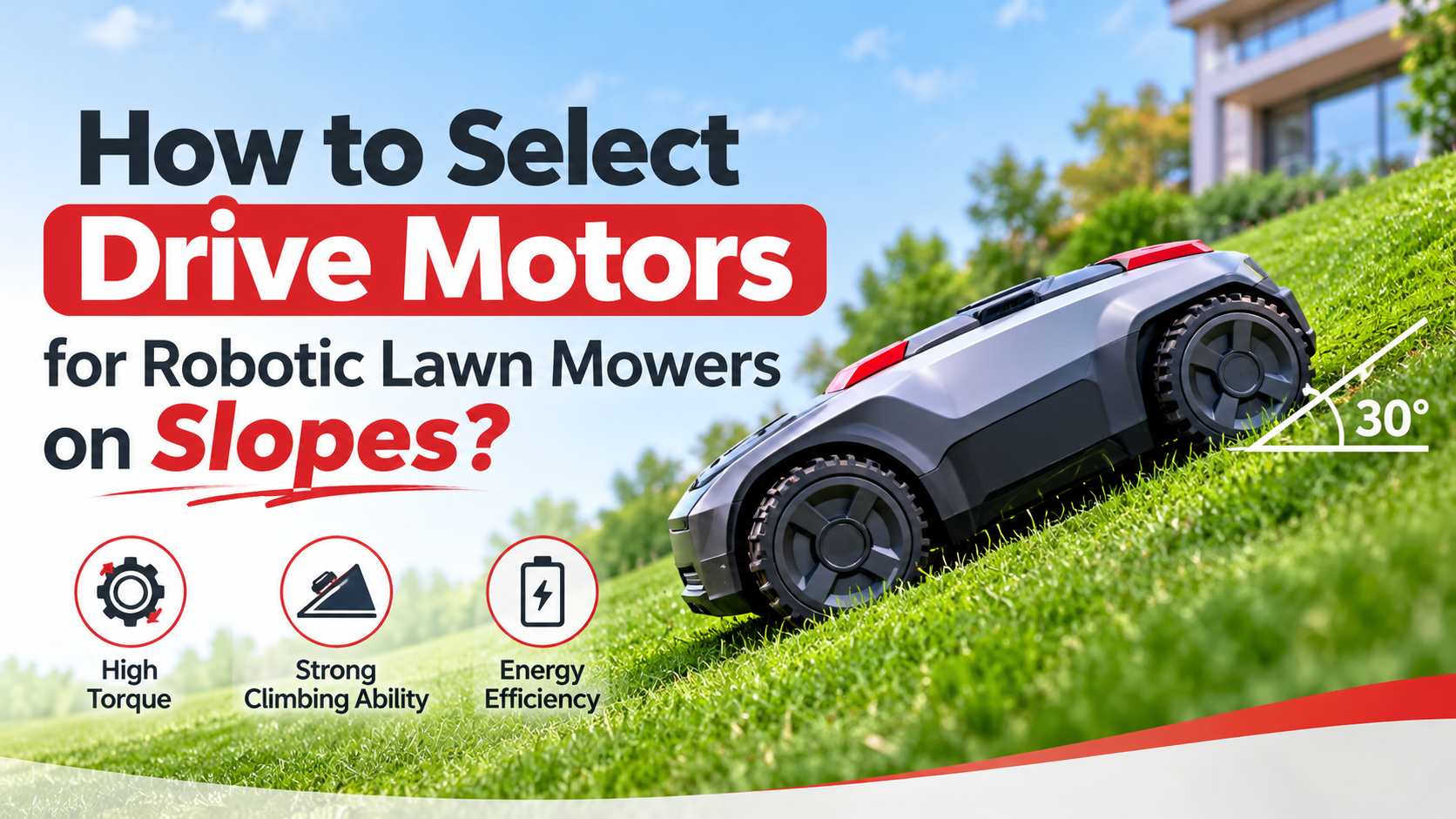
Consider a robotic mower with a total weight of 20 kg operating on a 30° slope, using two driven wheels with a 100 mm effective radius.
The gravitational force acting down the slope is approximately 98 N. If the two drive wheels share the load equally, each wheel must provide approximately 49 N of uphill force.
At this operating point, each wheel requires approximately 4.9 N·m of ideal output torque, before accounting for rolling resistance, acceleration, gearbox losses, uneven load distribution, and engineering safety margin.
This example demonstrates why selecting a motor based only on rated wattage can lead to poor results: two motors with similar power ratings may have significantly different low-speed torque characteristics and gearbox configurations.
Why Gearbox Selection Matters?
Most robotic lawn mower drive systems use a reduction gearbox to convert relatively high motor speed into lower wheel speed and higher output torque.
A properly selected gearbox allows a compact BLDC motor to provide the torque required for climbing without unnecessarily increasing motor size.
| Gearbox Consideration | Engineering Impact |
|---|---|
| Gear ratio | Determines the relationship between motor speed and wheel speed |
| Output torque | Determines available wheel-driving force |
| Gear efficiency | Affects usable torque and energy consumption |
| Gear material | Influences durability and wear resistance |
| Backlash | Affects directional accuracy and motion smoothness |
| Thermal capacity | Determines continuous operating capability |
For example, a higher reduction ratio can improve climbing torque, but excessive reduction may limit travel speed and reduce maneuverability.
Therefore, gearbox selection should balance maximum climbing torque, normal operating speed, acceleration, and continuous duty requirements.
Tire Traction: More Motor Torque Does Not Always Mean Better Climbing
One of the most common mistakes in robotic mower design is assuming that increasing motor torque automatically improves slope performance.
In reality, the maximum usable driving force is limited by the friction between the tire and ground.
When the motor produces more wheel torque than the tire-ground interface can transfer, the wheel begins to slip. This can increase grass damage, reduce climbing stability, and waste battery energy.
Tire performance depends on several factors:
- Tread pattern and tread depth
- Tire diameter and width
- Rubber compound
- Contact pressure
- Wheel loading
- Grass moisture
- Soil condition
- Surface irregularities
A 2023 study published in Sensors, titled “Grass Cutting Robot for Inclined Surfaces in Hilly and Mountainous Areas,” investigated robotic locomotion on steep terrain and compared different steering configurations. The research demonstrated the importance of traction and wheel-control strategies, with four-wheel steering providing effective mobility on inclined grass surfaces.
How Load Changes Affect Drive Motor Selection?
A robotic mower rarely operates under constant mechanical load. Its drive motors must handle several changing conditions throughout a mowing cycle.
| Operating Condition | Load Characteristics | Motor Requirement |
|---|---|---|
| Flat-ground travel | Relatively low resistance | Efficient continuous operation |
| Uphill climbing | Increased gravitational resistance | Higher continuous torque |
| Starting on a slope | High initial torque demand | Adequate peak torque |
| Turning on grass | Different wheel speeds and resistance | Responsive speed control |
| Wet grass | Reduced tire traction | Controlled torque output |
| Uneven terrain | Changing wheel loading | Stable torque and current control |
| Downhill travel | Gravity assists movement | Controlled braking and speed regulation |
For example, a mower may climb successfully on dry grass but experience wheel slip on wet grass at the same slope angle. Similarly, a fully loaded mower with additional battery or cutting-system weight may require more climbing torque than an unloaded prototype.
Engineers should therefore evaluate both continuous and peak operating conditions instead of sizing the motor around one ideal test.
BLDC Motor vs. Geared BLDC Motor for Robotic Mowers
| Comparison | BLDC Motor | Geared BLDC Motor |
|---|---|---|
| Output speed | Generally higher | Reduced |
| Output torque | Depends on motor size | Increased through reduction |
| Installation | May require external gearbox | Integrated or matched gearbox |
| Low-speed operation | Depends on control and motor design | Can be optimized through reduction |
| Climbing applications | Requires suitable torque configuration | Often more suitable |
| System integration | Additional mechanical design may be needed | More convenient for compact drive systems |
For most compact robotic mower platforms, a geared BLDC motor is a practical option because it combines efficient electric drive with the mechanical reduction required for wheel propulsion.
However, the final selection depends on vehicle weight, wheel diameter, required speed, available installation space, and the terrain.
How to Select a Robotic Mower Drive Motor Step by Step?
Step 1: Define the maximum slope
Identify the maximum operating gradient and distinguish between continuous climbing, short-duration climbing, and boundary-area operation.
Step 2: Determine total vehicle weight
Include the battery, cutting system, housing, electronics, and other installed components.
Step 3: Calculate required wheel torque
Consider slope resistance, rolling resistance, acceleration, wheel radius, and uneven load distribution.
Step 4: Select the gearbox
Match the reduction ratio to the required wheel speed and output torque, while considering gearbox efficiency and service life.
Step 5: Check tire traction
Confirm that the tires can transfer the required driving force without excessive wheel slip.
Step 6: Verify motor thermal performance
Repeated uphill operation can increase winding temperature and current demand. Check continuous torque, peak current, and thermal limits.
Step 7: Test under real conditions
Validate climbing performance on dry grass, wet grass, uneven ground, and different slope angles.
Common Drive Motor Problems and Solutions
| Problem | Possible Cause | Recommended Solution |
|---|---|---|
| Mower cannot climb | Insufficient wheel torque | Recheck motor and gearbox selection |
| Wheels spin on slopes | Insufficient tire traction | Improve tread and wheel loading |
| Motor overheats | Excessive continuous load | Select suitable continuous torque capacity |
| Mower slows down uphill | Insufficient torque reserve | Optimize reduction ratio |
| Uneven turning | Different wheel speeds or loading | Improve independent wheel control |
| Poor battery runtime | Excessive current demand | Optimize motor efficiency and drivetrain |
| Unstable downhill movement | Insufficient braking control | Improve regenerative or electrical braking strategy |
Why OEM Motor Customization Matters?
Different robotic mower platforms require different drive configurations. A residential mower weighing 15–20 kg has different torque and thermal requirements from a commercial mower designed for larger areas and more demanding terrain.
UNITED MOTION INC. provides BLDC motor solutions across approximately 28–110 mm frame sizes, with customization options including gearboxes, encoders, and integrated drivers.
For robotic lawn mower manufacturers, these configurations can support different requirements for motor voltage, speed, torque, wheel-end output, feedback, and installation dimensions.
A customized geared BLDC motor can help OEM engineers balance climbing capability, compact structure, energy efficiency, and long-term operating reliability.
Source: UNITED MOTION INC. BLDC motor product information and engineering capabilities.
Conclusion
Selecting the right robotic mower drive motor requires a complete understanding of slope resistance, wheel-end torque, tire traction, gearbox performance, and changing operating loads.
A motor with high rated power may still perform poorly if the gearbox ratio is unsuitable or the tires cannot transfer sufficient force to the ground. Conversely, a properly matched BLDC motor, gearbox, and wheel configuration can provide reliable climbing performance without unnecessary increases in motor size or battery consumption.
For OEM manufacturers, the most effective approach is to evaluate the complete drive system under realistic terrain conditions and customize the motor configuration around the actual application requirements.
UNITED MOTION INC. supports OEM motor development with BLDC motor, gearbox, encoder, and integrated driver solutions for industrial and outdoor equipment applications.