
Quick Answer
A hub motor is often the better choice for robotic lawn mowers that require compact wheel-drive integration, fewer transmission components, and simplified mechanical assembly, while a geared motor is often preferable when the design requires a specific reduction ratio, high output torque at low wheel speed, flexible motor placement, or greater freedom in transmission design.
The right solution depends on wheel diameter, mower weight, grass conditions, slope capability, traction requirements, battery voltage, operating noise, and production cost. For OEM manufacturers, the decision should be based on the complete drive system rather than motor price alone.
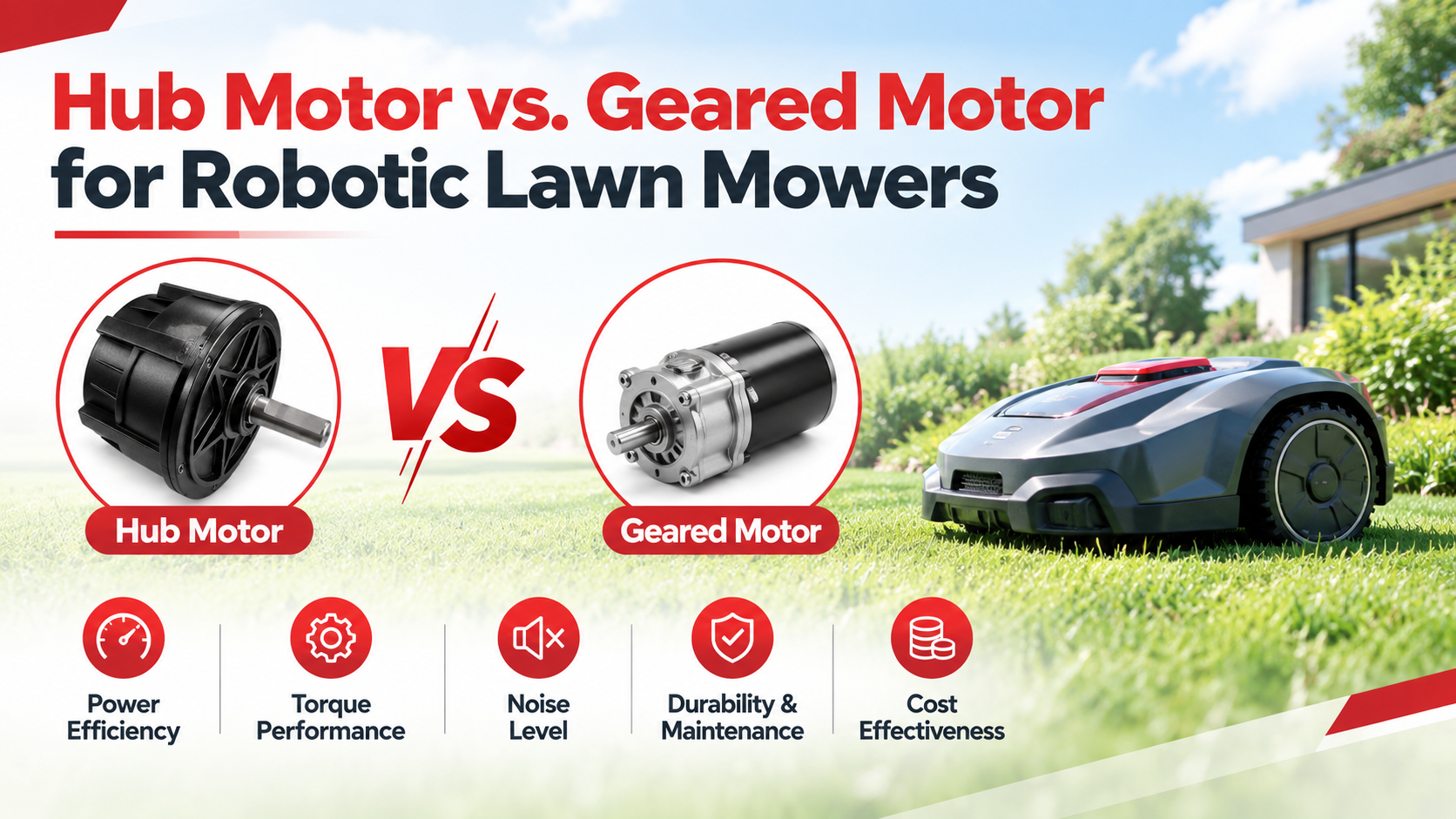
A robotic lawn mower hub motor integrates the drive motor into the wheel or wheel hub, reducing the need for a separate transmission between the motor and wheel. A geared motor combines an electric motor with a gearbox, allowing engineers to select a reduction ratio that matches the required wheel speed and torque.
Engineering takeaway: Choose a hub motor when compact integration and fewer mechanical components are priorities; choose a geared motor when transmission flexibility, output torque optimization, and independent motor placement are more important.
What Is a Robotic Lawn Mower Hub Motor?
A hub motor places the motor’s driving mechanism within the wheel assembly, allowing the wheel to receive torque directly from the integrated drive unit without requiring a conventional external gearbox between the motor and wheel.
Depending on the design, a hub motor may use a brushless DC motor, permanent magnets, bearings, and an integrated wheel structure. Some configurations also incorporate position sensors or other feedback components.
For robotic lawn mower manufacturers, the main advantages include:
High integration: The motor and wheel-drive assembly form a compact unit.
Reduced transmission complexity: Fewer external mechanical transmission components may be required.
Simplified assembly: Fewer separate drive components can reduce installation steps.
Flexible product packaging: The integrated arrangement can help free space for batteries, controllers, and other mower components.
However, a hub motor must still accommodate wheel loads, impact forces, moisture, dirt, grass debris, and heat generated during prolonged operation. Bearing selection, sealing, structural strength, and serviceability therefore remain critical design considerations.
What Is a Geared Motor for Robotic Lawn Mowers?
A geared motor combines an electric motor with a gearbox that reduces rotational speed and increases available output torque within the limits of the complete drive system.
For robotic lawn mowers, common configurations include BLDC motors paired with planetary, spur, or other suitable gearboxes. The appropriate gearbox depends on the required output speed, torque, efficiency, noise, load characteristics, and available installation space.
A geared motor offers several engineering advantages:
Adjustable transmission ratio: Engineers can match motor speed to wheel speed.
Flexible placement: The motor can be positioned independently of the wheel when the mechanical layout permits.
Torque optimization: Gear reduction can provide the output torque needed for starting, turning, and climbing slopes.
Design flexibility: Different gearbox configurations can support different wheel sizes and mower platforms.
The main trade-offs are the additional mechanical components, gearbox packaging requirements, potential transmission noise, and maintenance considerations associated with the selected gear design.
Hub Motor vs. Geared Motor: Key Differences
| Comparison Factor | Hub Motor | Geared Motor |
| Integration | Motor integrated into wheel assembly | Motor and gearbox form a drive unit connected to the wheel |
| Installation space | Can reduce separate transmission space | Requires space for the motor and gearbox |
| Transmission structure | Direct wheel-drive architecture | Uses a reduction gear train |
| Output speed | Determined by motor and wheel-drive design | Adjusted through motor speed and gear ratio |
| Output torque | Depends on motor design and wheel configuration | Can be increased through appropriate gear reduction |
| Mechanical assembly | Potentially fewer separate components | Usually involves additional transmission components |
| Maintenance | Fewer transmission components, but wheel-unit servicing may be complex | Gearbox may require inspection or service, depending on design |
| Noise | No external reduction gearbox, but motor and bearing noise remain | Gear-mesh noise may be present |
| Cost considerations | Can reduce assembly and component count | Gearbox adds components but may enable a lower-cost motor design |
| Best fit | Compact, integrated wheel-drive platforms | Applications requiring flexible speed reduction and motor placement |
These are general tendencies rather than universal performance guarantees. Actual results depend on motor architecture, gearbox type, wheel geometry, manufacturing volume, environmental protection, and service requirements.
Installation Space and Integration
Hub Motor: A Compact Drive Architecture
A robotic lawn mower hub motor can reduce the number of separate drive components, making it attractive when the mower chassis has limited space or when manufacturers want to simplify wheel-drive assembly.
This arrangement can also reduce the need for separate transmission housings and mounting interfaces. However, engineers must reserve sufficient space for wheel bearings, electrical connections, structural supports, and environmental sealing.
Geared Motor: More Freedom in Mechanical Layout
A geared motor can be installed inside the chassis or connected to a wheel through a suitable transmission arrangement, allowing engineers to separate the motor’s location from the wheel when required.
This flexibility is valuable when wheel geometry, suspension, chassis structure, or service access makes a fully integrated hub assembly impractical.
Selection tip: Compare the complete installed envelope, including connectors, mounting brackets, gearbox housing, wiring clearance, and service access, instead of comparing motor dimensions alone.
Transmission Structure, Torque, and Climbing Ability
Robotic lawn mowers must maintain traction when starting on grass, crossing uneven terrain, turning, or climbing slopes. Wet grass, dense vegetation, wheel diameter, and mower weight can significantly change the required drive torque.
A hub motor provides an integrated wheel-drive arrangement, but its available torque must still be sufficient for the intended operating conditions.
A geared motor allows engineers to select a reduction ratio that better matches the motor’s operating speed to the required wheel speed. Nevertheless, gearbox efficiency, mechanical strength, backlash, and peak-load capacity must be evaluated rather than assuming that a higher reduction ratio automatically produces a better drive system.
| Application Requirement | Design Consideration |
| Frequent starts and stops | Peak torque and thermal capability |
| Sloped lawns | Wheel torque, traction, and motor temperature |
| Wet or dense grass | Load variation and wheel-slip control |
| Compact chassis | Complete drive-unit dimensions |
| Low operating noise | Motor, gearbox, bearing, and structural vibration |
| Long operating cycles | Continuous torque and thermal management |
For either architecture, the drive system must be validated under representative grass, slope, temperature, and battery conditions.
Maintenance and Reliability
A hub motor can reduce the number of separate transmission components, potentially simplifying routine maintenance. However, integrating the motor into the wheel can make repairs more involved if the complete assembly must be removed to access internal components.
A geared motor introduces additional mechanical elements, including gears, bearings, and potentially lubrication or sealing systems. The maintenance requirements depend on whether the gearbox is sealed, lubricated for life, or designed for periodic servicing.
For outdoor robotic lawn mowers, both architectures should be assessed for:
- Water and dust ingress
- Grass and debris accumulation
- Bearing wear
- Shock and vibration
- Cable and connector durability
- Thermal performance
- Availability of replacement components
An appropriate ingress-protection rating should be selected according to the actual exposure conditions and verified at the complete assembly level where applicable.
Which Solution Has the Lower Total Cost?
The lowest initial motor price does not necessarily produce the lowest overall system cost.
A hub motor may reduce the number of parts, brackets, and assembly operations, potentially lowering manufacturing costs when the integrated design is well suited to the product platform. Conversely, a geared motor may offer cost advantages when a standard motor and gearbox combination meets the application requirements without extensive customization.
OEM purchasing teams should evaluate:
- Motor and gearbox purchase price.
- Mounting hardware and chassis modifications.
- Assembly time and production labor.
- Wiring and controller integration.
- Testing and quality-control requirements.
- Expected maintenance and replacement costs.
- Product reliability and warranty exposure.
The final decision should consider the total cost of ownership across the expected product life, not merely the unit price quoted by a supplier.
How to Select the Right Motor: A Step-by-Step Guide?
Step 1: Define the mower requirements. Establish total weight, wheel diameter, target speed, slope capability, battery voltage, operating duration, and environmental conditions.
Step 2: Determine the torque and speed requirements. Consider starting, climbing, turning, and continuous operation rather than relying only on nominal running conditions.
Step 3: Compare the complete mechanical layouts. Evaluate wheel integration, chassis space, wiring, mounting interfaces, and maintenance access.
Step 4: Evaluate thermal and electrical compatibility. Confirm that the motor, controller, and battery can support continuous operation and peak-load events.
Step 5: Test representative conditions. Validate traction, temperature rise, noise, water and debris protection, and endurance using the intended wheel and mower configuration.
Step 6: Compare total system costs. Include assembly, customization, quality control, maintenance, and expected service life before finalizing the design.
Common Robotic Lawn Mower Drive Problems
| Problem | Possible Cause | Recommended Check |
|---|---|---|
| Insufficient climbing ability | Inadequate wheel torque or traction | Test on the specified slope and grass conditions |
| Excessive motor temperature | Overloading, insufficient cooling, or poor control settings | Measure current and temperature under sustained load |
| High operating noise | Gear mesh, bearings, vibration, or structural resonance | Inspect the complete drive assembly |
| Frequent wheel-drive failures | Water ingress, shock loading, or bearing damage | Inspect sealing, bearings, and mechanical loads |
| Limited battery runtime | Excessive drive current or inefficient system operation | Measure energy consumption across representative mowing cycles |
| Difficult maintenance | Poor service access or highly integrated components | Review replacement procedures during the design stage |
Why Work with UNITED MOTION INC.?
Selecting a drive motor for a robotic lawn mower requires coordination between motor performance, transmission design, electrical control, and mechanical integration.
UNITED MOTION INC. provides BLDC motor solutions across approximately Φ28–Φ110 mm frame sizes, with configurable options such as gearboxes, encoders, and integrated drivers. The appropriate configuration depends on the application’s required torque, speed, voltage, installation envelope, and control requirements.
For OEM manufacturers developing robotic lawn mowers, the key is to select a motor system that meets the actual operating requirements while balancing integration, reliability, production cost, and long-term serviceability.
Whether a project requires a compact wheel-drive architecture or a BLDC motor paired with a reduction gearbox, the motor configuration should be evaluated against the complete mower design.
Contact UNITED MOTION INC. to discuss motor requirements for your robotic lawn mower project.
Frequently Asked Questions
1. Is a hub motor better than a geared motor for a robotic lawn mower?
A hub motor is often preferable when compact integration and reduced transmission complexity are priorities. A geared motor is often better when a specific reduction ratio, flexible motor placement, or a particular output-torque requirement determines the design.
2. Does a geared motor provide more torque than a hub motor?
Not necessarily. A gearbox can increase output torque by reducing speed, but the final result depends on motor torque, gear ratio, transmission efficiency, and mechanical limits. A suitably designed hub motor can also provide substantial wheel torque.
3. Which motor is easier to maintain?
A hub motor may have fewer separate transmission components, but servicing an integrated assembly can be more complicated. A geared motor may require additional gearbox inspection, depending on its construction and lubrication design.
4. Which motor is more cost-effective for OEM production?
The answer depends on production volume, component pricing, assembly labor, chassis design, customization, and maintenance costs. Comparing total system cost is more reliable than comparing motor prices alone.
5. Can a BLDC motor be used in a robotic lawn mower?
Yes. BLDC motors are suitable for robotic lawn mower drive systems when their torque, speed, voltage, thermal performance, and environmental protection meet the application requirements. They can be configured with gearboxes, feedback devices, and compatible motor drivers.
6. What should OEM engineers consider when selecting a robotic lawn mower hub motor?
Key considerations include wheel diameter, mower weight, continuous and peak torque, climbing ability, installation dimensions, sealing, thermal performance, controller compatibility, and serviceability.