
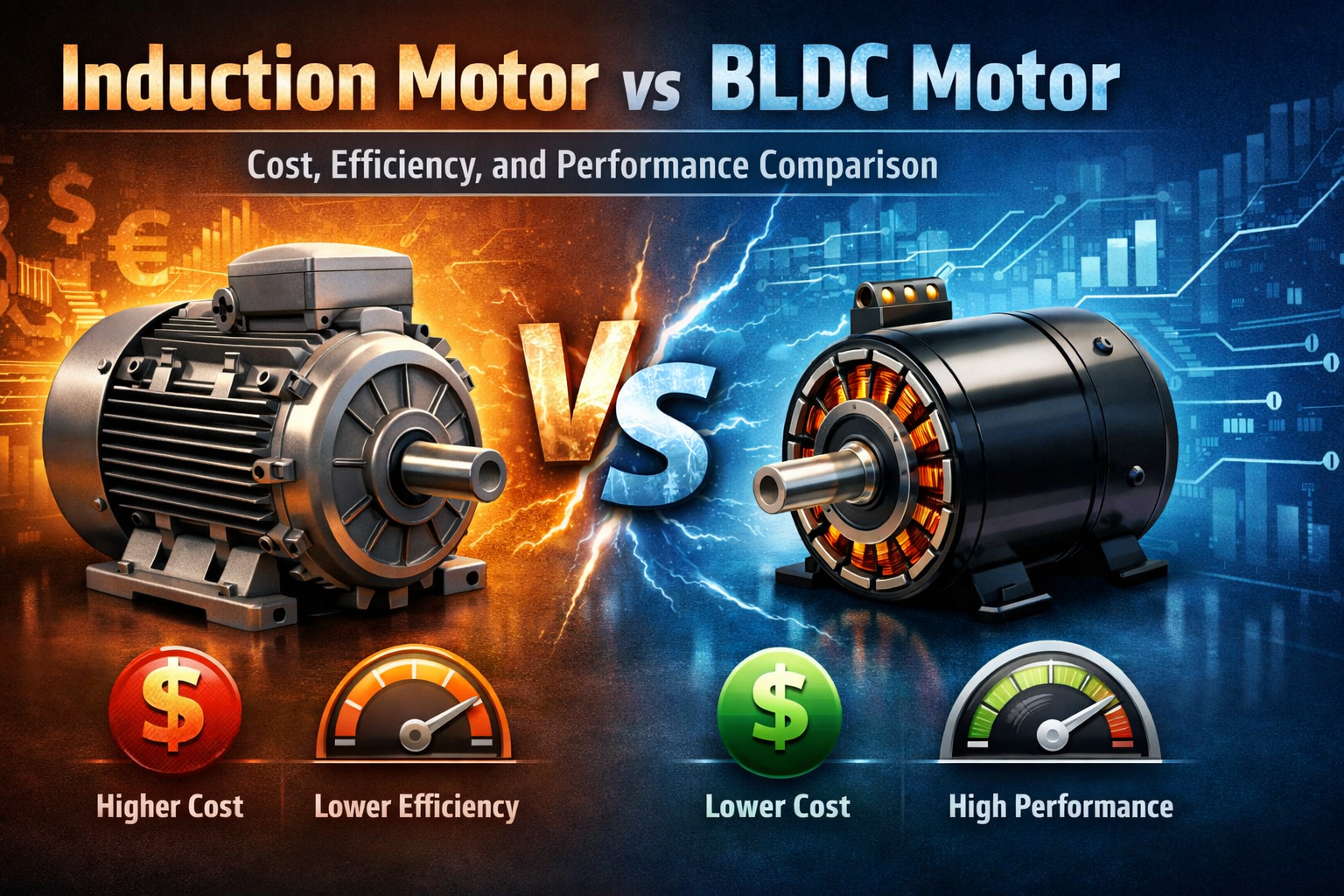
Induction Motor vs BLDC Motor: Cost, Efficiency, and Performance Comparison
In today’s fast-evolving automation and electrification landscape, choosing the right motor is no longer just a technical decision—it directly impacts system efficiency, operating cost, and long-term reliability. Buyers, engineers, and product designers often compare induction motors and BLDC motors when evaluating motion solutions for industrial equipment, robotics, electric vehicles, and smart appliances. While both motor types are widely used, their differences in cost structure, efficiency, and performance characteristics can significantly affect your final product.
This guide from United Motion Inc. explores these differences in depth, helping you make a confident and informed decision based on real-world application needs.
Understanding the Basics: Induction Motor vs BLDC Motor
An induction motor, also known as an asynchronous motor, operates by inducing current in the rotor through electromagnetic fields generated by the stator. It does not require permanent magnets, which makes it structurally simple and cost-effective for many industrial uses. This motor type has been the backbone of manufacturing for decades due to its durability and low maintenance.
In contrast, a BLDC motor (Brushless DC Motor) uses permanent magnets on the rotor and relies on electronic commutation instead of brushes. This design eliminates mechanical wear components and allows for higher efficiency, precise control, and compact size. BLDC motors are now widely used in applications such as robotics, electric vehicles, and smart home devices.
Cost Comparison: Initial Investment vs Lifecycle Value
When comparing cost, many buyers focus only on the initial purchase price. However, the real difference between induction motors and BLDC motors becomes clearer when evaluating the total cost of ownership.
Induction motors typically have a lower upfront cost because they do not use expensive rare-earth magnets or advanced controllers. This makes them a popular choice in large-scale industrial environments where cost sensitivity is high and precision control is not critical. For example, conveyor systems, pumps, and HVAC equipment often rely on induction motors due to their affordability and robustness.
However, BLDC motors come with higher initial costs due to the inclusion of permanent magnets and electronic controllers. Despite this, they often deliver better long-term value. Their higher efficiency reduces energy consumption, and their lower maintenance requirements minimize downtime and service costs. In applications where energy efficiency and performance are critical, the return on investment for BLDC motors is often faster than expected.
From a buyer’s perspective, the key question is not “Which motor is cheaper?” but rather “Which motor delivers the best value over time?”
Efficiency Comparison: Energy Savings and System Optimization
Efficiency is one of the most important factors in modern motor selection, especially as energy costs continue to rise and sustainability becomes a priority.
Induction motors generally operate at efficiency levels between 85% and 92%, depending on design and load conditions. While this is sufficient for many industrial applications, energy losses in the rotor and stator can accumulate over time, especially in continuous operation environments.
BLDC motors, on the other hand, can achieve efficiency levels above 90% and often reach up to 95% under optimal conditions. Because they use permanent magnets and eliminate rotor losses, they generate less heat and require less energy to produce the same output power. This makes them particularly suitable for battery-powered devices and energy-sensitive applications.
In real-world scenarios, switching from an induction motor to a BLDC motor can result in energy savings of 20% to 30%, depending on usage patterns. For manufacturers operating multiple machines, this difference can translate into significant cost reductions over the life of the equipment.
Performance Comparison: Speed, Torque, and Control
Performance is where BLDC motors clearly differentiate themselves from traditional induction motors.
Induction motors are known for their reliability and ability to handle heavy loads. However, their speed control typically requires additional components such as variable frequency drives (VFDs), which increase system complexity and cost. Even with VFDs, achieving precise speed and torque control can be challenging.
BLDC motors excel in performance due to their electronic commutation and advanced control algorithms. They offer precise speed regulation, high starting torque, and quick response times. This makes them ideal for applications requiring accuracy, such as robotic arms, CNC machines, and medical equipment.
Another key advantage of BLDC motors is their ability to maintain consistent performance across a wide speed range. This flexibility allows designers to optimize system performance without compromising efficiency.
Maintenance and Reliability: Long-Term Considerations
Maintenance is a critical factor in industrial environments where downtime can be costly.
Induction motors are highly durable and can operate in harsh conditions with minimal maintenance. Since they do not rely on brushes or electronic components, they are less sensitive to environmental factors such as dust and temperature fluctuations.
BLDC motors, while generally reliable, depend on electronic controllers and sensors, which may require more careful handling and protection. However, because they do not have brushes, they eliminate one of the most common points of failure found in traditional DC motors.
In many cases, BLDC motors offer longer service life and reduced maintenance intervals, especially in clean and controlled environments.
Application Scenarios: Choosing the Right Motor for Your Needs
Different applications demand different motor characteristics, and understanding these requirements is key to making the right choice.
Induction motors are best suited for:
- Industrial machinery
- Pumps and compressors
- HVAC systems
- Conveyor systems
BLDC motors are ideal for:
- Robotic systems
- Electric vehicles
- Drones and automation equipment
- Smart appliances
- Precision medical devices
For buyers searching for a reliable BLDC motor manufacturer, companies like United Motion Inc. provide customized solutions tailored to specific application needs, ensuring optimal performance and efficiency.
Hidden Costs and System Integration Factors
Beyond the obvious differences in cost and efficiency, there are hidden factors that can influence your decision.
Induction motors often require additional components such as gearboxes and cooling systems, which can increase overall system complexity. Their larger size and weight may also impact product design and shipping costs.
BLDC motors, with their compact size and high power density, can simplify system design and reduce overall footprint. However, they require compatible controllers and software integration, which may add to development time.
Understanding these factors helps buyers make more strategic decisions rather than focusing solely on specifications.
Future Trends: Why BLDC Motors Are Gaining Popularity
As industries move toward automation, electrification, and energy efficiency, BLDC motors are becoming the preferred choice for many modern applications.
Advancements in motor control technology, decreasing costs of electronic components, and increasing demand for energy-efficient solutions are driving the adoption of BLDC motors across industries.
At the same time, induction motors continue to evolve with improved designs and materials, ensuring they remain relevant in heavy-duty applications.
The future is not about replacing one motor type with another, but about selecting the right technology for the right application.
Final Thoughts: Making the Right Decision
Choosing between an induction motor and a BLDC motor requires a clear understanding of your application requirements, budget constraints, and long-term goals.
If your priority is low upfront cost and rugged performance, an induction motor may be the right choice. However, if you are looking for higher efficiency, precise control, and better long-term value, a BLDC motor is often the smarter investment.
References
International Energy Agency (IEA) – Energy Efficiency in Motor Systems
U.S. Department of Energy – Electric Motor Systems Market Opportunities
IEEE Industry Applications Society – Motor Efficiency Standards
Siemens Technical Documentation – Induction Motor Performance Guide
ResearchGate – Comparative Study of BLDC and Induction Motors
NEMA Standards Publication – Motor Design and Efficiency Guidelines