
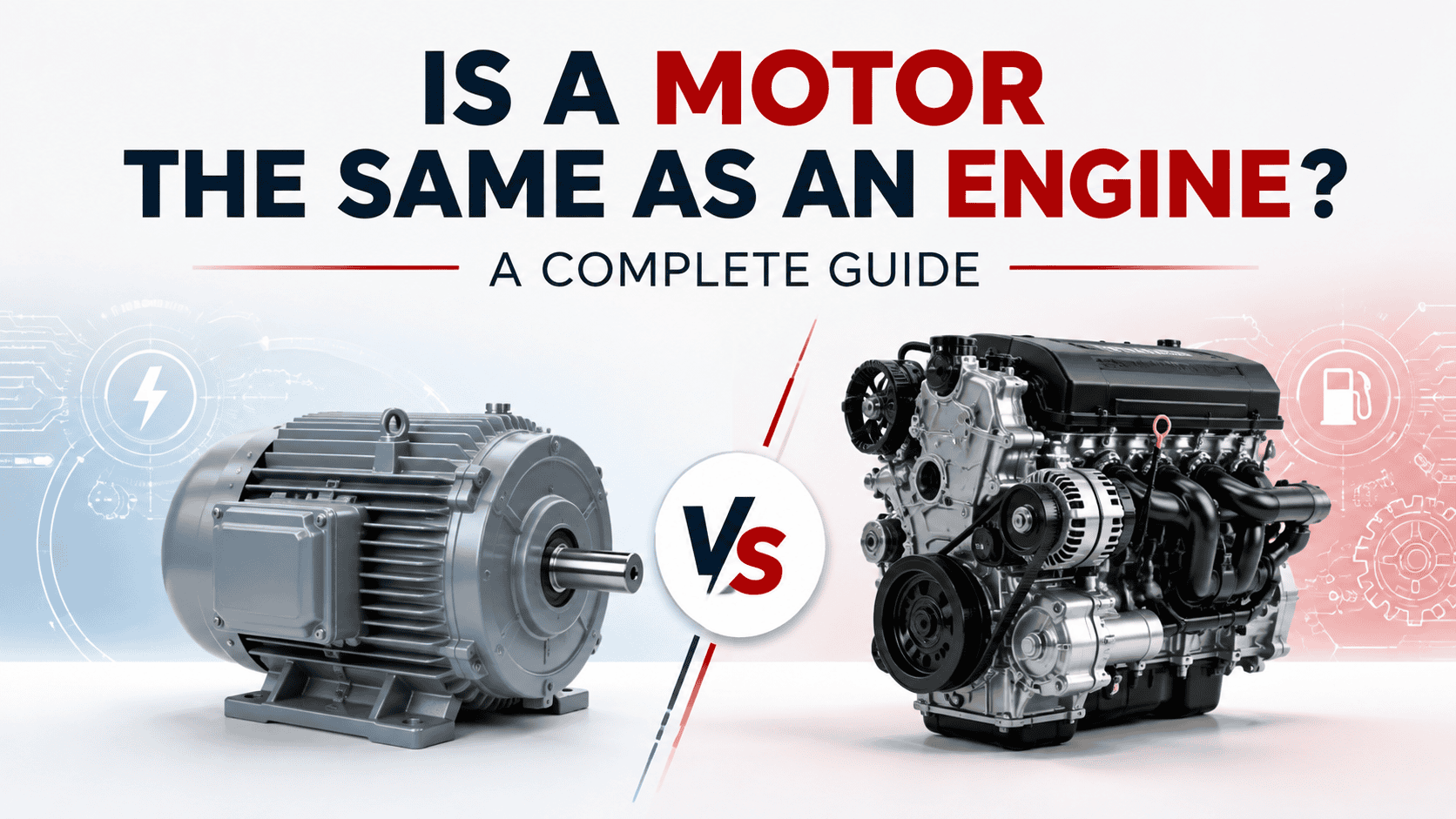
Is a Motor the Same as an Engine? A Complete Guide
No. A motor and an engine are not exactly the same thing.
In modern engineering, an electric motor converts electrical energy into mechanical energy, while an engine commonly converts energy stored in fuel into mechanical work. Internal combustion engines, for example, burn gasoline, diesel, or other fuels to produce mechanical power.
However, the terms can overlap in everyday language. The word motor can be used more broadly to describe a machine that produces motion or provides motive power. This is why terms such as “motor vehicle” and “motor engine” can sometimes cause confusion.
For industrial applications, the most useful distinction is:
Electric motor: electrical energy → mechanical energy
Internal combustion engine: chemical energy in fuel → mechanical energy
The correct choice depends on the application’s power source, control requirements, operating environment, efficiency targets, and maintenance requirements.
| Feature | Electric Motor | Internal Combustion Engine |
| Energy Source | Electricity | Gasoline / Diesel |
| Energy Conversion | Electrical → Mechanical | Chemical → Thermal → Mechanical |
| Combustion | No | Yes |
| Exhaust | None | Required |
| Maintenance | Generally Low | Generally Higher |
| Typical Applications | EVs, Robotics, Pumps | Cars, Trucks, Generators |
Why Buyers Often Confuse Motors and Engines?
In the industrial supply chain, many procurement teams and engineers work across different product categories—automation, HVAC, EV components, robotics, pumps, and more. While “motor” and “engine” are used casually in daily life, technical markets use these terms very differently. One of the biggest pain points is that online sellers sometimes misuse these names, which confuses buyers researching BLDC motors, AC motors, servomotors, PMDC motors, or internal combustion engines.
For example, someone searching for “electric engine for a robot” may actually need a brushless DC motor, not an engine. Similarly, a buyer looking for a “motor for a generator” might require an engine, not a motor. Understanding this difference saves time, avoids misquoted specs, and ensures you choose parts that truly match your application. This is especially important in industries relying heavily on high-efficiency electric motion systems, such as smart home appliances, robotics, medical devices, and automated machinery.
The Core Difference: What Drives the Power?
The most fundamental distinction between a motor and an engine lies in the energy source:
A motor converts electrical energy into mechanical motion.
This includes:
- Brushless DC motors (BLDC motors)
- Brushed DC motors
- AC induction motors
- Servo motors
- Stepper motors
- PMDC motors
These are the main focus of United Motion Inc., which supplies specialized motion solutions across global industries.
An engine converts chemical energy into mechanical motion.
Engines work through combustion—burning fuel to create power.
Examples include:
- Gasoline engines
- Diesel engines
- Natural gas engines
In simple terms:
➡ Motors = electricity → motion
➡ Engines = fuel combustion → motion
This energy source difference affects efficiency, maintenance, lifespan, noise levels, heat generation, and environmental impact. It also determines where each device is typically used in industry.
Where Motors Are Used in Modern Industry?
Motors appear in almost every modern application involving controlled movement. With the growing push toward electrification, many buyers now shift from combustion-based designs to more efficient electric motor technology.
Here are common industries relying on high-efficiency electric motors:
✓ Robotics & automation
BLDC motors and servo motors allow robots to move precisely and quietly, which is essential for industrial automation, medical robots, and collaborative robots (cobots).
✓ Smart home appliances
Air purifiers, washing machines, refrigerators, and automated window systems use low-noise motors for better consumer experience.
✓ Medical equipment
Motors designed for reliability power ventilators, pumps, infusion systems, and surgical devices.
✓ Electric vehicles (EVs)
EVs use large-format electric motors, which offer high torque, strong acceleration, and energy savings.
✓ Industrial machinery
Fans, conveyors, pumps, CNC equipment, and packaging lines all rely on AC and DC motor solutions.
Because of these applications, motors must be highly efficient, precise, and often compact—qualities United Motion Inc. specializes in providing.
Where Engines Still Play a Role?
Even though electric motors dominate many industries due to their efficiency and environmental benefits, engines still play an important role in heavy-duty applications where fuel-based combustion provides high raw power.
Common examples include:
- Construction machinery (excavators, bulldozers)
- Automotive vehicles (traditional sedans, trucks, motorcycles)
- Generators operating in remote environments
- Marine equipment
- Agricultural machines (tractors, harvesters)
Engines operate well under harsh, fuel-driven conditions but require more maintenance, produce emissions, and generate more noise and vibration.
This is why many industries are gradually transitioning toward electric motors where possible—especially for mobile robotics, drones, small vehicles, and consumer appliances.
Key Technical Differences Buyers Should Know
When comparing motors and engines, buyers typically evaluate factors such as efficiency, lifetime cost, maintenance, and noise. Here’s what truly matters:
Power Source
Motors: Electricity (DC or AC)
Engines: Fuel (gasoline, diesel, natural gas)
Efficiency
Electric motors often exceed 85–90% efficiency, making them ideal for continuous operation.
Engines average 20–35% efficiency due to energy lost during combustion.
Maintenance
Motors: Minimal maintenance, fewer moving parts
Engines: Requires oil changes, fuel filters, spark plugs, and frequent servicing
Environmental Impact
Motors produce zero emissions at point of use.
Engines produce exhaust gases and require fuel transport.
Noise and Vibration
Electric motors operate smoothly and quietly, which is essential for medical devices, autonomous robots, and household appliances.
Lifespan
Motors typically last longer because they experience less mechanical wear.
These differences drive the global shift toward electric motion systems and why United Motion Inc. supports clients transitioning from combustion-based to electric-powered designs.
Motor vs Engine: Key Differences
| Feature | Motor | Engine |
|---|---|---|
| Energy Source | Electrical energy (AC / DC) | Chemical energy (fuel combustion) |
| Working Principle | Converts electricity into mechanical motion | Converts fuel into motion through combustion |
| Common Types | BLDC motor, AC motor, servo motor, stepper motor | Gasoline engine, diesel engine, natural gas engine |
| Efficiency | High (typically 85–90%+) | Lower (typically 20–35%) |
| Maintenance | Low (fewer moving parts) | High (oil, filters, combustion system) |
| Noise & Vibration | Low noise, smooth operation | High noise and vibration |
| Environmental Impact | Zero emissions at point of use | Produces emissions (CO₂, NOx, etc.) |
| Control Precision | High (ideal for automation & robotics) | Limited precision |
| Typical Applications | Robotics, EVs, CNC, home appliances | Cars, generators, heavy machinery |
| Lifespan | Longer (less wear and tear) | Shorter (due to combustion stress) |
Why the Motor–Engine Confusion Still Exists?
Even though the technical distinction is clear, buyers often mix these terms for several reasons:
- Everyday language blurs the line.
- People commonly say “car motor,” even though a car has an engine.
- Marketing descriptions vary across regions.
- Some countries casually use the word “motor” for any device that produces movement.
- Search engines mix categories.
- A simple Google search may show electric motors on one page and small combustion engines on the next.
- Non-technical buyers rely on common phrasing.
- Procurement teams may search for “electric engine for a machine” because it sounds intuitive.
This confusion is why suppliers like United Motion Inc. aim to educate buyers, ensuring they source the correct type of device for their application.
Historical Background of the Terms
Words carry stories. Let’s take a short trip back in history.
The word engine comes from the Latin ingenium, which means “clever invention” or “ability to create.” In medieval times, an engine could mean anything mechanical, like a catapult or siege tower. When combustion-powered machines were invented, the term “engine” stuck.
The word motor comes from the Latin motor, meaning “mover.” The first time it became common was in the late 19th century with the rise of electric motors. In fact, the term “automobile” was once called a “motor car” to distinguish it from horse-drawn carriages.
So historically, “engine” has roots in inventions that use fuel or force, while “motor” grew popular with the rise of electrical power.
Types of Engines
To really appreciate the distinction, let’s explore the world of engines.
Internal Combustion Engines (ICEs)
These are the engines found in most cars, trucks, motorcycles, and airplanes.
They burn fuel inside cylinders, pushing pistons that turn a crankshaft.
Sub-types include gasoline engines, diesel engines, rotary engines, and two-stroke engines.
External Combustion Engines
These include steam engines, where the fuel burns outside the main chamber, producing steam to power pistons or turbines.
They were crucial in the Industrial Revolution, powering trains and ships.
Jet and Rocket Engines
Jet engines burn fuel to produce high-speed exhaust, propelling aircraft.
Rocket engines burn fuel and oxidizer together to launch spacecraft beyond Earth.
Types of Motors
Motors, on the other hand, don’t rely on combustion. They harness other forms of energy.
Electric Motors
Electric motors are the most common type today, found in appliances, fans, pumps, electric vehicles, and even drones.
They work on electromagnetic principles, where electric current and magnetic fields create rotation.
Hydraulic Motors
Use pressurized fluid to produce motion.
Common in construction machinery like excavators and forklifts.
Pneumatic Motors
Use compressed air to generate motion.
Often found in tools like air drills or jackhammers.
Other Specialized Motors
Stepper motors and servo motors are used in robotics and precision machines.
Everyday Examples of Motors vs. Engines
To make things even clearer, let’s look at daily life examples:
Car: Runs on an engine if it uses fuel, but if it’s electric, it runs on a motor.
Ceiling Fan: Uses an electric motor.
Airplane: Uses jet engines.
Blender: Powered by a motor.
Motorbike: Has an engine, despite the name.
Electric Car: Uses an electric motor.
Diesel Generator: The engine burns fuel, but the output shaft drives a generator with a motor-like function.
Why Industries Care About the Difference?
In industries, words matter because they define function.
Automotive Industry: Gas-powered vehicles are discussed in terms of “engines,” while electric vehicles (EVs) rely on “motors.”
Electrical Engineering: Professionals always say “motor” when referring to devices powered by electricity.
Aerospace: They talk about jet engines or rocket engines, not motors.
Manufacturing: Robots, conveyor belts, and machines use motors, not engines.
This precision helps avoid confusion and ensures everyone knows what type of machine is being discussed.
Motor vs Engine: Which One Should You Choose?
| Scenario | Recommended Option | Reason |
|---|---|---|
| Industrial automation | Motor | High precision and controllability |
| Robotics & medical devices | Motor | Low noise and high efficiency |
| Electric vehicles (EVs) | Motor | Energy-saving and eco-friendly |
| Heavy-duty construction | Engine | High power output |
| Remote power generation | Engine | No reliance on electricity grid |
| Smart home appliances | Motor | Quiet and compact design |
The Overlap Between Motors and Engines
Here’s where things get tricky:
Some people call any power unit a “motor,” even if it burns fuel. For instance, “motor oil” is used in cars with combustion engines.
The term “motor vehicle” applies to both gasoline-powered and electric cars.
In casual talk, many people say “motor” when they mean “engine.”
This overlap exists because, at the end of the day, both motors and engines serve the same purpose: to create motion.
Common Misconceptions About Motors and Engines
A Motor and an Engine Are the Same Thing
This is one of the most common misconceptions. While both produce mechanical motion, they differ fundamentally in energy source, efficiency, and system integration.
Electric Motors Are Less Powerful Than Engines
In reality, electric motors often deliver higher torque at low speeds, better control, and superior efficiency compared to combustion engines of similar power ratings.
Motor Is Just Another Word for Engine
In everyday language this may be true, but in technical documentation, specifications, and procurement contracts, this assumption can cause costly errors.
Which Is Better: a Motor or an Engine?
Neither is universally better. The appropriate technology depends on the application.
An electric motor is generally preferable when the system requires:
- Precise speed or position control
- Frequent starts and stops
- High energy efficiency
- Low noise and vibration
- Compact integration
- Easy electronic control
- Battery or electrical power
An engine can be advantageous when:
- Liquid fuel provides the primary energy source
- Electrical infrastructure is unavailable
- Long operating range is important
- High energy density of fuel is required
- The application is designed around combustion power
For automation, robotics, medical equipment, pumps, fans, and many electric vehicles, electric motors are the standard choice.
Frequently Asked Questions
What is the main difference between a motor and an engine?
The main difference is how they produce mechanical power. An electric motor uses electromagnetic forces generated by electrical current, while an internal combustion engine burns fuel to create expanding gases that produce mechanical work. This difference affects efficiency, maintenance, emissions, noise, and control.
Which is more efficient, an electric motor or an engine?
Electric motors are generally much more efficient at converting their input energy into mechanical output than internal combustion engines. However, efficiency depends on the motor or engine design, operating point, and complete energy system. For this reason, electric motors are widely used where efficient and controllable motion is required.
Which produces more torque, a motor or an engine?
Neither is universally higher in torque because torque depends on the motor or engine design, size, speed, and operating point. Electric motors can provide substantial torque from low or zero speed, which makes them particularly useful for electric vehicles, robotics, and other applications requiring rapid acceleration or precise motion control.
Why do electric vehicles use motors instead of engines?
Battery electric vehicles use electric motors because the battery provides electrical energy directly to the drivetrain. The motor converts this electricity into mechanical power to drive the wheels. Unlike conventional vehicles, a battery electric vehicle does not need an internal combustion engine or fuel-burning system.
Can an electric motor replace an internal combustion engine?
Yes, electric motors can replace internal combustion engines in many applications, including electric vehicles, industrial equipment, robotics, material-handling systems, and some agricultural machinery. However, the suitability depends on factors such as available electricity, battery capacity, required power, operating range, environment, and system design.
What applications use electric motors?
Electric motors are used in industrial automation, robotics, pumps, fans, compressors, conveyors, CNC machines, medical equipment, AGVs, electric vehicles, appliances, and many other systems. Different motor technologies are selected according to the required torque, speed, precision, efficiency, and control method.
What applications still use engines?
Internal combustion engines remain common in applications where liquid fuel provides practical advantages, including heavy-duty vehicles, construction machinery, agricultural equipment, marine equipment, and some remote power-generation systems. Engines can operate independent ly of an electrical grid when fuel is available.
How do I choose the right electric motor for my application?
Choose an electric motor based on required power, continuous and peak torque, operating speed, voltage, duty cycle, load characteristics, control method, available space, environmental conditions, and required feedback. The motor type should then be matched to the application, such as BLDC for efficient variable-speed motion or servo motors for precise closed-loop positioning.
Related blog: Compare PMSM vs Induction Motor Performance for EV