
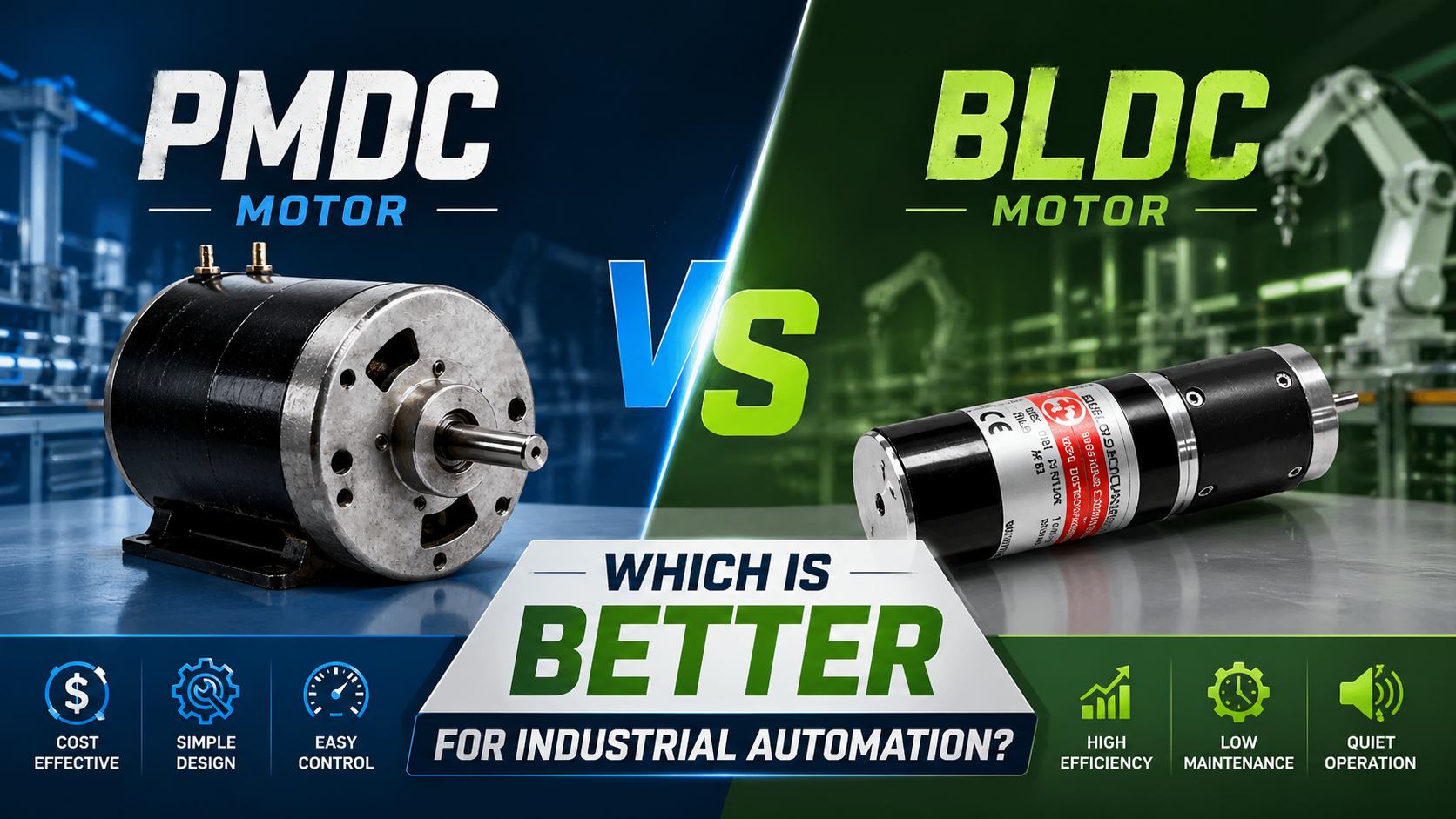
Choosing the right motor is not just a technical decision—it directly affects efficiency, maintenance cost, and product lifespan. In industrial automation, two common choices are PMDC motors and BLDC motors. While both serve similar purposes, their differences can significantly impact performance in real-world applications. This guide explains those differences in a practical, buyer-focused way.
Understanding the Basics of PMDC and BLDC Motors
A PMDC motor, or Permanent Magnet DC motor, is one of the simplest types of electric motors. It uses brushes and a commutator to transfer current to the rotor. Because of this structure, it is easy to control and relatively low in cost. Many small machines, basic automation systems, and consumer devices still rely on PMDC motors for their simplicity.
A BLDC motor, or Brushless DC motor, works differently. It removes the brushes and uses electronic commutation instead. This design reduces mechanical wear and improves efficiency. BLDC motors are now widely used in modern industrial automation systems, robotics, HVAC systems, and electric vehicles because they offer better performance over time.
From a buyer’s perspective, the core difference comes down to mechanical vs electronic commutation. That single difference affects reliability, maintenance, noise, and cost.
How Each Motor Works in Real Applications?
PMDC motors rely on physical contact between brushes and the commutator. As the motor rotates, the brushes continuously make and break contact, which generates motion. This design is simple but creates friction, heat, and wear over time. In low-duty applications, this is acceptable. In high-duty cycles, it becomes a problem.
BLDC motors use sensors and controllers to switch current electronically. There is no physical contact inside the motor for commutation. This results in smoother operation, lower noise, and much longer lifespan. However, it requires a motor driver, which increases system complexity.
In industrial automation, where machines often run continuously, this difference becomes critical. Downtime costs money, and maintenance cycles need to be minimized.
Efficiency Comparison: Where the Real Difference Shows
Efficiency is one of the most searched factors when buyers compare “PMDC motor vs BLDC motor.” In simple terms, BLDC motors are more efficient.
PMDC motors typically operate at 70–80% efficiency due to brush friction and energy loss. Over time, as brushes wear out, efficiency drops further. Heat generation also increases, which may require additional cooling solutions.
BLDC motors can reach efficiencies above 85–90%. Because there is no brush friction, less energy is wasted. This makes them ideal for applications where energy consumption is critical, such as automated production lines or battery-powered systems.
For companies looking to reduce operational costs, the efficiency advantage of BLDC motors often justifies their higher upfront cost.
Maintenance and Lifespan Considerations
Maintenance is one of the biggest pain points in industrial automation. Machines that require frequent servicing can disrupt production schedules.
PMDC motors require regular maintenance because brushes wear out over time. Depending on usage, brushes may need replacement every few thousand hours. If not maintained, performance drops and failures become more likely.
BLDC motors, on the other hand, have minimal maintenance requirements. Without brushes, there are fewer parts that wear out. This makes them suitable for continuous operation environments such as conveyor systems, robotic arms, and automated inspection equipment.
For buyers comparing total cost of ownership, BLDC motors often come out ahead despite higher initial investment.
Cost Analysis: Initial vs Long-Term Investment
Cost is often the deciding factor, especially in large-scale industrial projects.
PMDC motors are cheaper upfront. Their simple design and lack of electronic controllers make them budget-friendly. For short-term or low-load applications, they are still a practical choice.
BLDC motors require additional components like controllers and sensors. This increases initial cost. However, when you factor in energy savings, reduced maintenance, and longer lifespan, the total cost over time is often lower.
Many buyers searching for “best motor for industrial automation cost comparison” are actually trying to balance this trade-off. The right choice depends on how long the system is expected to operate and how critical uptime is.
Control and Performance in Automation Systems
Control precision is another key factor in automation.
PMDC motors offer simple speed control using voltage variation. This makes them easy to integrate into basic systems. However, they lack precision in speed and position control, which limits their use in advanced automation.
BLDC motors provide precise control when paired with the right driver. They can maintain stable speed, torque, and positioning. This is essential for applications like CNC machines, robotics, and automated assembly lines.
If your system requires high accuracy and repeatability, BLDC motors are clearly the better choice.
Noise and Heat Performance
In many industrial environments, noise and heat are not just comfort issues—they affect system reliability and safety.
PMDC motors generate more noise due to brush contact. They also produce more heat, which can reduce efficiency and shorten lifespan.
BLDC motors operate quietly and generate less heat. This makes them suitable for environments where noise reduction is important, such as medical equipment or indoor automation systems.
Typical Industrial Applications
PMDC motors are commonly used in:
• Simple conveyor systems
• Small pumps and fans
• Basic automation tools
• Cost-sensitive machinery
BLDC motors are widely used in:
• Robotics and robotic arms
• CNC machines
• HVAC systems
• Electric vehicles
• High-precision automation lines
Understanding where each motor is typically used helps buyers align their decision with real-world performance expectations.
Buyer Decision Guide: Which One Should You Choose?
If your priority is low cost and simple control, a PMDC motor may still be a good option. It works well in applications where performance demands are low and maintenance is manageable.
If your priority is efficiency, reliability, and long-term cost savings, a BLDC motor is the better choice. It is especially suitable for modern industrial automation systems where downtime and energy use must be minimized.
From an industry trend perspective, more companies are shifting toward BLDC motors as automation becomes more advanced.
Industry Trends and Future Outlook
The global shift toward energy efficiency and smart manufacturing is driving the adoption of BLDC motors. With the rise of Industry 4.0, systems are becoming more connected and intelligent. Motors are no longer standalone components—they are part of a larger ecosystem.
BLDC motors integrate better with digital control systems, making them more future-proof. As technology costs decrease, the price gap between PMDC and BLDC motors is also narrowing.
For companies planning long-term automation upgrades, investing in BLDC technology aligns better with future industry standards.
Why Choose United Motion Inc.?
At United Motion Inc., we understand that every application has unique requirements. We provide both PMDC and BLDC motor solutions designed for industrial automation. Our engineering team focuses on performance, durability, and cost optimization to help clients make the right choice.
Whether you need a cost-effective PMDC motor or a high-efficiency BLDC motor, we offer customized solutions to match your system requirements. Our goal is to support long-term reliability and operational efficiency.
Conclusion
The comparison between PMDC motors and BLDC motors is not about which one is universally better. It is about which one fits your application.
PMDC motors offer simplicity and low cost, making them suitable for basic applications. BLDC motors deliver higher efficiency, longer lifespan, and better control, making them ideal for modern industrial automation.
For most advanced systems today, BLDC motors are becoming the preferred choice. However, PMDC motors still have their place where budget and simplicity matter.
Making the right decision requires understanding both the technical differences and the practical impact on your operations.
References
1. Chapman, S. J. Electric Machinery Fundamentals, McGraw-Hill
2. Boldea, I., & Nasar, S. A. Electric Drives, CRC Press
3. IEEE Papers on Brushless DC Motor Efficiency and Control
4. U.S. Department of Energy – Motor System Efficiency Guidelines
5. Industry reports on Industrial Automation Trends (2024–2025)
Related blog: What is the Difference between BLDC Motor and PMSM Motor?