
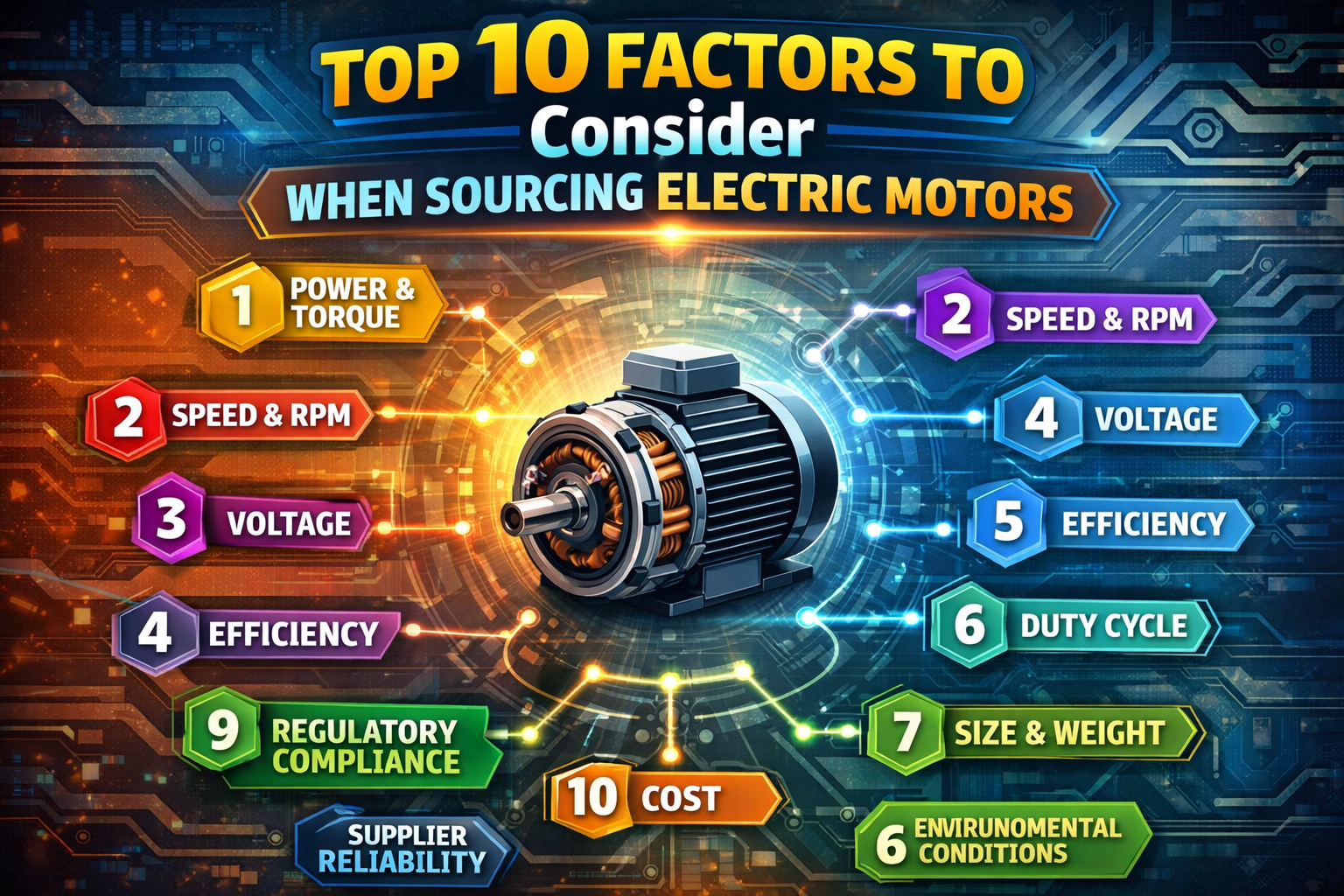
Top 10 Factors to Consider When Sourcing Electric Motors
Choosing the right electric motor is not just a technical decision—it directly affects product performance, reliability, and long-term cost. Many buyers focus only on price or basic specs, but that often leads to failures, delays, or expensive redesigns. Whether you are sourcing for automation, robotics, or industrial equipment, understanding the key factors behind motor selection can save both time and money.
This guide breaks down the top 10 factors to consider when sourcing electric motors, based on real industry challenges and buyer behavior.
Application Requirements Define Everything
Every successful motor sourcing project starts with a clear understanding of the application. This sounds obvious, but many buyers underestimate how critical this step is. A motor used in a robotic lawn mower requires very different characteristics compared to one used in industrial automation or medical devices.
You need to define load type, duty cycle, environmental conditions, and motion requirements. For example, continuous-duty applications demand motors with excellent thermal performance, while intermittent loads may prioritize torque bursts. Ignoring these differences often leads to overheating, inefficiency, or premature failure.
Torque and Speed Requirements Must Be Precise
Torque and speed are the backbone of motor performance. Many sourcing mistakes happen because buyers rely on rough estimates instead of calculated requirements.
You should always determine:
- Required starting torque
- Rated torque
- Peak torque
- Operating speed range
For example, in robotic applications, insufficient torque can cause stalling, while excessive speed may reduce control precision. On the other hand, over-specifying torque leads to unnecessary cost and energy consumption.
Search trends show strong demand for keywords like “high torque electric motor,” “low RPM high torque motor,” and “motor torque calculation.” These reflect real buyer concerns about performance matching.
Motor Type Selection (BLDC vs Brushed vs AC)
Choosing the correct motor type is one of the most critical decisions. Each motor type has distinct advantages:
- BLDC motors: high efficiency, long lifespan, low maintenance
- Brushed DC motors: simple control, lower cost
- AC motors: robust, ideal for heavy industrial use
Modern industries increasingly prefer brushless DC motors (BLDC) because of their efficiency and durability. This is especially true in automation, robotics, and smart equipment.
Buyers often search for:
“BLDC motor manufacturer”
“brushless vs brushed motor difference”
“energy efficient electric motor”
This reflects a shift toward long-term value rather than upfront cost.
Efficiency and Energy Consumption Impact ROI
Energy efficiency is no longer optional—it is a key purchasing factor. Motors account for a large portion of industrial energy consumption, so even small efficiency gains can result in significant savings over time.
High-efficiency motors reduce heat generation, improve system stability, and lower operating costs. In large-scale deployments, this can translate into thousands of dollars saved annually.
From a buyer’s search behavior, keywords like “high efficiency motor,” “energy saving motor,” and “IE3 IE4 motor efficiency” are increasingly popular, especially in regions with strict energy regulations.
Size and Integration Constraints
Space limitations often create unexpected challenges. A motor that meets performance requirements may still fail if it does not fit within the system design.
Compact design is especially important in:
- Robotics
- Medical devices
- Consumer automation systems
Modern buyers are actively searching for “compact electric motor,” “small BLDC motor,” and “high power density motor.” This indicates a strong demand for motors that deliver performance without increasing size.
Thermal Management and Heat Dissipation
Heat is one of the biggest enemies of electric motors. Poor thermal management leads to reduced efficiency, insulation damage, and shorter lifespan.
When sourcing motors, you must consider:
- Ambient temperature
- Cooling methods
- Heat dissipation design
For example, motors used outdoors or in sealed systems require enhanced cooling solutions. Ignoring thermal factors can result in unexpected failures, especially under continuous operation.
This is why buyers often search for “motor overheating solutions,” “thermal protection motor,” and “high temperature motor design.”
Control Compatibility and Driver Integration
A motor is only as good as its control system. Compatibility with controllers, drivers, and feedback systems is essential for smooth operation.
BLDC motors, for instance, require electronic controllers for commutation. If the control system is not properly matched, performance issues such as vibration, noise, or inefficiency can occur.
Buyers frequently look for:
“motor driver compatibility”
“BLDC motor controller matching”
“integrated motor solutions”
This shows a growing preference for complete system solutions rather than standalone components.
Reliability and Lifespan
Reliability is a major concern, especially for industrial and commercial applications. A motor failure can stop production lines, increase maintenance costs, and damage brand reputation.
Key factors affecting reliability include:
- Bearing quality
- Material selection
- Manufacturing precision
Brushless motors typically offer longer lifespan due to the absence of brushes, which reduces wear and tear. This is why they are widely used in critical applications.
Search behavior supports this trend with keywords like “long life electric motor,” “durable motor supplier,” and “industrial motor reliability.”
Supplier Capability and Manufacturing Quality
Choosing the right supplier is just as important as choosing the right motor. A reliable electric motor manufacturer should offer:
- Consistent quality
- Customization capability
- Strong engineering support
- Stable supply chain
Many buyers face issues such as inconsistent quality or delayed delivery when working with inexperienced suppliers.
Keywords like “reliable motor supplier,” “OEM motor manufacturer,” and “custom motor factory” reflect the importance of supplier evaluation in the sourcing process.
Cost vs Total Value (Not Just Price)
Focusing only on price is one of the most common sourcing mistakes. A cheaper motor may lead to higher costs in the long run due to maintenance, downtime, or inefficiency.
Instead, buyers should evaluate:
- Total cost of ownership (TCO)
- Maintenance requirements
- Energy consumption
- Expected lifespan
High-quality motors may have a higher upfront cost but deliver better performance and reliability, resulting in lower overall expenses.
This aligns with search intent around “cost-effective motor solutions,” “best value electric motor,” and “motor ROI analysis.”
Additional Insights: Trends in Electric Motor Sourcing
The electric motor industry is evolving rapidly, driven by automation, electrification, and sustainability. Buyers are increasingly looking for:
- Smart motors with integrated sensors
- IoT-enabled monitoring systems
- Customization for niche applications
- Energy-efficient designs
There is also a growing demand for application-driven solutions rather than standard products, which creates opportunities for manufacturers who can provide engineering support and fast customization.
Conclusion
Sourcing electric motors is a complex process that requires balancing technical requirements, cost considerations, and supplier capabilities. By focusing on the factors outlined above, buyers can make informed decisions and avoid common pitfalls.
For companies looking to stay competitive, working with a trusted partner like United Motion Inc. can provide not only high-quality motors but also the engineering expertise needed to optimize performance and reduce risk.
References
International Energy Agency (IEA) – Motor Systems Efficiency Report
IEEE Industry Applications Society – Electric Motor Standards
U.S. Department of Energy – Energy Efficient Motor Guidelines
NEMA (National Electrical Manufacturers Association) – Motor Specifications
ABB & Siemens White Papers on Industrial Motor Efficiency
Related blog: Top Applications of BLDC Motors in Modern Industry