
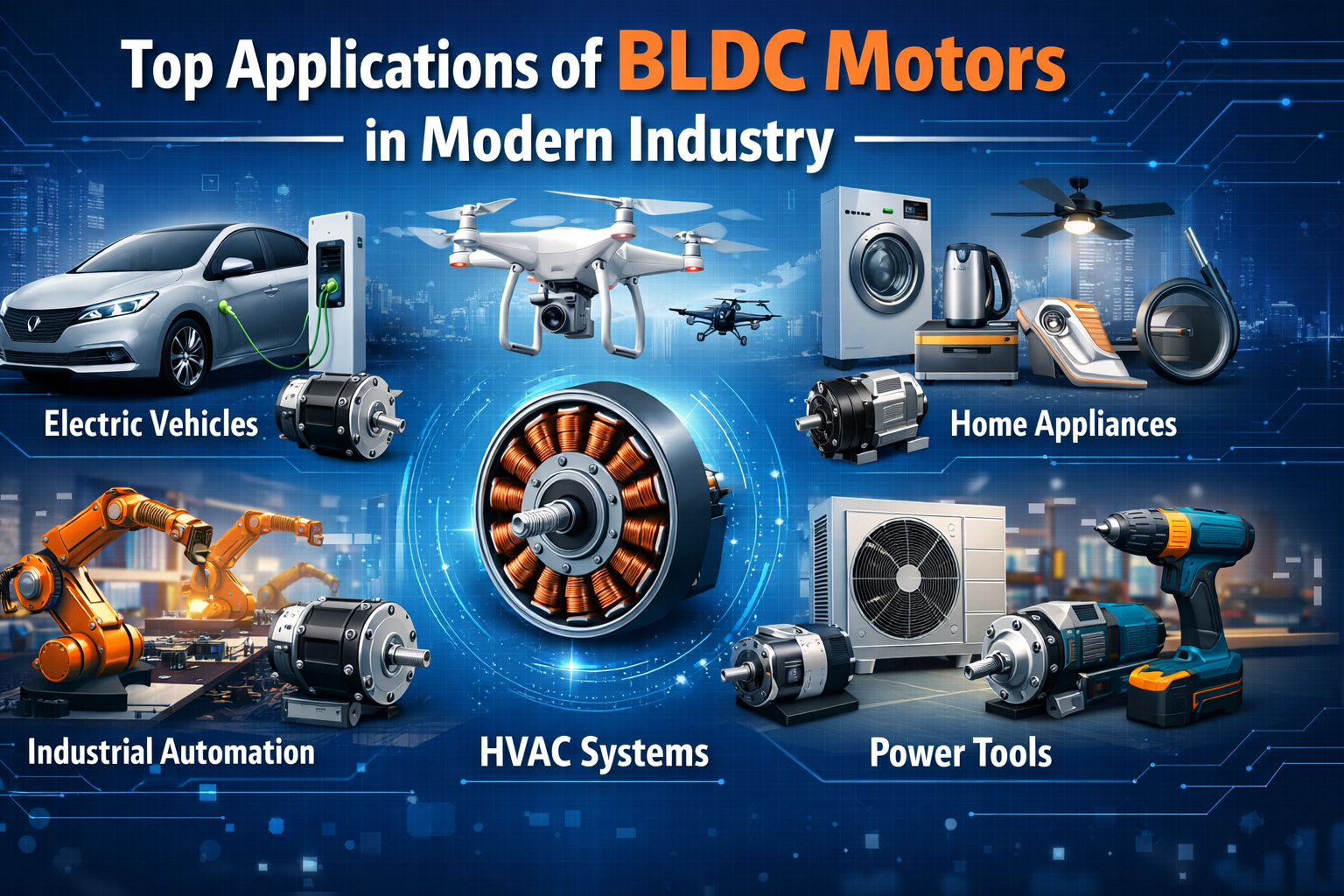
Top Applications of BLDC Motors in Modern Industry
Brushless DC motors are quietly powering many of the systems we rely on every day. From smart home devices to industrial automation, these motors have become a core technology in modern engineering. Their high efficiency, long lifespan, and compact design make them ideal for industries that demand reliability and precision.
As manufacturing moves toward automation and energy efficiency, BLDC motors are replacing traditional brushed motors in many applications. They generate less heat, require less maintenance, and offer precise electronic control. For engineers and buyers searching for dependable motion solutions, BLDC motors have become the preferred choice. In this article, we explore the top applications of BLDC motors across modern industries, explain why they are widely adopted, and provide useful insights for engineers, procurement managers, and automation designers.
Understanding BLDC Motors
A Brushless DC Motor (BLDC motor) is an electric motor that uses permanent magnets on the rotor and electronic controllers to manage commutation. Unlike brushed motors, BLDC motors do not rely on mechanical brushes to switch current. Instead, sensors or sensorless control systems manage the electrical switching process.
This design provides several advantages. First, removing brushes reduces mechanical wear and eliminates sparking, which significantly increases motor lifespan. Second, electronic commutation improves efficiency and enables more precise speed and torque control. Third, BLDC motors are typically more compact while delivering higher power density.
Because of these characteristics, BLDC motors are now widely used in robotics, electric vehicles, medical devices, consumer electronics, and industrial automation.
Many companies today actively search for a BLDC motor manufacturer capable of providing customized solutions for specific industries. Factors such as torque output, voltage range, efficiency, and integration with gear systems often determine the best motor selection.
Why BLDC Motors Are Replacing Traditional Motors?
Industries are rapidly transitioning from brushed DC motors and induction motors to brushless designs. This shift is largely driven by the need for higher performance, energy efficiency, and reduced maintenance.
One major advantage of BLDC motors is their efficiency. Traditional motors often lose energy through friction and heat generated by brushes. In contrast, brushless motors minimize energy loss and deliver higher efficiency, which is critical in applications such as electric vehicles and battery-powered equipment.
Another key benefit is durability. Because BLDC motors eliminate brush wear, they can operate for thousands of hours without requiring maintenance. This is particularly valuable in industrial systems where downtime can result in significant financial losses.
Precision control is also an important factor. BLDC motors can be integrated with electronic controllers and feedback systems, allowing engineers to precisely manage speed, torque, and positioning. This capability makes them ideal for robotics and automation.
Finally, the compact design of BLDC motors allows engineers to build smaller and lighter products while maintaining strong performance. For industries developing portable or space-constrained equipment, this advantage is extremely important.
Major Applications of BLDC Motors in Modern Industry
1. Industrial Automation and Robotics
Industrial automation is one of the fastest-growing sectors using BLDC motors. Modern factories rely on robots, conveyor systems, and automated machinery to increase production efficiency and maintain consistent quality.
Robotic arms, for example, require motors that deliver precise movement and smooth operation. BLDC motors provide excellent torque control and can respond quickly to control signals. This allows robotic systems to perform complex tasks such as assembly, welding, packaging, and material handling.
In automated manufacturing lines, conveyor belts and positioning systems also benefit from BLDC motors. Their high efficiency reduces energy consumption, while their long lifespan ensures reliable operation in demanding environments.
Many robotics manufacturers now prefer brushless DC motor manufacturers that can supply integrated solutions such as BLDC motors with planetary gearboxes, encoders, and braking systems. These integrated systems simplify installation and improve overall system performance.
As factories continue adopting Industry 4.0 technologies, the demand for reliable motion control solutions will continue to grow, making BLDC motors a critical component in modern automation systems.
2. Electric Vehicles and Transportation
The electric vehicle revolution has significantly increased the demand for high-performance motors. BLDC motors play a key role in electric scooters, e-bikes, drones, and certain electric vehicle subsystems.
One reason BLDC motors are ideal for transportation systems is their high power-to-weight ratio. Electric vehicles require motors that deliver strong torque while keeping overall weight low. BLDC motors meet these requirements by combining efficient magnetic design with electronic control systems.
Another advantage is their energy efficiency. In battery-powered vehicles, efficiency directly affects driving range. BLDC motors help extend battery life by minimizing energy losses and maximizing mechanical output.
Electric bicycles and scooters commonly use BLDC hub motors that integrate directly into the wheel. These systems simplify drivetrain design and reduce mechanical complexity.
As governments and industries continue investing in electric mobility, the demand for reliable BLDC motor manufacturers capable of supporting EV applications is expected to grow rapidly.
3. Robotic Lawn Mowers and Outdoor Equipment
Outdoor automation equipment is another important application for BLDC motors. Robotic lawn mowers, for example, require multiple motors to drive the wheels, control the cutting blade, and manage navigation systems.
Wheel drive motors must provide stable torque and precise control so the robot can navigate uneven terrain. Cutting motors must maintain consistent speed to ensure a clean and efficient cut.
BLDC motors are ideal for these tasks because they deliver high torque, operate quietly, and maintain efficiency even during continuous operation. In many robotic mower systems, different motor sizes are used for different tasks. For example, a compact 36mm BLDC drive motor may power the wheels, while a larger 57mm BLDC motor can drive the cutting blade. Manufacturers of robotic lawn mowers often collaborate with specialized robotic lawn mower motor manufacturers to develop motors optimized for outdoor environments, including protection against dust, moisture, and temperature variations.
4. Medical Equipment
The medical industry requires extremely reliable and precise motion control systems. Many medical devices now rely on BLDC motors because they provide quiet operation, long service life, and accurate control.
For example, BLDC motors are used in surgical robots, infusion pumps, ventilators, and imaging equipment. In these systems, motor reliability is critical because failure can directly affect patient safety.
BLDC motors also produce less electromagnetic interference compared to some traditional motors. This characteristic is important in sensitive medical environments where electronic equipment must operate without signal disruption.
Another advantage is compact design. Medical devices are often designed to be portable or space-efficient, especially in hospital environments where equipment must be easily moved between rooms.
Because of these factors, many medical equipment manufacturers partner with experienced BLDC motor manufacturers capable of meeting strict quality and regulatory standards.
5. HVAC Systems and Smart Buildings
Heating, ventilation, and air conditioning systems are essential components of modern buildings. BLDC motors are increasingly used in HVAC systems because they significantly improve energy efficiency. Traditional AC motors often operate at fixed speeds, which leads to unnecessary energy consumption. In contrast, BLDC motors can operate with variable speed control. This allows HVAC systems to adjust airflow based on real-time environmental conditions. For example, when a building requires less cooling or heating, the motor speed can automatically decrease, reducing energy consumption. Over time, this energy saving can be substantial. BLDC motors also operate more quietly than traditional motors. This is particularly important in residential buildings, offices, and hospitals where noise reduction improves comfort. With global energy regulations becoming stricter, the adoption of BLDC motors in HVAC systems is expected to continue growing.
6. Consumer Electronics
Many everyday electronic devices rely on BLDC motors. Products such as computer cooling fans, vacuum cleaners, washing machines, and drones use these motors to deliver efficient and reliable performance. In computer systems, BLDC motors power cooling fans that regulate temperature. Because these fans run continuously, efficiency and durability are essential.
Vacuum cleaners also benefit from BLDC technology. High-speed brushless motors provide strong suction power while reducing noise and energy consumption.
Drones are another important example. The flight stability and maneuverability of drones depend heavily on the performance of their motors. BLDC motors offer the rapid response and precise speed control necessary for stable flight.
As consumer electronics continue to evolve, the demand for compact, efficient motors will drive further innovation in BLDC motor technology.
7. Industrial Tools and Power Equipment
Industrial power tools require motors capable of delivering high torque and consistent performance. BLDC motors are increasingly replacing brushed motors in drills, grinders, and other portable tools.
One key advantage is longer operating life. Since brushes are eliminated, maintenance requirements are significantly reduced. This makes brushless tools more reliable for professionals who use them daily.
Another benefit is improved battery efficiency in cordless tools. BLDC motors convert electrical energy into mechanical output more efficiently, allowing tools to run longer on a single battery charge.
Because of these advantages, many manufacturers now market brushless tools as premium products designed for professional use.
Choosing the Right BLDC Motor Manufacturer
Selecting the right motor supplier is a critical decision for equipment manufacturers. Not all motors are suitable for every application, and customized solutions are often required.
When evaluating a BLDC motor manufacturer, engineers typically consider several factors:
• Motor efficiency and torque performance
• Customization options
• Integration with gearboxes or encoders
• Reliability and lifespan
• Production capacity and supply stability
Companies like United Motion Inc. focus on providing tailored motor solutions for automation, robotics, and industrial equipment. By combining brushless motor technology with precision gear systems, manufacturers can achieve better motion control and improved system performance.
Working with an experienced supplier also helps ensure long-term reliability and technical support during product development.
Future Trends of BLDC Motors
The future of BLDC motor technology is closely connected to the growth of automation, robotics, and electrification. Several trends are expected to shape the industry in the coming years.
- First, the integration of smart electronics will allow motors to communicate with control systems more efficiently. Smart motors equipped with sensors and IoT connectivity will provide real-time performance monitoring and predictive maintenance capabilities.
- Second, advances in magnetic materials and motor design will further increase power density and efficiency. This will enable even smaller motors to deliver higher torque output.
- Third, the expansion of electric mobility will continue driving demand for high-performance brushless motors across transportation systems.
- Finally, the growth of service robots and autonomous machines will create new opportunities for customized BLDC motor solutions.
As industries continue to pursue automation and energy efficiency, BLDC motors will remain a core technology supporting these innovations.
Conclusion
BLDC motors have become a fundamental component in modern industry. Their efficiency, durability, and precise control make them ideal for a wide range of applications, from industrial robotics and electric vehicles to medical devices and consumer electronics.
As technology continues to evolve, the demand for reliable motion solutions will only increase. Companies seeking high-performance motors are increasingly turning to experienced BLDC motor manufacturers capable of providing customized solutions.
With continued innovation in design and control systems, BLDC motors will play an even larger role in shaping the future of automation, transportation, and smart technology.
References
Hughes, A., & Drury, B. Electric Motors and Drives: Fundamentals, Types and Applications.
Krishnan, R. Permanent Magnet Synchronous and Brushless DC Motor Drives.
Boldea, I., & Nasar, S. Electric Drives.
Texas Instruments – BLDC Motor Control Application Guide
IEEE Industry Applications Society – Electric Motor Efficiency Studies