
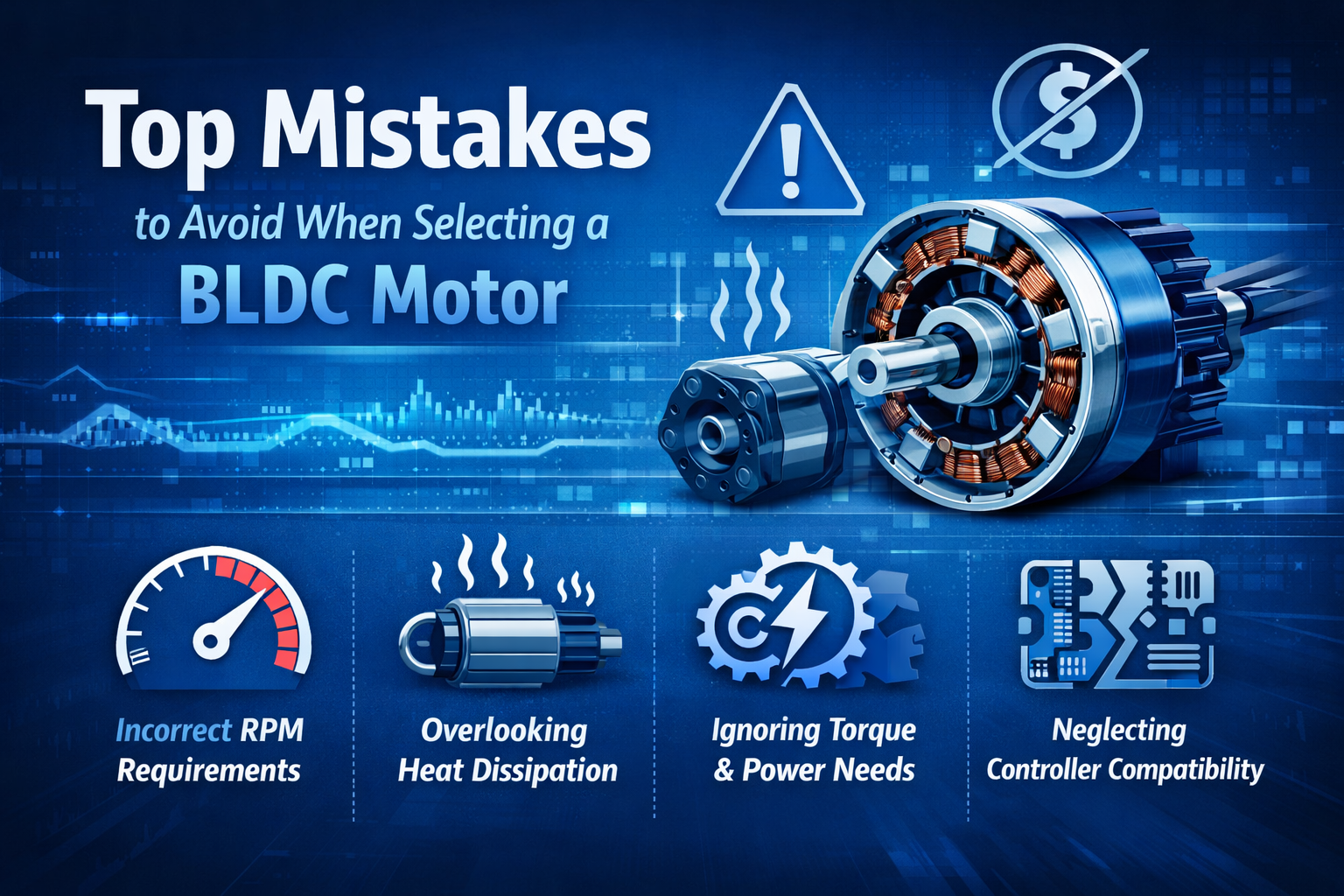
Top Mistakes to Avoid When Selecting a BLDC Motor
Electric motors are everywhere in modern industry, but few components cause as many hidden problems as a poorly selected motor. Among all motor types, BLDC motors (Brushless DC motors) are now one of the most widely used solutions in automation, robotics, medical devices, EV subsystems, HVAC, and smart equipment. They offer high efficiency, long life, and precise control. However, choosing the wrong BLDC motor can quietly damage system performance, increase total cost, shorten product life, and even delay time-to-market. Many of these issues do not appear during early testing. They only surface after deployment, when changes are expensive and reputation is already at risk.
This article explains the top mistakes to avoid when selecting a BLDC motor, based on real industry pain points and buyer search behavior. It is written to help engineers, purchasing teams, and decision-makers make better, safer, and more cost-effective choices.
Mistake 1: Focusing Only on Motor Power Instead of System Requirements
One of the most common mistakes buyers make is selecting a BLDC motor based mainly on rated power (watts or horsepower). While power is important, it is only one part of the system equation. In real applications, motors do not operate at rated power all the time. Load profiles change. Speed varies. Torque spikes occur during startup, acceleration, or sudden load changes. If the motor is selected only by power rating, it may fail to deliver stable performance under real working conditions. A proper BLDC motor selection should start with a complete system analysis, including continuous torque, peak torque, operating speed range, duty cycle, ambient temperature, mounting constraints, and expected lifetime. Without this information, even a high-quality motor may underperform.
Mistake 2: Ignoring Torque Characteristics Across the Speed Range
Torque is often misunderstood or oversimplified during BLDC motor selection. Some buyers assume that torque remains constant across the full speed range, which is rarely true in real applications. BLDC motors typically have a torque-speed curve, and this curve must match the load profile. If the required torque at low speed is higher than what the motor can provide, the motor may stall, overheat, or trigger driver protection. If torque drops too early at high speed, system efficiency and performance will suffer. Another common error is ignoring peak torque requirements, such as during startup or sudden load changes. Peak torque may be required only for a short time, but if the motor or driver cannot support it, the system will fail. Correct motor selection means understanding both continuous torque and peak torque, and ensuring that the BLDC motor operates comfortably within its safe operating area.
Mistake 3: Overlooking the Role of the Motor Driver or Controller
A BLDC motor never works alone. It always depends on a BLDC motor driver or controller, and many selection mistakes come from treating the motor and driver as separate decisions. Motor performance is strongly influenced by the driver’s voltage range, current capability, control algorithm, and feedback method. A well-designed BLDC motor can perform poorly if paired with an unsuitable driver. For example, mismatched current ratings can limit torque output. Incompatible feedback signals can reduce control accuracy. Poor commutation methods can cause noise, vibration, and efficiency loss.
Mistake 4: Underestimating Thermal Management and Heat Dissipation
Heat is one of the silent killers of electric motors. Many BLDC motor failures are not caused by electrical issues, but by thermal overload over time. Some buyers only consider ambient temperature and ignore internal heat generation. Others assume that efficiency alone is enough to control temperature. In reality, even high-efficiency BLDC motors generate heat under load. Poor thermal management can reduce insulation life, weaken magnets, degrade bearings, and shorten overall motor lifespan. This problem becomes more serious in compact designs, sealed enclosures, or high-duty applications. Proper BLDC motor selection should include thermal analysis, including airflow, mounting surface, heat sink options, and expected duty cycle. Selecting a motor with adequate thermal margin is not over-engineering; it is risk management.
Mistake 5: Choosing the Wrong Voltage Level for the Application
Voltage selection is often driven by availability or habit rather than system optimization. Many buyers simply choose a BLDC motor that matches their existing power supply, without evaluating whether that voltage is ideal for performance and efficiency. Lower voltage systems often require higher current to deliver the same power, which increases heat and cable losses. Higher voltage systems may reduce current but introduce safety and insulation considerations. The wrong voltage choice can limit speed range, reduce torque output, or increase total system cost. A proper evaluation should consider power supply design, driver efficiency, safety standards, and system scalability. Experienced suppliers like United Motion Inc. help customers balance voltage selection with performance, safety, and long-term cost.
Mistake 6: Ignoring Mechanical Integration and Mounting Constraints
Motor selection is not only an electrical decision. Mechanical integration plays a critical role in long-term success. Common mechanical mistakes include ignoring shaft size, shaft tolerance, bearing load capacity, mounting flange compatibility, and overall motor dimensions. These issues often appear late in the design process, when mechanical changes are expensive. Vibration and misalignment caused by poor mechanical matching can reduce bearing life and increase noise. In precision applications, even small mechanical errors can affect accuracy and repeatability. A BLDC motor should fit the mechanical system naturally, without forcing adapters or compromises that reduce reliability.
Mistake 7: Overlooking Environmental Conditions
Many BLDC motors perform well in clean laboratory environments but struggle in real industrial conditions. Dust, moisture, chemicals, vibration, and temperature fluctuations all affect motor life. Ignoring environmental factors can lead to premature failure, corrosion, insulation breakdown, or sensor malfunction. This is especially important in outdoor equipment, food processing, medical devices, and heavy automation. Selecting the correct IP rating, sealing method, material coating, and connector type is essential. Environmental suitability should never be treated as an afterthought.
Mistake 8: Assuming All BLDC Motors Are the Same
BLDC motors may look similar on the outside, but internal design differences can be significant. Magnet material, winding method, lamination quality, bearing selection, and manufacturing consistency all affect performance and reliability. Some low-cost motors meet basic specifications but lack long-term stability. Variations in quality can cause inconsistent performance across production batches. For B2B buyers, especially OEMs, consistency and traceability matter as much as initial performance. Working with a reliable manufacturer like United Motion Inc. reduces these risks and ensures stable supply.
Mistake 9: Ignoring Control Requirements and Feedback Options
Modern applications often require precise speed, position, or torque control. Selecting a BLDC motor without considering control requirements can limit system capability. Feedback options such as Hall sensors, encoders, or sensorless control each have advantages and limitations. Choosing the wrong feedback method can affect accuracy, startup behavior, and low-speed performance. The motor, driver, and control strategy must work together as a system. Early alignment between mechanical, electrical, and control teams prevents costly redesigns.
Mistake 10: Prioritizing Unit Price Over Total Cost of Ownership
Focusing only on the motor’s purchase price is one of the most expensive mistakes a buyer can make. A lower-cost motor may lead to higher energy consumption, more maintenance, shorter lifespan, and higher failure rates. Total cost of ownership includes energy efficiency, downtime risk, maintenance cost, replacement frequency, and system integration effort. In many cases, a slightly higher initial investment delivers far better long-term value.
Mistake 11: Failing to Plan for Future Scalability
Many projects start small but grow over time. Selecting a BLDC motor that barely meets current requirements can limit future upgrades. Changes in load, speed, control accuracy, or regulatory standards may require more capable motors later. Designing with some performance margin allows systems to evolve without major redesign. Future-proofing motor selection is a strategic decision that saves time and cost over the product lifecycle.
Mistake 12: Not Involving the Motor Supplier Early Enough
Motor suppliers are often contacted late in the design process, when most decisions are already fixed. This limits optimization opportunities. Involving an experienced supplier early allows for better matching of motor, driver, and system requirements. It also helps identify risks before they become problems. United Motion Inc. works closely with customers during early design stages to ensure the selected BLDC motor truly fits the application.
Why Correct BLDC Motor Selection Matters More Than Ever?
As industries move toward automation, electrification, and energy efficiency, BLDC motors play an increasingly critical role. They are no longer simple components, but core elements of system performance. Mistakes in motor selection affect not only technical performance, but also business outcomes. Delays, failures, and quality issues directly impact customer satisfaction and brand reputation. By avoiding the common mistakes outlined above, buyers and engineers can make more confident decisions and build systems that perform reliably over time.
References
IEC 60034 – Rotating Electrical Machines Standards
IEEE Transactions on Industrial Electronics – BLDC Motor Control and Design
NEMA Motor Efficiency Guidelines
Electric Motor Handbook, H. Wayne Beaty
Industry case studies from automation, HVAC, and EV subsystem manufacturers