
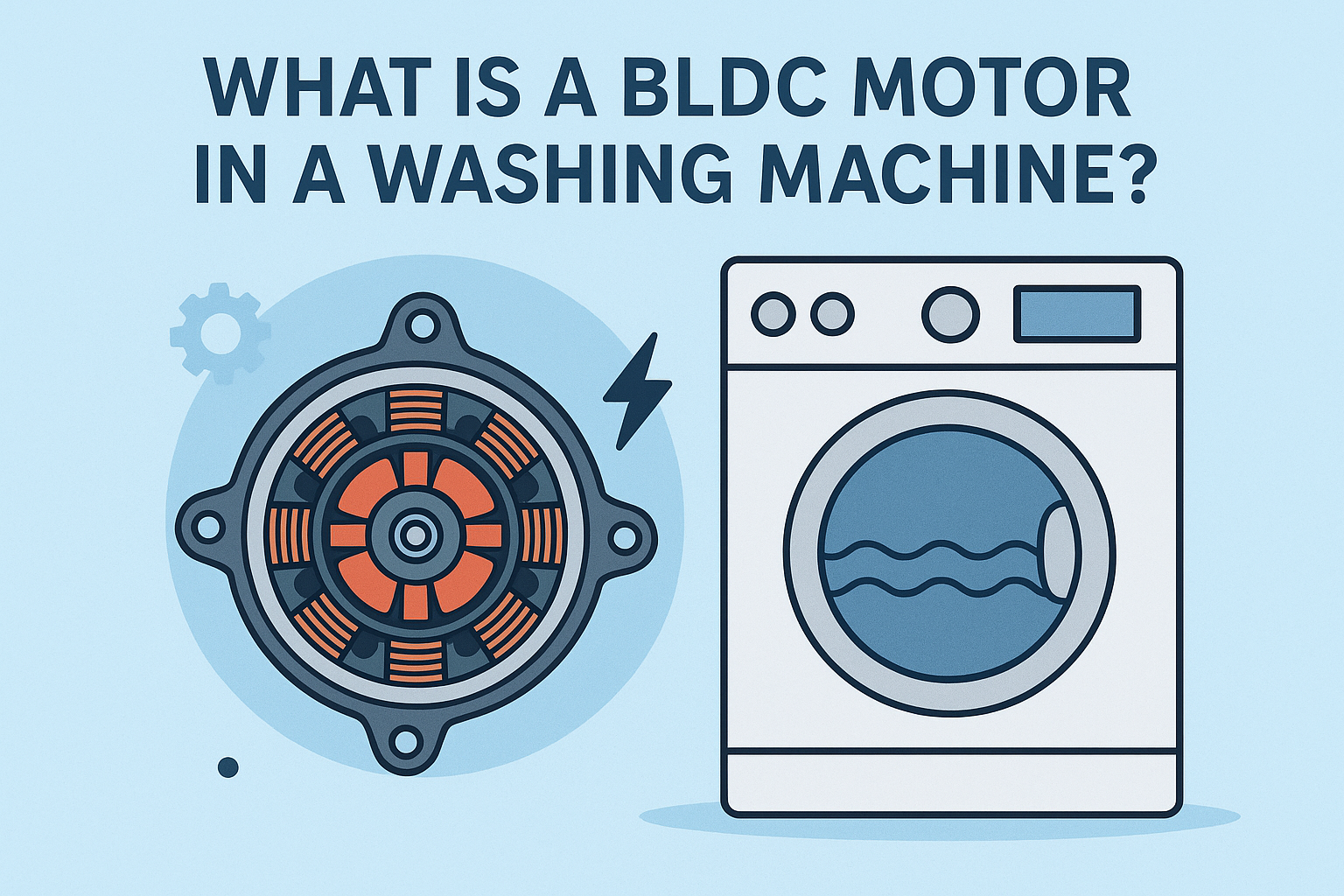
What Is a BLDC Motor in a Washing Machine?
In today’s home appliance market, washing machines are getting smarter, more efficient, and quieter. One of the key technologies driving this change is the BLDC motor, a type of motor that has quickly replaced older motor types. Many manufacturers are shifting to BLDC motors because they solve long-standing problems like noise, vibration, energy waste, and low motor lifespan. But what exactly is a BLDC motor in a washing machine, and why does the industry value it so much?
Understanding the BLDC Motor: A Simple Explanation with Real Industry Context
A Brushless DC (BLDC) motor is a motor driven by electricity but controlled with electronic circuits instead of brushes. In traditional motors, carbon brushes rub against the commutator to switch current flow and generate rotation. This was common for decades, but it created problems such as brush wear, sparking, noise, and loss of efficiency. Engineers and appliance manufacturers always understood these limitations, but technology wasn’t ready to replace these parts—until BLDC motors became affordable and easy to control.
In a washing machine, a BLDC motor removes the entire brush system and replaces it with electronic commutation, meaning the motor’s rotation is controlled by precise signals from a PCB. This shift enables a level of performance that older motors simply cannot match. When appliance engineers discuss modern washing machine design, they highlight BLDC motors as the solution to nearly every performance challenge: stable torque, high efficiency, adjustable speed, minimal noise, and very long operating life.
For companies like United Motion Inc., supplying accurate and durable BLDC motor solutions is not just about performance—it is about giving machine manufacturers reliability they can build their entire appliance line around.
Why BLDC Motors Became the First Choice for Washing Machines?
If we look at the appliance industry over the last decade, we see a clear shift toward energy-saving and noise-reduction technologies. Consumers want washing machines that feel premium, run smoothly, and last a long time. Governments also enforce stricter energy standards. All of these trends pushed manufacturers away from universal motors and toward BLDC motors.
Energy Efficiency Matters More Than Ever
Modern washing machines must meet tight energy standards, especially in Europe and Asia. BLDC motors offer much higher electrical efficiency because there are no brush losses and rotor magnets reduce current consumption. In real-world testing, BLDC motors often reduce energy use by up to 30–40%. For consumers, this means lower electricity bills. For manufacturers, this means their machines score higher on energy rating labels, making them more competitive in the market.
Noise and Vibration Are Top Consumer Complaints
A universal motor spins fast but is loud due to friction and brush contact. In contrast, BLDC motors move smoothly, with limited mechanical friction. This makes them extremely quiet even during high-speed spins. Appliance brands often market this benefit as “silent wash,” “quiet performance,” or “low vibration technology,” all powered by BLDC design.
Precision Control Improves Washing Quality
One of the biggest breakthroughs BLDC motors brought to washing machines is variable speed control. Older motors had limited speed options, often relying on belts and mechanical adjustments. BLDC motors can change speed instantly and precisely. This helps the washing machine control drum rotation based on washing modes, fabric types, water levels, and real-time load balancing. As a result, wash quality improves noticeably.
Long Lifespan Reduces Warranty and Repair Costs
Because BLDC motors have no brushes to wear out, their lifespan is significantly longer. Many manufacturers now offer 10–12 year motor warranties, something unheard of with universal motors. From a business standpoint, using BLDC motors helps reduce after-sales repair costs and improves brand trust.
These reasons show why BLDC motors are not just a trend—they are now the global standard for mid- to high-end washing machines.
How BLDC Motors Work Inside a Washing Machine?
While BLDC motors may appear simple on the outside, their internal operation involves several intelligent control technologies. Understanding how they work can help engineers design better machines and help consumers understand why these motors matter.
Permanent Magnet Rotor
The rotor contains strong permanent magnets. When the electronics energize the stator coils, it creates a rotating magnetic field that drives the rotor.
Stator Coils
The stator produces controlled electromagnetic fields. Instead of relying on brushes, the “commutation” is handled electronically.
Inverter / Control PCB
This is the heart of BLDC motor control. It receives digital signals from sensors and sends precise voltage pulses to the motor. It determines:
- how fast the drum rotates
- how much torque is needed
- how to prevent imbalance
- how speed changes during wash cycles
This electronic control allows washing machines to adapt to different loads, fabrics, and washing conditions in real time.
Feedback System
Most BLDC motors use Hall sensors or sensorless algorithms to monitor rotor position. This feedback allows fine-tuned motion with minimal noise and vibration.
Because of this intelligent control method, BLDC motors transform the washing machine from a simple mechanical device into a smart, adaptive system.
Comparing BLDC Motors with Other Motor Types in Washing Machines
To truly understand the value of BLDC motors, we need to compare them with older technology. The chart below illustrates the general industry shift:
This chart offers a basic glance at the estimated usage distribution among different motor types in modern washing machines. While older motors still appear in low-cost models, BLDC motors dominate due to their superior performance and reliability.
Here’s a detailed comparison:
| Feature | BLDC Motor | Universal Motor | Induction Motor |
|---|---|---|---|
| Noise | Very low | High | Medium |
| Efficiency | Very high | Low | High |
| Maintenance | Near zero | High (brush wear) | Medium |
| Torque control | Excellent | Poor | Good |
| Cost | Higher | Low | Medium |
| Lifespan | Long | Short | Medium |
This comparison clearly shows why appliance manufacturers worldwide continue moving toward BLDC motors.
Pain Points in the Washing Machine Industry That BLDC Motors Solve
Manufacturers, engineers, and even consumers have faced recurring issues tied to universal motors. BLDC technology directly addresses these problems:
Frequent Motor Failures Due to Brush Wear
Brushes wear out quickly, especially in households that run washing cycles daily. Replacing them constantly raises repair costs and frustrates customers. BLDC motors eliminate this issue completely.
High Energy Consumption
Energy waste is one of the biggest complaints about traditional washing machines. With BLDC motors, energy use is significantly lower, helping brands meet international efficiency certifications.
Noisy Operation
Consumers are increasingly sensitive to noise. Universal motors produce mechanical noise and vibrate heavily. BLDC motors change this experience, making washing machines suitable for apartments and small homes.
Poor Torque Control During Heavy Loads
Traditional motors struggle with uneven loads, causing drum imbalance, noise, and poor washing quality. BLDC motors offer precise torque control, ensuring smoother drum rotation.
Low Speed Accuracy
Accurate control is crucial for sensitive fabrics, different wash programs, and high-speed spin cycles. BLDC motors allow exact speed control that older motors cannot achieve.
By solving these long-standing problems, BLDC motors have become the foundation of next-generation washing machine design.
Real Use Cases of BLDC Motors in Modern Washing Machines
Different washing cycles benefit from BLDC motors in unique ways:
Gentle Wash Modes
The motor rotates slowly and smoothly to avoid damaging delicate fabrics. BLDC motors handle low-speed control precisely.
Heavy Loads and Towel Cycles
High torque is needed to move heavy fabrics. BLDC motors deliver this without overheating or slowing down.
High-Speed Spinning
During spinning, the drum rotates at very high speeds. BLDC motors maintain stability and reduce vibration.
Automatic Load Sensing Systems
Some washing machines adjust motor speed based on the weight of the laundry. BLDC motors respond instantly to changes.
Direct-Drive Washing Machines
Modern direct-drive systems connect the drum directly to the motor. BLDC motors are the only type capable of delivering the control and reliability needed for this design.
These use cases highlight how important BLDC motors have become for premium washing machine performance.
Benefits for Manufacturers, Brands, and End Consumers
BLDC motors do more than just improve washing performance. They bring a wide range of benefits across the entire value chain.
For Manufacturers:
- Lower warranty and repair costs
- Better energy rating certifications
- Higher product reliability
- Stronger brand image
- Ability to design modern, quiet machines
For Appliance Brands:
- More competitive marketing claims
- Higher customer satisfaction
- Longer product lifespan (good for reputation)
- Opportunity for premium pricing
For Consumers:
- Lower electricity usage
- Quieter wash cycles
- Longer-lasting motor
- Better wash quality
- Fewer repairs over years of use
These benefits demonstrate why BLDC motors offer strong long-term value for everyone involved.
How BLDC Motors Will Shape the Next Generation of Washing Machines?
The future of washing machine technology will focus on automation, connectivity, smart energy use, and user comfort. BLDC motors play a central role in these developments.
AI-Controlled Washing Cycles
More washing machines will use advanced sensors and AI algorithms to adjust drum movement based on fabric behavior. BLDC motors make this possible through precision control.
Smaller, Lighter, More Efficient Designs
As engineers miniaturize machine components, BLDC motors will continue adapting to more compact designs.
Integration with Smart Home Systems
With smoother and quieter operation, BLDC motors enable washing machines to run overnight or during low-tariff hours without disturbing users.
Better Control for Water-Saving Programs
Eco-friendly washing modes depend heavily on motor precision. BLDC motors ensure the drum moves accurately even with minimal water.
Extended Motor Warranty Programs
Brands will continue using longer motor warranties to increase customer confidence. These trends show how BLDC motors will remain a core technology in washing machine evolution.
References
Internal engineering notes and long-term performance data from appliance manufacturers.
Industry discussions on noise reduction, motor efficiency, and energy standards.
Comparative analysis of universal motors vs BLDC motors in domestic appliances.
Technical documentation from motor control system designers.
Field reports on washing machine maintenance and lifecycle evaluation.
Frequently Asked Questions
What is a BLDC motor in a washing machine?
A BLDC motor in a washing machine is a brushless DC motor that uses electronic commutation instead of mechanical brushes. It provides high efficiency, precise speed control, low noise, and long service life, making it suitable for inverter-driven and energy-efficient washing machines used by modern appliance manufacturers.
Why are BLDC motors used in modern washing machines?
BLDC motors are used because they offer higher energy efficiency, quieter operation, better speed and torque control, and longer lifespan compared to traditional motors. These advantages help washing machine manufacturers meet energy regulations, reduce maintenance costs, and improve overall product performance.
How does a BLDC motor work in a washing machine?
A BLDC motor works by using an electronic controller to energize stator windings based on rotor position feedback. The controller adjusts current and frequency in real time, allowing the motor to operate efficiently across different washing and spinning speeds while adapting to load changes inside the drum.
What are the advantages of BLDC motors over universal motors in washing machines?
Compared with universal motors, BLDC motors deliver higher efficiency, lower noise, reduced vibration, and longer service life. Universal motors rely on brushes that wear out over time, while BLDC motors use electronic commutation, resulting in lower maintenance and better compatibility with modern inverter control systems.
Do BLDC motors require a special drive or controller?
Yes, BLDC motors require an electronic drive or inverter to perform commutation, speed regulation, and torque control. In washing machines, the motor drive is typically integrated into the control board and includes power electronics, a microcontroller, and protection circuits to ensure safe and stable operation.
Are BLDC motors more energy efficient than induction motors in washing machines?
In most washing machine applications, BLDC motors are more energy efficient than induction motors, especially under variable speed and partial load conditions. Their higher efficiency helps reduce power consumption and supports compliance with global energy efficiency standards.
What control methods are used for BLDC motors in washing machines?
BLDC motors can be controlled using sensored methods with Hall sensors or sensorless methods based on back-EMF detection. Both approaches are commonly used in washing machines, depending on cost targets, performance requirements, and control system design.
How do BLDC motors improve washing machine performance?
BLDC motors improve washing machine performance by enabling smooth speed transitions, stable torque at low speeds, and high-speed spin capability. This results in better wash quality, reduced fabric damage, and more efficient water extraction during spin cycles.
What factors should OEMs consider when selecting a BLDC motor for washing machines?
OEMs should consider rated power and torque, speed range, control method, voltage rating, thermal performance, and compatibility with the motor drive system. Evaluating the motor as part of a complete motor-drive solution helps reduce integration risks and development time.
Are BLDC motors suitable for smart and inverter washing machines?
Yes, BLDC motors are ideal for smart and inverter washing machines because they support precise digital control, variable speed operation, and integration with intelligent control algorithms. Their design aligns well with future trends in connected and energy-efficient appliances.