
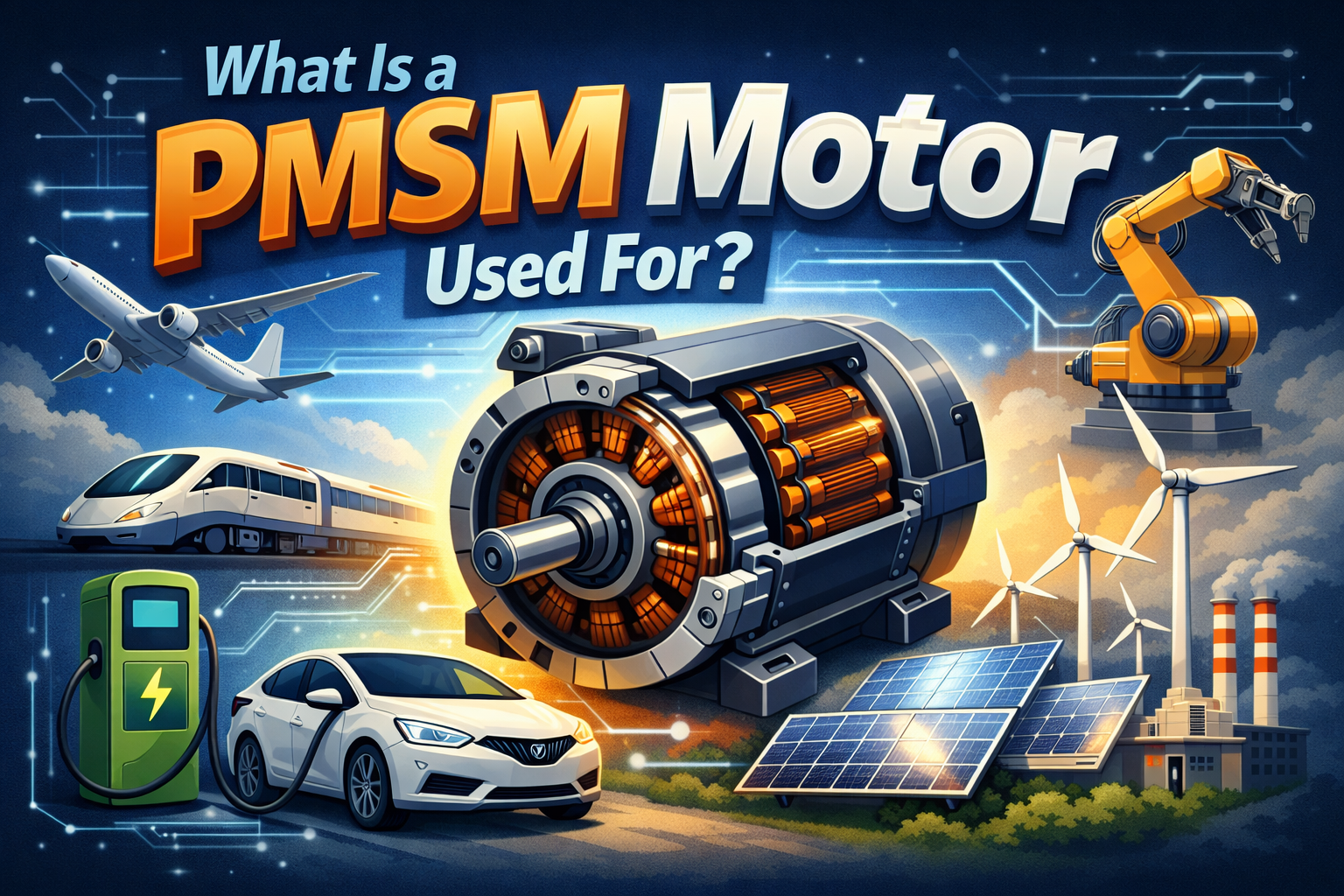
What Is a PMSM Motor Used For?
Permanent Magnet Synchronous Motors, commonly known as PMSM motors, are now one of the most widely used electric motor technologies in modern industry. From electric vehicles to industrial automation systems, PMSM motors are trusted for their high efficiency, stable torque, compact size, and long service life. As industries shift toward energy savings and intelligent control, more buyers are searching for reliable PMSM motor suppliers who can deliver performance without compromise. This guide answers those questions in clear and practical terms, based on real industry needs and purchasing concerns.
Understanding PMSM Motors in Simple Terms
A PMSM motor is a synchronous motor that uses permanent magnets embedded in or mounted on the rotor. Unlike induction motors, PMSM motors do not rely on induced current to create magnetic fields. Instead, the permanent magnets generate a constant magnetic field, allowing the rotor to rotate in sync with the stator’s magnetic field.
This design improves energy efficiency, reduces heat loss, and delivers smooth torque output across a wide speed range. For buyers searching for high-efficiency electric motors, high torque density motors, or energy-saving motor solutions, PMSM technology frequently appears as the top recommendation.
The structure may look simple, but the control system is advanced. Most PMSM motors use vector control or field-oriented control (FOC), which enables precise speed and torque regulation. This makes them ideal for high-performance motion control applications.
Why Industries Prefer PMSM Motors?
When buyers compare PMSM motors with induction motors or brushless DC motors, several advantages stand out.
First, PMSM motors provide high efficiency, often above 90%, which significantly reduces operating costs in continuous-duty applications. Second, they offer high torque density, meaning more power output in a smaller frame size. Third, they operate with low noise and vibration, which is critical in medical, robotics, and EV applications.
Energy regulations worldwide are becoming stricter. Governments in regions such as the United States and the European Union promote high-efficiency motor standards to reduce carbon emissions. As a result, manufacturers increasingly adopt PMSM motors to meet IE3 and IE4 efficiency requirements.
From a buyer’s perspective, this means lower long-term operating costs, better system performance, and easier compliance with energy efficiency standards.
What Is a PMSM Motor Used For in Electric Vehicles?
One of the most well-known applications of PMSM motors is in electric vehicles. Leading automotive companies such as Tesla and Toyota have widely adopted permanent magnet motor technology in their EV platforms.
In electric vehicles, PMSM motors provide several critical benefits. They deliver high starting torque, which ensures fast acceleration. They maintain high efficiency across a wide speed range, extending battery life and driving range. They also offer compact design, allowing engineers to optimize vehicle space.
For EV traction systems, smooth torque output is essential. Any torque ripple can affect driving comfort. PMSM motors excel in delivering stable torque with minimal vibration. Additionally, regenerative braking systems integrate easily with PMSM motor control, improving overall vehicle energy recovery.
Because of these advantages, PMSM motors are commonly used in passenger EVs, hybrid vehicles, electric buses, and electric motorcycles.
PMSM Motors in Industrial Automation
Industrial automation is another major application area. Modern factories demand precise motion control, stable speed regulation, and continuous operation reliability. PMSM motors meet all these requirements.
In CNC machines, robotic arms, conveyor systems, and packaging equipment, accurate positioning is essential. PMSM motors paired with advanced servo drives provide tight speed control and high dynamic response. This ensures consistent product quality and reduces production errors.
Companies such as Siemens and ABB integrate PMSM motor solutions into smart manufacturing systems.
For buyers in automation sectors, key search terms often include high precision servo motor, industrial PMSM motor supplier, and high torque synchronous motor. PMSM motors address these needs directly.
PMSM Motor Applications in Robotics
Robotics requires compact motors with high torque and fast response. Whether in collaborative robots, industrial robotic arms, or warehouse automation systems, smooth motion and accurate positioning are essential.
PMSM motors are ideal for robotic joints because they provide high torque density and stable performance at low speeds. Their compact design allows for lighter robotic arms, improving energy efficiency and reducing mechanical stress.
Companies such as KUKA and FANUC rely on permanent magnet motor technologies in many of their robotic systems.
For buyers in robotics manufacturing, PMSM motors offer reliability, long service life, and low maintenance requirements.
PMSM Motors in HVAC Systems
Heating, ventilation, and air conditioning systems operate for long hours, often continuously. Energy consumption is a major concern in commercial buildings and industrial facilities.
PMSM motors improve HVAC efficiency by delivering consistent airflow with minimal energy waste. Because they maintain high efficiency even at partial loads, they significantly reduce electricity bills.
Many modern variable-speed compressors and high-efficiency air conditioning systems use PMSM motors to meet global energy-saving standards. For facility managers and equipment manufacturers, this translates into lower operational costs and better environmental performance.
Renewable Energy and PMSM Motors
Renewable energy systems also benefit from PMSM technology. Wind turbines frequently use permanent magnet synchronous generators due to their high efficiency and compact size.
In wind power systems, reduced mechanical losses directly increase electricity output. Permanent magnet designs eliminate rotor excitation losses, improving overall system reliability.
As global renewable energy installations grow, the demand for high-efficiency permanent magnet motors continues to increase.
PMSM in Medical Equipment
Medical devices require quiet operation, precise control, and long-term reliability. From imaging systems to surgical robots and ventilators, stable motor performance is critical.
PMSM motors offer low noise and smooth operation, making them suitable for sensitive medical environments. Their compact design allows integration into portable medical devices.
Manufacturers often prioritize PMSM motors for MRI-compatible systems and precision diagnostic equipment where electromagnetic interference must be minimized.
Key Advantages Buyers Should Consider
- High efficiency reduces electricity consumption
- High torque density enables compact system design
- Low maintenance lowers total ownership cost
- Wide speed range improves flexibility
- Stable synchronous operation ensures consistent performance
However, PMSM motors also require advanced motor drives and precise control algorithms. This means working with experienced motor manufacturers is essential.
At United Motion Inc., we provide customized PMSM motor solutions tailored to application needs. Whether the requirement involves high-speed motors for automation or high-torque motors for electric mobility, engineering support ensures optimized design and long-term reliability.
PMSM vs Induction Motor: What Buyers Need to Know
Many customers ask whether PMSM is better than induction motors. The answer depends on application priorities.
Induction motors are robust and cost-effective for general industrial use. However, PMSM motors typically offer higher efficiency and better power density.
For high-performance applications such as EVs, robotics, and precision automation, PMSM often provides superior results. For heavy-duty and lower-cost industrial equipment, induction motors may remain competitive.
Understanding your load conditions, duty cycle, and energy goals is essential before choosing.
Common Purchasing Pain Points
Buyers often struggle with several issues when sourcing PMSM motors.
- They worry about magnet material quality. Rare earth magnets directly affect performance and stability.
- They question thermal management capabilities. High torque density can lead to heat buildup if cooling is insufficient.
- They need assurance about long-term supply chain stability, especially for permanent magnet materials.
- They require compatibility with inverters and control systems.
Addressing these concerns requires collaboration with a knowledgeable motor manufacturer that offers testing data, engineering drawings, and customization services.
How to Choose the Right PMSM Motor?
When selecting a PMSM motor, buyers should clearly define the following:
- Rated power and voltage
- Required torque and speed range
- Duty cycle and load conditions
- Cooling method
- Environmental factors such as dust, moisture, or vibration
Additionally, ensure compatibility with motor drives using vector control or FOC technology.
Working with an experienced partner like United Motion Inc. ensures proper motor sizing, performance validation, and long-term reliability.
The Future of PMSM Motor Technology
The future of PMSM motors looks strong. With global electrification trends, smart manufacturing, and renewable energy expansion, demand will continue to rise.
Improvements in magnet materials, power electronics, and digital control systems will further enhance efficiency and reduce cost.
Artificial intelligence-based motor diagnostics and predictive maintenance systems will also increase reliability and reduce downtime.
Final Thoughts
So, what is a PMSM motor used for? The answer is broad but clear. PMSM motors are widely used in electric vehicles, industrial automation, robotics, HVAC systems, renewable energy, and medical equipment.
They offer high efficiency, compact design, precise control, and long service life. For buyers seeking energy-saving motor solutions and high-performance electric motors, PMSM technology stands out as a reliable choice.
At United Motion Inc., we combine engineering expertise with global manufacturing capabilities to deliver customized PMSM motor solutions that meet industry standards and application demands.
If you are searching for a reliable PMSM motor supplier, our team is ready to support your next project with technical consultation and tailored motor design services.
References
International Energy Agency – Global EV Outlook and motor efficiency trends
U.S. Department of Energy – Energy efficiency standards for electric motors
International Electrotechnical Commission – IEC 60034 standards for rotating electrical machines
IEEE – Research publications on permanent magnet synchronous motor control
National Renewable Energy Laboratory – Renewable energy generator and motor technology studies
European Commission – Ecodesign regulations for electric motor efficiency
Related blog: What is the Difference between BLDC Motor and PMSM Motor?