
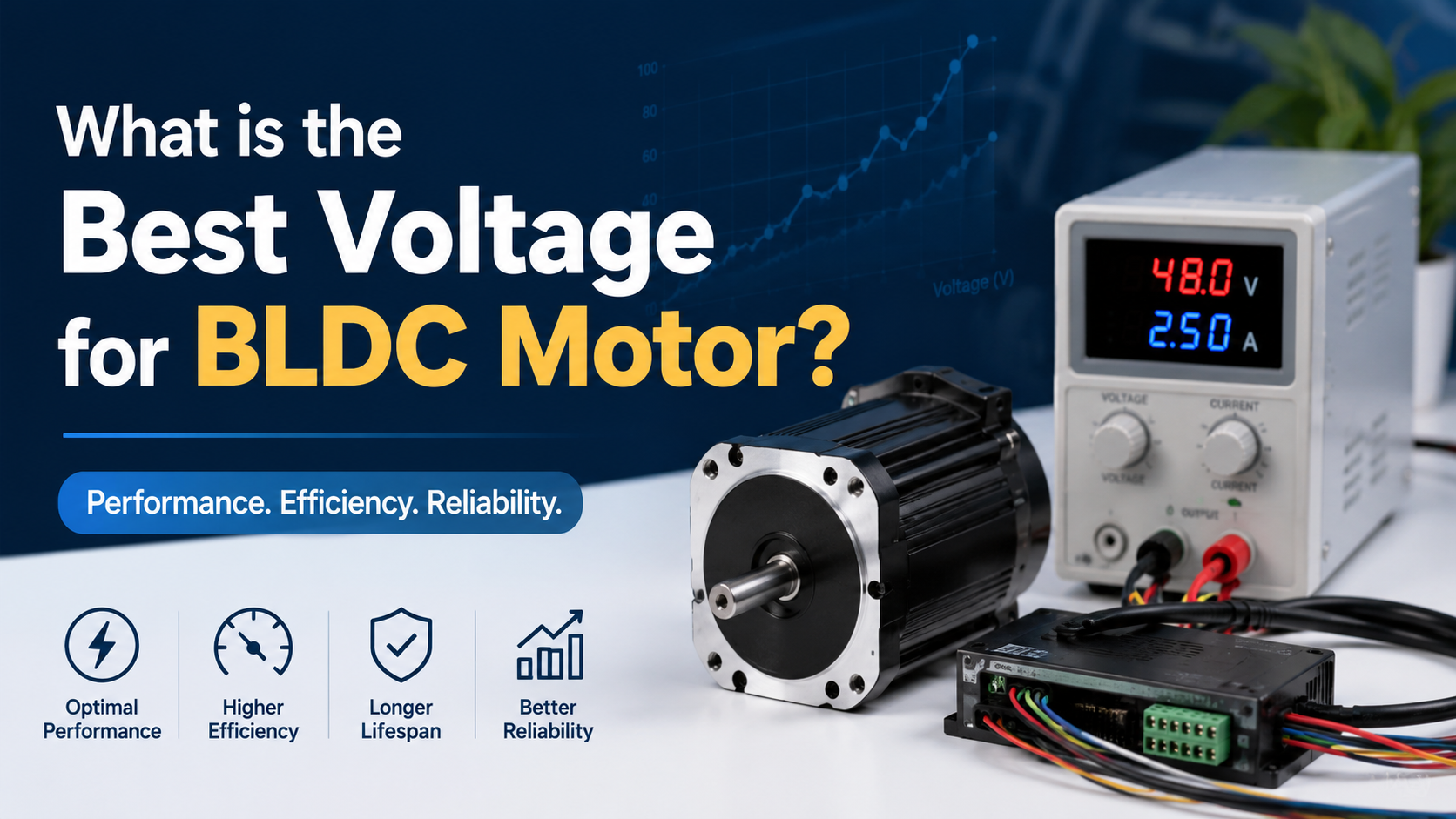
Selecting the correct BLDC motor voltage is one of the most important engineering decisions in any motion control system because it directly influences motor efficiency, torque production, current consumption, wiring size, controller selection, thermal performance, and overall system reliability. While there is no single “best” voltage suitable for every application, the ideal voltage depends on the required power, operating speed, available power source, environmental conditions, and cost constraints.
In general:
12–24 V BLDC motors are ideal for portable and battery-powered devices.
24–48 V systems offer an excellent balance between efficiency, power density, and safety, making them the preferred choice for industrial automation and AGVs.
48–96 V BLDC motors are widely used in electric mobility, robotics, and heavy-duty equipment requiring higher power.
Above 100 V BLDC motors are primarily designed for industrial machinery, HVAC equipment, compressors, and high-power servo systems.
Choosing the proper voltage means optimizing the entire electrical system rather than simply selecting a motor with the highest voltage rating.
Why Does BLDC Motor Voltage Matter?
Voltage determines how electrical energy is delivered to the motor. Together with current, voltage defines electrical power according to:
Power (W) = Voltage (V) × Current (A)
For the same mechanical output power, increasing voltage allows the system to operate at lower current.
For example:
480 W = 24 V × 20 A
480 W = 48 V × 10 A
Although both systems deliver identical power, the 48 V system experiences:
- lower copper losses
- smaller voltage drop
- cooler wiring
- reduced controller stress
- higher overall efficiency
Engineering Insight
Copper loss follows:
P = I²R
Since current is squared, reducing current dramatically decreases heat generation.
How Voltage Affects BLDC Motor Performance?
Speed
Motor speed is approximately proportional to applied voltage.
The relationship is commonly expressed as:
RPM ≈ Voltage × Kv
where:
Kv = motor speed constant (RPM/V)
Example:
Motor constant = 120 RPM/V
At 24 V:
120 × 24 = 2,880 RPM
At 48 V:
120 × 48 = 5,760 RPM
Actual speed depends on controller limits, load, winding resistance, and back EMF.
Torque
Unlike speed, torque is mainly proportional to current rather than voltage.
Higher voltage simply enables the controller to maintain required current more easily during acceleration or heavy loading.
This is why increasing voltage often improves dynamic performance without changing rated torque.
Efficiency
Higher-voltage systems generally achieve:
- lower line current
- lower wiring losses
- higher controller efficiency
- better battery utilization
- reduced heat generation
However, excessive voltage beyond the motor’s rated specification may:
- damage insulation
- increase switching losses
- shorten bearing life
- reduce reliability
Operating above rated voltage is never recommended unless specifically approved by the manufacturer.
Typical BLDC Motor Voltage Ranges
| Rated Voltage | Typical Applications | Advantages |
| 5–12 V | Cooling fans, drones, electronics | Compact, inexpensive |
| 12 V | Automotive accessories | Widely available |
| 24 V | AGVs, conveyors, automation | Excellent industrial standard |
| 36 V | Power tools | Higher power density |
| 48 V | Mobile robots, e-bikes, lawn equipment | High efficiency |
| 72–96 V | Electric motorcycles, EV subsystems | Lower current |
| 110–400 V | Industrial drives, HVAC compressors | High-power operation |
Which Voltage Is Best for Different Applications?
Battery-Powered Equipment
Examples include:
- robotic lawn mowers
- mobile robots
- AGVs
- electric wheelchairs
- cleaning robots
Recommended voltage:
24–48 V
Reasons:
- improved battery efficiency
- manageable safety requirements
- lower cable losses
- excellent controller availability
Industrial Automation
Examples include:
- conveyors
- packaging machines
- CNC auxiliary drives
- logistics equipment
Recommended voltage:
24 V or 48 V DC
Industrial power supplies commonly support these voltages while complying with standard automation architectures.
Electric Vehicles
Electric mobility applications often require:
- rapid acceleration
- high torque
- long operating distance
Typical voltages include:
- 48 V
- 72 V
- 96 V
- 300–800 V (traction systems)
Higher voltage reduces battery current while improving drivetrain efficiency.
Step-by-Step Guide to Choosing the Best BLDC Motor Voltage
Step 1: Determine Required Mechanical Power
Calculate:
Output Power
Example:
Torque = 1.5 Nm
Speed = 3000 RPM
Mechanical Power ≈ 471 W
Step 2: Estimate Efficiency
Assume:
Motor efficiency = 90%
Electrical input:
471 / 0.90 ≈ 523 W
Step 3: Compare Current at Different Voltages
| Voltage | Current |
| 24 V | 21.8 A |
| 36 V | 14.5 A |
| 48 V | 10.9 A |
The higher-voltage system requires roughly half the current.
Step 4: Check Controller Compatibility
Confirm:
- maximum bus voltage
- continuous current
- peak current
- PWM frequency
- protection features
Controller limitations often determine practical voltage selection.
Step 5: Verify Battery or Power Supply
Ensure the power source can deliver:
- continuous voltage
- surge current
- acceptable voltage ripple
Undersized batteries frequently cause voltage sag during acceleration.
Step 6: Evaluate Thermal Conditions
Higher current increases:
- winding temperature
- MOSFET temperature
- cable heating
- connector losses
Thermal simulation is recommended for continuous-duty applications.
Comparison: Low Voltage vs High Voltage BLDC Motor Systems
| Feature | 24 V System | 48 V System |
| Current | Higher | Lower |
| Copper Loss | Higher | Lower |
| Cable Size | Larger | Smaller |
| Efficiency | Good | Better |
| Heat Generation | Higher | Lower |
| Battery Runtime | Shorter | Longer |
| Controller Cost | Lower | Slightly Higher |
| Safety Requirements | Easier | More Protection Needed |
Common Engineering Mistakes When Selecting BLDC Motor Voltage
Choosing Voltage Only by Available Battery
Many engineers select motors simply because a 24 V battery is already available.
Instead, motor voltage should be chosen after calculating:
- required power
- peak current
- efficiency
- duty cycle
- Ignoring Current Ratings
Two motors may both be rated at 500 W.
One draws:
24 A
The other:
12 A
The lower-current system often provides superior reliability.
Overvolting the Motor
Running a 24 V BLDC motor at 48 V can result in:
- insulation damage
- excessive RPM
- bearing failure
- controller shutdown
- permanent winding damage
Always remain within the manufacturer’s voltage specification.
Undersized Wiring
Even the best motor cannot perform correctly if cable resistance causes significant voltage drop.
Industrial systems typically limit voltage drop to:
2–3%
Troubleshooting Voltage-Related Problems
| Problem | Possible Cause | Recommended Solution |
| Motor overheats | Voltage too low causing excessive current | Increase voltage within rating or reduce load |
| Low speed | Insufficient supply voltage | Verify battery or power supply |
| Controller trips | Voltage sag during startup | Increase battery capacity |
| Motor vibrates | Controller voltage mismatch | Check controller parameters |
| Reduced efficiency | Excessive cable loss | Shorten cable or increase conductor size |
| Excessive noise | Overvoltage operation | Return to rated voltage |
Practical Voltage Recommendations from Engineers
For most industrial motion-control applications, engineers generally recommend:
12 V
Suitable for:
- small pumps
- automotive accessories
- portable electronics
24 V
Ideal for:
- AGVs
- conveyors
- warehouse automation
- medical equipment
One of the most common industrial standards.
48 V
Excellent for:
- collaborative robots
- service robots
- electric lawn equipment
- autonomous mobile robots
Provides an excellent balance between efficiency and manageable safety requirements.
Above 100 V
Best suited for:
- industrial compressors
- HVAC
- large servo systems
- manufacturing equipment
Requires higher insulation levels and stricter electrical safety practices.
How UNITED MOTION INC. Helps Customers Select the Right BLDC Motor Voltage?
At UNITED MOTION INC., selecting the appropriate BLDC motor goes beyond matching a voltage rating. Our engineering team evaluates the complete operating environment—including torque requirements, duty cycle, ambient temperature, controller compatibility, gearbox configuration, power supply characteristics, and expected service life—to recommend the most suitable solution for each application.
We offer customized BLDC motor solutions across a wide range of voltage options, including 12 V, 24 V, 36 V, 48 V, and higher-voltage industrial systems, with optional gearboxes, encoders, brakes, and integrated drive electronics. By optimizing voltage selection at the design stage, customers can improve efficiency, reduce thermal losses, extend battery runtime, and enhance long-term system reliability.
Frequently Asked Questions
Can a BLDC motor run at a lower voltage?
Yes. A BLDC motor can operate below its rated voltage, but maximum speed and available output power decrease accordingly. Continuous operation at significantly reduced voltage may also require higher current to maintain torque, increasing heat generation.
Is a higher-voltage BLDC motor always better?
No. Higher voltage reduces current and electrical losses, but it also increases insulation requirements, controller cost, and safety considerations. The best voltage is the one that matches the application’s power, speed, and system architecture.
Why is 48 V becoming more popular?
Because it offers an excellent compromise between efficiency, manageable current levels, battery performance, and compliance with many industrial and mobility standards.
What happens if I exceed the rated voltage?
Exceeding the rated voltage may cause excessive motor speed, overheating, insulation breakdown, bearing wear, controller faults, or permanent motor damage. Always operate within the manufacturer’s specified voltage range.
How do I calculate the required BLDC motor voltage?
Start by determining the required mechanical power, calculate the corresponding electrical input considering motor efficiency, estimate current at different voltage levels, and then select the voltage that minimizes current while remaining compatible with the controller, power supply, and safety requirements.