
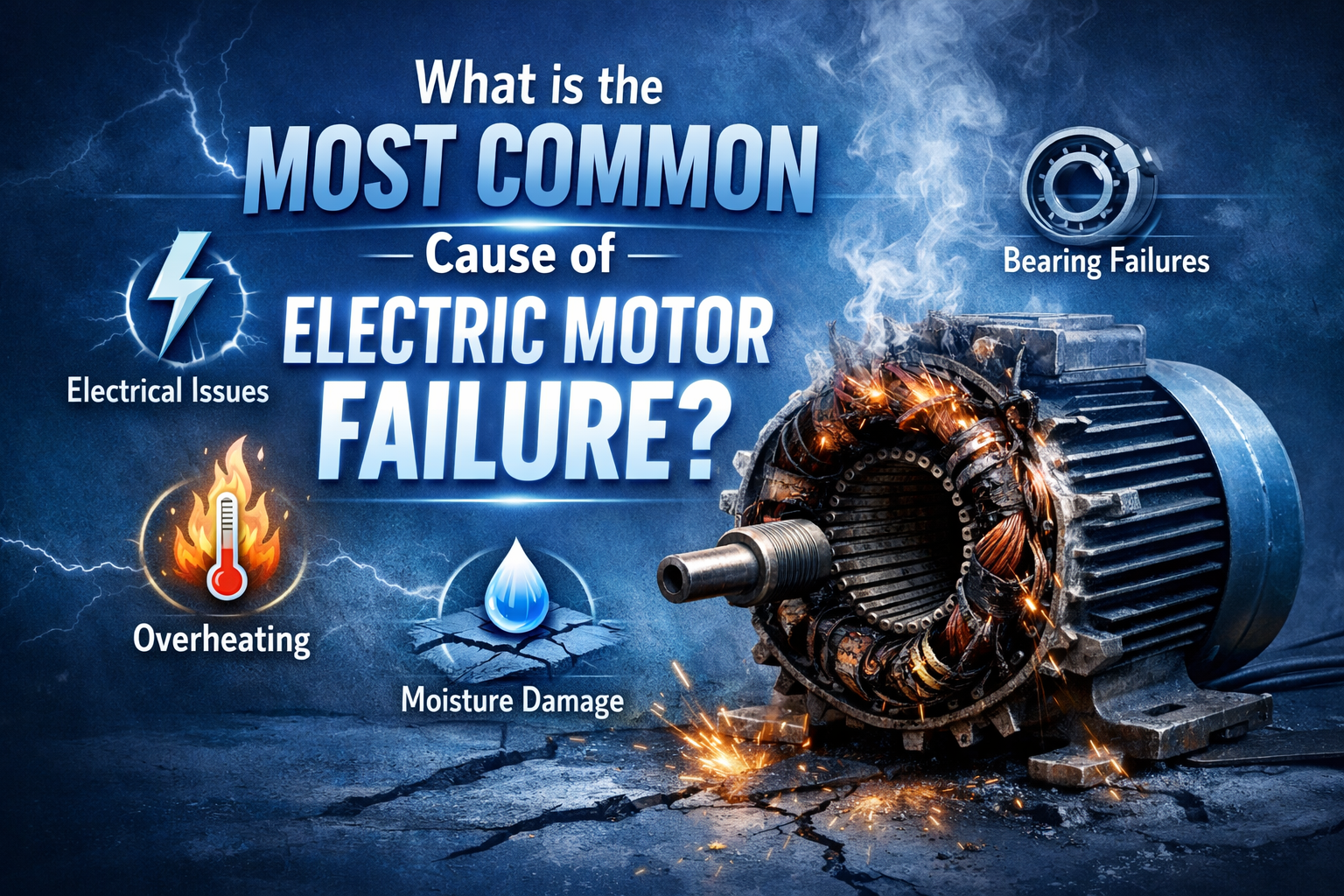
What Is the Most Common Cause of Electric Motor Failure?
Electric motors power nearly every modern industry, but motor failure remains a major cause of downtime, production loss, and maintenance cost. At United Motion Inc., OEMs and engineers often ask what causes electric motor failure and how to prevent it. While heat is the primary culprit, long-term failure is usually driven by a combination of electrical, mechanical, environmental, and operational factors that gradually damage motor components.
Why Electric Motor Failure Matters More Than Ever?
Electric motors account for a significant share of industrial energy consumption worldwide. As production lines become more automated and equipment more compact, motors are expected to deliver higher efficiency, greater precision, and longer service life under tighter operating margins. At the same time, many buyers face pressure to reduce maintenance budgets while increasing uptime. When a motor fails unexpectedly, the cost is rarely limited to the motor itself. Lost production, delayed deliveries, safety risks, and emergency repairs often multiply the financial impact.
Modern buyers are also more informed than ever. Before contacting a manufacturer, they search online for failure causes, troubleshooting guides, and reliability benchmarks. They want answers that are practical, credible, and clearly explained. This is why it is important to move beyond generic explanations and focus on the root causes that actually lead to failure in the field.
The Short Answer: Overheating Is the Leading Cause
Across industries and motor types—AC motors, DC motors, BLDC motors, and servo motors—overheating consistently ranks as the most common cause of electric motor failure. Heat accelerates insulation breakdown, degrades lubrication, weakens bearings, and shortens the life of electronic components. According to multiple industry studies, a motor’s insulation life is reduced by roughly half for every 10°C increase above its rated temperature.
However, overheating is rarely a standalone problem. It is usually the final symptom of deeper issues such as overload, poor ventilation, voltage imbalance, misalignment, or improper motor selection. To truly prevent failure, it is essential to understand how these contributing factors interact.
Understanding Heat Generation Inside an Electric Motor
Electric motors generate heat as a natural byproduct of operation. Electrical losses in the stator windings, magnetic losses in the core, and mechanical friction in bearings all contribute to temperature rise. Under normal conditions, this heat is dissipated through the motor housing, cooling fan, or external cooling system. Problems arise when heat generation exceeds heat dissipation.
In real-world applications, this imbalance often develops gradually. A motor may run slightly hotter than normal for months without triggering alarms. Over time, insulation becomes brittle, lubrication degrades, and clearances change. By the time failure occurs, the root cause may be overlooked or misdiagnosed.
Electrical Causes of Motor Failure
Overload and Overcurrent Conditions
One of the most common electrical causes of motor overheating is overload. When a motor is required to deliver more torque than it is designed for, it draws higher current. This increased current raises winding temperature and stresses insulation. Overload conditions can result from process changes, mechanical binding, improper gear ratios, or undersized motor selection.
Many buyers underestimate the importance of service factor and duty cycle when selecting a motor. A motor that operates continuously near its maximum rating may meet short-term needs but suffer premature failure in long-term operation. At United Motion Inc., we often recommend evaluating real load profiles rather than relying solely on nominal power ratings.
Voltage Imbalance and Poor Power Quality
Voltage imbalance is another major contributor to motor failure, especially in three-phase AC motors. Even a small imbalance between phases can cause significant current imbalance, leading to localized overheating in windings. Power quality issues such as harmonics, voltage spikes, and unstable supply further stress motor insulation and drive electronics.
In facilities with variable frequency drives (VFDs), improper grounding or filtering can introduce additional electrical stress. Over time, these conditions accelerate insulation aging and increase the risk of winding failure.
Insulation Breakdown
Insulation is the heart of an electric motor’s reliability. It separates conductive components and prevents short circuits. Heat, moisture, contamination, and electrical stress gradually degrade insulation materials. Once insulation integrity is compromised, partial discharge, short circuits, or ground faults can occur.
Modern motors use advanced insulation systems, but even the best materials have limits. Proper thermal management, clean operating environments, and correct voltage levels are essential to extending insulation life.
Mechanical Causes of Motor Failure
Bearing Failure as a Secondary Effect
Bearings are often cited as a leading cause of motor failure, and for good reason. However, bearing failure is frequently a secondary effect rather than the primary root cause. Excess heat, misalignment, shaft imbalance, and electrical currents can all damage bearings over time.
When bearings fail, friction increases, which further raises motor temperature. This creates a feedback loop that accelerates overall motor degradation. Proper lubrication, alignment, and bearing selection are critical, especially in high-speed or precision applications.
Misalignment and Mechanical Stress
Misalignment between the motor shaft and the driven load introduces radial and axial forces that bearings and shafts are not designed to handle continuously. Coupling issues, improper installation, and foundation settling are common contributors. Over time, misalignment leads to vibration, noise, and premature mechanical wear. For buyers focused on long-term reliability, installation quality is just as important as motor design. Even a high-quality motor can fail early if installed incorrectly.
Environmental Factors That Accelerate Failure
Contamination and Dust Ingress
Dust, dirt, oil mist, and chemical vapors are silent killers of electric motors. Contaminants can clog cooling paths, reduce heat dissipation, and attack insulation materials. In some industries, such as food processing or chemical manufacturing, environmental exposure is unavoidable. Selecting the right enclosure rating and sealing solution is essential. Motors designed for clean environments may not survive in harsh conditions without additional protection.
Moisture and Humidity
Moisture ingress leads to corrosion, insulation breakdown, and electrical tracking. Motors operating in outdoor, washdown, or high-humidity environments are particularly vulnerable. Condensation during temperature cycling can also cause damage even if the motor is not directly exposed to water. Using motors with appropriate ingress protection, heaters, or coatings can significantly reduce moisture-related failures.
Operational and Human Factors
Improper Motor Selection
One of the most overlooked causes of electric motor failure is improper selection at the design stage. Choosing a motor based solely on power rating or price often leads to mismatches in torque, speed, duty cycle, or thermal capacity. These mismatches may not cause immediate failure but gradually shorten motor life.
Lack of Preventive Maintenance
Preventive maintenance is often the first budget item to be reduced, yet it plays a critical role in motor reliability. Simple practices such as temperature monitoring, vibration analysis, insulation testing, and lubrication checks can identify issues long before failure occurs. In many cases, motors fail not because problems were undetectable, but because warning signs were ignored or not measured.
Why Heat Connects All Failure Modes?
When analyzing motor failure data across industries, a clear pattern emerges: heat is the common thread linking electrical, mechanical, environmental, and operational issues. Overload increases current and heat. Poor ventilation traps heat. Bearing friction generates heat. Contamination blocks cooling paths. Even control system issues often result in excessive thermal stress. This is why thermal management should be a central focus for anyone seeking to improve motor reliability. Temperature monitoring, proper derating, and adequate cooling are not optional extras—they are fundamental design and maintenance considerations.
How Modern Motor Design Reduces Failure Risk?
Advances in materials, manufacturing, and control technology have significantly improved motor reliability. High-efficiency designs reduce losses and operating temperature. Improved insulation systems withstand higher thermal and electrical stress. Precision manufacturing reduces vibration and mechanical imbalance.
Servo motors and BLDC motors, commonly supplied by United Motion Inc., offer additional advantages such as precise control, lower heat generation, and integrated feedback. However, even advanced motors require correct application and installation to realize their full reliability potential.
Practical Steps to Prevent Electric Motor Failure
Preventing motor failure starts with understanding the application. Accurate load analysis, correct motor sizing, and appropriate control strategies form the foundation. From there, attention should be given to installation quality, environmental protection, and ongoing monitoring.
Buyers should work with experienced manufacturers who can provide technical guidance rather than just catalog specifications. A motor is not a commodity component; it is a system-critical asset.
Why Buyers Trust United Motion Inc.?
At United Motion Inc., we combine engineering expertise with real-world application knowledge. Our electric motor solutions are designed with reliability, efficiency, and long service life in mind. We support customers throughout the entire lifecycle, from selection and customization to operation and optimization. By addressing the most common causes of electric motor failure at the design stage, we help our customers reduce downtime, lower maintenance costs, and improve overall system performance.
References
1. IEEE Industry Applications Society, Motor Reliability and Failure Analysis
2. Electric Power Research Institute (EPRI), Causes of Electric Motor Failures
3. NEMA MG 1, Motors and Generators Standard
4. U.S. Department of Energy, Improving Motor and Drive System Performance
5. ABB Technical Guide, Electric Motor Maintenance and Failure Prevention
Related blog: What Size Electric Motor for a Kayak?