
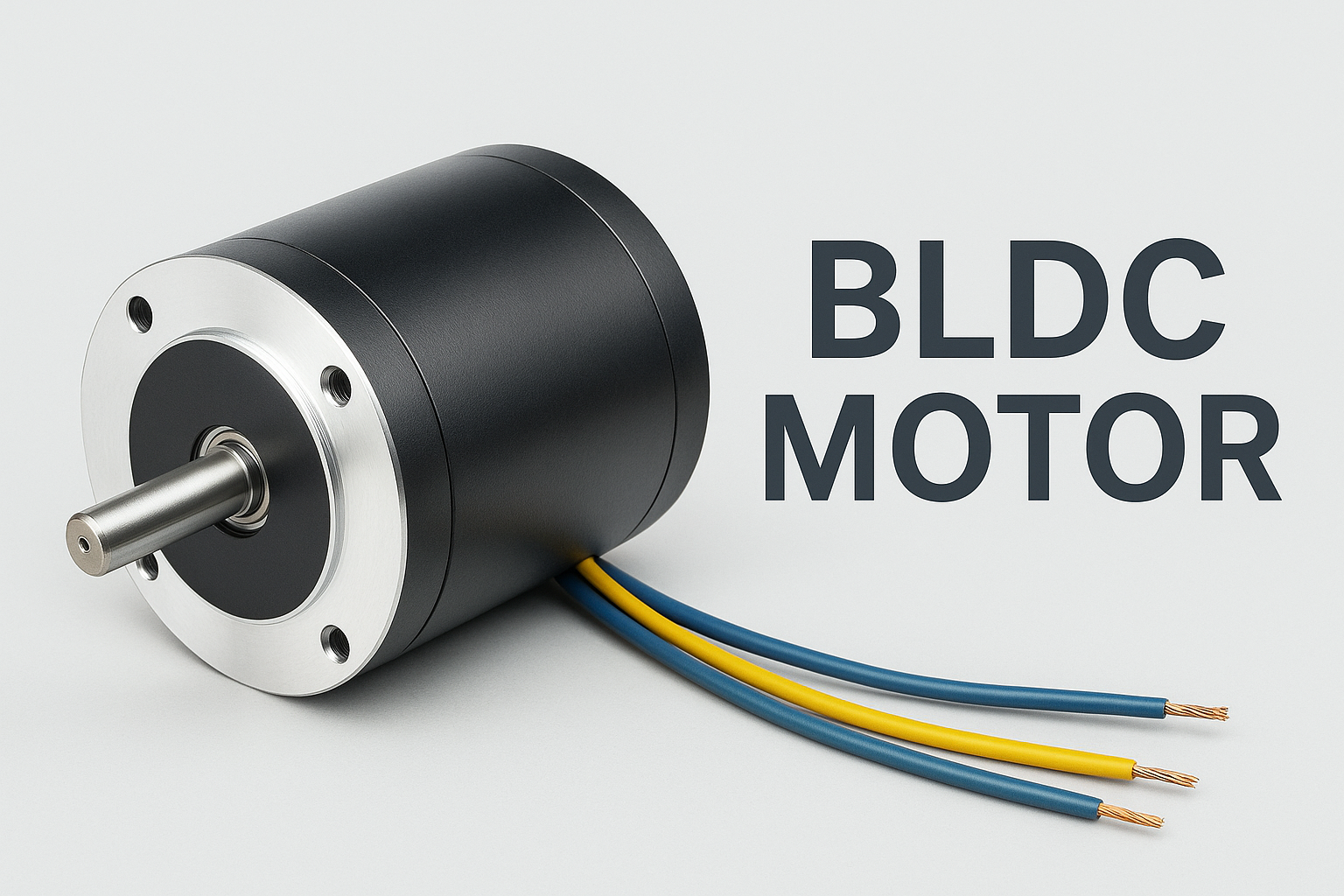
What is a BLDC Motor and How it works?
In today’s world, efficiency, precision, and compactness define industrial and consumer technology. Behind many of these advancements lies a motor that has changed how motion is created and controlled — the Brushless DC Motor (BLDC Motor). Unlike traditional brushed motors, BLDC motors operate without brushes, providing smoother control, higher efficiency, and longer service life. They’ve become the backbone of electric vehicles, drones, robotics, HVAC systems, and industrial automation.
At United Motion Inc., we’ve seen this shift firsthand. Customers who once relied on conventional DC motors are moving rapidly toward BLDC solutions because they want performance without compromise — minimal maintenance, high reliability, and precise torque control. But what exactly makes a BLDC motor so different? How does it work? And why is it becoming the preferred choice in so many industries?
In this in-depth guide, we’ll break down the working principle, structure, and function of a BLDC motor in simple, human language. By the end, you’ll understand not only how it works but also why it works so well — and how it can improve your system’s overall performance.
What is a BLDC Motor?
A Brushless DC Motor (BLDC motor) is an electronically commutated motor that runs on direct current (DC) electricity. Instead of using brushes and a mechanical commutator to switch the current direction, a BLDC motor relies on an electronic controller to manage the current flow through the motor windings.
In traditional brushed motors, brushes make physical contact with the commutator to reverse current and maintain torque. Over time, this mechanical contact wears down, causing friction, noise, and maintenance issues. The BLDC motor eliminates this physical contact, replacing it with a sensor or sensorless electronic control system that switches the stator windings at the right time to keep the rotor spinning.
This design gives the BLDC motor several clear advantages:
- Higher efficiency and torque per weight
- Longer lifespan due to no brush wear
- Less electrical noise and smoother operation
- Compact and lightweight design
- Accurate speed and position control
Basic Construction of a BLDC Motor
To understand how a BLDC motor works, we first need to look at its main components. Despite its advanced design, the BLDC motor’s structure is straightforward and can be divided into two main parts — the stator and the rotor.
| Component | Description | Material / Function |
|---|---|---|
| Stator | The stationary part of the motor that contains the windings connected to the power supply. | Laminated steel core with copper windings. |
| Rotor | The rotating part containing permanent magnets. | Made of rare-earth magnets (like Neodymium) for high magnetic strength. |
| Hall Sensors | Detect the rotor position and send signals to the controller. | Used for electronic commutation. |
| Controller (Driver) | Manages the current direction and timing. | Replaces the mechanical commutator. |
| Shaft and Bearings | Support mechanical rotation. | Ensures low friction and smooth motion. |
The stator works as the electromagnetic field generator, while the rotor moves in response to that field. Together, they convert electrical energy into mechanical energy with outstanding precision.
The Working Principle of a BLDC Motor
The working principle of a BLDC motor is based on electromagnetic induction and electronic commutation. When DC voltage is applied to the stator windings, an electromagnetic field is created. The rotor, which has permanent magnets, aligns with this field.
As the motor runs, the controller continuously switches the current direction in the stator coils. This switching action keeps the magnetic poles changing, and as a result, the rotor continues to rotate — always trying to align with the newly created magnetic field.
To simplify, the controller plays the role of the “brain,” ensuring the motor receives the right current at the right time. The rotor keeps following the moving magnetic field, resulting in smooth, continuous motion.
How Electronic Commutation Works?
- Position Detection: Hall sensors or a sensorless feedback method detect the rotor’s position.
- Signal Transmission: The detected position is sent to the controller.
- Switching Sequence: The controller activates the appropriate stator windings in sequence.
- Magnetic Interaction: The rotor’s magnetic poles align with the stator’s electromagnetic field.
- Continuous Rotation: This process repeats rapidly, creating rotation without physical contact.
BLDC Motor Types
BLDC motors come in two main types based on their construction:
Inner Rotor Type
- The rotor is located inside the stator.
- Provides efficient cooling of the windings.
- Common in fans, drones, and servo drives.
Outer Rotor Type
- The rotor surrounds the stator.
- Offers higher torque at lower speeds.
- Common in electric bicycles, HVAC blowers, and compact drives.
Functions of a BLDC Motor
The main function of a BLDC motor is to convert electrical energy into mechanical motion with high control and low loss. However, its application goes beyond simple rotation. Here’s a closer look at what it can do:
1. Efficient Energy Conversion
BLDC motors convert DC electrical input into mechanical output with minimal loss. Their efficiency typically ranges between 85% to 95%, significantly higher than brushed DC motors.
2. Speed Control
Because they are electronically commutated, speed can be easily controlled through pulse-width modulation (PWM) or voltage adjustments, allowing for smooth acceleration and deceleration.
3. Torque Control
BLDC motors deliver consistent torque across a wide range of speeds, making them perfect for applications that require precision, such as CNC machines and robotics.
4. Position Control
With the help of feedback systems, these motors can control position accurately, enabling their use in servo applications.
5. Maintenance-Free Operation
Without brushes, there’s no frictional wear, which reduces downtime and the need for replacements.
Working Principle Illustrated
Let’s visualize the principle in a simplified flow:
| Step | Action | Result |
|---|---|---|
| 1 | DC power is applied | Magnetic field forms in the stator. |
| 2 | Rotor position is detected | Controller determines switching sequence. |
| 3 | Controller switches current | Magnetic field rotates electronically. |
| 4 | Rotor follows field | Mechanical rotation occurs. |
| 5 | Cycle repeats | Continuous motion maintained. |
This sequence happens thousands of times per second in real operation, allowing smooth rotation even under load variations.
Advantages of Using BLDC Motors
BLDC motors are popular for a reason — they outperform traditional motors in several critical areas.
1. High Efficiency
Because there are no brush losses, BLDC motors achieve higher efficiency, especially at partial loads.
2. Long Lifespan
Without mechanical contact, wear is drastically reduced. Bearings become the only components subject to mechanical wear.
3. Compact Design
The compactness of BLDC motors allows them to be integrated into small devices while maintaining high torque output.
4. Quiet and Smooth Operation
No brush contact means reduced vibration and noise — essential for applications like medical devices or office equipment.
5. Better Control
With advanced electronics, torque and speed can be finely tuned, giving precise control in industrial and automation settings.
Common Applications
BLDC motors are everywhere — from your laptop fan to large industrial systems. Let’s look at key sectors:
| Application Area | Example Uses |
|---|---|
| Automotive | Electric vehicles, power steering, pumps. |
| Aerospace | Drone propulsion, actuation systems. |
| Industrial Automation | CNC tools, conveyors, robotic arms. |
| Home Appliances | Fans, air conditioners, washing machines. |
| Medical Equipment | Pumps, prosthetics, imaging systems. |
At United Motion Inc., our BLDC motor line is tailored for these fields, especially where efficiency and precision control matter most.
Why Industries Prefer BLDC Motors Over Brushed Motors?
Buyers often switch from brushed motors due to:
- Longer lifespan
- No brushes means minimal mechanical wear.
- Lower heat generation
- Higher efficiency reduces power loss.
- Better torque control
- BLDC motors respond quickly and accurately to commands.
- Quiet operation
- Less friction equals lower noise.
- Higher speed capability
- Electronic commutation allows higher RPM ranges.
- Better safety and reliability
- Smoother control reduces risk in medical and industrial machines.
Many industries have already standardized BLDC motors as their primary motion source, and more continue to shift because of these advantages.
BLDC Motor Controllers Explained
A BLDC system is incomplete without a driver. The controller handles:
- Commutation
- Speed control
- Torque control
- Over-current protection
- Soft-start and braking
- Fault detection
- EMI reduction
Three main control modes exist:
Open-Loop Control
Simple and low-cost. Suitable for fans, small pumps.
Closed-Loop Control (Hall Feedback)
Better torque accuracy and speed stability.
Closed-Loop Control (Encoder or Sensorless)
Used for high-precision robotic and EV systems.
Buyers must match the controller with the motor to avoid overheating or poor performance.
Sizing a BLDC Motor: Buyer’s Checklist
When customers contact United Motion Inc., they often ask for help choosing the right size. Here is a checklist used by many engineers:
- Load torque requirement
- Rated and peak speed
- Duty cycle
- Power supply voltage
- Available space
- Mounting type
- Environment (temperature, humidity)
- Noise requirement
- Cooling conditions
- Driver compatibility
Selecting a BLDC motor is not just about torque. Heat, speed, and duty cycle must match the application.
BLDC Motor Efficiency and Power Consumption
BLDC motors typically reach 85–92% efficiency, making them suitable for battery-powered devices. Low losses also reduce heat. With proper control and cooling, BLDC motors keep energy usage stable, even under load.
Efficiency depends on:
- Copper loss
- Iron loss
- Driver switching loss
- Mechanical friction
This is why BLDC motors outperform brushed alternatives by a large margin.
Common Misunderstandings Buyers Have
Even experienced buyers sometimes misunderstand BLDC motors. Here are common points that United Motion Inc. helps clarify:
Misunderstanding: Higher speed means higher torque
Truth: Torque drops as speed increases.
Misunderstanding: Bigger motor always gives better performance
Truth: Oversizing wastes energy and increases cost.
Misunderstanding: Hall sensors are required
Truth: Sensorless motors work well in many applications.
Misunderstanding: All BLDC motors are the same
Truth: Winding design and magnet quality vary widely among suppliers.
How BLDC Motors Improve Product Quality?
Manufacturers that switch to BLDC motors typically report:
- Smoother motion quality
- Faster response
- Lower defect rate
- Longer product lifespan
- Lower energy costs
- Fewer customer complaints related to noise
These improvements directly affect sales, customer satisfaction, and brand value.
Working with a BLDC Motor Supplier
Choosing a reliable bldc motor supplier is as important as choosing the right motor. A professional supplier provides:
- Engineering support
- Custom shaft and housing options
- Driver matching
- Speed-torque optimization
- Quality control and testing
- Long-term supply stability
- Clear communication and fast delivery
United Motion Inc. supports global customers with tailored BLDC solutions for a wide range of applications.
Maintenance and Troubleshooting Tips
BLDC motors need minimal maintenance, but to maximize lifespan:
- Keep the motor clean and dust-free
- Ensure proper ventilation
- Use the correct driver
- Avoid over-current or overload
- Monitor bearing noise
- Inspect wiring and connectors regularly
Most faults come from wiring mistakes or mismatched drivers—not the motor itself.
References
Krishnan, R. (2010). Permanent Magnet Synchronous and Brushless DC Motor Drives. CRC Press.
Pillay, P., & Krishnan, R. (1989). “Modeling of Permanent Magnet Motor Drives.” IEEE Transactions on Industrial Electronics.
United Motion Inc. Internal Product Specifications – BLDC Series 36mm.
Boldea, I., & Nasar, S. A. (2002). Electric Drives: A Modern Control Approach. CRC Press.