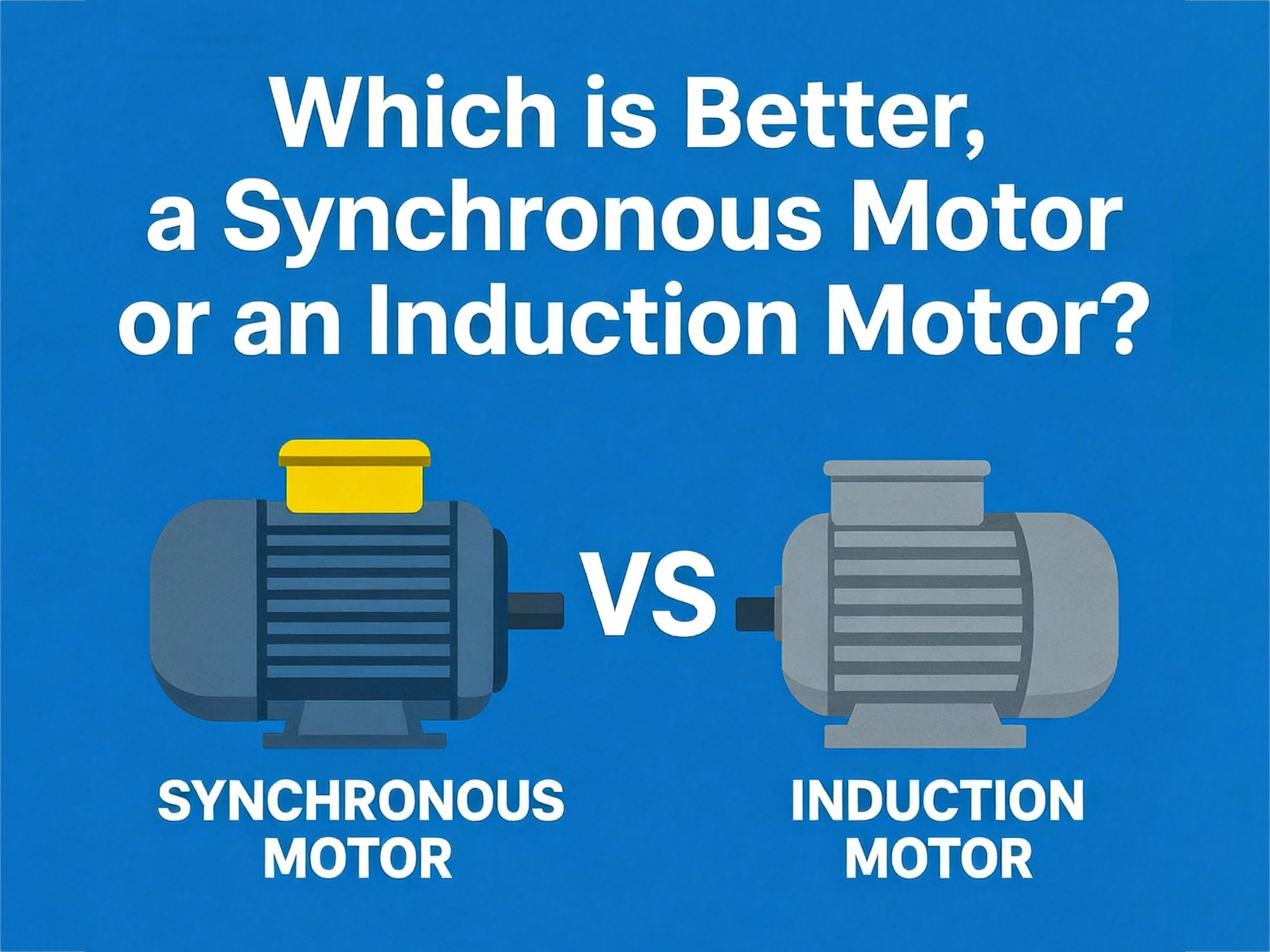
Which is Better, a Synchronous Motor or an Induction Motor?
Understanding the Basics of Electric Motors
What Is a Synchronous Motor?
- Positioning systems and robotics
- Industrial automation requiring precise timing
- Large-scale compressors and pumps
- Machine tools where uniform rotation is vital
What Is an Induction Motor?
- Conveyors and fans
- Pumps and blowers
- Mixers, grinders, and compressors
- HVAC systems and general-purpose machinery
Key Differences Between Synchronous and Induction Motors
| Parameter | Synchronous Motor | Induction Motor |
|---|---|---|
| Operating Principle | Rotor speed equals stator field speed (no slip) | Rotor lags stator field (slip exists) |
| Starting Mechanism | Requires external starting system | Self-starting |
| Speed Control | Constant and precise | Varies with load and slip |
| Efficiency | Higher at constant loads | Moderate, drops under variable loads |
| Power Factor | Adjustable (leading, lagging, or unity) | Generally lagging |
| Maintenance | Requires more (brushes, excitation) | Low maintenance |
| Cost | Higher | Lower |
| Applications | Precision equipment, synchronous drives, high-torque needs | General industry, fans, pumps, conveyors |
Performance Comparison in Real-World Conditions
When discussing which motor is “better,” the answer depends on what “better” means for your application — efficiency, speed stability, cost, or ease of use.
1. Speed Stability
A synchronous motor maintains constant speed regardless of load fluctuations. This makes it the go-to option for precision applications, such as robotics, conveyors that must run in perfect coordination, or processes like printing and textile manufacturing.
An induction motor, however, experiences minor speed variations as load changes. For example, an induction motor rated for 1800 RPM might slow down to 1750 RPM under heavy load. For many industrial processes, this small variation is acceptable.
2. Efficiency
At steady loads, synchronous motors tend to be more energy-efficient because they operate without slip losses. Additionally, when over-excited, they can improve the power factor of an entire system — reducing the overall power bill in a factory setup.
Induction motors, although slightly less efficient, excel in variable load applications. They are robust enough to handle sudden changes in torque or speed without losing performance integrity.
3. Starting and Control
Induction motors are self-starting — simply connect them to the AC supply, and they begin rotating immediately. Synchronous motors, in contrast, need an auxiliary mechanism (like a damper winding or separate DC excitation) to start. This makes them slightly more complex to implement.
However, once started, synchronous motors deliver unmatched speed accuracy.
4. Cost and Maintenance
Induction motors win this round. Their simple construction — no brushes, slip rings, or separate excitation — keeps both initial costs and long-term maintenance low. Synchronous motors, due to their additional excitation systems, cost more upfront and require more attention during maintenance cycles.
Application-Based Comparison: Which Motor Fits Your Industry?
Choosing the right motor often depends more on the application than the technology itself. Let’s look at how each motor performs in real-world scenarios.
Industrial Automation and Robotics
In automation systems, precision and control are critical. Synchronous motors, especially brushless types like BLDC motors, are widely used in robotics, CNC machines, and automated production lines.
Their ability to maintain constant speed and deliver high torque makes them ideal for these applications.
HVAC Systems and Pumps
Induction motors dominate HVAC systems, pumps, and fans due to their simplicity and cost-effectiveness. These applications do not require precise speed control, making induction motors a practical choice.
Electric Vehicles and Advanced Systems
In modern electric vehicles and high-performance systems, synchronous motors are often preferred due to their higher efficiency and better power density.
Heavy Industry and Continuous Operations
For heavy-duty applications such as mining, steel production, and large-scale manufacturing, induction motors are widely used because of their durability and low maintenance requirements.
Cost-Benefit Analysis
When comparing synchronous and induction motors, cost is a major factor.
Let’s consider a typical scenario:
| Aspect | Synchronous Motor | Induction Motor |
|---|---|---|
| Initial Cost | Higher | Lower |
| Installation Complexity | Moderate to high | Low |
| Energy Efficiency | High at steady load | Moderate |
| Maintenance Cost | Higher (excitation, brushes) | Minimal |
| Total Lifetime Cost | Higher for small systems, balanced for large-scale plants | Lower for small and medium systems |
In summary, synchronous motors provide a better return in large-scale, precision-oriented applications where energy efficiency and power factor correction matter. Induction motors, however, are more economical and flexible for standard industrial use.
Reliability and Maintenance Considerations
From a maintenance perspective, induction motors clearly have the advantage. Their rugged construction allows for long-term operation even in harsh industrial environments with minimal supervision. The absence of slip rings or DC excitation makes them more resilient against mechanical wear. Synchronous motors, while reliable, have more complex parts — excitation windings, slip rings, and sometimes brushes — that require regular inspection. They also need precise alignment during installation to prevent vibration or synchronization failure. That said, with proper maintenance and environmental protection, synchronous motors can operate efficiently for decades, making them a smart long-term investment for mission-critical systems.
Power Factor and Energy Efficiency
Power factor is often an overlooked but significant aspect of motor selection. Induction motors inherently have a lagging power factor because they consume reactive power to magnetize the core. This can result in higher apparent power (kVA) and reduced overall system efficiency. Synchronous motors, on the other hand, can be tuned to operate at leading, lagging, or unity power factor by adjusting excitation. This makes them excellent for power factor correction — reducing reactive losses and improving grid performance. In facilities with many induction motors, installing a synchronous motor can help balance the power system, leading to reduced electricity costs and improved stability.
Control Systems and Automation Integration
In modern automation, motors are rarely used in isolation. They are part of sophisticated control systems managed by PLCs, sensors, and drives.
Induction Motors pair seamlessly with Variable Frequency Drives (VFDs), allowing precise control over speed and torque. This makes them extremely versatile in applications like conveyors, mixers, or fans where speed variation is necessary.
Synchronous Motors, when paired with servo drives or advanced controllers, offer pinpoint motion accuracy — perfect for robotics and mechatronics.
The trend in modern automation favors hybrid systems, where induction motors handle heavy-duty continuous tasks, and synchronous motors manage precision roles.
Environmental and Operational Factors
Selecting the right motor type also depends on your operating environment. In dusty or humid conditions, induction motors are preferred for their sealed, maintenance-free designs. They are also more tolerant of voltage fluctuations and thermal overload. Synchronous motors are better suited for clean, controlled environments where accuracy and efficiency outweigh ruggedness. In recent years, permanent magnet synchronous motors (PMSMs) have gained popularity for offering both high efficiency and compact size, making them ideal for electric vehicles and compact machinery.
Technological Evolution in Motor Design
Motor technology has evolved rapidly over the past decade. Modern synchronous and induction motors are no longer as distinct as they once were.
Advanced materials, better insulation, and digital controls have improved both types significantly. For example:
Permanent Magnet Synchronous Motors (PMSMs) deliver superior torque density and efficiency.
Sensorless Vector Control for induction motors allows near-synchronous performance with simpler hardware.
High-Efficiency Designs (IE4 and IE5) now meet global energy standards, pushing both types toward more sustainable operation.
The Verdict: Which Is Better?
There is no absolute winner.
If your application demands precision, stable speed, and energy optimization, the synchronous motor stands out as the superior choice.
If your priority is ruggedness, simplicity, and cost-effectiveness, then the induction motor remains unbeatable.
Ultimately, the “better” motor is the one that aligns with your operational goals — and in many modern factories, both coexist in perfect harmony.
References
Fitzgerald, A.E., Kingsley, C., & Umans, S.D. (2003). Electric Machinery. McGraw-Hill.
Chapman, S.J. (2011). Electric Machinery Fundamentals. McGraw-Hill Education.
IEEE Industry Applications Society. (2018). Motor System Energy Efficiency Standards.
NEMA MG1 Standard — Motors and Generators, National Electrical Manufacturers Association.
Related blog: Do Electric Cars Use AC or DC Motors?