
Quick Answer
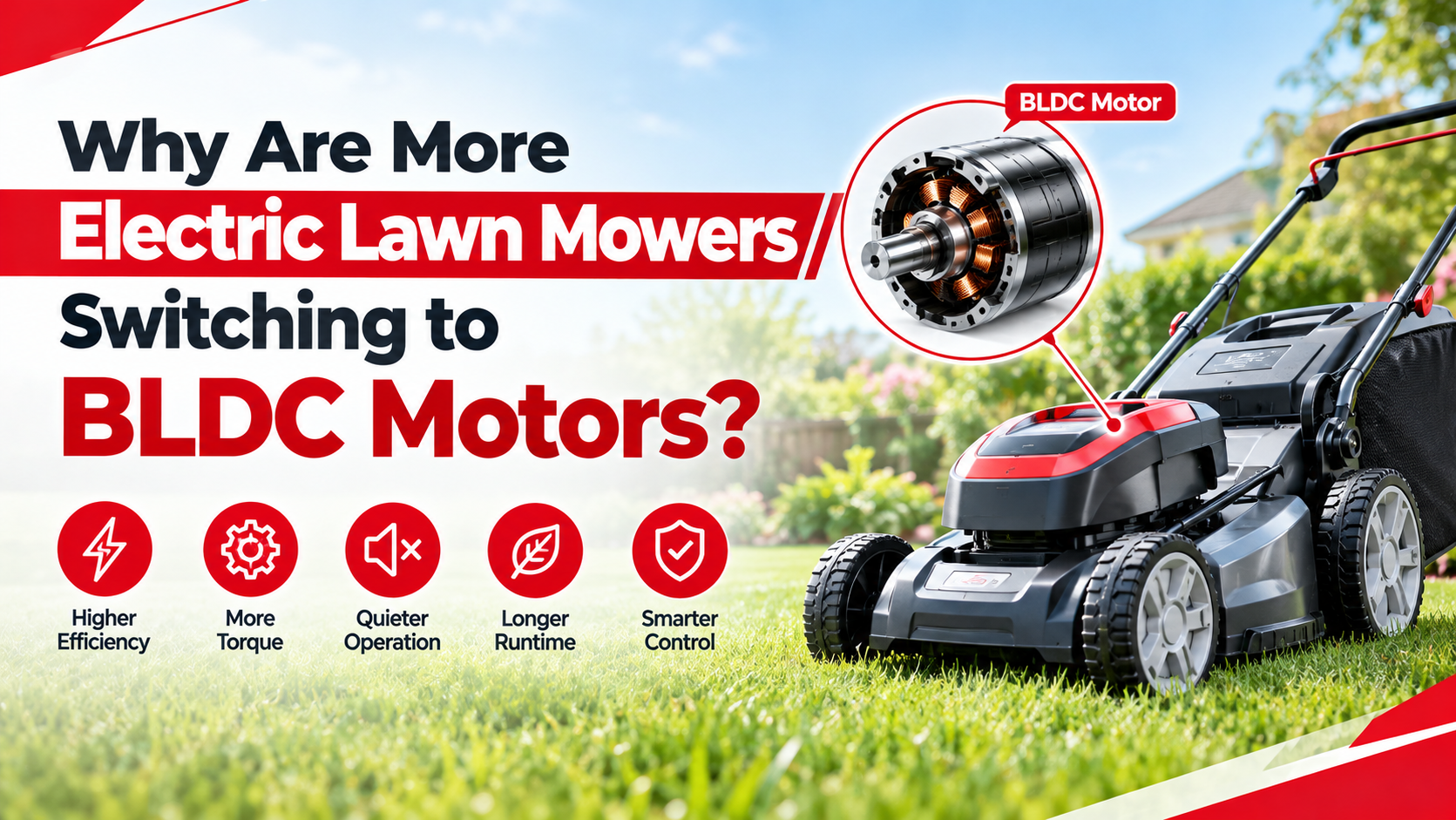
Electric lawn mowers are increasingly adopting brushless DC (BLDC) motors because they offer high electrical efficiency, strong torque performance, precise speed control, reduced maintenance, and improved compatibility with battery-powered equipment. Compared with brushed DC motors, BLDC motors eliminate mechanical brushes and commutators, reducing wear and maintenance while enabling more advanced electronic control.
For manufacturers developing cordless lawn mowers and robotic mowing systems, BLDC technology also provides greater flexibility in motor speed, torque, thermal management, and battery integration. When combined with Field-Oriented Control (FOC), an appropriately designed BLDC motor can improve low-speed torque response, reduce torque ripple, and help manage operating noise under changing grass and cutting-load conditions.
Engineering takeaway: BLDC motors are becoming an attractive choice for electric lawn mowers because they combine efficient battery utilization, controllable cutting performance, and flexible integration into compact outdoor power equipment.
Higher Efficiency Helps Extend Battery Runtime
Battery runtime is one of the most important purchasing and engineering considerations for cordless lawn mowers. The motor must deliver sufficient cutting power while minimizing the electrical energy consumed during operation.
BLDC motors use permanent magnets on the rotor and electronically commutated stator windings, eliminating the brush friction and commutation losses associated with conventional brushed DC motors. Although winding resistance, magnetic losses, bearing friction, and controller losses remain, a properly designed BLDC motor can convert a greater proportion of battery energy into useful mechanical output.
For example, if a mower draws 500 W of electrical power from its battery, improving total drive efficiency from 80% to 88% would increase mechanical output from 400 W to 440 W at the same electrical input. Alternatively, the motor could deliver the same mechanical output while drawing less power.
Actual efficiency depends on the operating point, controller, cooling conditions, and cutting load, so engineers should evaluate the complete motor-drive system rather than relying on a single peak-efficiency figure.
Engineering implications for OEMs:
- More efficient use of battery capacity
- Potentially longer mowing time per charge
- Reduced electrical losses and heat generation
- Greater flexibility in battery and motor sizing
High Torque Supports Changing Cutting Loads
A lawn mower motor rarely operates under a constant load. Cutting resistance changes with grass height, moisture, blade condition, cutting width, and travel speed, and these variations can create sudden torque demand.
A properly selected BLDC motor can provide rapid torque response through electronic current control, helping the blade maintain a more stable speed when cutting resistance increases. This is especially important when a mower encounters dense grass or transitions between lightly and heavily loaded sections of a lawn.
Motor performance must be evaluated using both continuous and peak torque requirements. Continuous torque determines whether the motor can sustain normal operation without overheating, while peak torque and the controller’s current limit determine how effectively it can respond to temporary load increases.
A motor with insufficient torque reserve may experience speed droop, excessive current, thermal overload, or repeated protection events. Conversely, oversizing the motor without considering efficiency and cooling can increase cost, weight, and battery demand.
OEM design considerations:
- Blade speed under changing grass conditions
- Continuous and peak torque requirements
- Battery voltage and current limits
- Motor thermal capacity
- Controller response and overload protection
Lower Noise and Smoother Operation
Noise is another reason manufacturers are evaluating BLDC technology for residential and robotic lawn mowers, where operating comfort and neighborhood noise restrictions can influence product design.
Removing brushes eliminates brush friction and mechanical commutation noise, but it does not make a motor silent. Total mower noise also comes from blade aerodynamics, grass impact, bearings, gearbox components, structural vibration, and electromagnetic torque fluctuations.
Electronic control can help improve smoothness. With Field-Oriented Control (FOC), the controller regulates motor current in a way that can provide smoother torque production than poorly tuned or basic commutation strategies, depending on the motor design and operating conditions.
Noise optimization therefore requires a system-level approach that includes motor geometry, blade balance, mounting stiffness, bearing quality, and controller tuning.
Practical recommendation: measure sound pressure under repeatable conditions, documenting the distance, microphone position, grass conditions, blade configuration, and operating mode. Without these details, comparisons between different mower designs may be misleading.
Technical basis: Electromagnetic torque-ripple analysis and rotating-equipment acoustic engineering.
Reduced Maintenance and Longer Service Life
Traditional brushed DC motors rely on physical contact between brushes and the commutator, which gradually wears during operation and may produce carbon dust, friction, and additional maintenance requirements.
BLDC motors eliminate these components, removing a major source of mechanical wear. This can be particularly valuable for robotic mowers, commercial lawn equipment, and products expected to operate repeatedly over many seasons.
However, eliminating brushes does not eliminate every maintenance or reliability concern. Bearings can wear, seals can deteriorate, moisture can enter the motor assembly, and excessive current or temperature can damage windings, magnets, or electronic components.
For outdoor applications, OEM engineers should therefore evaluate ingress protection, corrosion resistance, vibration, thermal management, bearing life, and controller reliability alongside the motor’s electrical specifications.
Design priorities include:
- Appropriate enclosure and ingress protection
- Effective heat dissipation
- Durable bearings and mechanical mounting
- Reliable connectors and cable routing
- Protection against overcurrent and overheating
BLDC Motors Work Well with Modern Battery and Control Systems
Modern electric lawn mowers need to balance cutting performance with battery voltage, current limits, motor temperature, and operating time. BLDC motors are well suited to this environment because their speed and torque can be managed through an electronic motor driver.
Hall sensors can provide rotor-position information for commutation, while sensorless control can estimate rotor position from electrical signals under suitable operating conditions. Encoders may be appropriate when more precise speed or position feedback is required.
FOC can also support smooth torque control and efficient operation across a range of speeds, provided that the motor parameters, controller, and software are properly matched.
The correct configuration depends on the mower architecture. A basic cordless mower may prioritize cost, robustness, and straightforward speed control, while a robotic mower may require additional feedback, variable-speed operation, diagnostics, and communication with a supervisory controller.
Key selection factors:
- Battery voltage and available current
- Required blade speed and torque
- Hall sensor, encoder, or sensorless control
- Driver integration and protection functions
- Thermal limits and duty cycle
Brushed DC vs. BLDC Motors for Electric Lawn Mowers
| Parameter | Brushed DC Motor | BLDC Motor |
| Commutation | Mechanical brushes and commutator | Electronic controller |
| Brush maintenance | Required over service life | Not required |
| Electrical efficiency | Depends on design and operating point | Often higher in a comparable optimized design |
| Torque control | Relatively straightforward | Flexible electronic control |
| Speed regulation | Depends on drive configuration | Supports advanced electronic regulation |
| Mechanical wear | Brush and commutator wear | No brush or commutator wear |
| Control electronics | Can be simpler | Requires a suitable electronic driver |
| System cost | May be lower for simple designs | Depends on motor, driver, and production volume |
| Typical design priorities | Simplicity and initial cost | Efficiency, controllability, and reduced brush maintenance |
The comparison is general rather than universal. Actual efficiency, service life, noise, and total cost depend on the specific motor design, controller, cooling arrangement, operating conditions, and product requirements.
How OEMs Should Select a BLDC Motor for a Lawn Mower?
A reliable selection process starts with the cutting application, not simply the motor’s rated power.
Step 1: Define the cutting requirements. Establish blade diameter, target blade speed, grass conditions, cutting width, and expected load variation.
Step 2: Determine continuous and peak power. Identify normal operating demand and temporary overload requirements, ensuring that the motor and driver can support both without exceeding thermal or current limits.
Step 3: Match the battery and controller. Confirm operating voltage, available battery current, commutation method, speed-control requirements, and protection functions.
Step 4: Evaluate thermal and mechanical integration. Check airflow, mounting, vibration, bearing loading, enclosure protection, and temperature rise under representative cutting conditions.
Step 5: Validate the complete system. Test runtime, cutting performance, current consumption, motor temperature, noise, and overload response using repeatable conditions.
This process helps prevent common problems such as selecting a motor based only on peak power, underestimating startup current, or ignoring the cooling limitations of an enclosed mower design.
Common BLDC Lawn Mower Problems and Troubleshooting
| Problem | Possible Cause | Recommended Check |
| Blade speed drops in thick grass | Insufficient torque reserve or current limit | Measure speed, current, and load response |
| Short battery runtime | Excessive current draw or poor system efficiency | Measure energy consumption under representative conditions |
| Motor overheats | Excessive load, inadequate cooling, or incorrect tuning | Check temperature, current, and ventilation |
| Excessive noise or vibration | Blade imbalance, mounting resonance, or torque ripple | Inspect blade balance and measure vibration |
| Motor fails to start reliably | Controller startup issue or excessive initial load | Check rotor-position detection, startup logic, and current limits |
| Repeated driver protection | Overcurrent, undervoltage, or thermal protection | Review fault codes and electrical measurements |
Troubleshooting should begin with measured operating conditions rather than immediately replacing the motor. In many cases, the root cause involves the battery, controller, blade assembly, or cooling system rather than the motor alone.
UNITED MOTION INC.: BLDC Motor Solutions for Lawn Equipment
UNITED MOTION INC. provides BLDC motor solutions across approximately 28–110 mm frame sizes, with configurable options such as gearboxes, encoders, and integrated drivers.
For lawn mower manufacturers and other outdoor power equipment OEMs, motor selection can be tailored around the required voltage, speed, torque, installation dimensions, feedback configuration, and control architecture.
A suitable custom motor solution should account for the complete operating environment, including blade load, battery constraints, thermal performance, vibration, noise, and expected service life. Motor and controller compatibility is particularly important when the product requires variable-speed control or consistent performance under changing cutting conditions.
By defining these requirements early, OEM engineering teams can evaluate whether a standard BLDC motor configuration is suitable or whether customized motor and drive integration would provide a better fit.
To discuss application requirements, visit the UNITED MOTION INC. BLDC Motor page or contact the engineering team.
FAQ
1. Why are electric lawn mowers switching to BLDC motors?
BLDC motors eliminate brush wear and offer the potential for high efficiency, responsive torque control, reduced maintenance, and flexible integration with battery-powered equipment.
2. Are BLDC motors more efficient than brushed DC motors?
A properly designed BLDC motor is often more efficient than a comparable brushed motor because it eliminates brush-related losses, although actual performance depends on the motor, controller, operating point, and cooling system.
3. Can a BLDC motor handle thick or wet grass?
Yes, if the motor and controller are sized for the resulting load. Engineers must evaluate continuous torque, peak torque, current limits, blade speed, and thermal capacity under realistic cutting conditions.
4. Do BLDC motors make lawn mowers quieter?
They can reduce brush-related noise and support smoother electronic torque control, but blade aerodynamics, bearings, structural vibration, and cutting impacts remain important noise sources.
5. What is the role of FOC in a BLDC lawn mower motor?
Field-Oriented Control regulates motor current to achieve smooth torque production and effective operation across different speeds and loads when properly matched to the motor and controller.
6. Can BLDC motors be customized for lawn mower OEMs?
Yes. OEM configurations can be developed around required voltage, speed, torque, mounting dimensions, gearbox integration, encoder feedback, and driver requirements.