
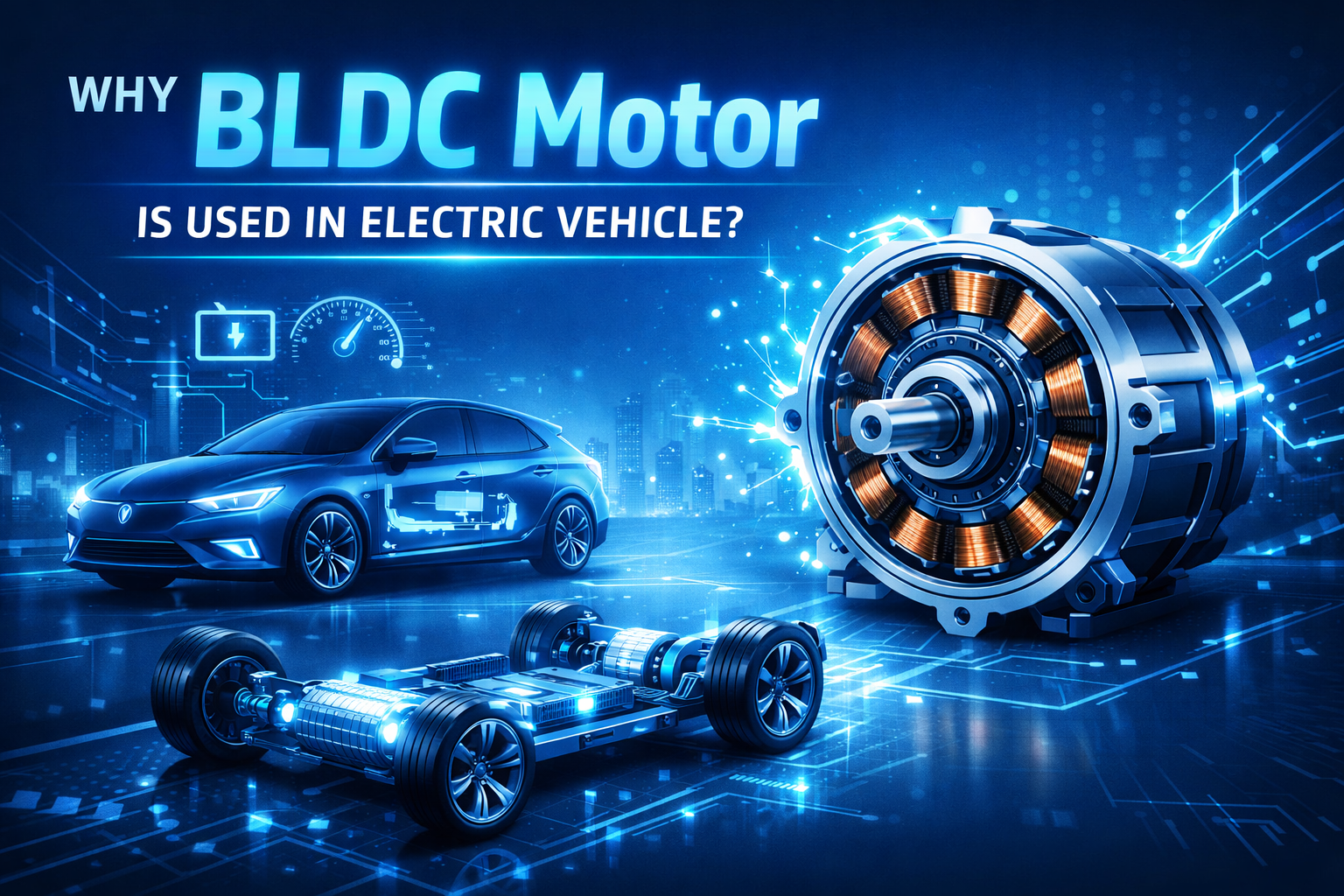
Why BLDC Motor Is Used in Electric Vehicles?
Electric vehicles are changing how people think about transportation, energy use, and mobility. At the center of this change is the electric motor. Among many motor types, the Brushless DC motor, commonly known as the BLDC motor, has become a preferred choice in modern electric vehicles. This is not a trend driven by marketing but a decision based on performance, efficiency, and long-term reliability. Understanding why BLDC motors are widely used in electric vehicles helps buyers, engineers, and decision-makers make better technical and commercial choices.
The Role of the Motor in an Electric Vehicle
An electric vehicle motor is not just a component that creates motion. It directly affects driving range, acceleration, efficiency, thermal behavior, noise levels, and overall vehicle lifespan. Unlike internal combustion engines, electric motors deliver torque instantly, which places high demands on motor control, stability, and thermal management.
In electric vehicles, motors must operate efficiently across a wide speed range, handle frequent start-stop cycles, and maintain stable performance under varying loads. They must also integrate smoothly with electronic controllers, battery systems, and regenerative braking mechanisms. This makes motor selection a strategic decision rather than a simple hardware choice.
What Is a BLDC Motor?
A BLDC motor is a type of permanent magnet motor that operates using electronic commutation instead of mechanical brushes. Traditional brushed motors rely on physical contact between brushes and a commutator to control current flow. This design leads to friction, wear, sparks, and energy loss.
BLDC motors remove brushes entirely. Instead, they use electronic controllers to switch current through the motor windings. The rotor typically uses permanent magnets, while the stator contains wound coils. Sensors or sensorless algorithms determine rotor position, allowing precise control of speed and torque. This brushless design is the foundation of many advantages that make BLDC motors ideal for electric vehicle applications.
High Energy Efficiency: A Key Reason for EV Adoption
Energy efficiency is one of the most critical reasons BLDC motors are used in electric vehicles. Every watt saved directly translates into longer driving range or smaller battery requirements.
BLDC motors have higher efficiency compared to brushed DC motors because there are no brush-related losses. The absence of friction from brushes reduces heat generation and energy waste. Additionally, electronic commutation allows optimized current delivery, ensuring the motor operates close to its peak efficiency across different speeds. For electric vehicle manufacturers, higher motor efficiency means better vehicle range ratings, lower battery stress, and improved energy utilization. For end users, it means fewer charging cycles and lower operating costs.
High Torque Density and Compact Design
Electric vehicles require motors that deliver high torque while occupying minimal space. BLDC motors offer a high torque-to-size ratio, also known as high torque density. This makes them ideal for vehicle designs where space and weight are limited.
Permanent magnets in the rotor allow BLDC motors to generate strong magnetic fields without additional electrical input. This enables the motor to produce higher torque at lower speeds, which is essential for vehicle acceleration and hill climbing.
Compact BLDC motor designs also give engineers more flexibility in vehicle layout. Motors can be integrated into wheel hubs, drive axles, or compact drive modules, supporting innovative vehicle architectures.
Precise Speed and Torque Control
Modern electric vehicles rely heavily on electronic control systems. BLDC motors integrate naturally with advanced motor controllers, enabling precise speed and torque regulation. Electronic commutation allows real-time adjustments based on throttle input, road conditions, battery state, and regenerative braking needs. This results in smoother acceleration, better traction control, and improved driving comfort. Precise motor control also improves safety. Features such as torque limiting, anti-slip control, and smooth deceleration depend on accurate motor response. BLDC motors respond quickly to control signals, making them well-suited for these safety-critical functions.
Longer Service Life and Lower Maintenance
Reliability is a major concern in electric vehicle design. BLDC motors offer a long operational life because they eliminate mechanical brushes, which are a common wear component in traditional motors. Without brushes, there is no sparking, reduced friction, and minimal mechanical wear. This significantly lowers maintenance requirements and reduces the risk of unexpected motor failure. For electric vehicle owners, this translates into lower lifetime ownership costs. For fleet operators and commercial EV users, reduced downtime and maintenance intervals provide clear economic benefits. From an industry perspective, this reliability improves brand reputation and customer satisfaction.
Reduced Noise and Vibration
Noise reduction is an important factor in electric vehicle design. Unlike combustion engines, electric vehicles are quiet, making motor noise more noticeable. BLDC motors operate smoothly with minimal vibration because of their electronic commutation and balanced magnetic fields. The absence of brush contact eliminates mechanical noise, while optimized control algorithms reduce torque ripple. Lower noise levels improve passenger comfort and help electric vehicles meet regulatory noise standards. This is especially important in urban environments and for applications such as electric buses, delivery vehicles, and passenger cars.
Thermal Performance and Heat Management
Heat management is critical in electric vehicles, particularly in high-power applications. Excessive heat can reduce motor efficiency, shorten component life, and impact vehicle safety. BLDC motors generate less heat compared to brushed motors due to higher efficiency and reduced mechanical losses. Advanced motor designs also allow better heat dissipation through optimized stator structures and cooling systems. Improved thermal performance allows BLDC motors to operate at higher power levels for longer periods without degradation. This is essential for electric vehicles that require sustained performance, such as highway driving or heavy-load applications.
Compatibility with Regenerative Braking
Regenerative braking is a defining feature of electric vehicles. It allows the motor to act as a generator during braking, converting kinetic energy back into electrical energy and recharging the battery. BLDC motors are well-suited for regenerative braking because of their electronic control and bidirectional power flow capability. The same motor controller that drives the vehicle forward can manage energy recovery efficiently. This improves overall vehicle efficiency and extends driving range. It also reduces wear on mechanical braking systems, further lowering maintenance requirements.
Scalability Across EV Types
One reason BLDC motors dominate the electric vehicle market is their scalability. They can be designed for a wide range of power levels, from small electric scooters and e-bikes to passenger cars, electric trucks, and industrial EVs. Manufacturers can customize BLDC motors based on voltage, power output, speed range, cooling method, and mounting configuration. This flexibility supports diverse vehicle platforms and evolving market demands.
Cost Efficiency Over the Vehicle Lifetime
While BLDC motors may have a higher initial cost compared to some traditional motor types, their total cost of ownership is lower. High efficiency reduces energy consumption, long service life minimizes replacements, and low maintenance cuts operational costs.
When evaluated over the full vehicle lifecycle, BLDC motors provide strong economic value. This long-term cost efficiency is especially important as electric vehicles become more widely adopted and price competition increases.
Alignment with Modern EV Electronics
Electric vehicles are increasingly software-driven. BLDC motors align perfectly with this trend because they depend on electronic controllers for operation. Advanced algorithms enable features such as adaptive torque control, fault detection, thermal protection, and remote diagnostics. This makes BLDC motors compatible with smart vehicle systems and connected mobility platforms. As EV technology evolves, motors that integrate seamlessly with digital control architectures will continue to be preferred.
Environmental and Sustainability Benefits
Sustainability is a core driver behind electric vehicle adoption. BLDC motors support this goal by offering higher efficiency, longer lifespan, and reduced material waste. Lower energy losses mean less electricity consumption per kilometer driven. Reduced maintenance and fewer replacements lower resource usage over time. These factors contribute to a smaller environmental footprint compared to less efficient motor technologies.
Industry Trends and Market Demand
Global demand for electric vehicles continues to grow, driven by regulations, fuel cost concerns, and environmental awareness. As EV production scales, manufacturers prioritize motor technologies that offer proven performance, reliability, and efficiency.
BLDC motors have become an industry standard in many EV applications due to their balanced advantages. Their widespread adoption has also driven continuous improvements in design, materials, and control systems.
Challenges and How the Industry Addresses Them
BLDC motors are not without challenges. They require sophisticated motor controllers, precise manufacturing, and proper system integration. However, advances in power electronics, sensor technology, and software algorithms have significantly reduced these barriers. Today, mature supply chains and experienced manufacturers make BLDC motor implementation more accessible than ever. Companies like United Motion Inc. focus on delivering reliable, application-specific solutions that simplify integration for EV manufacturers.
Why Buyers Prefer BLDC Motors for EV Projects?
From a buyer’s perspective, BLDC motors offer a combination of performance, reliability, and future readiness. Engineers appreciate their control precision and efficiency. Procurement teams value their long-term cost savings. End users benefit from smooth, quiet, and dependable operation. Search trends also show growing interest in terms such as “BLDC motor for electric vehicle,” “EV motor efficiency,” and “brushless DC motor advantages,” reflecting strong market awareness and demand.
Future Outlook of BLDC Motors in Electric Vehicles
As electric vehicles continue to evolve, BLDC motors will remain a core technology. Ongoing research focuses on improving magnet materials, reducing rare earth dependency, enhancing control algorithms, and increasing power density. The future points toward even more efficient, compact, and intelligent motor systems. BLDC motors are well-positioned to support next-generation electric mobility solutions.
FAQS about BLDC Motor
Why are BLDC motors used in electric vehicles?
BLDC motors are used in electric vehicles because they offer high efficiency, precise control, long service life, and low maintenance, helping improve driving range and reliability.
Do BLDC motors increase EV driving range?
Yes, BLDC motors reduce energy loss during operation, which helps electric vehicles use battery power more efficiently and achieve longer driving range.
Are BLDC motors reliable for long-term EV use?
BLDC motors are highly reliable because they have no brushes, which reduces mechanical wear, heat generation, and failure risk over time.
Do BLDC motors require regular maintenance?
BLDC motors require minimal maintenance since they have fewer wear parts and no brushes that need replacement.
Are BLDC motors noisy in electric vehicles?
No, BLDC motors operate quietly with low vibration, making them suitable for smooth and comfortable electric vehicle operation.
Are BLDC motors good for stop-and-go city driving?
Yes, BLDC motors provide high torque at low speeds and respond quickly, making them ideal for frequent start-stop driving conditions.
Can BLDC motors support regenerative braking?
Yes, BLDC motors work efficiently with regenerative braking systems, allowing energy recovery during deceleration.
Can BLDC motors be used in different types of EVs?
BLDC motors are used in electric bikes, scooters, passenger cars, delivery vehicles, and industrial electric vehicles due to their flexible design.
Are BLDC motors customizable for EV applications?
Yes, BLDC motors can be customized for voltage, power, speed, size, and control requirements to match specific EV designs.
Are BLDC motors cost-effective over time?
BLDC motors offer lower lifetime costs due to higher efficiency, reduced energy consumption, and minimal maintenance needs.
Will BLDC motors remain important in future EVs?
Yes, BLDC motors are expected to remain a core EV technology as efficiency standards and electric mobility adoption continue to grow.
References
International Energy Agency – Global EV Outlook
IEEE Papers on Brushless DC Motor Control
SAE International – Electric Vehicle Powertrain Standards
U.S. Department of Energy – Electric Motor Efficiency Studies
Industry White Papers on EV Motor Technologies