
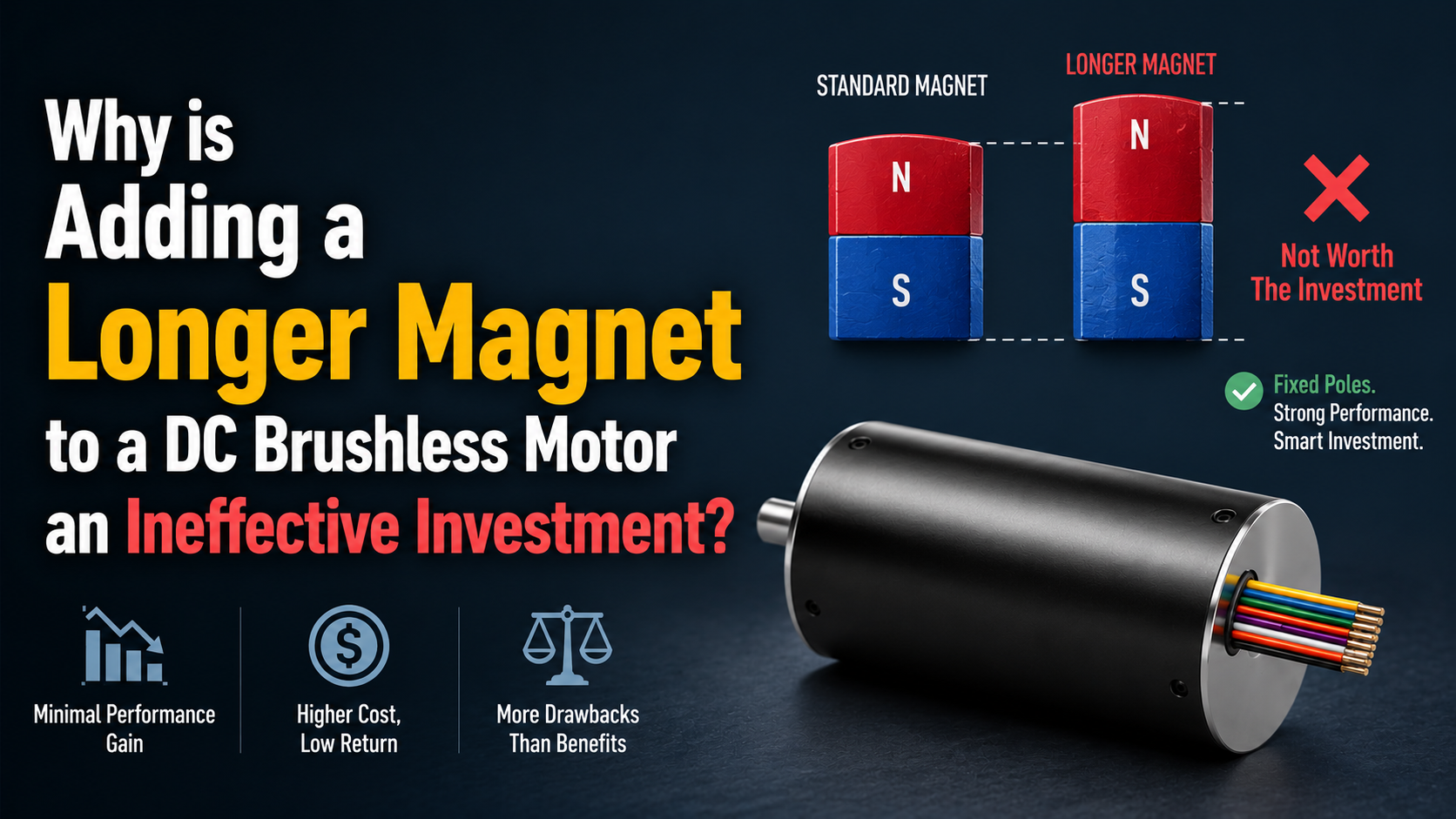
Adding a longer magnet to a Brushless DC Motor Engineering usually provides diminishing performance returns because the magnetic circuit inside the motor reaches saturation before the full magnet length can be effectively utilized.
In most industrial BLDC motor designs:
• Torque improvement becomes marginal after optimal magnet coverage is reached
• Core saturation limits additional magnetic flux
• Rotor inertia increases
• Material cost rises significantly
• Thermal performance may worsen
• Efficiency gains are often negligible
Engineering studies from institutions such as IEEE and NIST consistently show that motor performance depends more on magnetic circuit optimization, winding design, air-gap control, and electronic commutation strategy than simply increasing magnet size.
For industrial applications, optimizing the electromagnetic system usually delivers better ROI than installing longer permanent magnets.
Understanding How a BLDC Motor Generates Torque
A BLDC motor produces torque through the interaction between:
1. Rotor permanent magnets
2. Stator electromagnetic field
3. Controlled commutation sequence
The electromagnetic torque equation can be simplified as:
𝑇=𝑘Φ𝐼
Where:
• T = Torque
• k = Motor constant
• Φ = Magnetic flux
• I = Phase current
This equation reveals an important engineering fact:
Increasing magnetic flux only helps until the magnetic circuit reaches saturation.
After saturation occurs, additional magnet material contributes very little usable torque.
What Happens When Magnet Length Increases?
Initial Performance Improvement
At first, increasing magnet length can improve:
• Air-gap flux density
• Back EMF
• Low-speed torque
• Starting capability
This is because more magnetic material produces stronger magnetic flux.
However, these improvements only continue until the stator core approaches saturation.
Magnetic Saturation: The Main Limitation
What Is Magnetic Saturation?
Magnetic saturation occurs when the stator steel cannot carry additional magnetic flux efficiently.
Once saturation begins:
• Additional magnet strength no longer translates into usable torque
• Iron losses increase
• Heat generation rises
• Efficiency decreases
Most electrical steels used in industrial BLDC motors saturate around:
| Material | Typical Saturation Flux Density |
|---|---|
| Silicon steel laminations | 1.5–2.0 Tesla |
| High-grade electrical steel | 2.1 Tesla maximum |
Research published by MIT and IEEE indicates that exceeding optimal flux density produces rapidly diminishing torque gains while increasing losses significantly.
Why Longer Magnets Often Produce Minimal Torque Gains?
1. Air-Gap Flux Reaches a Ceiling
The motor air gap acts as a magnetic bottleneck.
Even if rotor magnets become longer:
• Air-gap reluctance remains
• Flux leakage increases
• Effective usable flux plateaus
Typical industrial BLDC motors already operate near optimal flux density.
Example:
| Magnet Length Increase | Average Torque Increase |
|---|---|
| +10% | 4–7% |
| +20% | 6–10% |
| +40% | Often less than 12% |
Beyond a certain point, magnet utilization efficiency drops sharply.
2. Rotor Inertia Increases
Longer magnets add rotor mass.
Higher rotor inertia causes:
• Slower acceleration
• Reduced dynamic response
• Worse servo precision
• Higher startup current demand
This becomes critical in:
• Robotics
• CNC systems
• AGV drive motors
• Servo systems
For motion-control applications, lower inertia is often more valuable than slightly higher torque.
3. Eddy Current and Iron Losses Increase
Higher magnetic flux density raises:
• Eddy current loss
• Hysteresis loss
• Rotor heating
• Stator heating
Core losses increase approximately with frequency and flux density.
The relationship is commonly represented as:
𝑃𝑐∝𝑓𝐵𝑛
Where:
• Pc = Core loss
• f = Frequency
• B = Flux density
• n ≈ 1.6–2.2 depending on material
This means excessive magnet strength can reduce overall efficiency rather than improve it.
Thermal Problems Caused by Oversized Magnets
Heat Is the Real Enemy of BLDC Motors
Motor lifespan is strongly linked to operating temperature.
Longer magnets can indirectly increase:
• Copper loss
• Core loss
• Demagnetization risk
• Bearing stress
Neodymium magnets lose magnetic strength as temperature rises.
Typical temperature limits:
| Magnet Grade | Max Operating Temperature |
|---|---|
| N35 | 80°C |
| N42SH | 150°C |
| High-temp grades | 180–220°C |
If the thermal system is not upgraded simultaneously, larger magnets may actually reduce motor reliability.
According to studies from NREL, thermal optimization usually contributes more to sustained torque capability than increasing magnet volume alone.
Cost vs Performance: Poor ROI
Magnet Material Is Expensive
Rare-earth materials such as neodymium and dysprosium are among the most expensive components in a BLDC motor.
Increasing magnet length raises:
• Raw material cost
• Rotor machining cost
• Balancing cost
• Assembly complexity
However, the performance increase may be extremely small.
Typical ROI Comparison
| Design Change | Relative Cost Increase | Typical Torque Improvement |
|---|---|---|
| Longer magnets | High | Low |
| Better winding fill factor | Medium | Medium-High |
| Improved cooling | Medium | High sustained performance |
| Reduced air gap | Low-Medium | High |
| Better controller tuning | Low | Medium-High |
This is why professional motor manufacturers prioritize full-system optimization rather than magnet enlargement.
Better Alternatives Than Using Longer Magnets
1. Optimize the Air Gap
Reducing air-gap distance often produces larger gains than increasing magnet size.
Typical industrial BLDC air gaps:
| Motor Type | Typical Air Gap |
|---|---|
| Small BLDC motor | 0.2–0.5 mm |
| Industrial servo motor | 0.5–1.0 mm |
| Large traction motor | 1.0–2.0 mm |
Even a small air-gap reduction can substantially improve flux linkage.
2. Improve Stator Lamination Design
Advanced lamination geometry can:
• Reduce core losses
• Improve magnetic flux paths
• Increase torque density
Modern motor manufacturers use:
• Skewed slots
• Thin laminations
• High-silicon steel
• Low-loss electrical steel
These upgrades often outperform magnet enlargement.
3. Enhance Winding Design
Improving copper fill factor increases electromagnetic efficiency.
Optimization methods include:
• Concentrated windings
• Distributed windings
• Hairpin winding
• Higher slot fill ratio
Better winding utilization improves torque without increasing rotor inertia.
4. Use Smarter Motor Controllers
Advanced FOC (Field-Oriented Control) algorithms significantly improve motor performance.
Benefits include:
• Better torque control
• Reduced current ripple
• Higher efficiency
• Lower heating
• Improved dynamic response
In many industrial applications, controller optimization delivers larger real-world gains than larger magnets.
Engineering Example: Why Longer Magnets Failed
Industrial Conveyor BLDC Motor Case
An industrial automation customer requested stronger rotor magnets for a 57mm BLDC motor used in a conveyor system.
Original Motor
| Specification | Value |
|---|---|
| Motor Diameter | 57 mm |
| Rated Voltage | 24V |
| Rated Torque | 0.45 Nm |
| Magnet Length | 20 mm |
Modified Design
| Change | Result |
|---|---|
| Magnet length increased 30% | Torque increased only 7% |
| Rotor inertia increased | 18% |
| Motor temperature increased | 11°C |
| Material cost increased | 22% |
Final conclusion:
The improved torque did not justify the additional cost and thermal penalties.
The engineering team instead optimized:
• Winding turns
• PWM strategy
• Cooling airflow
• Stator slot geometry
The optimized version achieved higher sustained torque with lower overall cost.
Common Engineering Mistakes
Mistake 1: Assuming Magnet Strength Equals Torque
Torque depends on the complete electromagnetic circuit — not magnet size alone.
Mistake 2: Ignoring Saturation
Many designers overlook stator saturation limits during early development.
Finite Element Analysis (FEA) is essential for accurate optimization.
Mistake 3: Overlooking Thermal Constraints
Peak torque is meaningless if the motor overheats continuously.
Continuous torque capability matters more in industrial systems.
Mistake 4: Ignoring Rotor Dynamics
Larger magnets may hurt:
• Position accuracy
• Servo response
• Speed stability
This is critical for automation systems.
Troubleshooting Table
BLDC Motor Performance Problems Related to Magnet Design
| Problem | Likely Cause | Recommended Solution |
|---|---|---|
| High temperature | Magnetic saturation | Reduce flux density |
| Weak acceleration | Excessive rotor inertia | Reduce rotor mass |
| Minimal torque gain after redesign | Saturated stator core | Optimize winding and air gap |
| Efficiency drops at high speed | Excessive back EMF | Rebalance electromagnetic design |
| Noise and vibration | Rotor imbalance | Improve magnet placement accuracy |
| Motor controller overheating | Excessive phase current | Improve commutation tuning |
When Longer Magnets DO Make Sense?
Although often inefficient, longer magnets may still help in some situations.
Valid Use Cases
Low-Speed High-Torque Applications
Examples:
• Direct-drive systems
• Hub motors
• Low-RPM industrial drives
Motors With Underutilized Magnetic Circuits
If the stator core is not near saturation, additional magnet length may still improve torque.
Specialized Axial Flux Designs
Axial flux BLDC motors sometimes benefit more from increased magnet surface area than traditional radial designs.
However, these designs require advanced thermal and magnetic analysis.
Why Professional BLDC Motor Manufacturers Avoid Oversized Magnets?
Leading industrial motor manufacturers focus on:
• Electromagnetic balance
• Thermal stability
• Dynamic response
• Cost efficiency
• Manufacturability
At UNITED MOTION INC., BLDC motor development emphasizes complete system optimization including:
• Magnetic circuit analysis
• Winding efficiency
• Controller integration
• Thermal management
• Motion control tuning
This approach produces more reliable and cost-effective industrial motor solutions than simply enlarging rotor magnets.
FAQ
Does a larger magnet always make a BLDC motor stronger?
No. Once the magnetic circuit approaches saturation, additional magnet material produces only small performance improvements.
Why do BLDC motors reach magnetic saturation?
The stator steel has a maximum magnetic flux density it can carry efficiently. Beyond that point, losses increase rapidly.
What is more effective than increasing magnet length?
Better winding design, reduced air gap, improved cooling, and advanced FOC motor control are usually more effective.
Can oversized magnets reduce efficiency?
Yes. Excessive magnetic flux can increase iron losses, eddy currents, and thermal stress.
How do engineers optimize BLDC motors professionally?
Professional optimization combines:
• Electromagnetic simulation
• Thermal analysis
• Rotor dynamics
• Controller tuning
• Manufacturing optimization
Are longer magnets useful in low-speed motors?
Sometimes. Low-speed direct-drive systems may benefit if the magnetic circuit is not already saturated.