
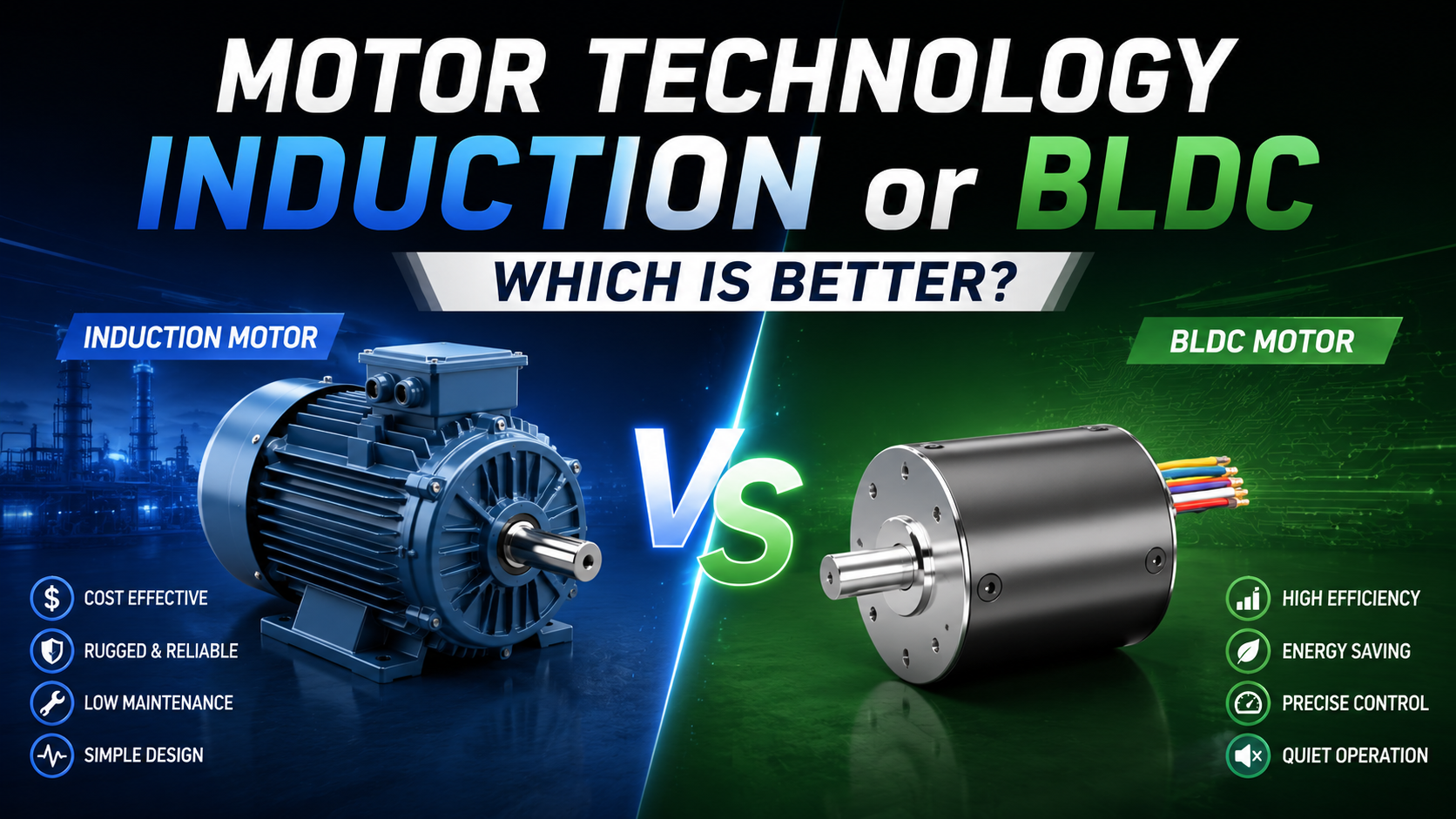
A BLDC motor (Brushless DC Motor) is generally better for applications requiring high efficiency, precise speed control, compact size, low maintenance, and energy savings. An induction motor is often better for heavy-duty industrial environments where low initial cost, ruggedness, and simple operation are priorities.
In simple terms:
• Choose a BLDC motor for:
• Robotics
• Medical devices
• AGVs
• Solar tracking systems
• HVAC variable-speed systems
• Battery-powered equipment
• Compact automation systems
• Choose an induction motor for:
• Pumps
• Compressors
• Conveyors
• Fans
• Large industrial machinery
• Constant-speed applications
According to the U.S. Department of Energy (DOE, 2024), electric motors consume approximately 50% of global electricity generated, making motor efficiency selection a critical engineering and operating-cost decision.
What Is a BLDC Motor?
A BLDC motor is a permanent magnet synchronous motor electronically commutated using a controller instead of mechanical brushes.
Key Components
• Permanent magnet rotor
• Stator windings
• Electronic controller
• Hall sensors or sensorless control system
Main Characteristics
• High efficiency
• High power density
• Excellent speed control
• Low acoustic noise
• Minimal maintenance
BLDC motors typically operate with efficiencies between 85% and 95%, depending on load conditions and controller design.
According to research from the U.S. Department of Energy (DOE, 2023), permanent magnet motor systems can significantly outperform conventional induction motors in partial-load efficiency.
What Is an Induction Motor?
An induction motor uses electromagnetic induction to generate rotor current without permanent magnets.
The most common industrial version is the three-phase squirrel cage induction motor.
Key Components
• Laminated stator
• Squirrel cage rotor
• Bearings
• Cooling system
Main Characteristics
• Rugged construction
• Lower upfront cost
• High durability
• Excellent for constant-speed operation
• Mature industrial technology
Typical industrial induction motor efficiency ranges from:
• 75% to 93%
depending on motor size and IE efficiency class.
According to the International Energy Agency (IEA, 2022), induction motors remain the dominant motor technology in industrial pumping and fan systems worldwide.
BLDC Motor vs Induction Motor: Core Differences
Efficiency
One of the largest differences between the two technologies is efficiency.
BLDC motors eliminate:
• Rotor copper losses
• Slip losses
• Brush friction losses
This allows them to maintain high efficiency even at partial load conditions.
Induction motors, however, generate additional heat due to:
• Rotor current losses
• Electromagnetic slip
In real industrial environments, this can significantly affect long-term energy consumption.
Engineering Insight
For systems operating:
• 12–24 hours daily
• Variable-speed conditions
• Frequent acceleration cycles
even a 3–5% efficiency improvement can create major energy savings over the motor lifespan.
According to DOE motor system studies (2024), improving motor efficiency can reduce industrial electricity costs substantially in high-duty-cycle applications.
Torque Performance Comparison
BLDC motors generally deliver:
• Higher starting torque
• Faster acceleration
• Better low-speed stability
This makes them highly suitable for:
• Robotics
• AGVs
• CNC systems
• Servo-driven automation
Because permanent magnets continuously provide magnetic flux, BLDC motors can achieve higher torque density in a smaller frame size.
Induction motors, meanwhile, are optimized for:
• Stable continuous operation
• Heavy industrial loads
• Long-duration runtime
Although they can produce high torque, low-speed precision is usually less accurate unless combined with advanced VFD systems.
Speed Control and Motion Precision
Why BLDC Motors Excel in Automation
BLDC motors are designed for precise electronic control.
Modern BLDC systems commonly use:
• Field Oriented Control (FOC)
• Sensorless vector control
• Hall-effect feedback systems
This allows:
• Rapid speed changes
• Smooth low-speed operation
• Precise positioning
• Reduced torque ripple
For industrial automation and robotics, these characteristics are extremely important.
Induction Motor Speed Control Limitations
Standard induction motors are typically optimized for fixed-speed operation.
To achieve variable-speed control, they usually require:
• Variable Frequency Drives (VFDs)
Although modern VFD technology has improved induction motor performance significantly, BLDC motors still provide superior response speed and positioning precision in compact intelligent systems.
Thermal Performance and Heat Management
Heat is one of the most important factors affecting motor lifespan.
Excessive temperature can cause:
• Insulation degradation
• Bearing damage
• Reduced efficiency
• Premature failure
BLDC Motor Thermal Advantages
Because BLDC motors do not generate rotor current losses, they typically produce less internal heat.
Benefits include:
• Better thermal stability
• Higher power density
• Improved compactness
• Longer operational lifespan
This is especially important in:
• Medical equipment
• Compact automation systems
• Battery-powered machinery
Induction Motor Thermal Challenges
Induction motors generate additional heat through rotor induction losses.
In heavy industrial environments, inadequate cooling or overload conditions may accelerate:
• Insulation aging
• Bearing wear
• Efficiency reduction
According to IEEE motor reliability research (2022), overheating remains one of the leading causes of industrial motor failure.
Maintenance and Reliability
BLDC Motor Maintenance
BLDC motors require minimal maintenance because they eliminate brushes and commutators.
Typical maintenance areas include:
• Bearings
• Cooling systems
• Drive electronics
This reduces:
• Downtime
• Mechanical wear
• Service frequency
Induction Motor Reliability
Induction motors are known for their exceptional industrial durability.
They perform extremely well in:
• Dusty environments
• High-temperature facilities
• Continuous-duty applications
However, common failure points include:
• Bearing wear
• Rotor bar damage
• Insulation breakdown
According to IEEE reliability studies, bearing-related problems account for approximately 40–50% of industrial motor failures.
Which Motor Is Better for Energy Savings?
In variable-speed systems, BLDC motors usually provide better overall efficiency.
This is particularly true for:
• HVAC systems
• Intelligent pumps
• Battery-powered equipment
• Automation machinery
Because energy costs continue rising globally, many manufacturers now prioritize:
• IE4 and IE5 efficiency targets
• Smart motion control
• Reduced operating cost
BLDC motors align closely with these goals.
However, for large industrial systems operating continuously at fixed speed, premium-efficiency induction motors can still provide excellent economic value.
Common Engineering Mistakes When Choosing a Motor
Selecting Based Only on Initial Price
Many engineers focus only on upfront motor cost.
In reality, lifecycle expenses often matter more:
• Electricity consumption
• Maintenance
• Downtime
• Replacement cost
A cheaper motor may become more expensive over time.
Ignoring Partial Load Conditions
Most industrial motors do not operate continuously at full load.
BLDC motors typically maintain higher efficiency during:
• Partial load
• Dynamic load
• Frequent speed changes
Ignoring this factor can result in poor energy optimization.
Undersizing the Motor
Improper motor sizing can lead to:
• Overheating
• Torque instability
• Reduced lifespan
Always consider:
• Peak torque
• Thermal margin
• Duty cycle
• Ambient temperature
Industrial Applications
Where BLDC Motors Perform Best
BLDC motors are increasingly used in:
• Robotics
• Solar tracking systems
• AGVs
• Medical devices
• Automated warehouse systems
• Precision motion control equipment
Their compact size and high efficiency make them ideal for intelligent automation.
Where Induction Motors Still Dominate
Induction motors remain highly effective in:
• Pumps
• Compressors
• Conveyors
• Industrial fans
• Mining equipment
• Heavy manufacturing
Their rugged structure and lower cost continue to make them a practical industrial standard.
Why UNITED MOTION INC. Focuses on Advanced Motion Solutions?
As a professional electric motor manufacturer, UNITED MOTION INC. provides:
• BLDC motors
• Servo motors
• PMDC motors
• Motion control solutions
• Custom electric motor OEM services
Our engineering team supports customers with:
• Motor selection
• Torque analysis
• Efficiency optimization
• Thermal design
• Application-specific customization
For modern industrial automation systems, choosing the correct motor technology directly impacts:
• Reliability
• Energy consumption
• Product performance
• Long-term operating cost
FAQ
Is a BLDC motor more efficient than an induction motor?
Yes. BLDC motors generally provide higher efficiency because they eliminate rotor copper losses and slip losses.
Why are induction motors still widely used?
Induction motors are rugged, affordable, and highly reliable in heavy industrial environments.
Are BLDC motors better for automation?
Yes. BLDC motors provide superior speed control, positioning accuracy, and dynamic response.
Which motor requires less maintenance?
BLDC motors usually require less maintenance because they do not use brushes.
Are induction motors cheaper?
Yes. Induction motors generally have lower upfront manufacturing costs.
Related blog: Single-Phase vs Three-Phase Induction Motors: Which One Do You Need?