
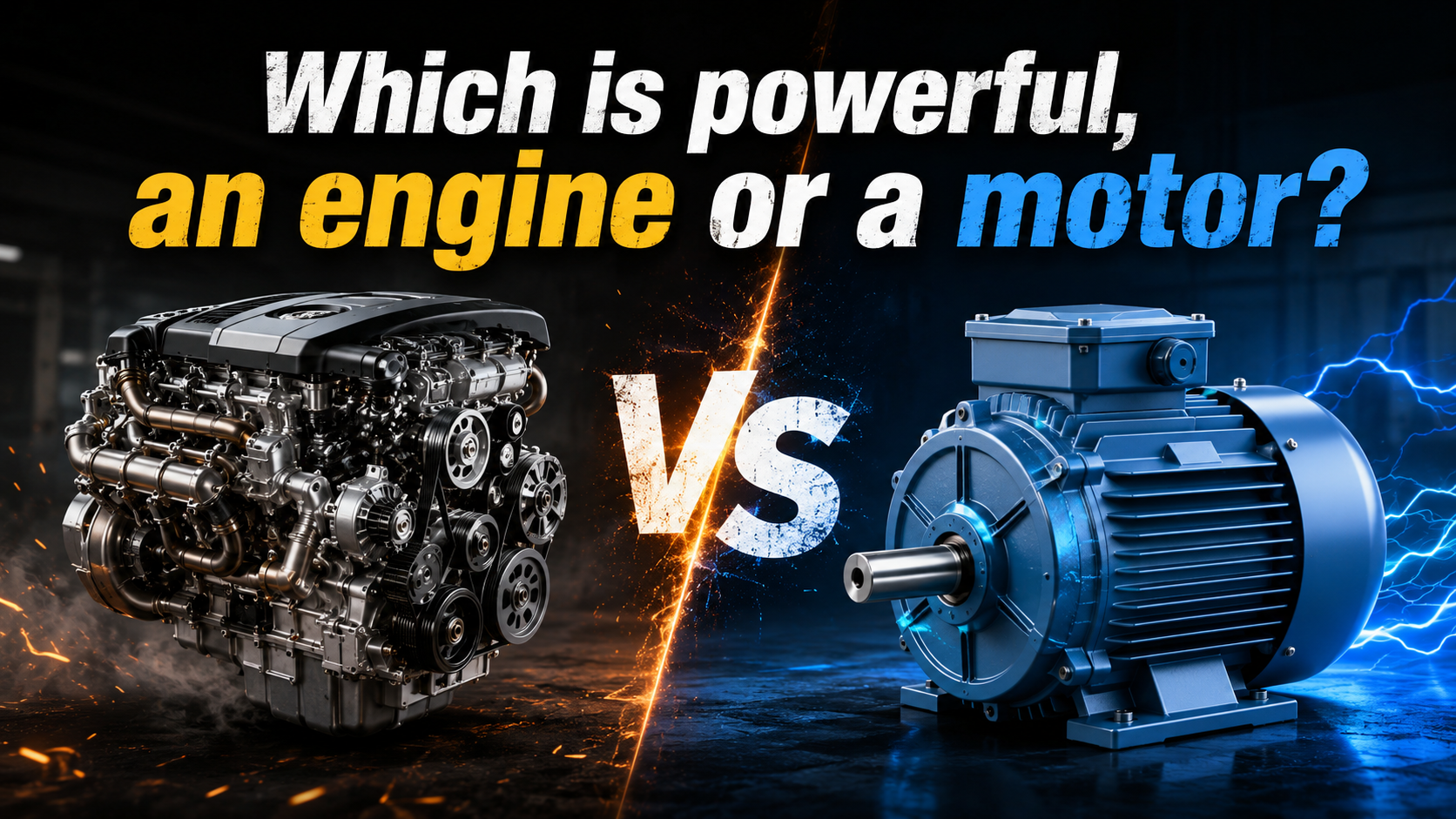
Neither an engine nor a motor is universally more powerful.
The answer depends on how “powerful” is defined:
- If you compare peak horsepower, large internal combustion engines can produce thousands of horsepower.
- If you compare instant torque, electric motors are generally more powerful at low speeds.
- If you compare efficiency, electric motors significantly outperform combustion engines.
- If you compare continuous operation under heavy loads, both technologies have advantages depending on the application.
In practical engineering applications, electric motors deliver higher torque at startup and superior energy efficiency, while combustion engines often provide greater energy density and longer operating ranges when fueled continuously.
Source: U.S. Department of Energy (DOE), Alternative Fuels Data Center, 2024; U.S. Environmental Protection Agency (EPA), 2024.
Understanding the Difference Between an Engine and a Motor
Many people use the terms “engine” and “motor” interchangeably, but engineers distinguish them based on how they generate mechanical power.
What Is an Engine?
An engine converts thermal energy into mechanical energy.
Most engines burn fuel to create pressure that drives pistons or turbines.
Examples include:
- Gasoline engines
- Diesel engines
- Jet engines
- Natural gas engines
The energy source is typically:
- Gasoline
- Diesel fuel
- Natural gas
- Aviation fuel
How an Engine Produces Power
Step-by-step:
Fuel enters the combustion chamber.
Air mixes with fuel.
Combustion occurs.
Expanding gases push pistons.
Crankshaft rotation generates mechanical output.
This process involves multiple energy conversions, resulting in efficiency losses.
Source: U.S. Department of Energy, Vehicle Technologies Office, 2024.
What Is a Motor?
A motor converts electrical energy directly into mechanical energy.
Examples include:
Brushless DC motors (BLDC)
AC induction motors
Servo motors
Permanent magnet synchronous motors (PMSM)
Electric motors rely on electromagnetic forces rather than combustion.
How a Motor Produces Power?
Step-by-step:
Electricity flows through windings.
A magnetic field is generated.
Interaction between magnetic fields creates torque.
Rotor rotation produces mechanical output.
Because fewer energy conversions occur, efficiency is much higher.
Source: National Renewable Energy Laboratory (NREL), 2024.
Engine vs Motor: Which Produces More Power?
The answer depends on the performance metric.
Power Comparison
Power is measured in:
• Horsepower (HP)
• Kilowatts (kW)
Power Formula:
Power = Torque × Speed
A device can have high torque but moderate power, or high power with moderate torque.
Typical Output Ranges
| Device Type | Typical Power Range |
| Small BLDC Motor | 50 W – 2 kW |
| Industrial Servo Motor | 100 W – 100 kW |
| EV Traction Motor | 100 kW – 500 kW |
| Small Gasoline Engine | 3 HP – 50 HP |
| Automotive Engine | 100 HP – 1,000 HP |
| Marine Diesel Engine | 1,000 HP – 100,000 HP |
Large industrial diesel engines can exceed the power output of most electric motors.
However, power alone does not tell the full story.
Source: Cummins Technical Publications, 2024; DOE Transportation Energy Data Book, 2024.
Why Electric Motors Feel More Powerful?
Many engineers and operators perceive electric motors as stronger than engines.
The reason is torque delivery.
Instant Torque Advantage
Electric motors can produce maximum torque from zero RPM.
For example:
| Technology | Peak Torque Availability |
| Electric Motor | 0 RPM |
| Gasoline Engine | 3,000–6,000 RPM |
| Diesel Engine | 1,000–2,500 RPM |
This gives motors significant advantages in:
• Elevators
• Industrial automation
• Electric vehicles
• Conveyor systems
• Robotics
An electric vehicle often accelerates faster than a gasoline vehicle with similar horsepower ratings because maximum torque is available immediately.
Source: SAE International, “Electric Vehicle Performance Characteristics,” 2023.
Torque Comparison: Engine vs Motor
What Is Torque?
Torque is rotational force.
It determines:
• Starting capability
• Acceleration
• Load handling
• Climbing ability
The torque equation is:
Torque = Force × Distance
Example
Consider:
• Electric motor: 300 Nm at 0 RPM
• Gasoline engine: 300 Nm at 4,500 RPM
Although both produce the same peak torque value, the motor delivers it immediately.
This results in:
• Faster response
• Better low-speed control
• Reduced mechanical complexity
Source: Massachusetts Institute of Technology (MIT) Electric Power Systems Research, 2023.
Efficiency Comparison
Efficiency is where motors dominate engines.
Typical Efficiency Levels
| Technology | Efficiency |
| Gasoline Engine | 20%–35% |
| Diesel Engine | 35%–45% |
| Industrial Electric Motor | 85%–97% |
| Premium IE5 Motor | Up to 98% |
Most energy in combustion engines is lost as:
• Heat
• Exhaust energy
• Friction
• Pumping losses
Electric motors convert most input energy directly into useful mechanical work.
Source: U.S. Department of Energy Motor Systems Program, 2024.
Power Density Comparison
Power density measures how much power is produced relative to size and weight.
Where Engines Win
Liquid fuels contain extremely high energy density.
For example:
| Energy Source | Energy Density |
| Gasoline | ~12,000 Wh/kg |
| Diesel | ~13,000 Wh/kg |
| Lithium-Ion Battery | ~250–300 Wh/kg |
This is why:
Aircraft still use engines
Long-haul trucks often use engines
Ships rely heavily on engines
Fuel stores significantly more energy per kilogram than current battery technology.
Source: U.S. Energy Information Administration (EIA), 2024.
Which Lasts Longer?
Motor Lifespan
Industrial electric motors often operate:
20,000–100,000 hours
Minimal maintenance
Common maintenance:
- Bearing replacement
- Lubrication
- Inspections
Engine Lifespan
Internal combustion engines require:
- Oil changes
- Fuel system maintenance
- Cooling system maintenance
- Combustion component replacement
Expected life:
5,000–40,000 hours depending on design
Source: IEEE Industry Applications Society, 2023.
Which Is Better for Industrial Applications?
The answer depends on application requirements.
Applications Where Motors Are Superior
Factory Automation
Advantages:
- Precise speed control
- High efficiency
- Low maintenance
Robotics
Advantages:
- Instant response
- Position accuracy
- Compact size
Conveyors
Advantages:
- Continuous operation
- Energy savings
Servo Motion Systems
Advantages:
- Closed-loop control
- High positioning precision
At UNITED MOTION INC., BLDC motors, servo motors, and integrated motion control systems are widely used in these applications because they provide precise torque control and excellent operational efficiency.
Applications Where Engines Remain Superior
Heavy Construction Equipment
Advantages:
- Remote operation
- Long run times
Marine Propulsion
Advantages:
- High energy storage
- Refueling convenience
Aviation
Advantages:
Exceptional fuel energy density
Mining Equipment
Advantages:
Continuous operation in remote locations
Common Misconceptions
Myth 1: Higher Horsepower Means More Torque
False.
Horsepower and torque are related but different measurements.
A motor can produce tremendous torque with moderate horsepower.
Myth 2: Engines Are Always More Powerful
False.
Many modern electric motors exceed the performance of similarly sized combustion engines.
Examples include:
- Electric sports cars
- Industrial servo systems
- High-performance traction motors
Myth 3: Motors Cannot Handle Heavy Loads
False.
Large industrial electric motors can exceed:
50 MW output
Hundreds of thousands of Newton-meters of torque
These motors are used in:
Mining
Steel production
Ship propulsion
Source: IEEE Transactions on Industry Applications, 2023.
Troubleshooting: Engine vs Motor Performance Problems
| Symptom | Engine Cause | Motor Cause |
| Low Torque | Fuel delivery issue | Incorrect drive tuning |
| Overheating | Cooling system failure | Overcurrent condition |
| Excessive Noise | Combustion problem | Bearing wear |
| Poor Efficiency | Incomplete combustion | Power quality issues |
| Speed Instability | Fuel system fault | Encoder feedback issue |
| Vibration | Misfire or imbalance | Rotor imbalance |
Engineering Selection Guide
Choose a motor if you need:
- High efficiency
- Precise control
- Instant torque
- Low maintenance
- Automation compatibility
Choose an engine if you need:
- Long operating range
- Fuel portability
- Remote operation
- Extremely high energy storage
For most modern industrial automation systems, electric motors are typically the preferred solution.
Final Verdict: Which Is More Powerful?
The question should not be “Which is more powerful?”
The better engineering question is:
“More powerful for what purpose?”
If your goal is:
- Instant torque
- Energy efficiency
- Precision control
- Automation performance
Then the motor is generally superior.
If your goal is:
- Long-distance operation
- High fuel energy density
- Remote deployment without electrical infrastructure
Then the engine may be the better choice.
As industrial electrification continues accelerating worldwide, electric motors are replacing engines in many sectors because they deliver exceptional efficiency, controllability, and reliability.
For manufacturers seeking advanced motion control solutions, high-performance BLDC motors, servo motors, and custom motor systems from UNITED MOTION INC. provide the performance needed for modern automation equipment.
FAQ
Is a motor stronger than an engine?
At low speeds, electric motors are generally stronger because they provide maximum torque immediately from zero RPM.
Why do electric cars accelerate faster?
Electric motors deliver instant torque without waiting for engine RPM to increase.
Which is more efficient, an engine or a motor?
Electric motors typically achieve 85%–97% efficiency, while combustion engines usually operate between 20% and 45%.
Can electric motors replace engines?
In many applications such as vehicles, robotics, industrial automation, and material handling systems, electric motors are already replacing combustion engines.
Do engines produce more horsepower?
Large industrial engines can produce higher peak horsepower than many motors, but electric motors often provide better usable torque and control.
Why are BLDC motors becoming more popular?
BLDC motors offer high efficiency, long service life, precise control, low maintenance, and excellent power-to-weight ratios.