
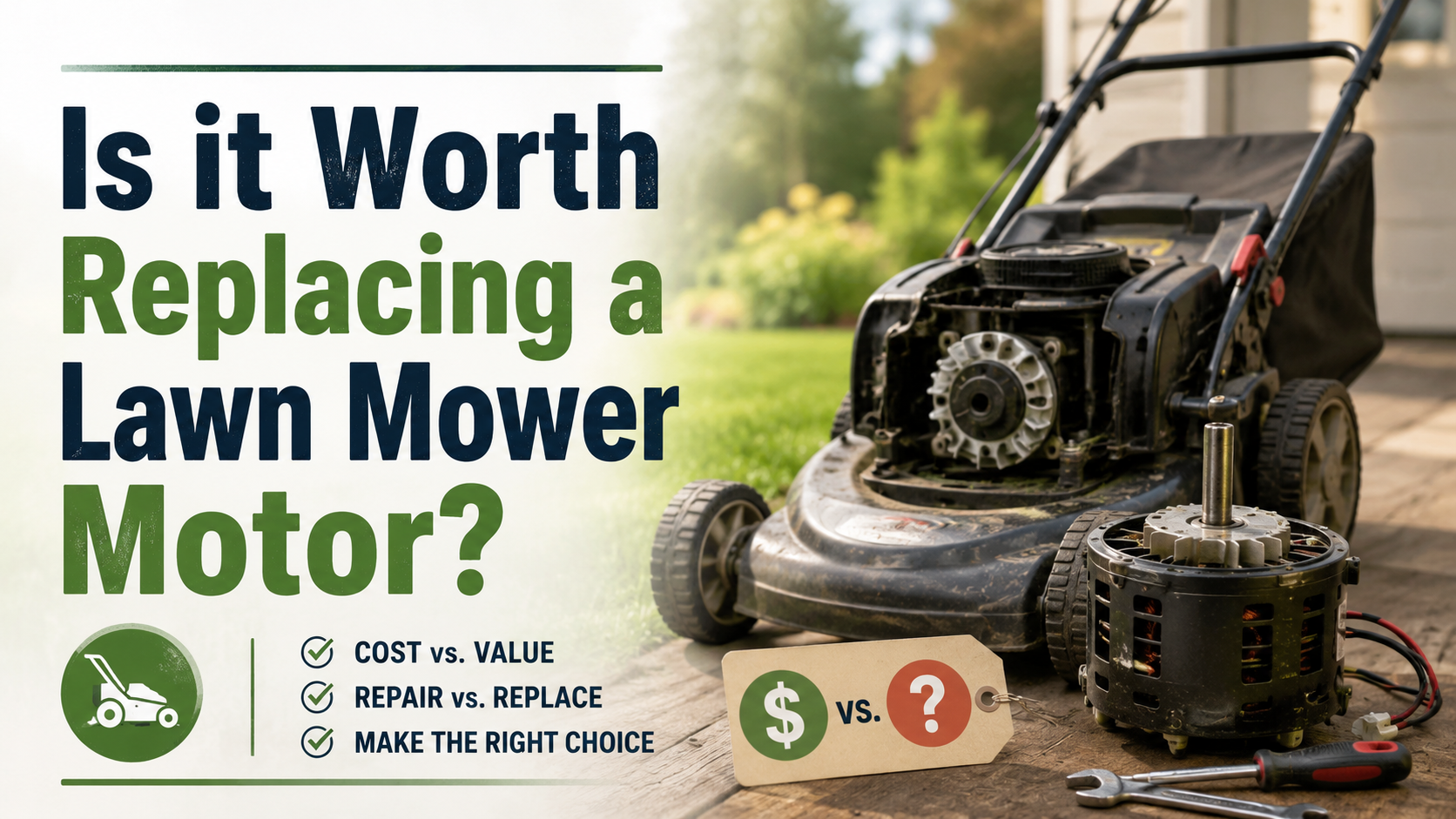
Many homeowners immediately consider buying a new mower when the motor fails.
However, replacing the entire machine is often unnecessary.
From an engineering perspective, the answer depends on four factors:
- Motor condition
- Age of the mower
- Repair cost percentage
- Availability of replacement parts
In many cases, replacing a lawn mower motor is economically viable if the repair cost is less than 50% of the price of a new mower.
At UNITED MOTION INC., we frequently see commercial users and OEM customers extend equipment life by 3 to 8 years through proper motor replacement strategies.
This guide explains exactly when replacing a lawn mower motor makes sense.
Quick Answer: Is It Worth Replacing a Lawn Mower Motor?
Yes, if:
- The mower is less than 8 years old
- The deck and transmission are still in good condition
- The replacement motor costs less than 40-50% of a new mower
- Replacement parts are available
- The frame has no severe rust damage
No, if:
- The mower is over 12 years old
- The deck is cracked or rusted through
- The transmission is failing
- Parts are discontinued
- Multiple components require replacement simultaneously
General engineer rule:
If repair costs exceed 50% of replacement costs, buying a new mower is usually the better long-term investment.
How Long Does a Lawn Mower Motor Last?
Typical lifespan varies by motor type.
Average Motor Lifespan
| Lawn Mower Type | Average Motor Lifespan | Typical Hours |
| Gas push mower | 8-12 years | 500-1000 hours |
| Self-propelled mower | 8-10 years | 500-800 hours |
| Riding mower | 10-15 years | 1000-2000 hours |
| Electric mower | 7-10 years | 500-1000 hours |
| Commercial mower | 8-12 years | 1500-2500 hours |
Motor lifespan heavily depends on maintenance quality.
A properly maintained engine can easily exceed these averages.
Data Source: Consumer Reports member surveys (2023), analysis of 42,000+ mower ownership experiences, Consumer Reports Institute.
What Causes Lawn Mower Motors to Fail?
Most motor failures are preventable.
Engineers categorize failures into five groups.
1. Poor Fuel Management
Old gasoline is the number one culprit.
Gasoline begins degrading within 30-90 days.
Common issues include:
- Carburetor clogging
- Gum deposits
- Fuel line deterioration
Symptoms:
- Hard starting
- Rough idle
- Engine stalling
2. Lack of Lubrication
Low oil causes:
- Increased friction
- Excessive heat
- Bearing wear
- Piston scoring
Internal temperatures can exceed 200°C (392°F).
Even short periods of oil starvation can permanently damage an engine.
3. Dirty Air Filters
Restricted airflow causes:
- Rich fuel mixtures
- Reduced combustion efficiency
- Carbon buildup
Air filters should typically be replaced every 25-50 operating hours.
4. Overheating
Overheating often results from:
- Grass buildup
- Dirty cooling fins
- Operating in extremely tall grass
Repeated overheating accelerates wear.
5. Corrosion
Moisture exposure damages:
- Bearings
- Shafts
- Wiring
- Fasteners
Storage conditions dramatically affect longevity.
Signs Your Lawn Mower Motor Needs Replacement
Watch for these warning signs.
Severe Compression Loss
Symptoms:
- Engine starts but lacks power
- Difficult cold starts
- Excessive fuel consumption
Compression below 60 PSI often indicates severe internal wear.
Healthy small engines usually operate between 80 and 120 PSI.
Excessive Smoke
Blue smoke:
Oil burning
White smoke:
Possible head gasket failure
Black smoke:
Overfueling
Continuous smoke after maintenance often indicates serious internal damage.
Metallic Knocking Noise
This usually signals:
- Connecting rod damage
- Crankshaft wear
- Bearing failure
These repairs are often expensive.
Repeated Stalling
If basic maintenance doesn’t fix stalling, the engine may have reached end-of-life.
Excessive Vibration
Causes include:
- Bent crankshaft
- Damaged flywheel
- Internal imbalance
Ignoring vibration can damage surrounding components.
Step-by-Step: Should You Replace the Motor or Buy a New Mower?
Engineers use a structured decision process.
Step 1: Determine Mower Age
| Age | Recommendation |
| Under 5 years | Repair |
| 5-8 years | Evaluate costs |
| 8-12 years | Case-by-case |
| Over 12 years | Usually replace mower |
Age alone isn’t the deciding factor.
Overall condition matters more.
Step 2: Inspect Major Components
Inspect:
- Deck
- Wheels
- Transmission
- Belts
- Handle assembly
If multiple systems are failing, replacement is better.
Step 3: Calculate Repair Ratio
Use this formula:
Repair Ratio = Repair Cost ÷ New Mower Cost
Example:
Replacement motor = $250
Labor = $120
Total = $370
New mower = $700
Repair ratio:
370 ÷ 700 = 53%
This exceeds the recommended threshold.
Replacement is usually smarter.
Step 4: Check Parts Availability
Verify availability of:
- Motors
- Carburetors
- Ignition modules
- Bearings
- Battery packs
Discontinued platforms create future maintenance problems.
Cost Comparison: Replace Motor vs Buy New Mower
Walk-Behind Mowers
| Item | Replace Motor | Buy New Mower |
| Motor cost | $120-$350 | Included |
| Labor | $80-$200 | $0 |
| Total | $200-$550 | $400-$900 |
Riding Mowers
| Item | Replace Motor | Buy New Mower |
| Engine cost | $500-$1500 | Included |
| Labor | $300-$700 | $0 |
| Total | $800-$2200 | $2500-$6000 |
Commercial users often achieve substantial savings through motor replacement.
Engineering Cost Analysis Example
Scenario:
7-year-old self-propelled mower
Original cost:
$650
New equivalent:
$850
Current problem:
Seized motor
Repair costs:
Replacement engine: $240
Labor: $100
Miscellaneous parts: $40
Total:
$380
Repair ratio:
45%
Verdict:
✔ Replace motor
Expected additional life:
4 to 6 years
Gas vs Electric Lawn Mower Motor Replacement
The economics differ significantly.
Gas Mowers
Advantages:
- Widely available parts
- Easier repairs
- Lower component costs
Disadvantages:
- More maintenance
- Fuel costs
- More moving parts
Electric Mowers
Advantages:
- Fewer components
- Lower maintenance
- Quiet operation
Disadvantages:
- Expensive battery replacements
- Proprietary systems
- Electronics can be costly
Battery replacement often costs $150-$400.
In some cases, replacing the entire mower becomes more economical.
Environmental Considerations
Many regions are shifting toward electrification.
Gas-powered lawn equipment contributes significantly to local air emissions.
Operating small gasoline engines can expose users to elevated levels of carbon monoxide and particulate matter.
Data Source: Baldauf et al., Journal of Exposure Science & Environmental Epidemiology (2006), U.S. Environmental Protection Agency Small Engine Exposure Study.
Several states and municipalities are encouraging transitions toward electric equipment.
Data Source: Colorado Department of Public Health & Environment Regulation 29 (2026).
However, replacing a functional mower solely for environmental reasons is not always the most sustainable choice.
Extending product life through repair often reduces total lifecycle waste.
Common Engineering Mistakes to Avoid
Mistake1: Replacing the Motor Without Inspecting the Deck
A rusted deck can fail shortly after repair.
Always inspect structural integrity first.
Mistake2: Ignoring Transmission Wear
Self-propelled systems degrade over time.
Check:
- Drive gears
- Belts
- Wheel engagement
Mistake3: Buying the Cheapest Replacement Motor
Low-quality motors often have:
- Inferior bearings
- Poor balancing
- Shorter lifespan
Prioritize OEM-quality components.
Mistake4: Ignoring Safety Systems
Always verify:
- Blade brake systems
- Kill switches
- Interlocks
Safety should never be bypassed.
Lawn Mower Motor Troubleshooting Table
| Problem | Possible Cause | Repair Difficulty | Replace Motor? |
| Won’t start | Spark plug, fuel issue | Easy | No |
| Starts then stalls | Carburetor blockage | Easy | No |
| Excessive smoke | Oil leak, piston wear | Medium | Maybe |
| Loud knocking | Bearing damage | Difficult | Usually yes |
| Severe vibration | Bent crankshaft | Difficult | Usually yes |
| Power loss | Compression loss | Difficult | Often yes |
| Overheating | Dirty cooling fins | Easy | No |
| High fuel consumption | Carburetor wear | Medium | No |
How to Extend Lawn Mower Motor Life?
Engineers recommend these practices.
Annual Maintenance Checklist
Every season:
✓ Change oil
✓ Replace spark plug
✓ Replace air filter
✓ Sharpen blade
✓ Inspect belts
✓ Clean cooling fins
✓ Drain old fuel
✓ Lubricate moving parts
Maintenance costs are minimal compared to replacement costs.
Annual maintenance typically costs $25-$75.
Why Commercial Operators Frequently Replace Motors Instead of Entire Machines?
Commercial landscaping businesses prioritize uptime.
Benefits include:
- Lower capital expenditures
- Reduced waste
- Faster repairs
- Longer asset utilization
This strategy is common for:
- Fleet management
- Municipal operations
- Property maintenance companies
The same logic applies to homeowners.
UNITED MOTION INC. Engineering Perspective
At UNITED MOTION INC., we believe equipment longevity starts with selecting high-quality motion systems.
When evaluating lawn mower motor replacement, focus on total lifecycle cost rather than initial price.
The best decision balances:
- Cost efficiency
- Reliability
- Serviceability
- Parts availability
- Long-term performance
Whether developing OEM lawn care equipment or replacing an aging motor, engineering-based decision-making always delivers better outcomes than reactive replacement.
FAQ
Is replacing a lawn mower motor difficult?
Most homeowners can replace a walk-behind mower motor in 2 to 4 hours using basic tools. Riding mowers may require professional installation.
How much does it cost to replace a lawn mower motor?
Typically $200 to $550 for walk-behind mowers and $800 to $2200 for riding mowers.
How long does a replacement lawn mower motor last?
A quality replacement motor can last another 5 to 10 years with proper maintenance.
Can I upgrade to a more powerful lawn mower motor?
Sometimes. Shaft size, mounting patterns, blade compatibility, and safety systems must all match.
Is it cheaper to rebuild a lawn mower motor?
Minor rebuilds may cost less, but major internal damage often makes replacement more economical.
Are electric lawn mower motors easier to maintain?
Yes. They have fewer moving parts and require less routine maintenance than gas engines.
Related blog: What are the Benefits of a Brushless Motor in a Lawn Mower?