
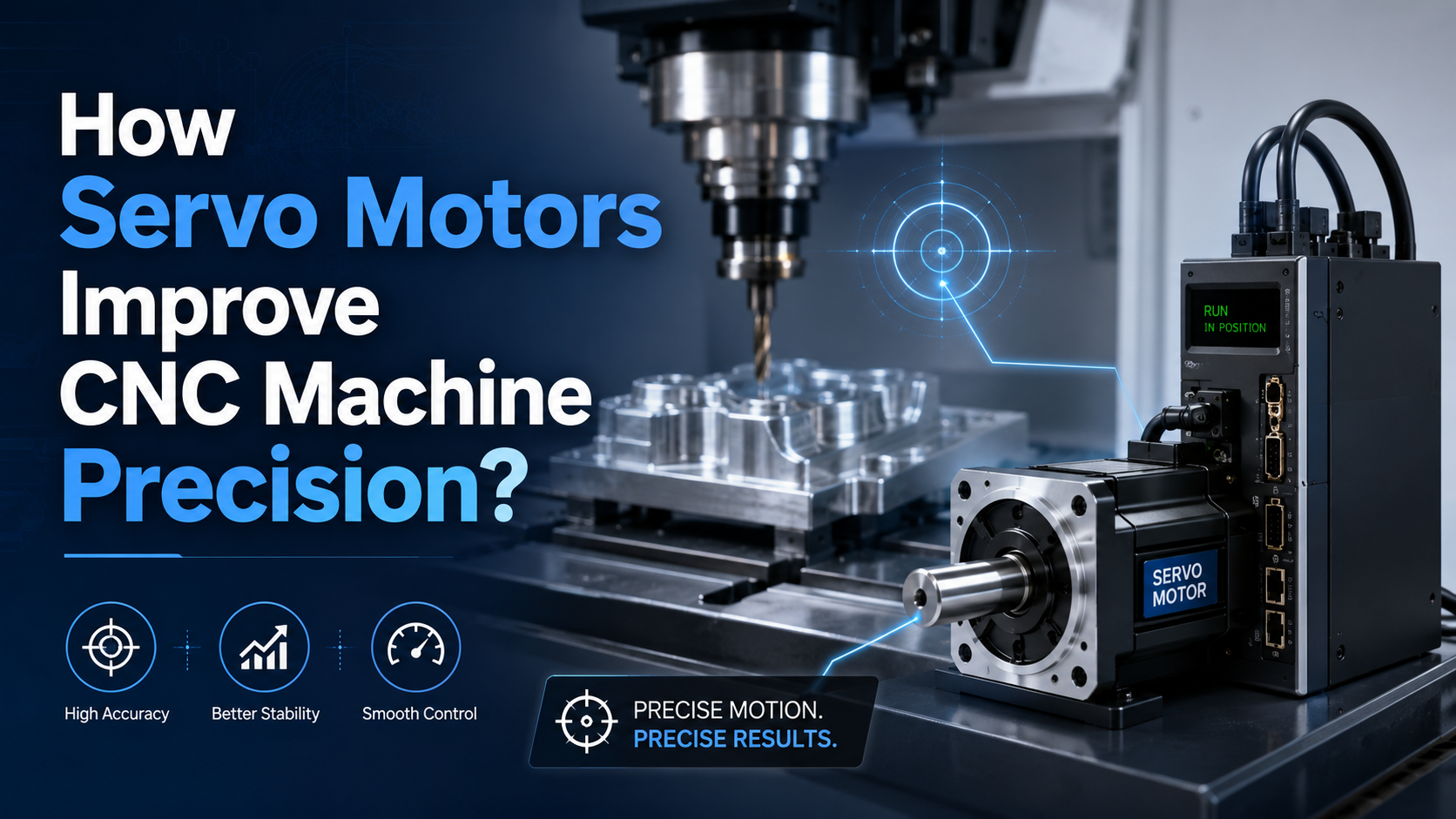
Servo motors improve CNC machine precision by continuously monitoring position, speed, and torque through a closed-loop feedback system.
Compared to conventional motors, servo systems can achieve:
- Positioning accuracy: ±0.001 mm to ±0.01 mm
- Repeatability: ±0.001 mm to ±0.005 mm
- Speed response: <5 ms
- Dynamic torque output: 300% peak torque capability
- Position correction thousands of times per second
This enables CNC machines to produce complex parts with tighter tolerances, smoother surface finishes, reduced scrap rates, and faster production cycles.
For industries such as aerospace, medical devices, automotive, and semiconductor manufacturing, servo motors have become the standard motion control solution.
Why CNC Machine Precision Depends on Motion Control?
Many people assume spindle quality determines machining accuracy.
In reality, motion control is equally important.
Every CNC machine relies on three core subsystems:
- Structural mechanical system
- Cutting spindle system
- Motion control system
The servo motor is the heart of the motion control system.
Its job is to move machine axes precisely according to programmed instructions.
Without accurate axis movement, even an expensive machine cannot maintain dimensional tolerances.
Common CNC axes include:
- X-axis
- Y-axis
- Z-axis
- A-axis
- B-axis
- C-axis
Every movement command generated by the controller must be executed accurately.
A positioning error of only 0.01 mm may lead to:
- Scrap parts
- Surface defects
- Tool collisions
- Assembly failures
Data Source: National Institute of Standards and Technology (NIST), “Machine Tool Performance Evaluation”, U.S. Department of Commerce, updated technical publications 2023.
What Is a Servo Motor?
A servo motor is a closed-loop electric motor system that integrates:
- Motor
- Encoder
- Servo drive
- Controller
Unlike ordinary motors, servo motors continuously receive feedback.
The controller compares:
Desired position
vs.
Actual position
Then automatically corrects any error.
Basic Servo System Components
Servo Motor
Provides rotational motion.
Types include:
- AC servo motor
- Brushless DC servo motor (BLDC servo)
- Direct drive servo motor
Encoder
Measures:
- Position
- Velocity
- Direction
Common encoder resolutions:
17-bit encoder:
131,072 counts/revolution
23-bit encoder:
8,388,608 counts/revolution
Processes control algorithms.
Functions:
- Position loop
- Speed loop
- Current loop
CNC Controller
Generates motion commands using G-code.
How Servo Motors Improve CNC Machine Precision?
1. Closed-Loop Feedback Eliminates Position Errors
This is the biggest advantage.
Traditional motors operate using open-loop control.
They assume movement happened.
Servo systems verify movement happened.
The control process works like this:
Step 1:
CNC controller sends movement command.
Step 2:
Servo drive energizes motor.
Step 3:
Encoder measures actual movement.
Step 4:
Controller compares actual vs target.
Step 5:
Errors are corrected instantly.
This cycle repeats thousands of times every second.
The result:
Extremely accurate positioning.
Example
Target:
Move 100 mm
Actual:
99.998 mm
Error:
0.002 mm
Servo system immediately compensates.
Open-loop systems cannot do this.
Data Source: Massachusetts Institute of Technology (MIT) OpenCourseWare, “Feedback Control Systems,” Department of Mechanical Engineering, updated educational materials 2024.
2. High Encoder Resolution Improves Positioning Accuracy
Encoder resolution directly impacts precision.
Higher counts equal finer positioning.
Encoder Comparison
| Encoder Type | Resolution | Counts per Revolution |
| Incremental 1000 PPR | Low | 4,000 |
| 17-bit Absolute | High | 131,072 |
| 20-bit Absolute | Very High | 1,048,576 |
| 23-bit Absolute | Ultra High | 8,388,608 |
Example Calculation
Ball screw pitch:
10 mm/revolution
Encoder:
23-bit
Linear resolution:
10 ÷ 8,388,608
= 0.00000119 mm
Real-world mechanical limitations reduce this value.
However, the control capability remains extremely high.
Data Source: Siemens Motion Control Engineering Handbook, Servo Encoder Technology Reference, 2023.
3. Servo Motors Deliver Exceptional Repeatability
Precision is not just accuracy.
Repeatability is often more important.
Difference
Accuracy:
How close the first movement is.
Repeatability:
How consistently the machine repeats that movement.
Manufacturers prioritize repeatability because production relies on consistency.
Typical servo repeatability:
±1 to ±5 microns
Equivalent to:
0.001 mm to 0.005 mm
Applications requiring high repeatability:
- Medical implants
- Semiconductor components
- Aerospace parts
- Optical systems
Data Source: International Organization for Standardization (ISO 230 Machine Tool Testing Standards), latest revisions adopted 2022.
4. High Dynamic Response Reduces Overshoot
Servo motors react extremely fast.
Typical response time:
1-5 milliseconds
Benefits:
- Faster acceleration
- Faster deceleration
- Reduced vibration
- Reduced overshoot
Example
Traditional motor:
Overshoots target.
Then settles.
Servo motor:
Predicts stopping point.
Stops accurately.
This significantly improves contouring operations.
Particularly useful for:
- 3D machining
- Mold manufacturing
- High-speed engraving
Data Source: FANUC Servo Fundamentals Technical Documentation, Industrial Automation Division, 2023.
5. Superior Torque Control During Load Changes
Cutting loads constantly change.
Factors include:
- Material hardness
- Tool wear
- Feed rate
- Depth of cut
Servo motors automatically compensate.
Peak torque capability:
250% to 350% of rated torque
Example:
Rated torque:
2 Nm
Peak torque:
6 Nm
This prevents:
- Stalling
- Position drift
- Missed cuts
Data Source: Mitsubishi Electric CNC Servo Technical Manual, Factory Automation Systems Division, 2024.
Step-by-Step: How a Servo Motor Executes a CNC Command
Suppose the CNC program executes:
G01 X100 F500
Meaning:
Move to X=100 mm at 500 mm/min.
Step 1
Controller interprets G-code.
Step 2
Position command generated.
Step 3
Servo drive calculates motion profile.
Step 4
Motor rotates.
Step 5
Encoder measures position.
Step 6
Position errors corrected.
Step 7
Axis arrives accurately.
This entire process happens continuously.
Servo Motor vs Stepper Motor for CNC Precision
| Parameter | Servo Motor | Stepper Motor |
| Control Type | Closed-loop | Open-loop |
| Position Feedback | Yes | No |
| Speed Range | 0-6000 RPM | 0-1500 RPM |
| Accuracy | Very high | Moderate |
| Repeatability | Excellent | Good |
| Missed Steps | No | Possible |
| Dynamic Response | Excellent | Moderate |
| Energy Efficiency | High | Lower |
| Heat Generation | Lower | Higher |
| Industrial CNC Suitability | Excellent | Limited |
Servo motors dominate medium and high-end CNC systems.
Which Servo Specifications Matter Most for CNC Precision?
Engineers should evaluate these parameters.
1. Encoder Resolution
Recommended:
17-bit to 23-bit
2. Rated Torque
Typical:
0.5 Nm to 50 Nm
Depends on axis size.
3. Rated Speed
Typical:
1500 to 3000 RPM
4. Peak Torque Ratio
Recommended:
300%
5. Inertia Matching
Ideal ratio:
1:1 to 5:1
Too much mismatch causes vibration.
6. Communication Protocol
Popular industrial protocols:
- EtherCAT
- CANopen
- Modbus
- PROFINET
- EtherNet/IP
Common Engineering Mistakes That Reduce CNC Precision
Mistake 1: Incorrect Servo Sizing
Problem:
Motor too small.
Results:
- Overheating
- Torque saturation
- Position errors
Solution:
Calculate:
Load inertia
Acceleration torque
Peak load torque
Duty cycle
Mistake 2: Ignoring Inertia Matching
Poor inertia ratio creates:
- Oscillation
- Resonance
- Noise
Recommended:
1:1 to 5:1
Avoid exceeding:
10:1
Mistake 3: Improper Servo Tuning
Poor tuning creates:
- Hunting
- Overshoot
- Vibration
Adjust:
- Position gain
- Speed gain
- Acceleration filters
Mistake 4: Encoder Cable Interference
EMI can create false signals.
Solutions:
- Shielded cables
- Proper grounding
- Cable separation
Avoid running encoder cables alongside power cables.
CNC Precision Troubleshooting Table
| Problem | Possible Cause | Recommended Solution |
| Position errors | Encoder issue | Check encoder feedback |
| Axis vibration | Poor tuning | Adjust servo gains |
| Surface chatter | Resonance | Enable filters |
| Overheating | Undersized motor | Increase motor size |
| Inconsistent dimensions | Loose coupling | Inspect mechanics |
| Overshoot | Aggressive gain | Retune parameters |
| Noise | EMI interference | Improve shielding |
| Poor contouring | Slow response | Increase bandwidth |
How AI, Industry 4.0, and Smart Factories Are Changing Servo Precision?
Modern servo systems are becoming intelligent.
Features include:
Predictive Maintenance
Monitors:
- Bearing wear
- Temperature
- Vibration
AI Motion Optimization
Algorithms optimize:
- Acceleration profiles
- Energy consumption
- Surface quality
Digital Twin Integration
Virtual models simulate machining before production.
Benefits:
- Faster commissioning
- Reduced downtime
Real-Time Monitoring
Continuous tracking of:
- Torque
- Position
- Efficiency
Data Source: National Institute of Standards and Technology (NIST), Smart Manufacturing Program, 2024.
Why Manufacturers Choose UNITED MOTION INC. Servo Motors for CNC Applications?
At UNITED MOTION INC., servo systems are engineered to deliver industrial-grade motion control solutions for precision automation.
Key advantages include:
High Precision Control
High-resolution encoder integration for micron-level positioning.
Wide Power Range
Solutions available for various CNC machine sizes.
Fast Dynamic Response
Optimized control algorithms reduce settling time.
Industrial Communication Compatibility
Support for:
- EtherCAT
- CANopen
- Modbus
Custom Motion Solutions
Engineering support for:
- OEM CNC builders
- Automation integrators
- Industrial machinery manufacturers
Reliable Long-Term Operation
Designed for continuous industrial environments.
Applications include:
- CNC milling machines
- CNC lathes
- Engraving machines
- Grinding machines
- Automated production equipment
Frequently Asked Questions (FAQ)
How accurate are servo motors in CNC machines?
Industrial servo systems typically achieve positioning accuracy between ±0.001 mm and ±0.01 mm, depending on encoder resolution, machine structure, and tuning quality.
Why are servo motors better than stepper motors for CNC?
Servo motors use closed-loop feedback, preventing missed steps while providing higher speeds, greater torque, and better precision.
What encoder resolution is best for CNC machines?
17-bit to 23-bit encoders are commonly used for industrial CNC applications.
Higher-end machines often use 23-bit absolute encoders.
Can servo motors improve surface finish quality?
Yes.
Better motion control reduces vibration, contour errors, and overshoot, resulting in smoother surface finishes.
What communication protocols do CNC servo systems use?
Common protocols include:
- EtherCAT
- CANopen
- PROFINET
- EtherNet/IP
- Modbus
How often should servo systems be maintained?
Recommended inspections:
Daily:
Temperature
Noise
Monthly:
Cable connections
Encoder signals
Every 6 months:
Servo tuning
Mechanical alignment