
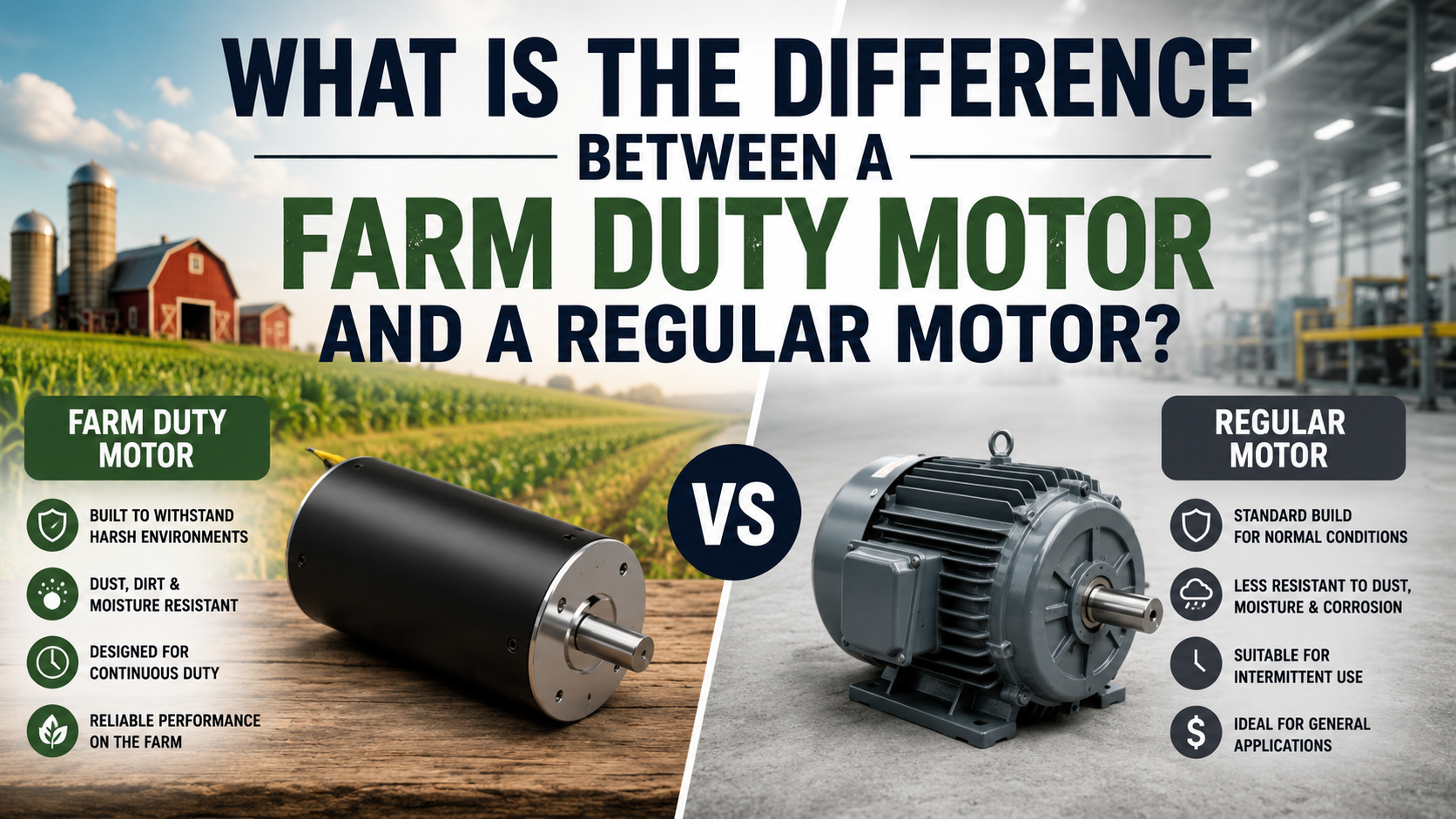
A farm duty motor is a specialized electric motor designed to operate reliably in harsh agricultural environments exposed to dust, moisture, animal waste, temperature fluctuations, and heavy continuous loads.
A regular motor (general-purpose motor) is designed for standard industrial or commercial environments with cleaner operating conditions and lower environmental exposure.
The biggest differences are:
- Environmental protection
- Sealing design
- Corrosion resistance
- Bearing durability
- Service life in harsh conditions
- Agricultural application suitability
A regular motor may work temporarily on a farm, but it often experiences premature failure due to contamination and corrosion.
For long-term agricultural operations, engineers should always specify a farm duty motor.
Why Does This Matter?
Motor failure during harvesting season can shut down an entire operation.
Agricultural facilities present some of the harshest environments electric motors encounter.
Common threats include:
- Dust
- Grain particles
- Fertilizer chemicals
- Humidity
- Rain exposure
- Ammonia from livestock facilities
- Extreme temperature swings
These conditions rapidly shorten the lifespan of standard motors.
According to agricultural motor manufacturers, farm duty motors are specifically engineered to withstand these conditions through enhanced sealing and rugged construction.
Data Source: ABB Baldor-Reliance Farm Duty Motor Product Information, ABB, updated 2025.
What Is a Farm Duty Motor?
A farm duty motor is a specially designed AC induction motor built for agricultural applications.
Most are:
- Three-phase induction motors
- Single-phase induction motors
- NEMA frame motors
- Continuous-duty rated
They are commonly installed on:
- Grain augers
- Irrigation pumps
- Feed conveyors
- Barn ventilation fans
- Grain dryers
- Livestock equipment
- Manure pumps
- Aeration systems
Farm duty motors prioritize reliability over compactness.
Typical Specifications
| Parameter | Typical Range |
| Power | 0.25 kW to 75 kW |
| Horsepower | 1/3 HP to 100 HP |
| Voltage | 115V, 230V, 460V |
| Frequency | 50Hz or 60Hz |
| Speed | 900-3600 RPM |
| Enclosure | TEFC |
| Protection Rating | IP54 to IP55 |
| Duty Cycle | Continuous Duty (S1) |
| Ambient Temperature | -20°C to +40°C |
Source: ABB Baldor-Reliance Farm Duty Motor Technical Specifications, 2025.
What Is a Regular Motor?
A regular motor is also called a general-purpose motor.
It is designed for standard industrial environments such as:
- Warehouses
- Manufacturing facilities
- Commercial buildings
- HVAC systems
- Packaging equipment
Regular motors are optimized for:
- Lower initial cost
- General applications
- Moderate environmental exposure
They are not intended for constant exposure to:
- Water spray
- Dust accumulation
- Corrosive gases
- Agricultural contaminants
Farm Duty Motor vs Regular Motor: Side-by-Side Comparison
Key Differences
| Feature | Farm Duty Motor | Regular Motor |
| Environment | Agricultural, harsh | Industrial, clean |
| Moisture Protection | High | Moderate |
| Dust Protection | High | Moderate |
| Corrosion Resistance | Excellent | Standard |
| Bearing Protection | Enhanced | Standard |
| Shaft Seals | Heavy-duty | Standard |
| Paint Coating | Corrosion resistant | Standard enamel |
| Service Life on Farms | Long | Short |
| Purchase Cost | Higher | Lower |
| Maintenance Frequency | Lower | Higher |
Why Are Farm Duty Motors More Durable?
The answer lies in engineering design.
1. Enhanced Sealing Systems
Farm duty motors use improved seals to block contaminants.
These seals protect against:
- Dust
- Grain particles
- Water droplets
- Insects
Common components include:
- Double-lip shaft seals
- Rubber gaskets
- Sealed conduit boxes
Without proper sealing, contaminants enter the motor and destroy insulation.
2. Better Corrosion Protection
Agricultural environments are surprisingly corrosive.
Livestock facilities produce ammonia gas.
Fertilizers contain aggressive chemicals.
Farm duty motors often use:
- Epoxy coatings
- Stainless hardware
- Corrosion-resistant paint
Regular motors may rust within a few years under these conditions.
3. Improved Bearings
Bearing failure is one of the most common causes of motor breakdown.
Farm duty motors use:
- Larger grease reservoirs
- Heavy-duty bearings
- Better contamination protection
This extends operating life.
4. Stronger Enclosures
Most farm duty motors use TEFC designs.
TEFC means:
Totally Enclosed Fan Cooled
Advantages:
- Prevents airborne contaminants
- Protects internal windings
- Improves reliability
IP54 protection is commonly used.
IP54 means:
- Dust protected
- Resistant to water splashes
Source: ABB Farm Duty Motor Specifications, 2025.
Why Do Regular Motors Fail on Farms?
Several mechanisms accelerate failure.
Problem 1: Dust Infiltration
Dust acts like insulation.
It traps heat.
Heat degrades winding insulation.
Eventually:
- Insulation cracks
- Short circuits occur
- Motors burn out
Problem 2: Moisture Intrusion
Water causes:
- Corrosion
- Bearing contamination
- Electrical leakage
Even small amounts reduce reliability.
Problem 3: Chemical Exposure
Agricultural chemicals attack:
- Paint
- Metal surfaces
- Electrical connections
Ammonia is especially harmful.
Problem 4: Temperature Cycling
Outdoor motors experience constant expansion and contraction.
Repeated cycles weaken:
- Seals
- Gaskets
- Insulation systems
Farm Duty Motor Selection Process
Engineers should follow a systematic approach.
Step 1: Determine Horsepower
Calculate load requirements.
Formula:
HP = (Torque × RPM) ÷ 5252
Always include a service factor margin.
Recommended:
10% to 20%.
Step 2: Identify Environmental Conditions
Evaluate:
- Indoor or outdoor
- Dust levels
- Humidity
- Corrosive exposure
Questions to ask:
Will fertilizer be present?
Will animals be nearby?
Will washdown occur?
Step 3: Select Enclosure Type
Typical recommendations:
| Environment | Recommended Enclosure |
| Indoor clean | ODP |
| Dusty agricultural | TEFC |
| Wet agricultural | TEFC IP55 |
| Corrosive | Severe-duty |
Step 4: Choose Voltage
Common North American options:
Single phase:
115V
230V
Three phase:
208V
230V
460V
575V
Step 5: Verify Duty Cycle
Continuous operation requires:
S1 duty motors.
Avoid intermittent-duty motors for agricultural operations.
Typical Agricultural Applications
Grain Augers
Requirements:
- High starting torque
- Continuous operation
- Dust resistance
Preferred:
Farm duty motor.
Irrigation Pumps
Requirements:
- Outdoor operation
- Moisture resistance
- Long runtime
Preferred:
Farm duty motor.
Barn Ventilation Fans
Requirements:
- Ammonia resistance
- Continuous operation
Preferred:
Farm duty motor.
Feed Conveyors
Requirements:
- Dust resistance
- Reliability
Preferred:
Farm duty motor.
Can a Regular Motor Ever Be Used on a Farm?
Yes, but only under limited conditions.
Acceptable situations:
- Enclosed mechanical rooms
- Temporary applications
- Climate-controlled buildings
Not recommended for:
- Outdoor exposure
- Livestock facilities
- Grain handling systems
Energy Efficiency Considerations
Efficiency is important regardless of motor type.
Modern premium efficiency motors reduce energy consumption significantly.
Industrial motor systems account for substantial industrial electricity consumption, making efficiency selection economically important.
Source: U.S. Department of Energy Motor Systems Program, DOE, updated 2025.
Common efficiency classes:
IE2: High Efficiency
IE3: Premium Efficiency
IE4: Super Premium Efficiency
Typical efficiencies:
| Motor Size | Efficiency |
| 5 HP | 87% – 90% |
| 10 HP | 89% – 92% |
| 25 HP | 91% – 94% |
| 50 HP | 93% – 96% |
Choose premium efficiency whenever possible.
Common Engineering Mistakes
Mistake 1: Selecting by Price Only
Cheaper motors often cost more over time.
Downtime is expensive.
Mistake 2: Ignoring Environmental Conditions
The environment often determines motor life more than horsepower.
Mistake 3: Oversizing Motors
Oversized motors operate inefficiently.
Target:
75% to 100% load utilization.
Source: U.S. Department of Energy Motor Systems Best Practices, updated 2025.
Mistake 4: Ignoring Voltage Quality
Voltage imbalance above 1% accelerates heating.
Consequences:
Reduced efficiency
Shortened insulation life
NEMA recommends minimizing voltage imbalance.
Farm Duty Motor Troubleshooting Guide
| Symptom | Possible Cause | Solution |
| Motor overheating | Dust buildup | Clean cooling fins |
| Bearing noise | Contamination | Replace bearings |
| Corrosion | Chemical exposure | Upgrade coating |
| Frequent trips | Voltage imbalance | Inspect power supply |
| Reduced torque | Undervoltage | Verify input voltage |
| Excess vibration | Misalignment | Realign equipment |
| Seal deterioration | UV exposure | Replace seals |
How Long Does a Farm Duty Motor Last?
Service life varies.
Typical expectations:
Regular motor on farm:
2-5 years
Farm duty motor:
8-15 years
Factors affecting lifespan:
- Maintenance quality
- Load factor
- Environment
- Operating hours
Preventive maintenance greatly extends life.
Maintenance Best Practices
Follow these guidelines.
Every month:
- Inspect seals
- Check vibration
- Remove dust
Every 3 months:
Inspect wiring
Tighten connections
Every 6 months:
Lubricate bearings if applicable
Annually:
Perform insulation resistance testing
Verify alignment
How UNITED MOTION INC. Supports Agricultural Motion Solutions?
As an experienced electric motor manufacturer, UNITED MOTION INC. provides motion solutions for demanding industrial environments.
Capabilities include:
- AC motors
- BLDC motors
- Servo motors
- Gear motors
- Custom electric motor OEM solutions
For agricultural applications, engineers should prioritize:
- Environmental protection
- Duty cycle requirements
- Efficiency optimization
- Long-term reliability
Customized solutions can further improve system uptime and reduce maintenance costs.
Visit UNITED MOTION INC. to explore industrial motor solutions.
Frequently Asked Questions
Is a farm duty motor better than a regular motor?
Not necessarily.
It is better specifically for harsh agricultural environments.
For standard industrial applications, a regular motor may be sufficient.
Can a farm duty motor be used in factories?
Yes.
Farm duty motors can operate in factories and often provide extra durability.
Are all farm duty motors waterproof?
No.
Most are water-resistant, not waterproof.
Always verify the IP rating.
Do farm duty motors cost more?
Yes.
Typically 10% to 30% more initially.
However, lifecycle costs are often lower.
Are farm duty motors more efficient?
Not automatically.
Efficiency depends on IE or NEMA efficiency classification, not duty type.
What enclosure should I choose for agricultural applications?
TEFC with IP54 or IP55 protection is typically recommended.