
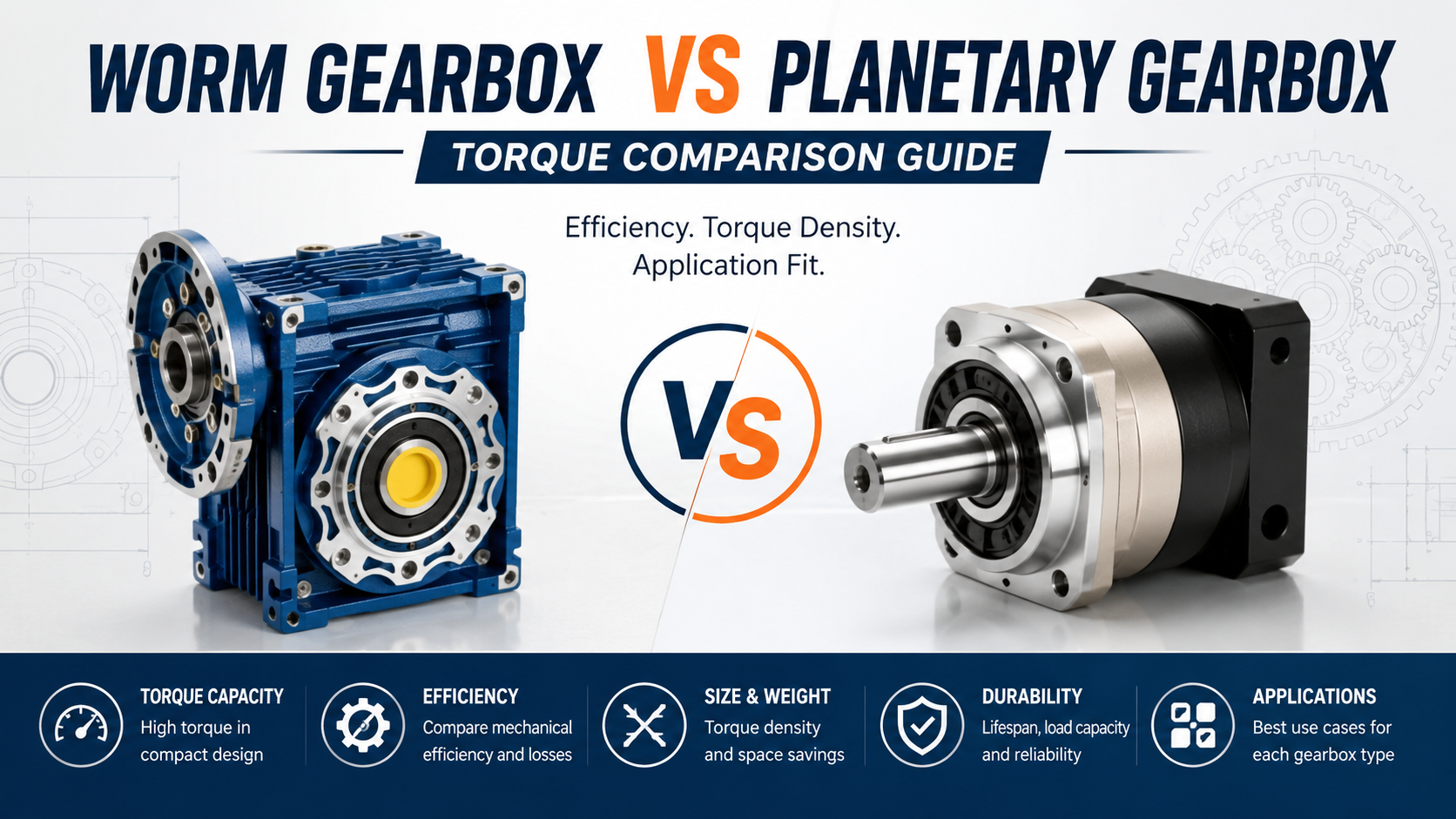
Selecting the right gearbox is one of the most important decisions in mechanical power transmission. Although both Worm Gearbox and Planetary Gearbox are widely used across industrial automation, robotics, medical equipment, AGVs, and electric machinery, they deliver torque in very different ways.
Many engineers focus only on torque ratings. In reality, torque capacity depends on multiple factors, including gear geometry, reduction ratio, efficiency, lubrication, thermal performance, and service factor.
This guide explains the engineering differences between worm and planetary gearboxes while helping OEM designers choose the best solution for their applications.
What Is a Worm Gearbox?
A Worm Gearbox consists of:
- Worm shaft
- Worm wheel
- Bearings
- Housing
- Lubrication system
Instead of rolling contact, the worm continuously slides against the gear teeth.
This sliding action creates:
- High reduction ratios
- Smooth transmission
- Quiet operation
- Significant friction losses
Typical reduction ratios include:
- 10:1
- 20:1
- 30:1
- 50:1
- 60:1
- 80:1
- 100:1
One major advantage is self-locking. When the lead angle is sufficiently small, the output shaft cannot back-drive the input.
Data source: Dudley’s Handbook of Practical Gear Design and Manufacture, CRC Press, latest edition; AGMA Engineering Standards.
What Is a Planetary Gearbox?
A Planetary Gearbox contains:
- Sun gear
- Planet gears
- Planet carrier
- Ring gear
Unlike worm gears, multiple planet gears simultaneously share the transmitted load.
This design provides:
- High torque density
- Excellent load distribution
- Compact size
- High efficiency
- Low backlash
Typical reduction ratios:
Single stage: 3:1–10:1
Multi-stage: up to 1000:1
Because several gears engage simultaneously, planetary systems withstand much higher torque within the same package size.
Data source: NASA Mechanical Components Design Handbook; AGMA Gear Design Manual.
How Torque Is Generated in Each Gearbox?
Torque multiplication follows the same mechanical principle:
Output Torque = Input Torque × Gear Ratio × Efficiency
However, efficiency differs significantly.
For example:
Input motor torque:
5 Nm
Reduction ratio:
20:1
Planetary Gearbox
Efficiency:
95%
Output torque:
5 × 20 × 0.95 = 95 Nm
Worm Gearbox
Efficiency:
70%
Output torque:
5 × 20 × 0.70 = 70 Nm
Although both use the same reduction ratio, the planetary gearbox delivers considerably more usable torque because less energy is lost through friction.
Data source: AGMA Efficiency Guidelines; Machinery’s Handbook, Industrial Press.
Worm Gearbox Torque Characteristics
A worm gearbox produces torque primarily through large speed reduction.
Advantages include:
High Reduction in One Stage
Ratios exceeding 100:1 are achievable without multiple gear stages.
Smooth Output
Continuous tooth contact minimizes vibration.
High Shock Absorption
Sliding contact absorbs impact loads better than rolling gears.
Self-Locking Capability
Certain lead angles prevent reverse driving.
However, the sliding motion creates:
- Higher heat generation
- Lower mechanical efficiency
- Greater lubricant demand
- Faster wear under heavy continuous loads
These factors limit continuous torque capacity.
Data source: American Gear Manufacturers Association (AGMA); Dudley’s Gear Handbook.
Planetary Gearbox Torque Characteristics
Planetary gearboxes generate high torque by sharing loads across multiple planet gears.
Advantages include:
High Torque Density
Multiple gears simultaneously transmit power.
Higher Efficiency
Typical efficiency:
95–98%
Better Load Distribution
Each planet carries only part of the transmitted torque.
Higher Continuous Duty Capability
Reduced friction enables longer operating life under heavy loads.
Better Precision
Planetary gearboxes typically exhibit:
- Low backlash
- High positioning accuracy
- Greater torsional stiffness
These characteristics make them ideal for servo systems.
Data source: NASA Gear Design Manual; AGMA Technical Papers.
Worm Gearbox vs Planetary Gearbox: Torque Comparison
Maximum Torque Capacity
Planetary gearboxes generally produce higher torque for the same physical size.
The load-sharing mechanism significantly increases allowable output torque.
Winner:
Planetary Gearbox
Torque Density
Torque density measures torque per unit volume.
Planetary gearboxes are among the highest torque-density gear systems available.
Winner:
Planetary Gearbox
Starting Torque
Worm gearboxes provide smooth startup characteristics.
Planetary gearboxes provide stronger instantaneous acceleration.
Winner:
Depends on application.
Continuous Torque
Continuous industrial operation favors planetary gearboxes because of lower heat generation.
Winner:
Planetary Gearbox
Shock Load Performance
Sliding contact absorbs impact effectively.
For heavy intermittent loads:
Worm gearboxes often perform well.
Winner:
Worm Gearbox
Torque Transmission Efficiency
Typical efficiencies:
Planetary:
95–98%
Worm:
50–90%
Efficiency varies according to:
- Reduction ratio
- Lubrication
- Material
- Surface finish
- Operating temperature
Data source: AGMA Gear Efficiency Standards; ISO 6336 Gear Calculations.
Efficiency and Heat Generation
One major engineering difference is heat.
Because worm gears rely on sliding contact:
- Friction increases
- Lubricant temperature rises
- Thermal expansion increases
- Efficiency decreases under load
Planetary gearboxes primarily use rolling contact.
Benefits include:
- Lower operating temperatures
- Longer lubricant life
- Higher continuous output
- Improved energy efficiency
For applications operating 24/7, efficiency directly affects operating costs.
Data source: U.S. Department of Energy (DOE), Industrial Motor System Efficiency Program; AGMA lubrication recommendations.
Which Gearbox Is Better for Different Applications?
Choose a Worm Gearbox When
- Self-locking is required
- Budget is limited
- Noise reduction is important
- High reduction ratio is needed in one stage
- Position holding without brake is desired
Common applications include:
- Conveyors
- Lifts
- Gates
- Packaging machinery
- Valve actuators
Choose a Planetary Gearbox When
- Servo control is required
- High torque density is needed
- Precision positioning matters
- Dynamic acceleration is important
- Continuous heavy-duty operation is expected
Typical applications include:
- Robotics
- CNC machines
- AGVs
- Medical equipment
- Automated production lines
- Electric mobility
How to Select the Right Gearbox?
Follow these engineering steps.
Step 1
Determine required output torque.
Include safety factor:
Typically:
1.5–2.5
Step 2
Calculate reduction ratio.
Motor speed ÷ Required output speed
Step 3
Evaluate duty cycle.
Continuous operation generally favors planetary gearboxes.
Step 4
Consider backlash requirements.
Servo systems often require:
Less than 10 arc-min
Precision systems may require:
Less than 5 arc-min
Step 5
Check environmental conditions.
Consider:
- Dust
- Humidity
- Washdown
- Corrosion
- Ambient temperature
Step 6
Evaluate maintenance requirements.
Planetary gearboxes generally require less maintenance under continuous operation.
Common Engineering Mistakes
Many gearbox failures originate during system design rather than manufacturing.
Common mistakes include:
- Selecting gearbox based only on peak torque
- Ignoring thermal limitations
- Underestimating shock loads
- Choosing an incorrect service factor
- Ignoring lubrication intervals
- Using oversized reduction ratios
- Neglecting motor starting torque
- Overlooking gearbox efficiency when calculating output torque
Proper gearbox selection should always consider the complete motion system rather than gearbox specifications alone.
Troubleshooting Guide
| Problem | Possible Cause | Recommended Solution |
| Gearbox overheats | Excessive load or poor lubrication | Reduce load and inspect lubricant |
| Low output torque | Incorrect reduction ratio | Verify gearbox sizing |
| High vibration | Misalignment | Realign motor and gearbox |
| Excessive noise | Worn gears or bearings | Inspect internal components |
| Oil leakage | Damaged seals | Replace seals and check housing |
| Reduced efficiency | Lubricant degradation | Replace lubricant according to maintenance schedule |
| Backlash increases | Gear wear | Inspect gears and replace worn components |
Frequently Asked Questions
Which gearbox produces more torque?
For the same physical size, a Planetary Gearbox generally delivers higher output torque because multiple planet gears distribute the transmitted load more efficiently.
Why is a worm gearbox less efficient?
The worm gear relies on sliding contact between the worm and wheel. Sliding friction converts more input power into heat, reducing mechanical efficiency compared with rolling-contact gear systems.
Is a worm gearbox stronger than a planetary gearbox?
Not necessarily. Worm gearboxes can achieve very high reduction ratios and handle shock loads well, but planetary gearboxes typically offer higher torque density, greater efficiency, and longer service life under continuous operation.
Which gearbox is better for servo motors?
Planetary gearboxes are generally preferred for servo applications because they provide low backlash, high torsional stiffness, excellent positioning accuracy, and high transmission efficiency.
Can a worm gearbox be back-driven?
Many worm gearboxes with small lead angles are self-locking and cannot be easily back-driven. However, higher lead-angle designs may allow reverse motion depending on load and lubrication conditions.
Related blog: What is a Planetary Gear Motor?