
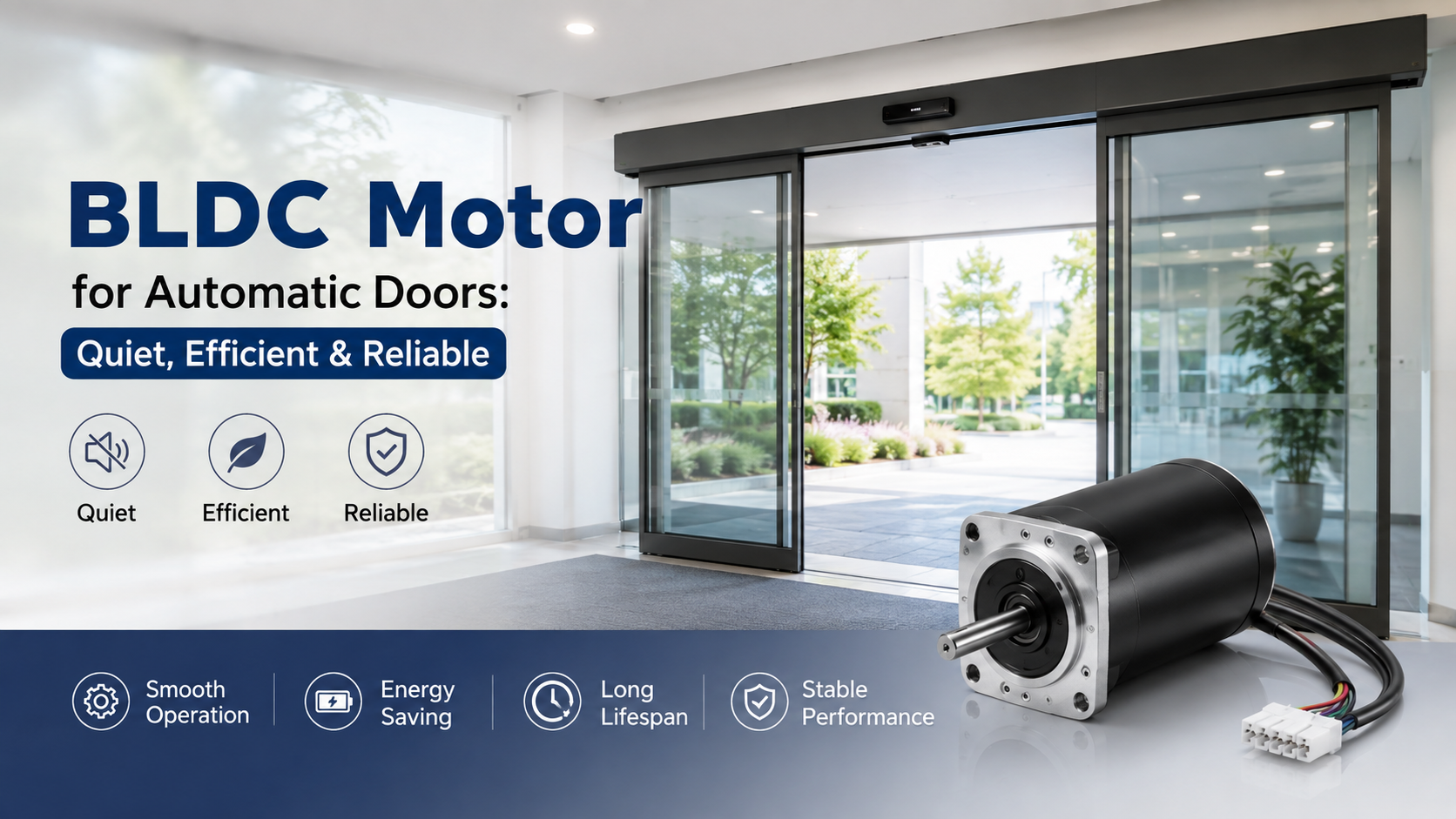
BLDC motors have become the preferred drive solution for modern automatic doors because they combine high efficiency, precise speed control, quiet operation, long service life, and minimal maintenance. Compared with brushed DC motors and AC induction motors, BLDC motors deliver smoother acceleration, higher torque density, and significantly lower operating noise, making them ideal for sliding doors, swing doors, revolving doors, hospital entrances, commercial buildings, industrial facilities, and smart access systems.
When paired with intelligent motor controllers, BLDC motors can achieve accurate position control, obstacle detection, soft start/stop functions, and energy-saving standby modes while maintaining reliable operation under frequent start-stop cycles.
Why Are BLDC Motors Ideal for Automatic Doors?
Automatic doors perform thousands of opening and closing cycles every month. Unlike conventional industrial machinery, they require continuous reliability, smooth motion, and extremely low operating noise because they are installed in locations occupied by people.
BLDC Motors satisfy these requirements through electronic commutation instead of mechanical brushes, eliminating friction between brushes and commutators while significantly reducing maintenance requirements.
Their advantages include:
- Quiet operation
- High starting torque
- Excellent efficiency
- Long service life
- Accurate speed regulation
- Compact motor size
- Low heat generation
- Easy integration with smart controllers
For applications such as hospitals, hotels, airports, office buildings, supermarkets, and residential smart entrances, these characteristics directly improve user experience while reducing operating costs.
Engineering Insight: In automatic door systems, smooth acceleration and deceleration are often more important than maximum speed because they reduce mechanical shock, extend gearbox life, and improve passenger safety.
How Does a BLDC Motor Work in an Automatic Door System?
A BLDC motor converts electrical energy into rotational motion using permanent magnets on the rotor and electronically controlled stator windings.
Unlike brushed motors, current switching is performed electronically by the motor controller.
The complete automatic door drive system typically consists of:
- BLDC motor
- Gear reducer (planetary or worm gearbox)
- Encoder or Hall sensors
- Electronic controller
- Door rail and transmission belt
- Safety sensors
- Power supply
Step 1 — Door Opening Signal
The controller receives a signal from:
- Motion sensor
- Radar sensor
- Push button
- RFID reader
- Access control system
Step 2 — Motor Starts
The controller energizes stator windings sequentially.
Rotor magnets follow the rotating magnetic field.
Because BLDC motors generate high torque at low speed, the door begins moving smoothly without sudden jerks.
Step 3 — Speed Control
PWM (Pulse Width Modulation) regulates motor speed.
Many commercial systems implement:
- Soft start
- Constant-speed travel
- Soft stop
This minimizes vibration and mechanical wear.
Step 4 — Position Feedback
Hall sensors or rotary encoders continuously monitor rotor position.
The controller adjusts motor current to maintain accurate positioning.
Door positioning accuracy can typically reach:
±1 mm to ±5 mm
depending on encoder resolution and mechanical transmission.
Step 5 — Safety Detection
If the controller detects:
- excessive motor current
- unexpected torque increase
- or obstacle detection
the door immediately stops or reverses.
This function improves pedestrian safety while protecting the drive mechanism.
Why Are BLDC Motors Quieter Than Traditional Motors?
Noise reduction is one of the biggest reasons why automatic door manufacturers are transitioning to BLDC Motors.
Major noise sources include:
| Motor Type | Primary Noise Source |
| Brushed DC Motor | Brush friction |
| AC Induction Motor | Electromagnetic vibration + gearbox |
| BLDC Motor | Mainly bearings and gearbox |
Because BLDC Motors eliminate carbon brushes, there is no brush arcing or commutator contact noise.
Modern Field-Oriented Control (FOC) further reduces torque ripple, resulting in smoother and quieter operation.
Typical operating noise:
| Motor Type | Typical Noise |
| Brushed DC | 55–70 dB |
| AC Motor | 50–65 dB |
| BLDC Motor | 35–50 dB |
Actual values depend on enclosure design, gearbox quality, load, mounting structure, and control algorithm.
Data Source: Texas Instruments, Trapezoidal Control of BLDC Motors (Application Report); Microchip Technology, Sensorless BLDC Motor Control (Application Notes); both widely referenced in motor-drive engineering.
Energy Efficiency Advantages
Commercial automatic doors operate continuously throughout the day.
Energy savings accumulate significantly over years of operation.
BLDC Motors commonly achieve efficiencies of:
85–95%
while brushed DC motors generally achieve:
65–80%
Higher efficiency means:
- lower electrical losses
- lower motor temperature
- reduced power consumption
- extended bearing life
Permanent magnets eliminate rotor copper losses that are present in induction motors, improving efficiency especially during partial-load operation.
Data Source: U.S. Department of Energy (DOE), Electric Motor Systems guidance; International Energy Agency (IEA), motor system efficiency reports.
Torque Requirements for Automatic Doors
Selecting the correct BLDC motor depends primarily on required output torque rather than rated power alone.
Common examples include:
| Door Type | Typical Output Torque | Typical Power |
| Residential sliding door | 2–5 Nm | 40–100 W |
| Commercial sliding door | 5–15 Nm | 80–250 W |
| Hospital door | 5–20 Nm | 100–300 W |
| Industrial automatic door | 20–80 Nm | 250–750 W |
Actual sizing depends on:
- door weight
- rail friction
- opening speed
- duty cycle
- gearbox ratio
- wind load
- ambient temperature
Oversizing increases cost and standby power consumption, while undersizing may cause overheating and shortened service life.
BLDC Motor vs Other Motor Technologies
| Feature | BLDC Motors | Brushed DC Motor | AC Induction Motor |
| Efficiency | 85–95% | 65–80% | 75–90% |
| Maintenance | Very Low | High | Low |
| Noise | Very Low | Moderate | Moderate |
| Speed Control | Excellent | Good | Requires VFD |
| Service Life | Very Long | Limited by brushes | Long |
| Torque Density | High | Medium | Medium |
| Position Control | Excellent | Moderate | Moderate |
| Smart Integration | Excellent | Limited | Good |
For automatic doors requiring intelligent control and continuous daily operation, BLDC Motors generally provide the best balance of performance, reliability, and lifecycle cost.
How to Select the Right BLDC Motor?
Engineers should evaluate the entire mechanical system rather than focusing solely on motor specifications.
1. Calculate Door Weight
Include:
- door panel
- glass
- frame
- accessories
2. Determine Opening Speed
Typical values:
0.3–0.8 m/s
Higher speeds require greater acceleration torque.
3. Calculate Duty Cycle
Typical commercial entrances may exceed:
500 cycles/day
Busy transportation hubs may exceed:
5,000 cycles/day.
4. Choose Gear Ratio
Planetary gearboxes offer:
- high efficiency
- compact size
- low backlash
Worm gearboxes provide:
- self-locking capability
- high reduction ratios
5. Select Feedback Method
Options include:
- Hall sensors
- Incremental encoders
- Absolute encoders
Higher positioning accuracy generally requires encoder feedback.
6. Select Controller
Recommended features:
- FOC control
- PWM speed regulation
- CAN communication
- RS485 communication
- Modbus support
- Current limiting
- Over-temperature protection
- Obstacle detection
- Regenerative braking (where applicable)
Common Engineering Challenges
| Problem | Possible Cause | Recommended Solution |
| Door vibrates during movement | Poor tuning or gearbox backlash | Optimize controller parameters and inspect gearbox |
| Motor overheats | Undersized motor or excessive duty cycle | Increase motor capacity and improve thermal management |
| Door cannot reach full speed | Low supply voltage or excessive load | Verify power supply and reduce mechanical resistance |
| Excessive noise | Bearing wear or poor alignment | Replace bearings and realign transmission components |
| Position drift | Encoder installation error | Recalibrate or replace encoder |
| Frequent controller faults | Overcurrent or incorrect parameter settings | Review acceleration profile, current limits, and controller configuration |
Common Design Mistakes
Many automatic door failures are caused by system integration rather than the motor itself.
Common mistakes include:
Selecting motor power without calculating required torque.
Ignoring gearbox efficiency during sizing.
Using insufficient cable gauge, resulting in voltage drop.
Poor thermal management inside compact enclosures.
Omitting safety margins for peak loads.
Neglecting controller tuning, leading to oscillation or unstable motion.
Choosing a low-cost gearbox with excessive backlash, which degrades positioning accuracy and increases noise over time.
A complete system-level design—including motor, gearbox, controller, sensors, and mechanical transmission—is essential for achieving long-term reliability.
Future Trends in Automatic Door Motors
The next generation of automatic door systems is moving toward intelligent, connected, and energy-efficient designs.
Emerging trends include:
- Sensorless BLDC control
- AI-assisted predictive maintenance
- IoT connectivity
- Remote diagnostics
- Integrated safety monitoring
- Compact integrated motor-drive units
- Higher-efficiency permanent magnet materials
- Low-noise Field-Oriented Control algorithms
- Regenerative energy recovery in high-cycle applications
These technologies help reduce maintenance costs while improving user safety and overall system performance.
Frequently Asked Questions (FAQ)
1. Why are BLDC Motors preferred for automatic doors?
Because they offer high efficiency, low noise, long service life, precise speed control, and minimal maintenance, making them ideal for high-cycle automated entrance systems.
2. What power rating is commonly used for automatic door BLDC motors?
Most automatic doors use motors ranging from 40 W to 300 W, while heavy industrial doors may require 250 W to 750 W, depending on door weight, operating speed, and duty cycle.
3. Do BLDC Motors require maintenance?
Very little. Since there are no brushes to replace, routine maintenance is generally limited to inspecting bearings, gearboxes, electrical connections, and cooling conditions.
4. Can BLDC Motors operate continuously?
Yes. When correctly sized and adequately cooled, BLDC Motors are well suited for continuous operation and frequent start-stop cycles commonly found in commercial automatic doors.
5. Are Hall sensors necessary?
Not always. Hall sensors simplify low-speed startup and positioning, while sensorless control can reduce cost and complexity. The choice depends on application requirements for precision, smoothness, and control strategy.
6. How long does a BLDC Motor typically last?
With proper sizing, thermal management, and maintenance, a quality BLDC Motor can operate for 20,000 to over 50,000 hours, with bearing life and operating conditions typically defining the overall service life.
Related blog: BLDC Motor Applications in Robotics and AGV Systems