
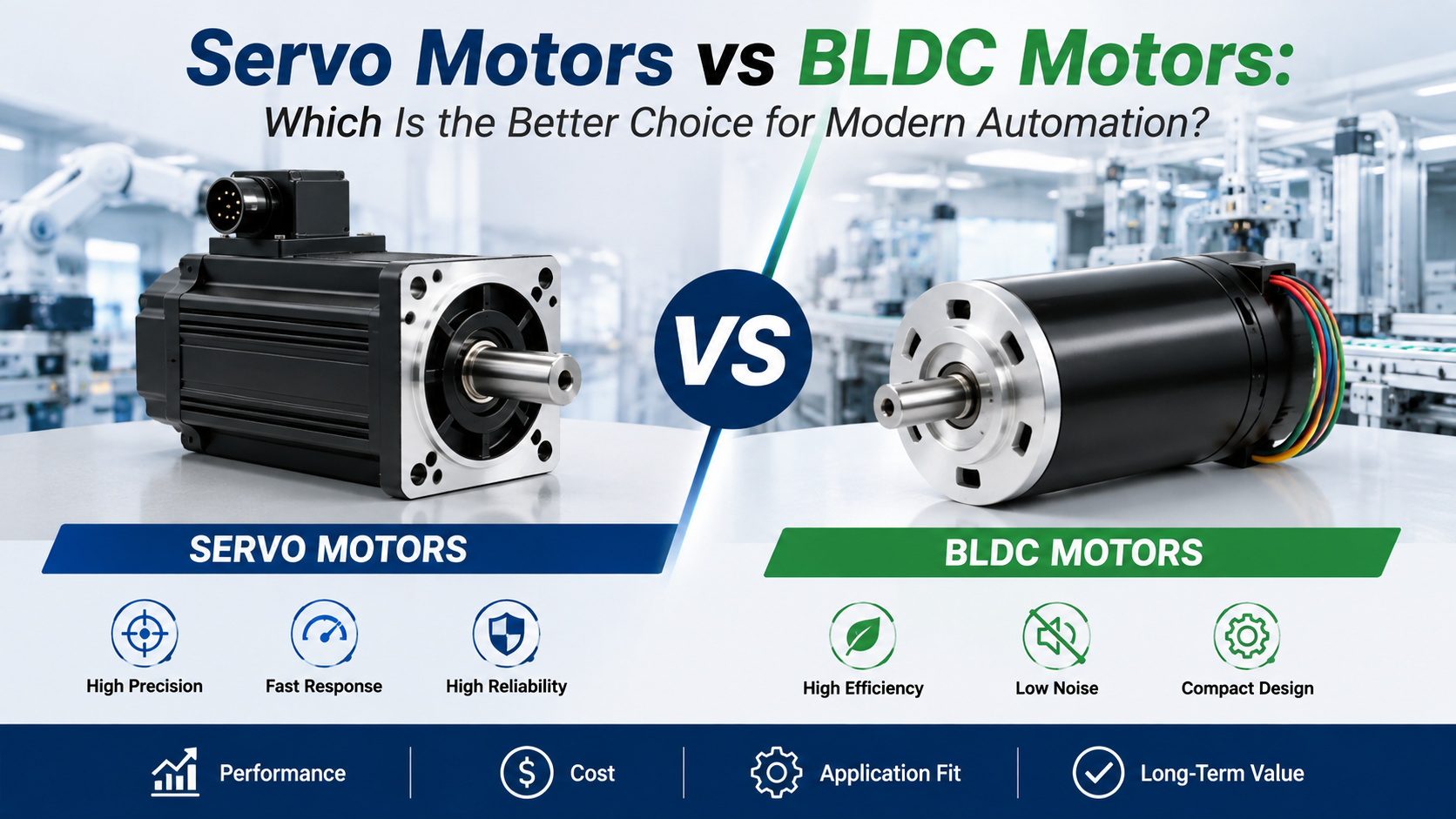
BLDC Motors are generally a better choice for efficient continuous rotation, compact designs, lower system cost, and applications that do not require extremely precise positioning. Servo motors are better for automation systems requiring accurate position control, high repeatability, fast acceleration, and closed-loop feedback.
The key difference is that BLDC describes a motor technology, while servo describes a motion-control system. A servo motor is commonly a brushless permanent-magnet motor combined with an encoder, servo drive, and closed-loop controller.
Therefore, the right choice depends more on the required control accuracy and motion profile than on the motor name alone.
BLDC Motors vs Servo Motors: Key Differences
| Parameter | BLDC Motor | Servo Motor |
| Feedback | Optional | Normally required |
| Position control | Basic to moderate | High precision |
| Speed control | Good | Excellent |
| Torque control | Good | Excellent |
| Dynamic response | Good | Very high |
| System complexity | Low–medium | Medium–high |
| Cost | Generally lower | Generally higher |
| Typical applications | Fans, pumps, AGVs, conveyors | Robotics, CNC, packaging |
| Best suited for | Continuous rotation | Precision motion |
A conventional BLDC motor can use Hall sensors, while sensorless BLDC systems can estimate rotor position from back-EMF. More advanced BLDC systems can also use Field-Oriented Control (FOC) to achieve smoother torque and better speed regulation. Microchip’s BLDC documentation describes FOC as a method for independently controlling motor torque and flux, making it suitable for more demanding motor-control applications. (Microchip Technology, 2021).
A servo system normally uses an encoder or resolver to continuously compare commanded and actual motor position or speed, allowing the controller to correct errors caused by changing loads or disturbances. (OMRON Industrial Automation, technical guide).
When Should You Choose BLDC Motors?
BLDC Motors are particularly suitable when the primary requirements are efficiency, reliability, compact size, and continuous rotation rather than extremely precise positioning.
Typical applications include:
- AGV and AMR drive systems
- Fans and blowers
- Pumps
- Electric lawn equipment
- Conveyors
- Medical equipment
- Small automation systems
- Battery-powered equipment
For example, if a conveyor only needs to maintain a target speed and does not need micron-level positioning, a BLDC motor can provide a simpler and more economical solution than a complete servo system.
Advantages of BLDC Motors
1. Long operating life
Because BLDC Motors do not use mechanical brushes, they avoid brush wear and mechanical commutator maintenance.
2. High efficiency
Permanent-magnet excitation eliminates rotor copper losses found in conventional induction motors, although actual system efficiency still depends on operating speed, load, controller losses, and motor design.
3. Compact design
The high power density of permanent-magnet motors makes BLDC Motors attractive for space-constrained equipment.
4. Lower system complexity
For applications requiring only speed or basic torque control, a BLDC motor with a suitable controller can be considerably simpler than a complete servo architecture.
When Should You Choose a Servo Motor?
A servo motor becomes the better option when position accuracy, repeatability, dynamic response, and closed-loop control are critical.
Typical applications include:
- Industrial robots
- CNC machines
- Pick-and-place systems
- Packaging machinery
- Semiconductor equipment
- Precision actuators
- Multi-axis automation
For example, a robotic joint may need to move from 30° to 120° and stop repeatedly at the commanded position while the external load changes. A servo system can continuously monitor the actual position through an encoder and adjust motor current to compensate for the error.
Why Servo Motors Are Better for Precision?
A typical servo system contains:
Motor → Encoder → Servo Drive → Motion Controller
The encoder provides feedback, while the drive controls current, speed, and position.
Modern industrial servo systems can use high-resolution feedback devices; for example, some commercial servo platforms use 23-bit encoders, providing very fine position feedback. However, encoder resolution does not automatically equal machine accuracy because mechanical backlash, coupling flexibility, gearbox clearance, vibration, and structural stiffness also affect final positioning performance.
How to Select the Right Motor?
Engineers should evaluate the complete motion profile rather than selecting a motor only from its rated power.
Step 1: Determine the required motion
Ask whether the application requires:
- Continuous rotation
- Variable speed
- Precise positioning
- Rapid acceleration
- Frequent reversingMulti-axis synchronization
If precise positioning is fundamental, a servo architecture is usually the safer choice.
Step 2: Calculate torque
A simplified relationship is:
T = J × α + Tload + Tfriction
where J is reflected inertia and α is angular acceleration.
The selected motor must satisfy both continuous and peak torque requirements.
Step 3: Check speed and power
Mechanical power can be estimated using:
P = T × ω
The motor should be evaluated across the complete operating range rather than at only one rated point.
Step 4: Determine feedback requirements
If the system only needs speed regulation, BLDC control may be sufficient.
If the system must continuously correct position or synchronize motion, servo feedback is normally preferred.
Common Engineering Mistakes
| Problem | Possible Cause | Recommended Action |
| BLDC vibration at low speed | Poor commutation | Check Hall alignment or use FOC |
| BLDC overheating | Excessive continuous load | Check RMS torque and thermal limits |
| BLDC startup failure | Sensorless control limitation | Use Hall sensors or improve startup algorithm |
| Servo oscillation | Incorrect tuning | Adjust position/speed loop gains |
| Poor positioning accuracy | Mechanical backlash | Check gearbox, coupling, and transmission |
| Slow servo response | Excessive inertia | Check inertia ratio and servo tuning |
One of the most common mistakes is selecting a motor only according to rated power. A 1 kW motor may be suitable for one machine but unsuitable for another because acceleration torque, inertia, duty cycle, speed range, thermal conditions, and feedback requirements are different.
BLDC Motors or Servo Motors: Which Is Better?
Choose BLDC Motors when you need efficient continuous rotation, compact dimensions, long service life, variable-speed operation, and a cost-effective control system.
Choose servo motors when you need precise positioning, high repeatability, rapid acceleration and deceleration, accurate speed regulation, or multi-axis synchronization.
For modern automation, the most important engineering principle is:
Choose the control architecture based on the required motion accuracy, dynamic response, load profile, and total system cost—not simply the motor type.
UNITED MOTION INC. provides customized BLDC motor and servo motor solutions for OEM automation equipment, including motor sizing, feedback configuration, gearbox integration, voltage customization, and application-specific engineering support.
FAQ
Are BLDC Motors and servo motors the same?
No. BLDC refers to a brushless permanent-magnet motor technology, while a servo motor is normally part of a closed-loop motion-control system.
Can a BLDC motor be used as a servo motor?
Yes. A BLDC motor can become part of a servo system when combined with an encoder, servo drive, and appropriate closed-loop control.
Which is better for robotics?
Servo motors are generally preferred for robotic joints requiring precise position and torque control, while BLDC Motors are widely suitable for robotic wheels and continuous-rotation applications.
Which motor is more cost-effective?
BLDC Motors are generally more economical when precise closed-loop positioning is unnecessary. Servo systems can justify their higher cost when precision and dynamic response are critical.
Can BLDC Motors use FOC?
Yes. FOC can provide smoother torque production, improved speed regulation, and more precise current control than basic six-step commutation.
Related blog: Servo Motor vs BLDC Motor for Barrier Gate Applications